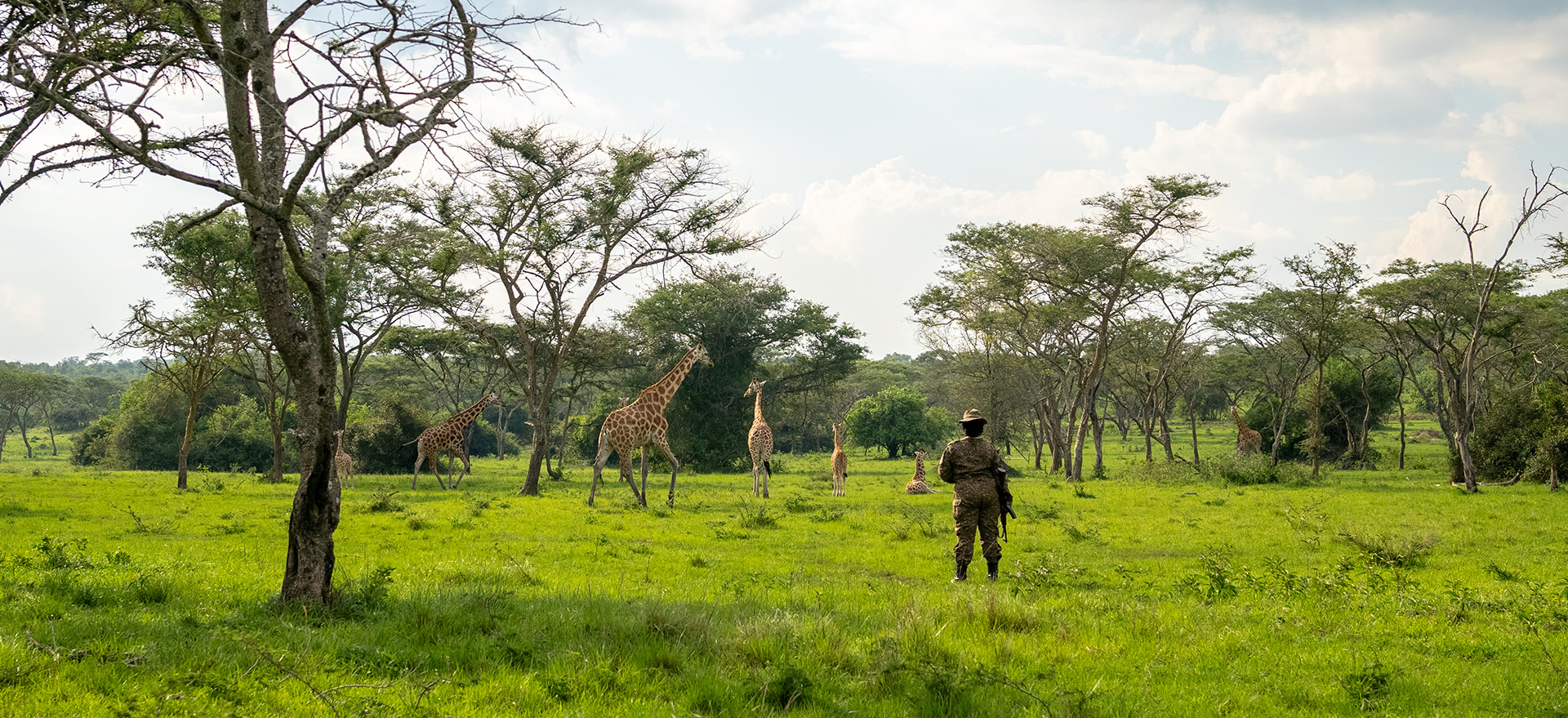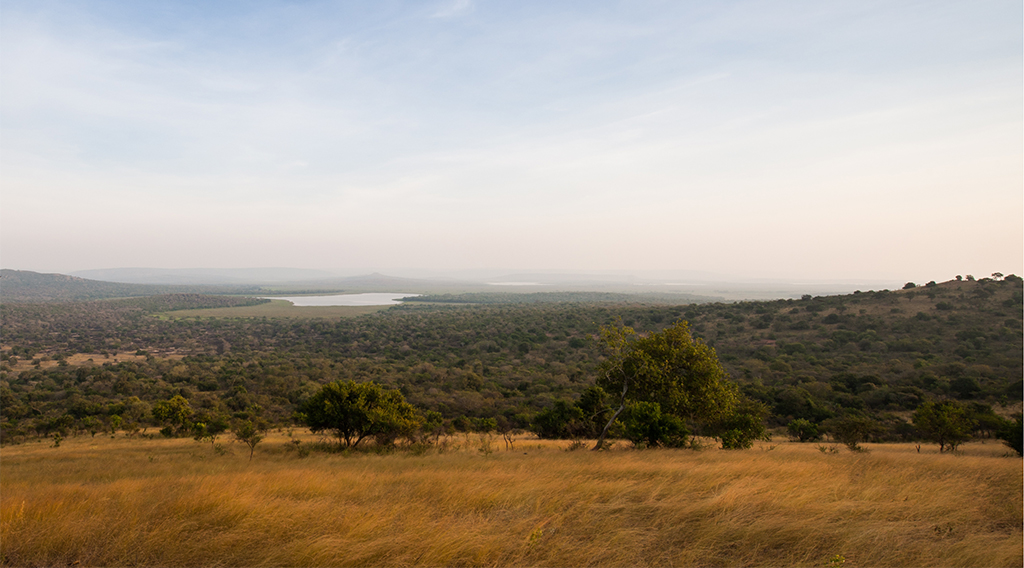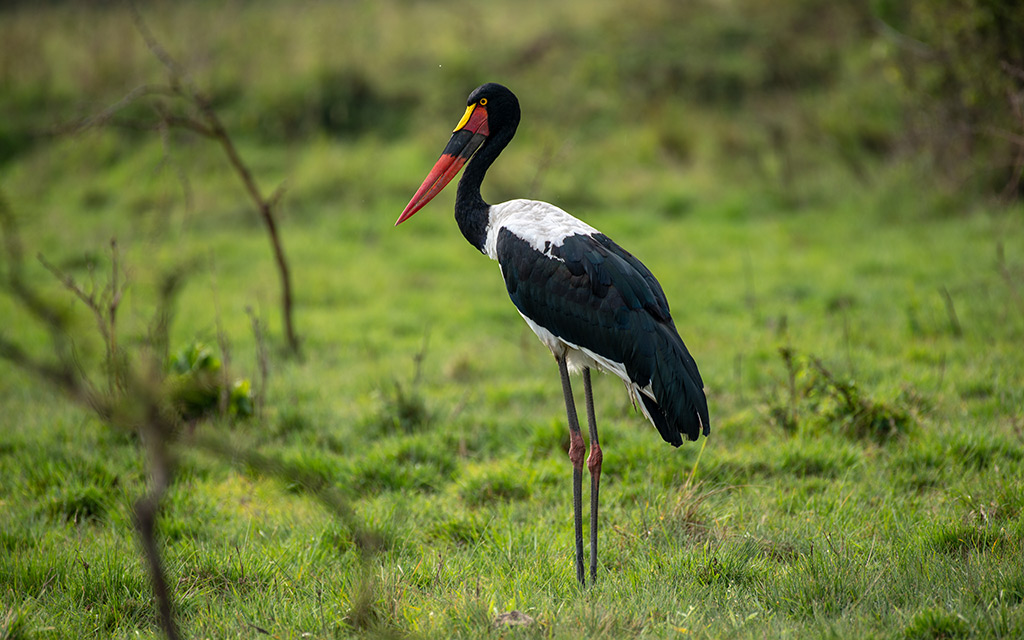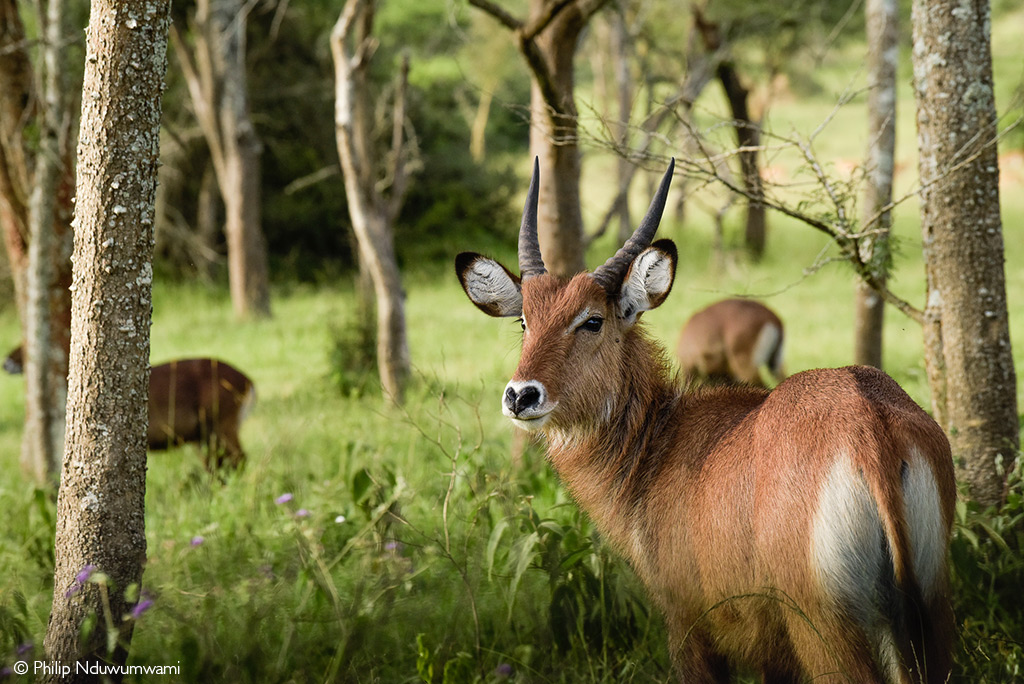


Speak with a safari expert

phone icon

Guest reviews

5 star icon
Safari experts & storytellers. Since 1991
Book a call with a safari expert Book a call
Guest reviews Client reviews
×
SEARCH OUR STORIES
SEARCH OUR SAFARIS

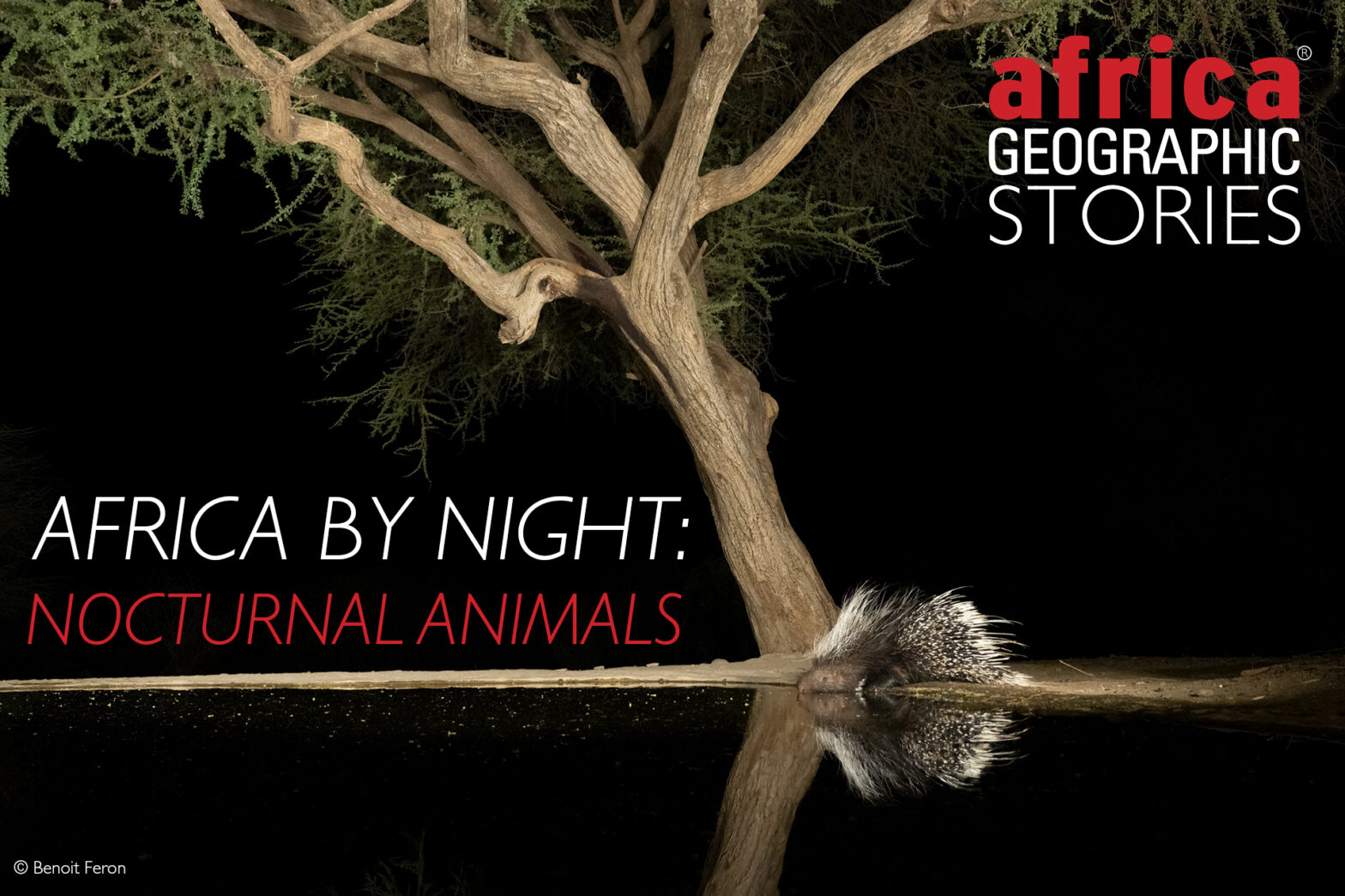
Africa by night – 12 nocturnal animals and where to find them

  • Africa’s nocturnal wildlife is challenging to find, but are all the more rewarding for their rarity.
  • Rare night sightings of elusive species reward patience.
  • Arid winter landscapes improve chances of nocturnal encounters.
  • Many species specialise in termites, ants, or insect diets.
  • Night drives reveal diverse mammals across savannas and forests.


Want to join us in an exploration of the African night? Check out these African safaris offering ample experiences of nocturnal and diurnal animals.


As the sun dips below the horizon and most safari guests start to think longingly of the five-course dinner awaiting them at the lodge, the nocturnal animals of the African night begin to stir. Noses twitch, pupils dilate, and limbs stretch out in preparation for the long, dark hours ahead.

They may be challenging to find, but Africa’s nocturnal animals are all the more rewarding for their rarity. Feast your eyes on our list of favourite lucifugous beasties and some advice on where to start the searc

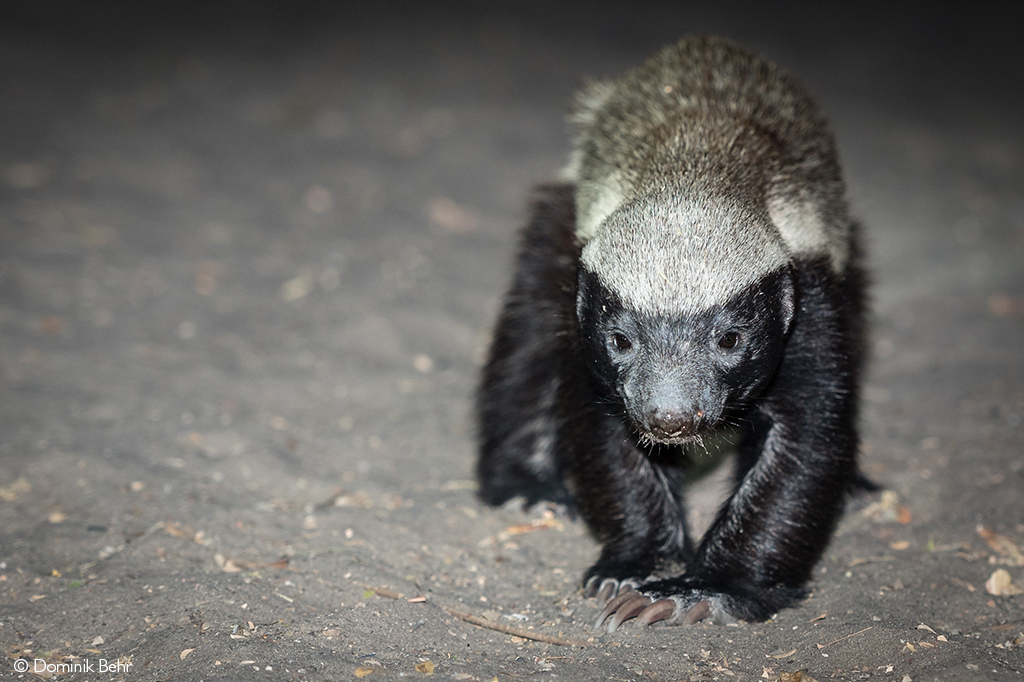
Honey badger

Few things in life genuinely live up to their reputation, but the honey badger certainly does. Known for their tenacity and toughness, they pack a punch that belies their small size when threatened but are otherwise largely content to simply go about their business.

Where to start? Honey badgers are predominantly nocturnal animals but are often active during the cooler winter days. Though they thrive in many habitats, arid regions like the Central Kalahari Game Reserve in Botswana offer a good chance to spot one due to the sparse vegetation (and their bolshie tendency to visit the campsites). To plan your next Botswana safari, click here.

Nocturnal animals
A honey badger seen in camp in the Okavango Delta

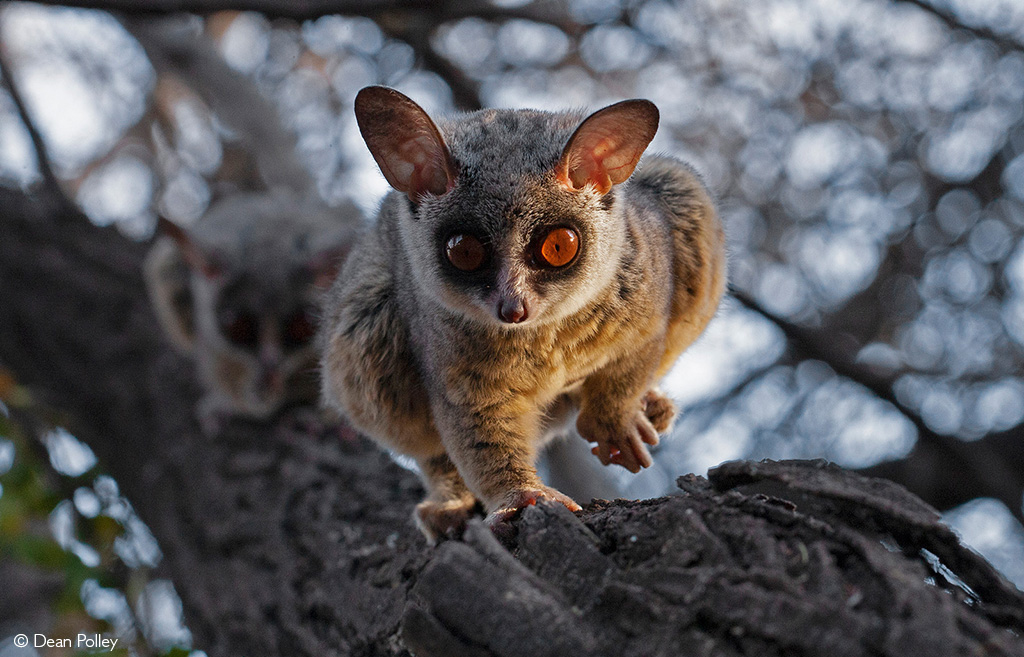
Bush baby

Bush babies (or galagos as they are more formally known) are a group of nocturnal primates found throughout sub-Saharan Africa. The continent’s myriad species come in many shapes and sizes, some utterly adorable. This is especially true of the tiny lesser Galagos, with their enormous bat-like ears and wide, surprised eyes.

Where to start? Almost anywhere on safari! Grab a spotlight or a flashlight and keep an eye out for quick reflection of their eye-shine as they leap from tree to tree. But be ready – these nocturnal animals can move fast! To browse our best African safaris on offer, click here.

Nocturnal animals
The bright-eyed lesser bushbaby
Africa Geographic Travel

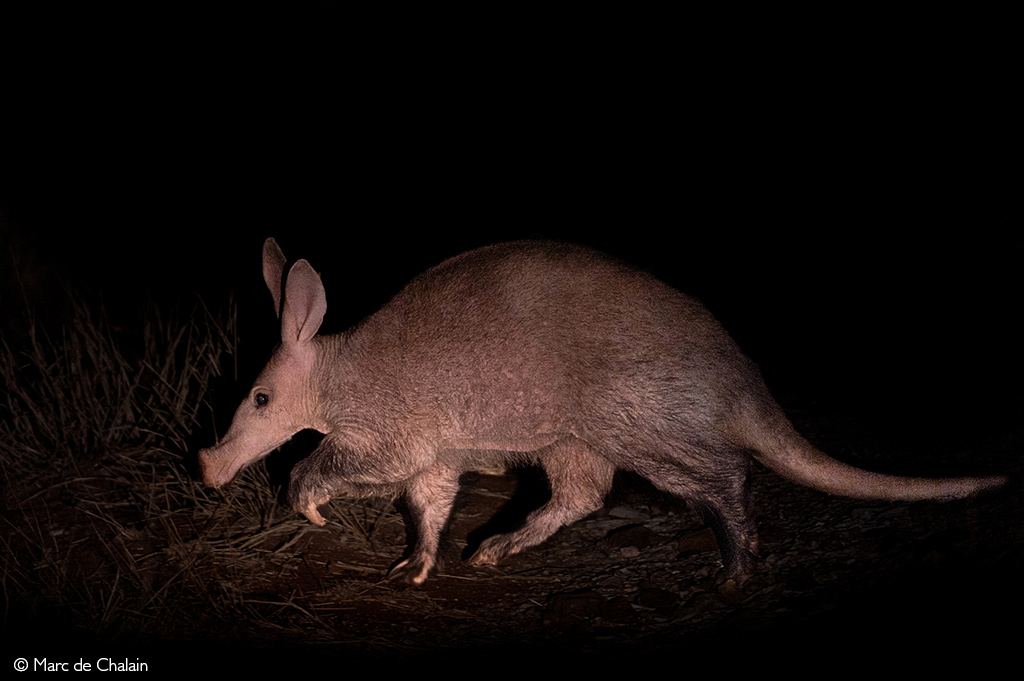
Aardvark

Nocturnal animals
An aardvark slinks into the night in Kimberley, South Africa

The unique aardvark, with its ginormous rabbit ears and pig-like snout, is one of Africa’s weirdest and more wonderful offerings. Aardvarks have poor eyesight and can be hyper-focused on their termite prey while foraging. As a result, a careful and considered approach may be rewarded with a lengthy and very special sighting.

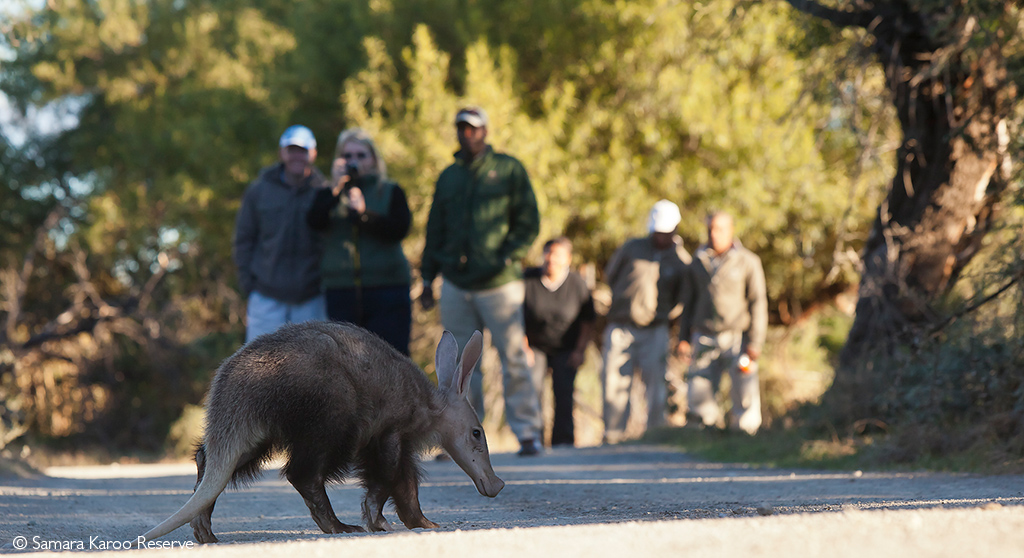
Where to start? Aardvarks are generally shy animals, but, like many of the nocturnal animals on this list, cold winter temperatures usually force them to search for food before dusk. The Karoo region in South Africa is home to (relatively) high densities of aardvark. Samara Karoo Reserve is a fantastic place to look for aardvarks thanks to its vast, rewilded Great Karoo landscapes, where this elusive nocturnal species thrives alongside an impressive diversity of wildlife.

Samara
Aardvark trekking in Samara Karoo Reserve

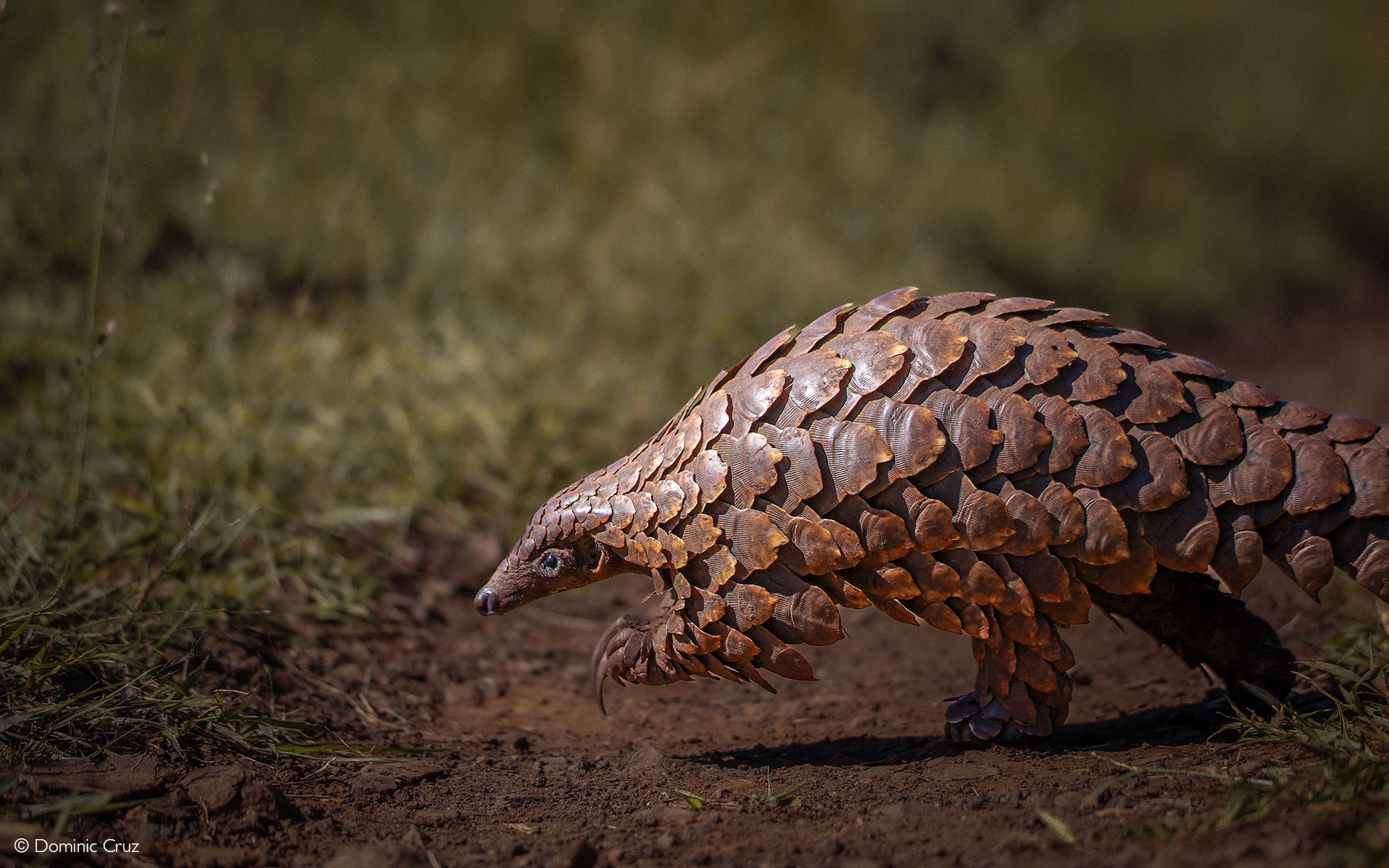
Pangolin

For an animal that looks somewhat like an anxious walking artichoke, the pangolin must be one of the most charming little characters roaming the continent. These inoffensive eccentrics are covered in a layer of keratin scales and sport powerful claws and a long sticky tongue for lapping up termites and ants.

Where to start? During the winter months in the arid areas of southern Africa, ground pangolins often emerge before dusk to begin their myrmecophagous hunt. Guests at Tswalu Kalahari Reserve in South Africa tend to have excellent pangolin luck. Visitors to Gorongosa can also walk with pangolins as the forage on this unique safari.

Nocturnal animals
A Temminck’s (ground) pangolin spotted in Manyoni Private Game Reserve, South Africa

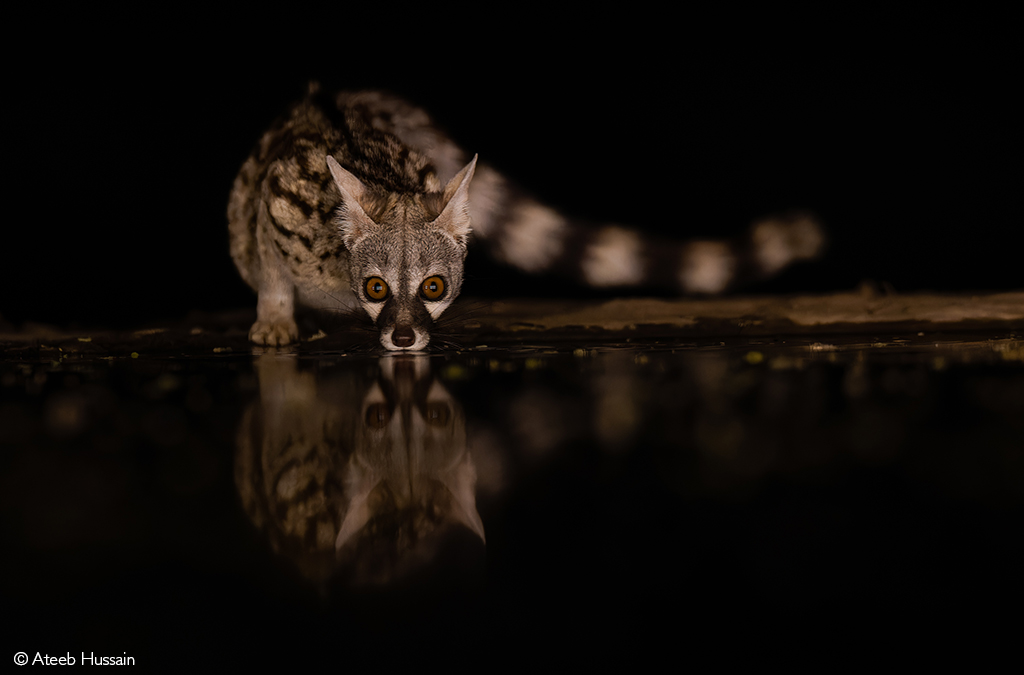
Genet

With needle-sharp teeth and a ferocious pounce, the lithe genets of Africa spend their evenings terrorising the tiny mammals, birds, and reptiles of the forests, savannas, and grasslands. These little predators are the epitome of grace and agility, seemingly flowing over obstacles, up trees and through the undergrowth.

Where to start? Genets are found throughout much of sub-Saharan Africa, though extended sightings are rare outside of a lodge context (where they have learned to associate people with food). There have been reports of melanistic genets wandering the plains of the Maasai Mara. To plan your Maasai Mara safari, click here.

Nocturnal animals
Witnessing the agility and elegance of genets in the wild is a treat

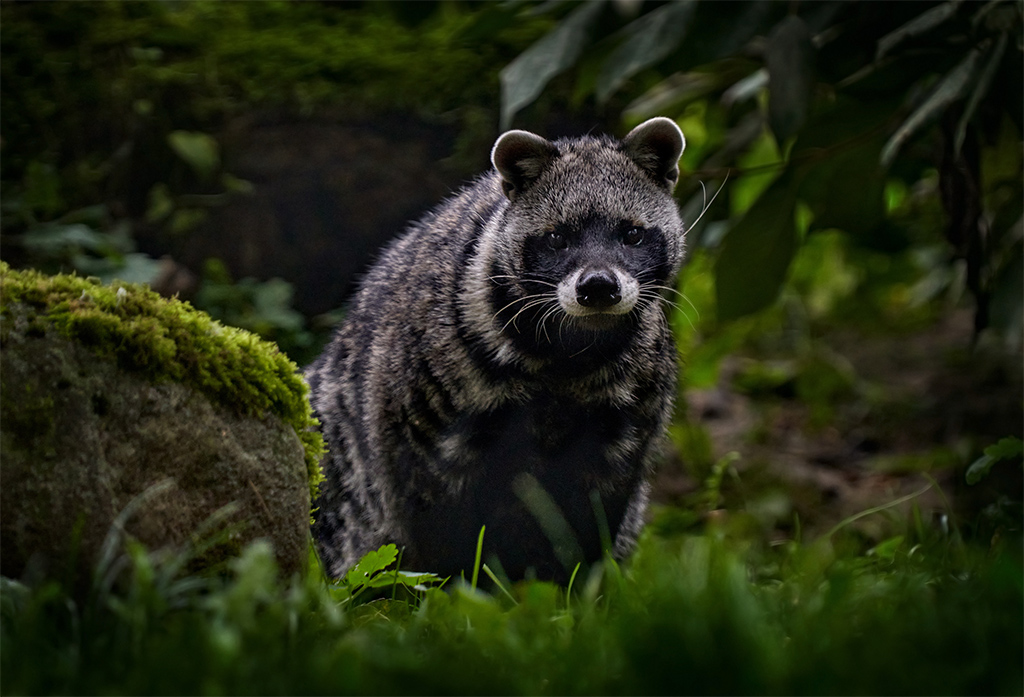
Civet

The African civet, with its masquerade facial markings, makes many people think of a raccoon, though the two species are unrelated. They are widely distributed throughout Africa’s savannah and forest habitats, but the civet’s nocturnal and elusive habits make encountering one in the wild a rare treat.

Where to start? Civets are creatures of habit, generally walking the same well-trodden paths night after night. There are several lodges in the Greater Kruger with “resident” civets that pass through during the hours of darkness. To plan your Greater Kruger safari, click here.

African civets are very elusive and difficult to spot
Africa Geographic Travel

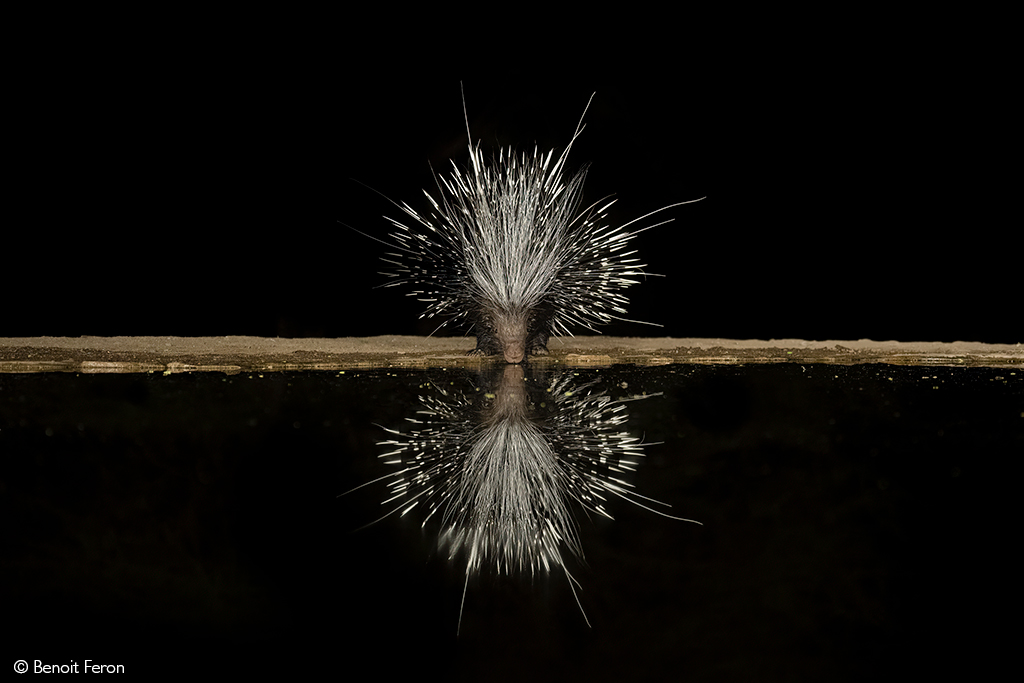
Cape porcupine

These prickly customers are the largest rodents in Africa – stocky, robust animals with short limbs and a protective quiver of barbed quills. Porcupines are decidedly family-oriented despite their somewhat antisocial appearance. It is not uncommon to encounter a family unit consisting of a monogamous male and female and their latest porcupette foraging together.

Where to start? Cape porcupines are widely distributed throughout most of sub-Saharan Africa, and the chances of encountering one on a night drive are roughly the same in many of the more popular safari destinations. Arid areas like the Kalahari and Namibia may offer the best opportunity to spot one because the vegetation cover is less dense.

A Cape porcupine enjoys a quiet drink in the dead of night


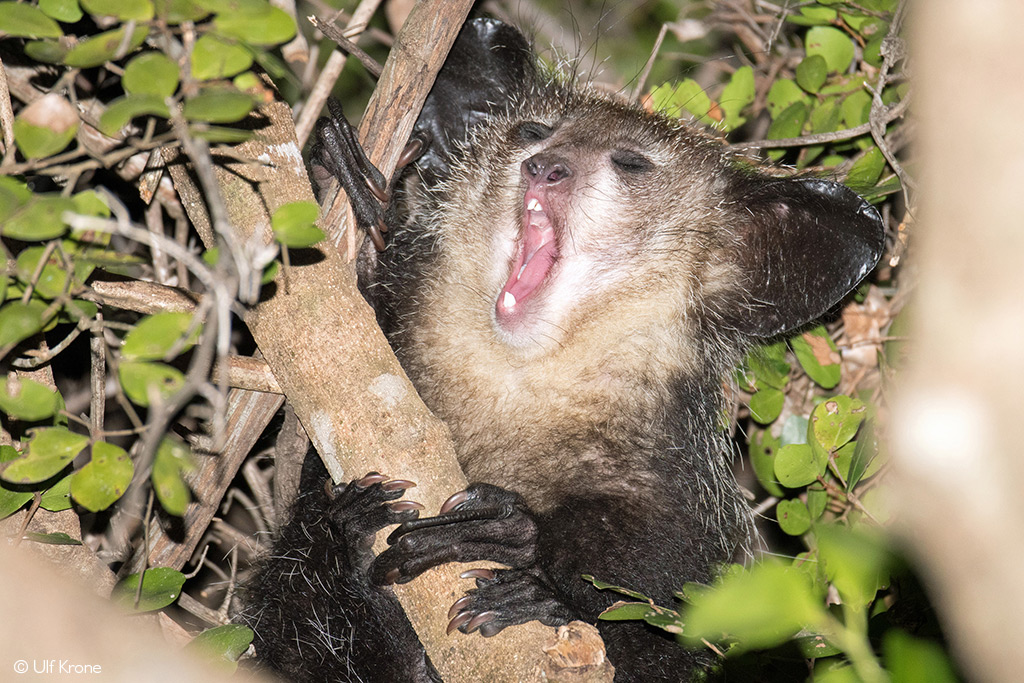
Aye-aye

Of the 12 fascinating animals on this list, Madagascar’s aye-aye is perhaps the most fantastical and outlandish. The world’s largest nocturnal primate is technically a lemur but sports several unusual anatomical adaptations that set it apart, including constantly growing incisors and a sixth digit (a “pseudo thumb”) on the front paws. The long, thin third finger is used woodpecker-like to tap on bark to locate insects and then fish the grubs out of their hiding places.

Where to start? The dense forests of Nosy Mangabe off the coast of eastern Madagascar offer some of the most reliable sightings of these endangered lemurs. They were introduced to the island during the 1960s as a conservation initiative and have flourished ever since.

A female aye-aye spotted in Loky-Manambato, Madagascar

Springhare

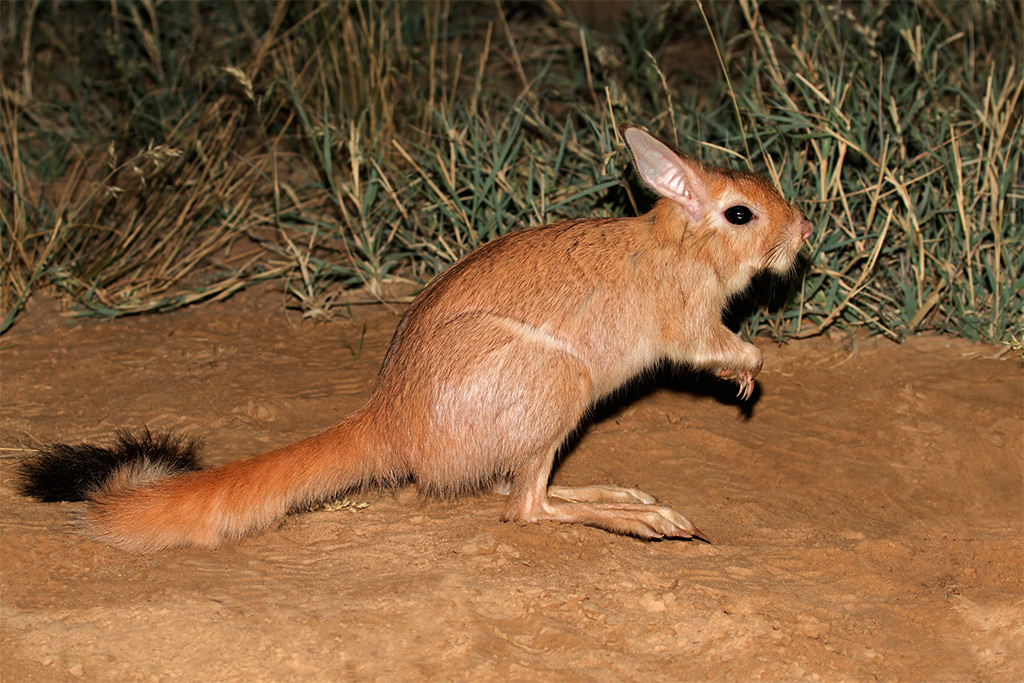
The bouncy springhare is Africa’s answer to the kangaroo, albeit in miniature form. At night, these spring-loaded rodents emerge from their underground burrows to forage, using their long tails to balance as they hop around searching for juicy roots and stems.

Where to start? Springhares thrive in the semi-arid regions of southern Africa, so a night drive in Madikwe Game Reserve in South Africa or the Tuli Block in Botswana may well reveal a glimpse of a lively springhare (or ten). To find out more about Madikwe and to browse safaris to Madikwe, click here.

The cartoon-like springhare

Aardwolf

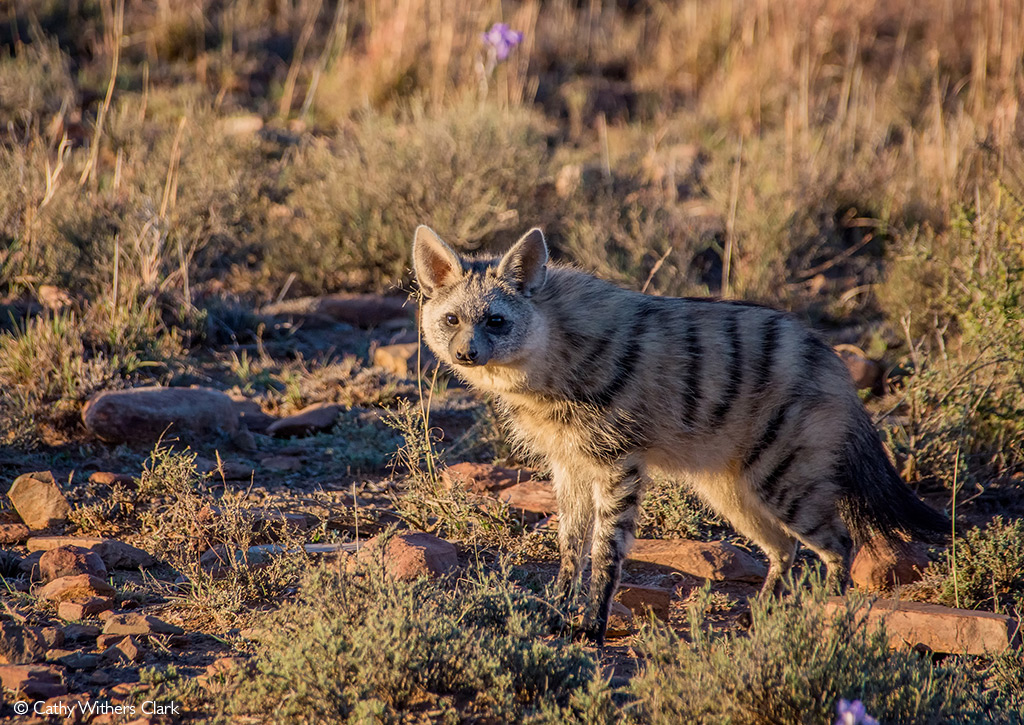
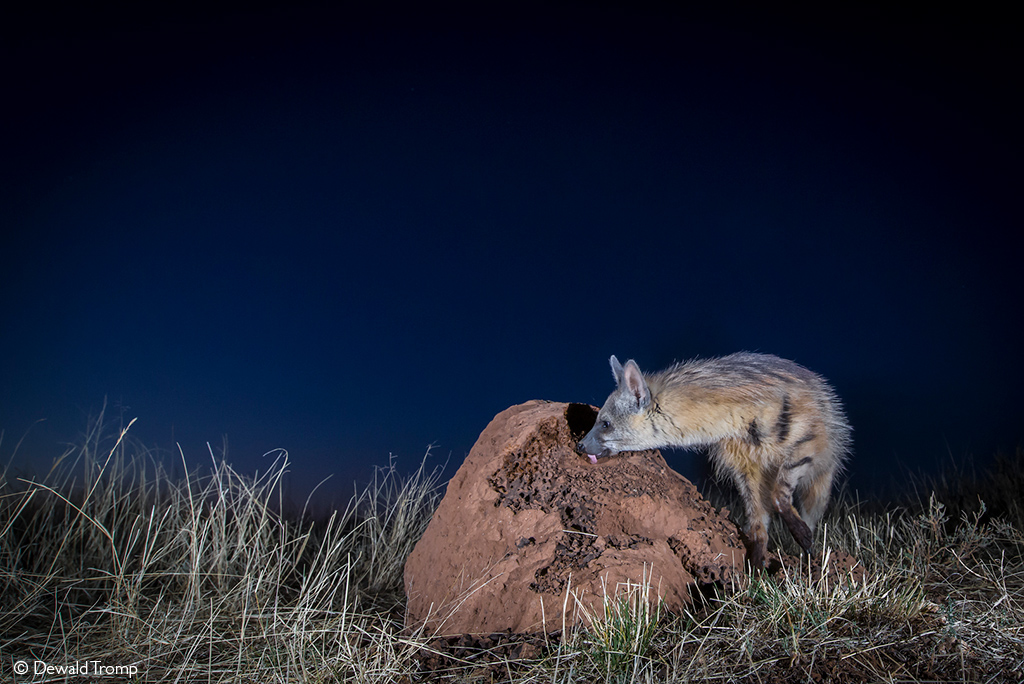
The shy and elusive aardwolf is perhaps one of the continent’s most underappreciated animals. These unique animals belong to the hyena family but are entirely myrmecophagous (they only eat termites and ants). They are also probably the most winsome of all the hyena species, with dramatically striped coats, delicate facial features, and oversized ears.

Where to start? There are two distinct populations of aardwolf in Africa, one in southern Africa and the other in East Africa. The best chance of finding one in southern Africa would be through exploring the vast Kalahari Basin, perhaps in Kgalagadi National Park in South Africa or Botswana’s salt pans. To find out more about safaris in the salt pans, click here.

An aardwolf foraging in the Karoo
Africa Geographic Travel

Bushpig

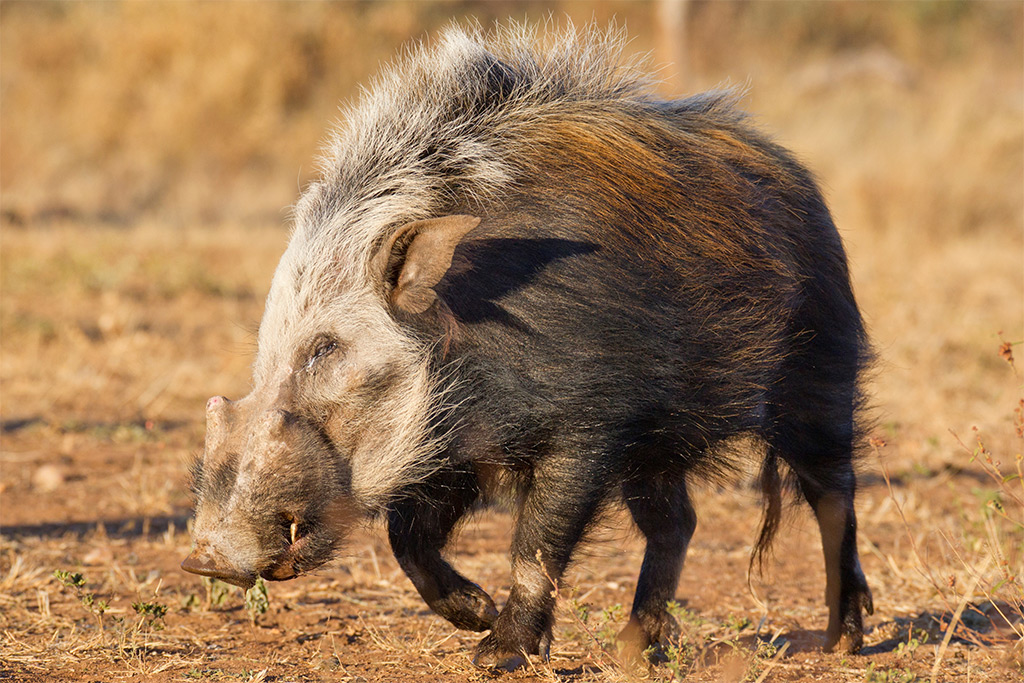
It seems astonishing that such a large animal might so easily evade visitors, yet few safari-goers ever glimpse the stocky, shaggy bushpig in the wild. Though often described as “dangerous” and “aggressive”, these porcine omnivores are wary and circumspect and generally avoid humans (unlike their brash and fearless cousins, the warthog).

Where to start? Bushpigs are adaptable animals found across a wide range of habitats. However, there are few areas where they are sufficiently habituated to people to make for reliable sightings. Some campsites in Marakele National Park are known for visits from marauding bushpigs, though they should be treated with absolute respect and given plenty of space.

The stocky and adaptable bushpig

Bat-eared fox

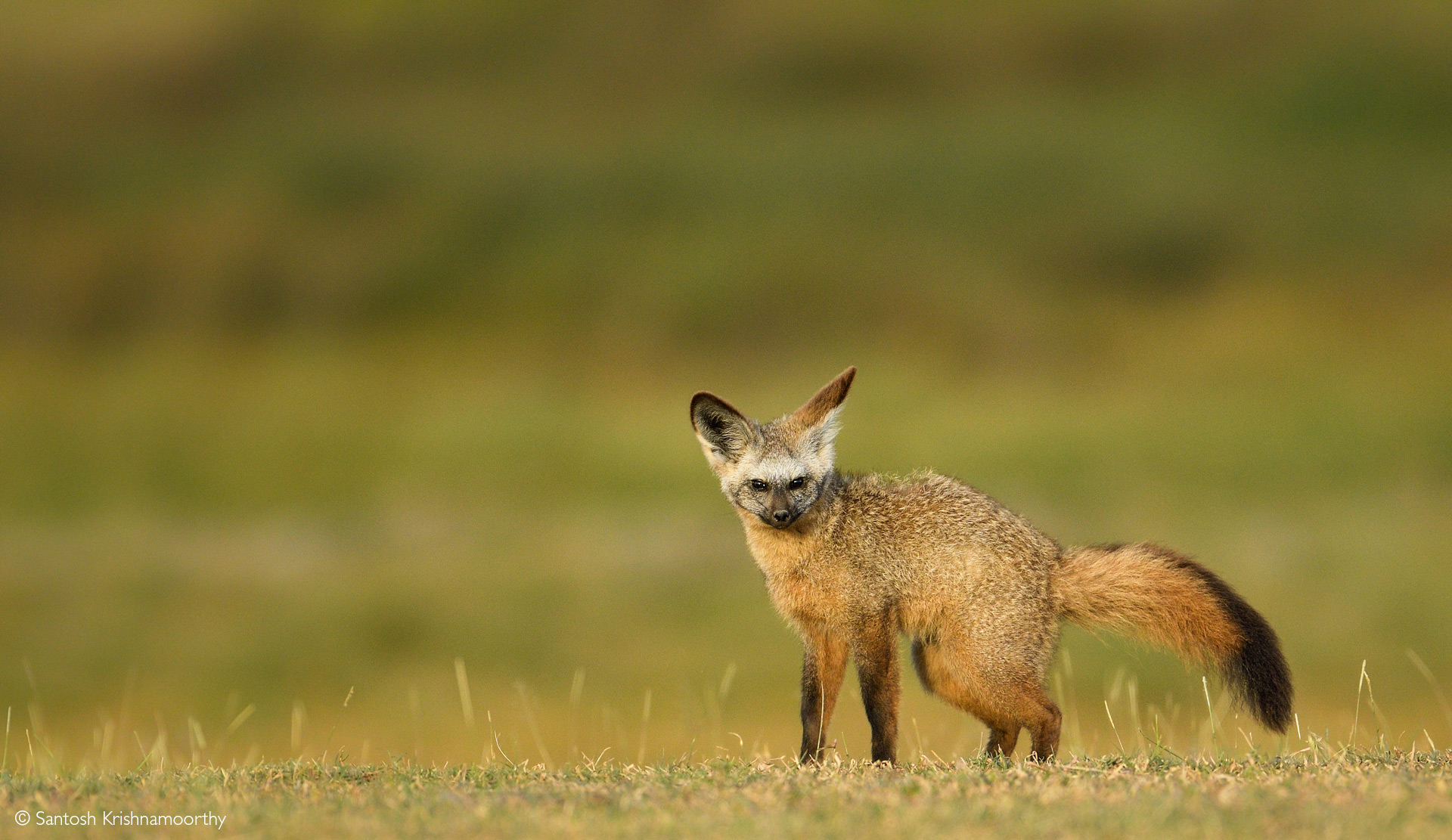
As the name implies, bat-eared foxes are defined by their enormous ears, reaching almost a third of their total body length. They are the only insectivorous canid species in the world, with a unique dental arrangement designed to suit their unusual diets. They generally forage in small families and are endlessly entertaining, with oddly sardonic expressions beneath their ridiculously oversized ears.

Where to start? Visitors to Marakele National Park in the heart of South Africa’s Waterberg Mountains and Nossob Camp in the Kgalagadi National Park regularly enjoy delightful bat-eared fox sightings. They are also regularly encountered in parts of the Serengeti National Park in Tanzania and the neighbouring Maasai Mara National Reserve. To plan your Serengeti safari, click here.

A bat-eared fox in Ndutu, Tanzania

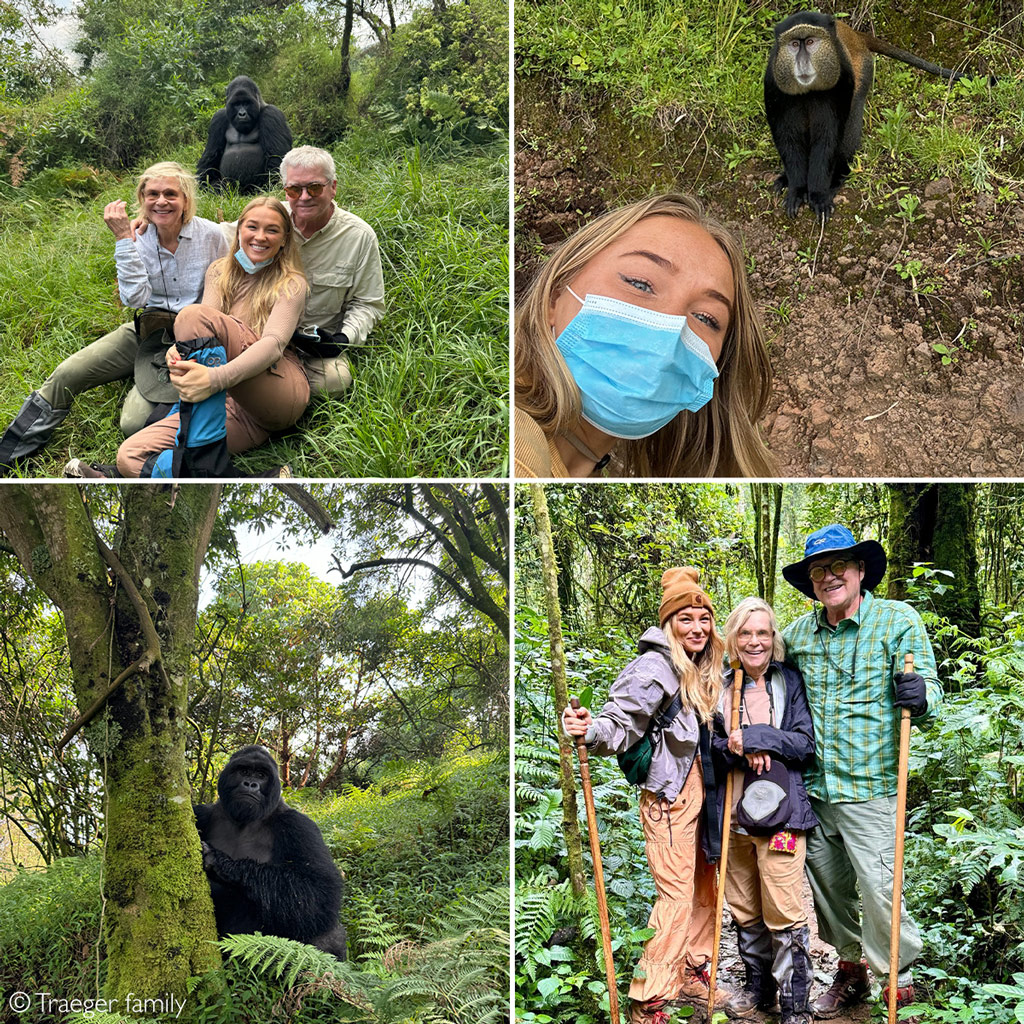
Gorilla trekking in Mgahinga Gorilla National Park

In a dense corner of Africa, in a land dotted with the dramatic, forested figures of ancient volcanoes, a trio of countries protects just over half of the world’s remaining mountain gorillas. Destinations like Virunga and Volcanoes National Parks have become synonymous with mountain gorilla trekking and conservation, but there is a third national park, so often forgotten, that forms the final corner of the triangle. Uganda’s Mgahinga Gorilla National Park is a small park that packs an astonishing biodiversity punch and offers some of Africa’s most exclusive gorilla trekking.

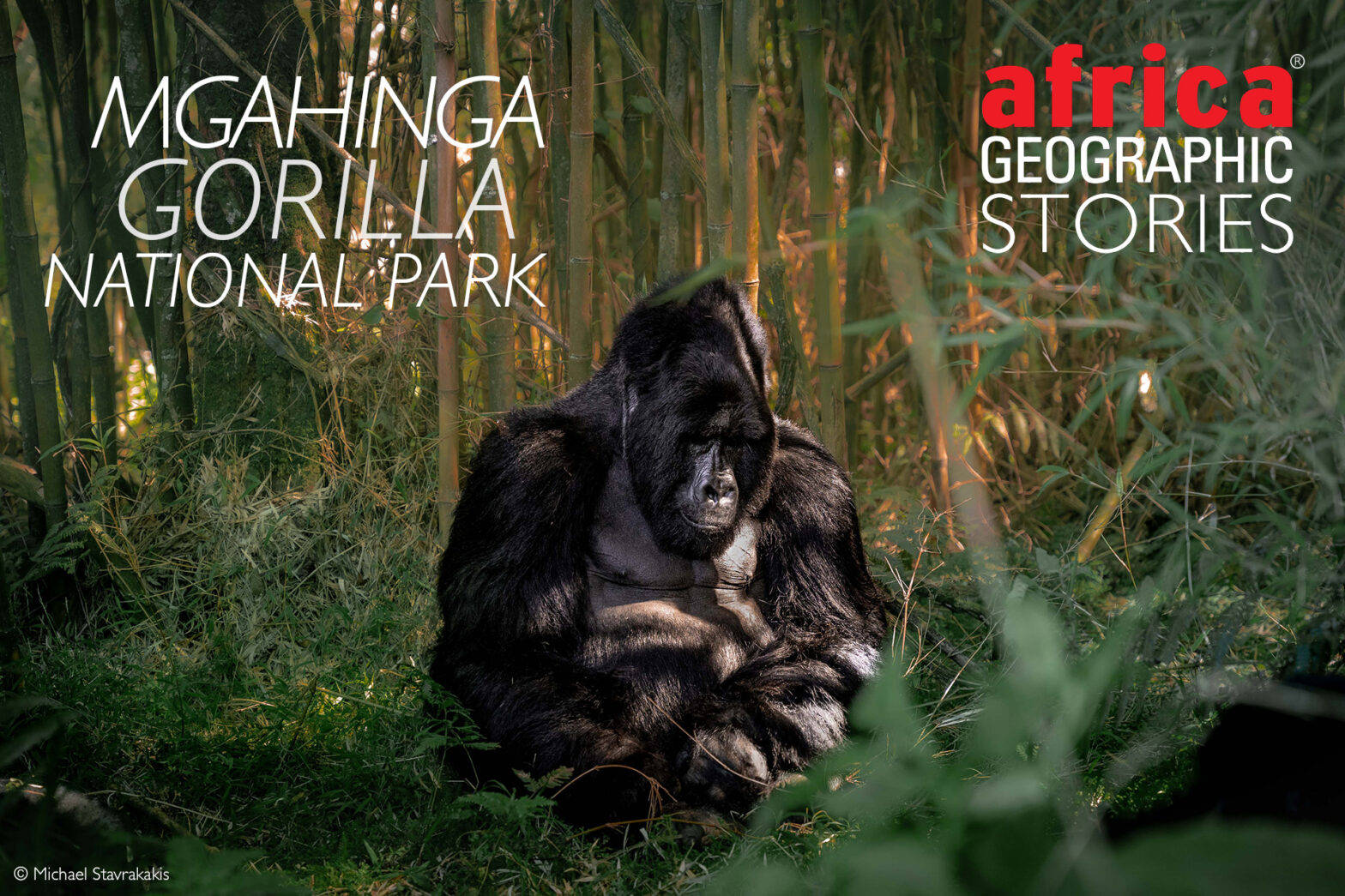
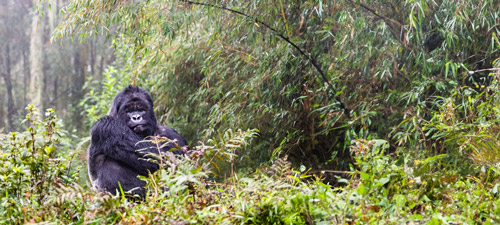
*Cover image: Mark, the 40-year-old leader of the Nyakagezi gorilla family, enjoys some alone time in the dense bamboo forest of Mgahinga. For more images from Michael Stavrakakis, check out @pics.stavtook on Instagram.

Mgahinga Gorilla National Park

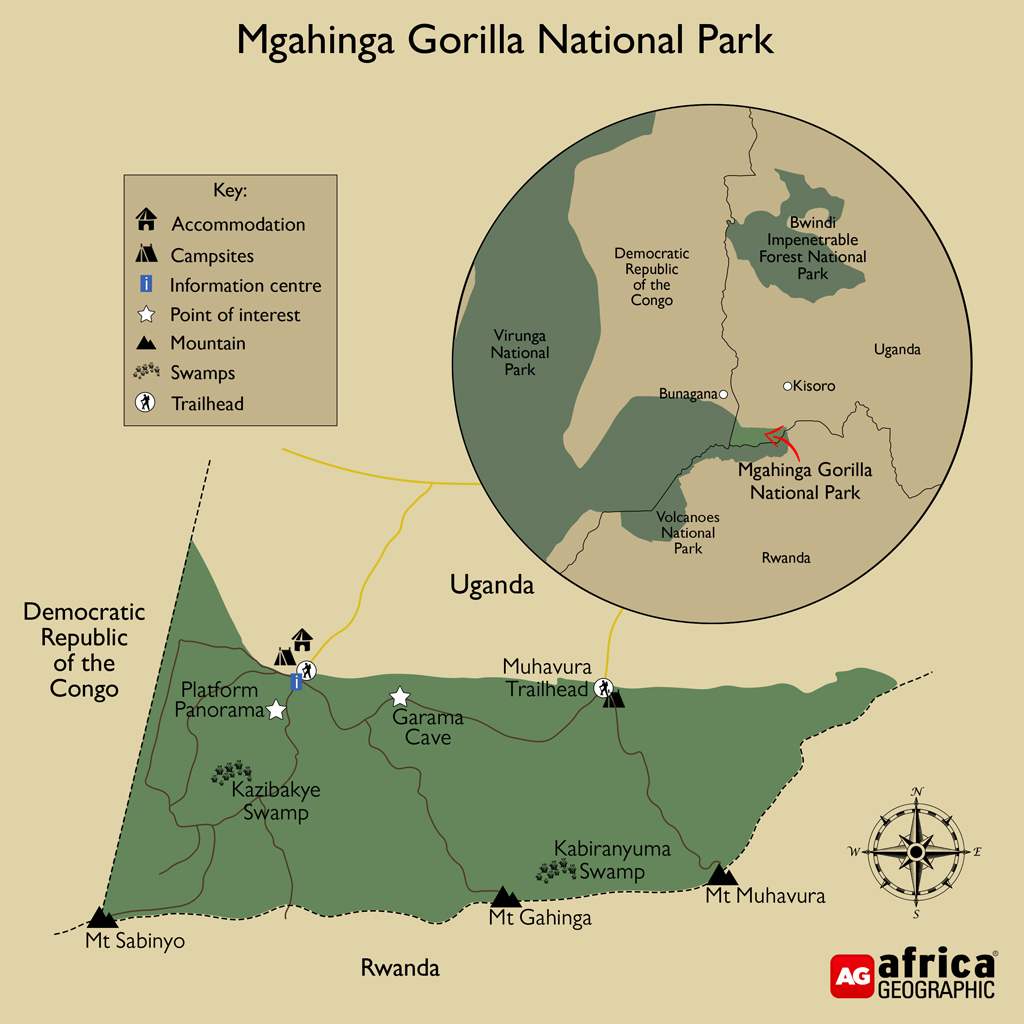
At just 34 km2 (3,400 hectares), Mgahinga Gorilla National Park is Uganda’s smallest national park, tucked away in the country’s southwestern corner. With Rwanda’s Volcanoes National Park to the north and Virunga National Park in the Democratic Republic of Congo to the west, Mgahinga completes the trifecta of parks protecting the Greater Virunga Ecosystem. Shaped by ancient (and relatively modern) volcanic forces, this primaeval landscape is known for its phenomenal scenic beauty and extraordinary biodiversity. It also protects just over half of the world’s remaining mountain gorillas.

Mgahinga
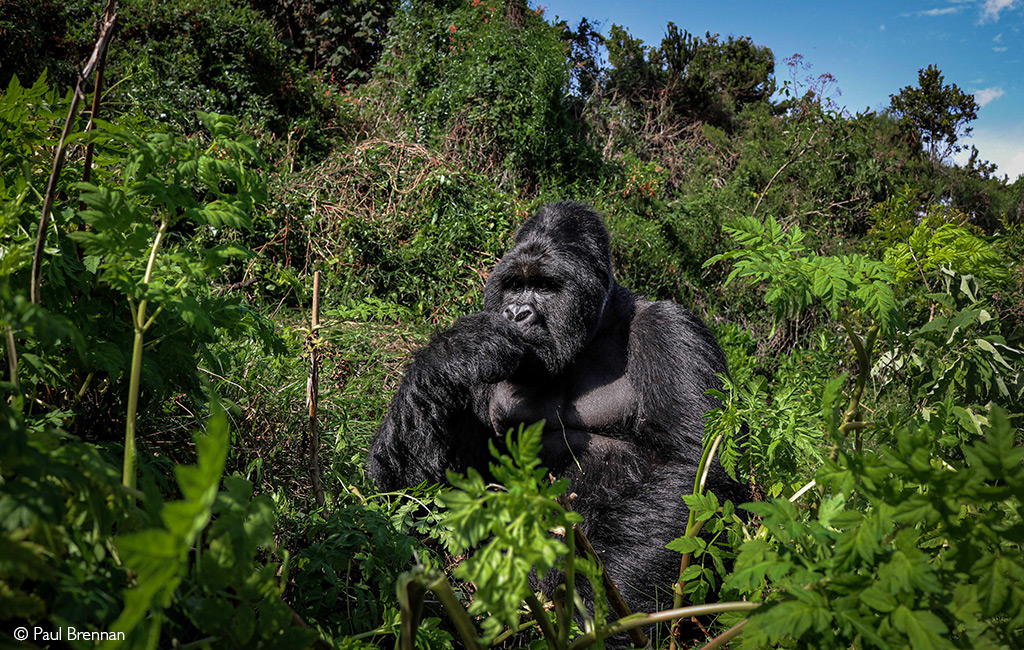
A mountain gorilla enjoys the morning sun on the slopes

The region’s topography is dominated by the looming forms of the eight Virunga volcanoes, of which three extend into Mgahinga Gorilla National Park: Muhavura (4,127 m), Gahinga (3,474 m), and Sabinyo (3,645 m). Unlike the two active volcanoes in neighbouring DRC, these peaks no longer explode at unpredictable intervals. Instead, their forested slopes support a plethora of life, from the celebrated mountain gorillas and coiffured golden monkeys to slinking leopards and an array of endemic birdlife.


Want to plan your African safari to meet the gorillas and golden monkeys of Mgahinga? We have ready-made safaris to choose from, or we can build one just for you.


The dramatic changes in altitude also ensure that, despite Mgahinga’s relatively small size, the park is a mosaic of diverse habitats. Steaming swamps give way to the verdant green of bamboo forests, which then melt into the dense montane habitat of the Albertine Rift at higher altitudes. Incongruously, at such tropical latitudes, the peaks of the iconic volcanoes are sparsely covered with alpine zones and moorland.

Mgahinga
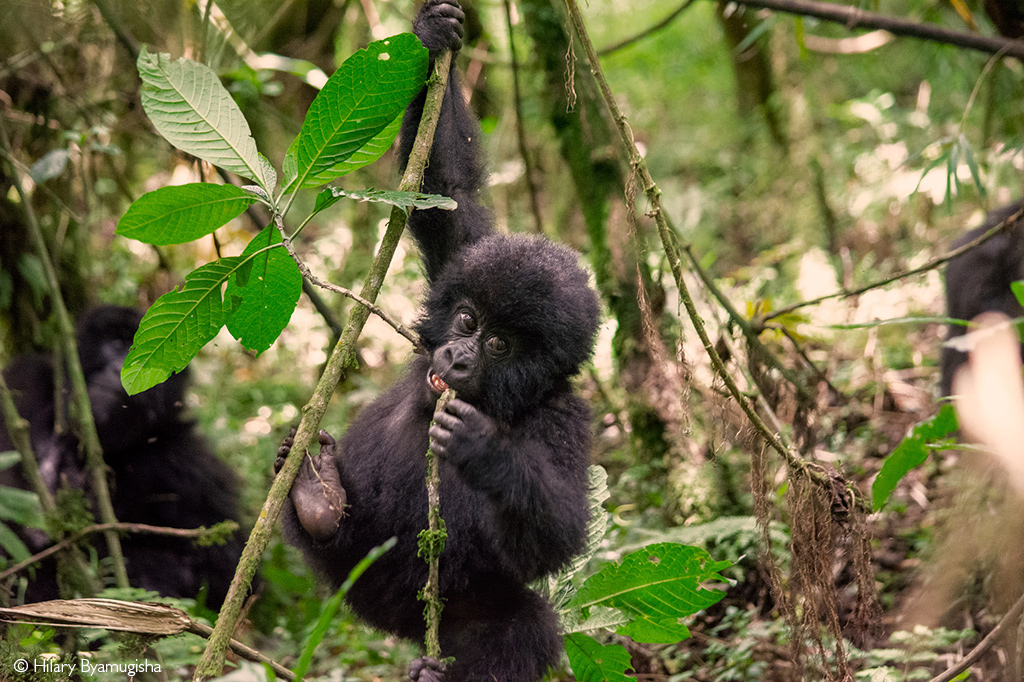
A baby gorilla samples the forest fare while dangling from a vine. Check out more images from @hillary_shots here
Africa Geographic Travel

Precious primates – silverbacks and golden monkeys

Regarding the Ugandan gorilla trekking experience, Mgahinga has traditionally been overshadowed by Bwindi Impenetrable National Park, which lies some 50km to the north and is home to the country’s only other population of mountain gorillas. This is partly because Mgahinga’s habituated gorilla family – the Nyakagezi family – have occasionally been known to cross the park’s boundary into Rwanda. However, in recent years, they have been all but resident on the Ugandan side of the ecosystem, and encounters are increasingly reliable.

Mgahinga
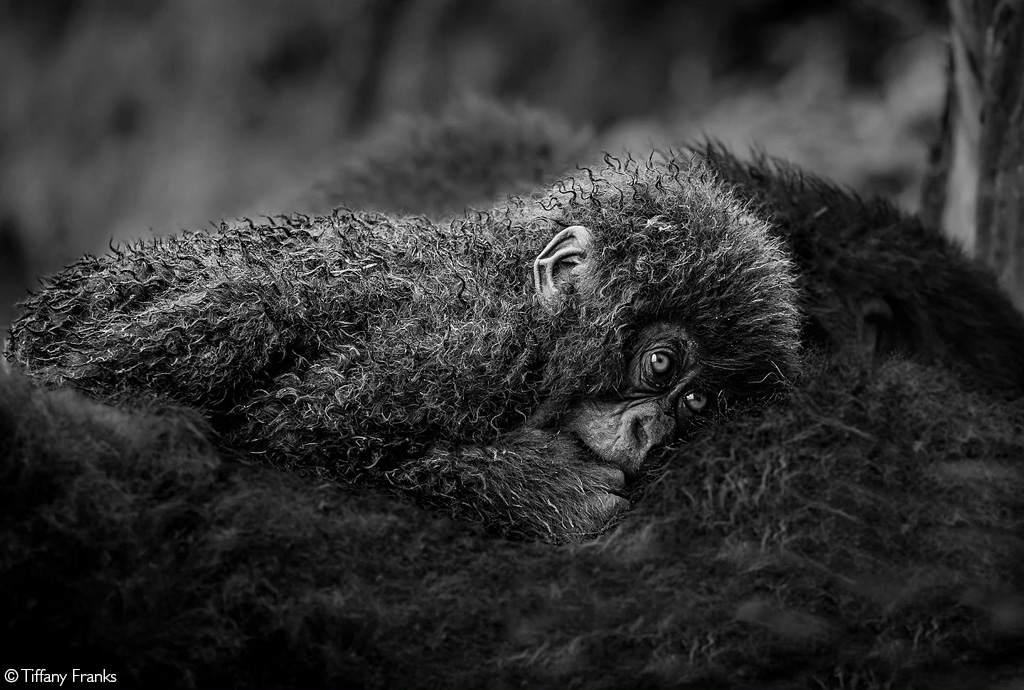
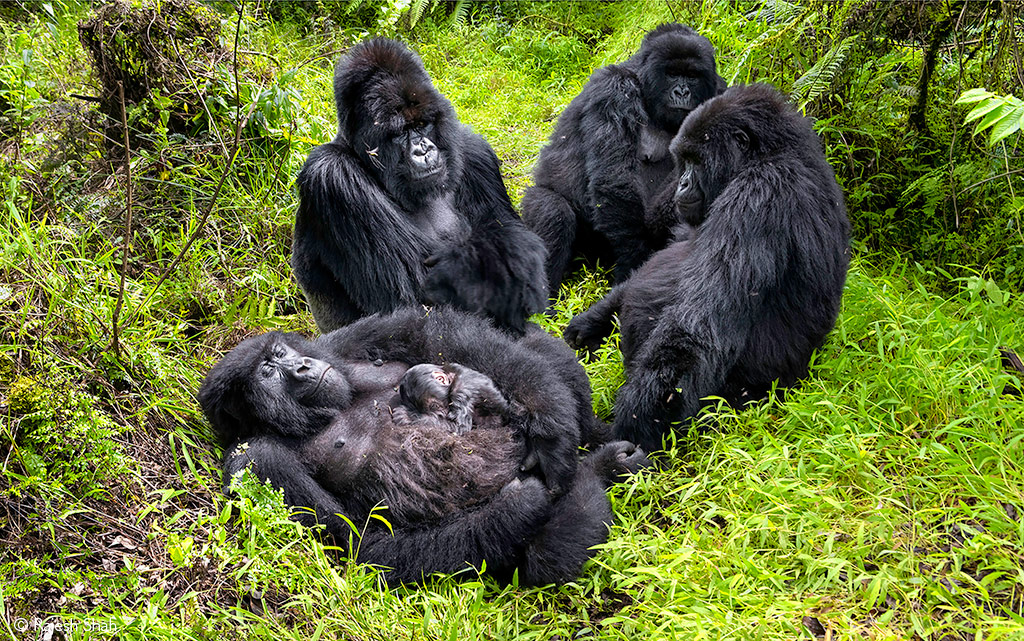
Mother and infant gorilla nap peacefully while surrounded by a watchful band

Not for nothing is gorilla trekking considered a safari essential on the bucket list. Though the time spent with gorillas is strictly limited to prevent over-exposure, the impact of such an encounter makes an indelible impression on the human soul. Though the hike through the forest can be physically demanding, the reward at the end is a goosebump-inducing meeting with our sentient relatives.

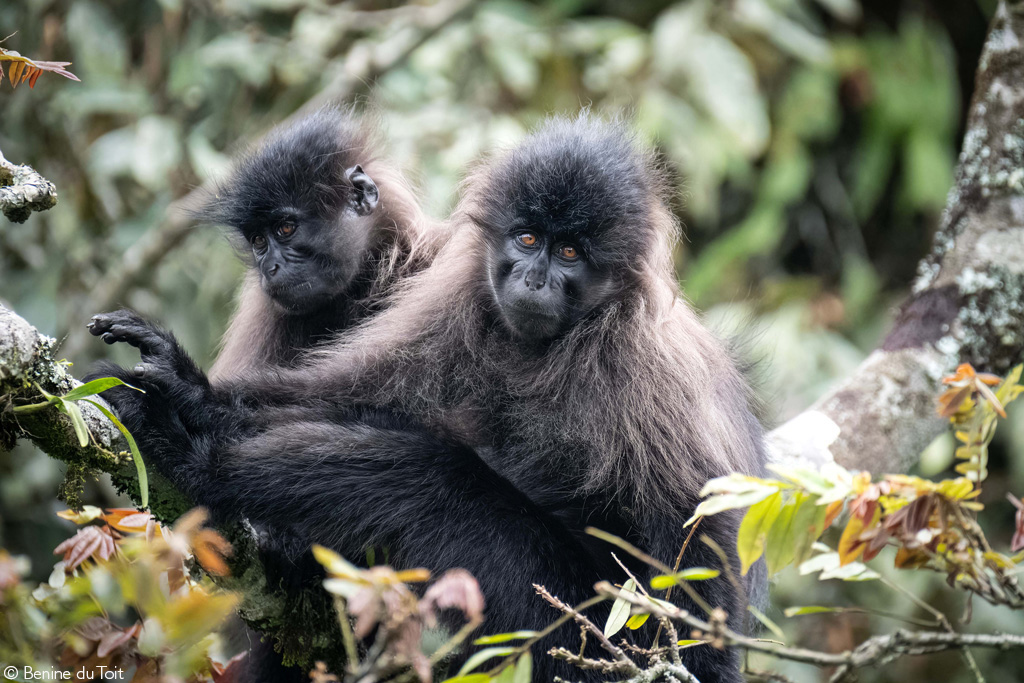
Naturally, the gorillas are the stars of a visit to Mgahinga, but they have found stiff competition in their bright-eyed smaller cousins, the golden monkeys. These unique endangered animals are restricted to the highland forests of Central Africa and are found only in a handful of national parks, including Mgahinga. They are named for their mottled gold facial mask and are usually found snacking on bamboo stalks. With the success of well-established gorilla trekking as a conservation model, park authorities have similarly habituated troops of these primates so that they can be observed without affecting their day-to-day behaviours. Visitors to Mgahinga can opt for the standard trek or spend several hours with the habituation team.

Mgahinga
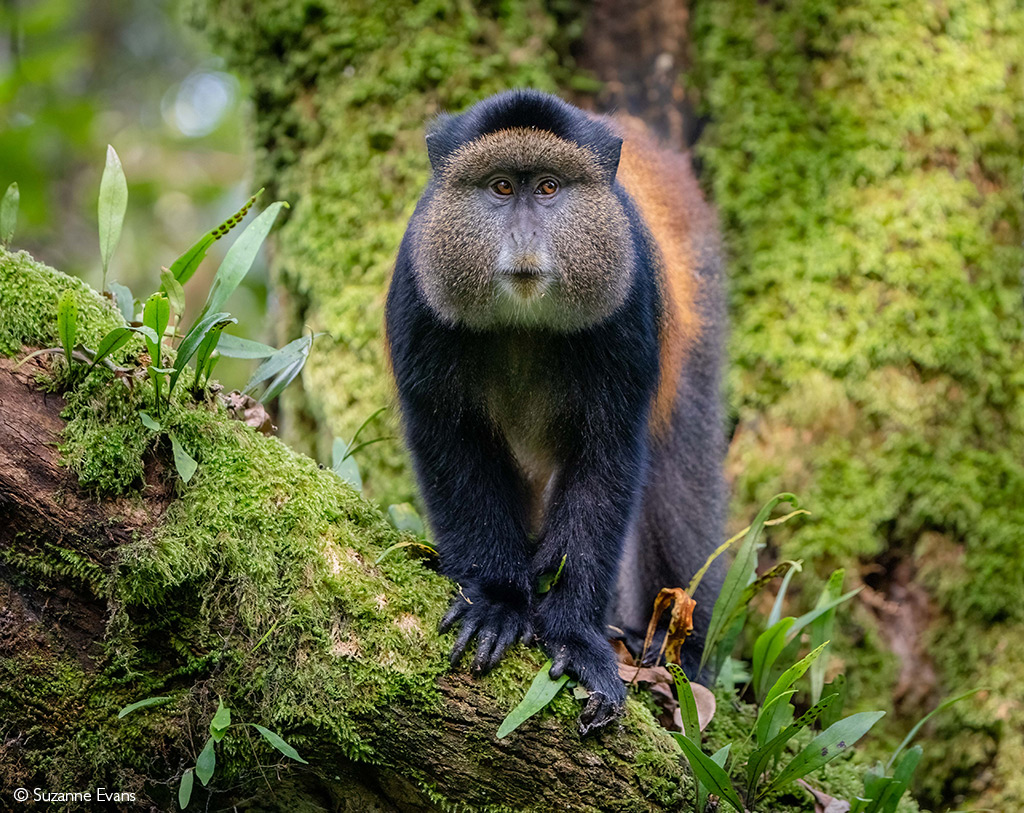
A golden monkey stands to attention
Africa Geographic Travel

Kingdom Animalia

The rich volcanic soils and moist tropical climate have ensured that the Greater Virunga Ecosystem is a hotbed for floral and faunal diversity. Moreover, scientists studying the region believe that much of the eastern Congo basin was an ice-age refuge, which escaped the worst of the glacial conditions that once blanketed the earth. Consequently, endemism levels are high, particularly among the forest’s feathered residents. Challenging though forest birding may be, Mgahinga is home to an impressive list of bird species, including several Albertine Rift Valley endemics and many Afrotropical mountain-habitat specials.

Mgahinga
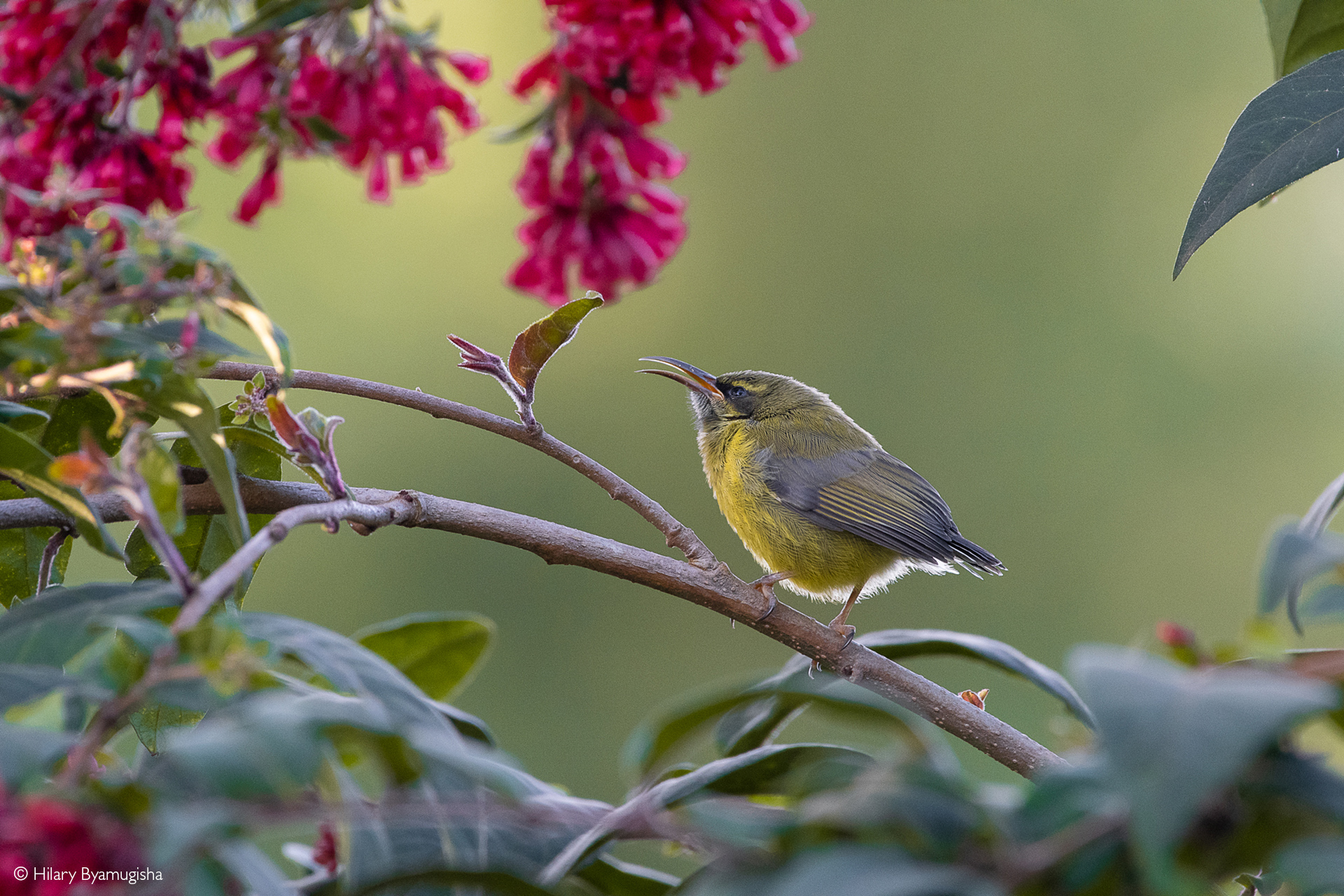
A juvenile bronze sunbird silhouetted by dim light

A hike along forest paths (perhaps serenaded by the melodious Kivu ground thrush) will reveal the dramatic flashes of African pittas and Rwenzori turacos. At the same time, a more strenuous route to the lobelias at the top of the volcanic peaks may be rewarded by the sight of scarlet-tufted sunbirds. True to its name, the Grauer’s swamp warbler can be heard singing its little heart out in the reeds of the Kabiranyuma and Kazibakye swamps in competition with the vocal handsome francolin on the peripheries. Further into the forest, sunbirds abound, with regal, blue-headed, and Rwenzori double-collared sunbirds contributing to the kaleidoscope of colour. The company of one of Uganda’s expert bird guides will unlock the park’s full birding potential, and eager aviphiles will find themselves dashing from dusky crimsonwings to Rwenzori batises and then on to the search for a montane nightjar.

For those who can tear their eyes away from the primate and avian extravaganza, the trails are decorated in butterflies of every shape and colour. Sharp-eyed visitors (or, more likely, the experienced guide) may even be lucky enough to spot one of the park’s rare Jackson’s chameleons – a three-horned creature that looks for all the world as though it sprang from the time of the dinosaurs. Elephants, leopards, giant forest hogs and bushpigs are all present in the forest but are shy and seldom encountered.

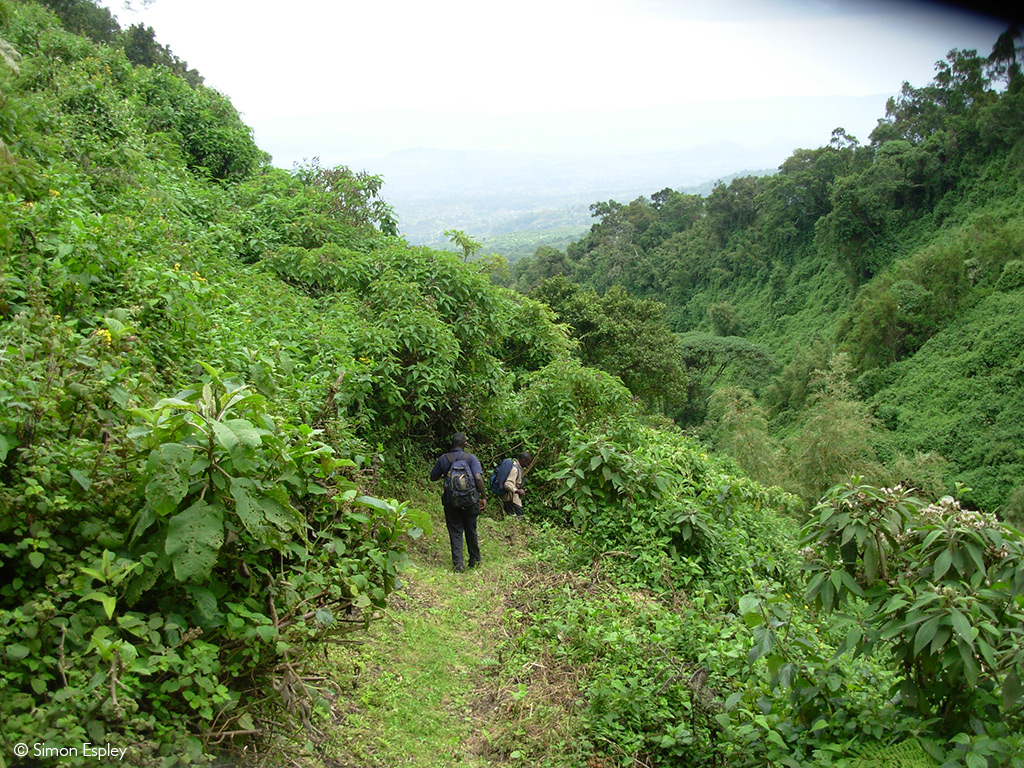
Heading into Sabinyo Gorge in search of rare birds
Africa Geographic Travel

Meandering in Mgahinga

With such abundant natural marvels, it’s no wonder hiking is a popular activity in Mgahinga. The well-kept trails range from short excursions and nature walks to full-day adventures up one of the three volcanic peaks to take in the panoramic views over Uganda, Rwanda and the DRC. The hike through Sabinyo Gorge is particularly favoured by birders but enchanting for visitors looking to explore the fantastical scenery and vegetation on display.

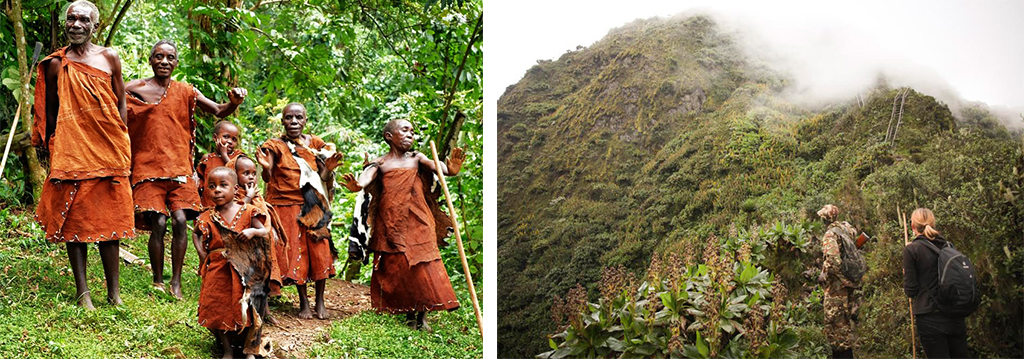
Another popular excursion is a trip to the Garama Cave, which extends for some 342 metres beneath a plateau and is sacred to the local Batwa people. In the gloom of the cave, conflict councils were held to discuss the defence of their lands, and the relics of their culture and religion can be found throughout the chambers. The Batwa people were evicted from the Mgahinga region when it was gazetted as a national park, but some remain on the park’s fringes. Cultural tours allow visitors to learn more about their way of life and the challenges of adapting to the loss of their ancestral lands.

Visitors can experience the culture of the Batwa while visiting Mgahinga, or hike up the volcanoes in the park

Explore & stay

Mgahinga Gorilla National Park experiences two rainy seasons: one from February to May and a second from September to December. However, rain is possible at any time of year, and visitors should always be well-prepared to waterproof valuables. Comfortable clothes with long sleeves and layers, and a sturdy pair of boots are essential to making the most of the Mgahinga experience.

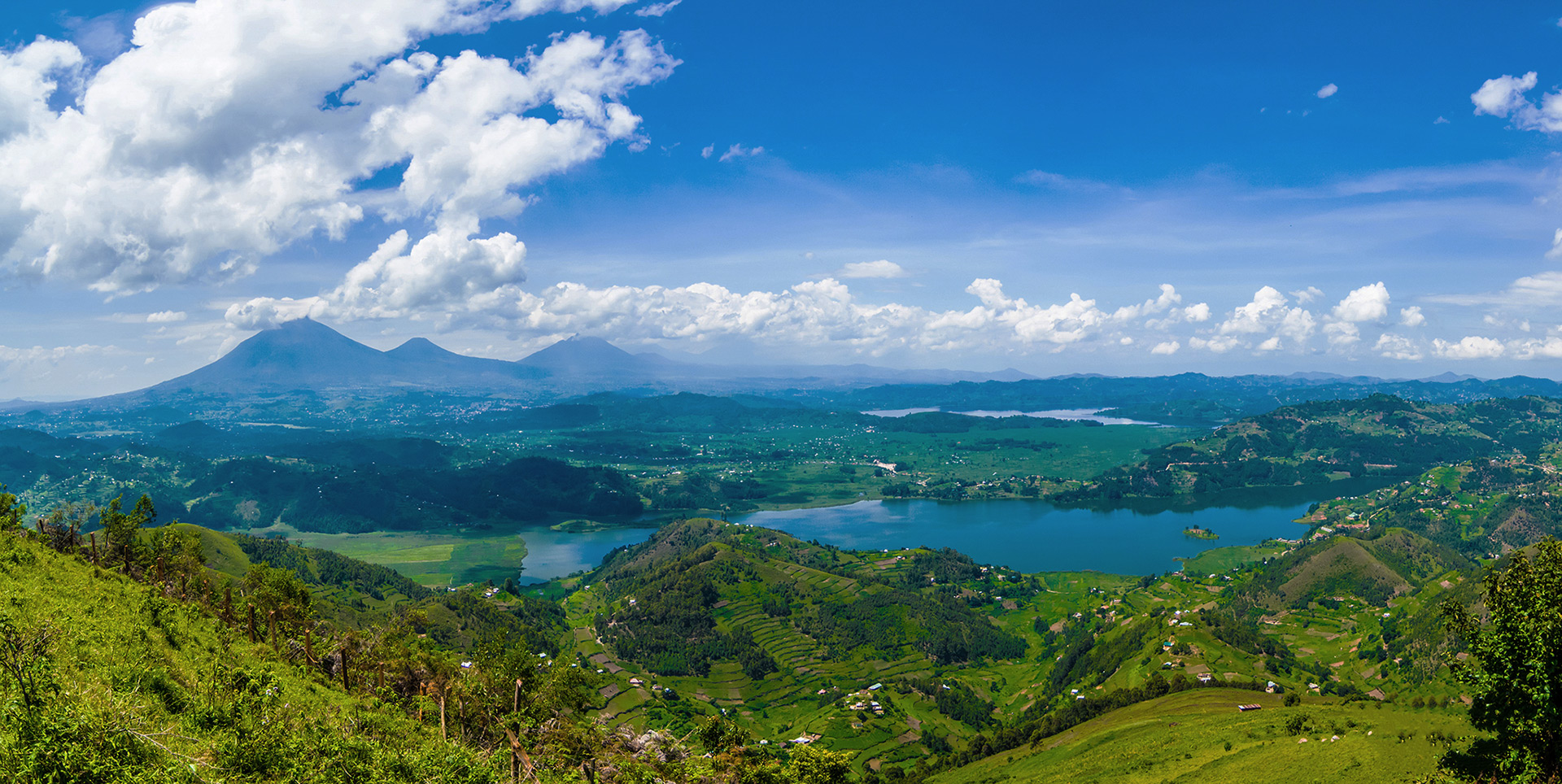
A luxury lodge near the park’s gate offers the only tourist accommodation available within Mgahinga itself, but there are several budget and mid-range camps and lodges along the park’s outskirts. Those wishing to travel slightly further afield could also explore options on the banks of nearby Lake Mutanda or Lake Bunyonyi, both astonishingly beautiful, framed by lush hills and dotted with tiny islands.

The Virunga mountains peak out from behind Lake Mutanda and Lake Mulehe

Final thoughts

While Mgahinga may be small compared to its neighbours, the national park is a vital cornerstone of the Greater Virunga Ecosystem, one of Africa’s most mysterious and untamed wildernesses.

Resources

Read more about some of Africa’s must-visit mountain kingdoms here.

For more info on gorilla trekking, and to check out our ready-made gorilla-trekking safaris, click here.

Calling an elephant by its name

elephant
Do elephant rumblings contain names? New research may have the answer

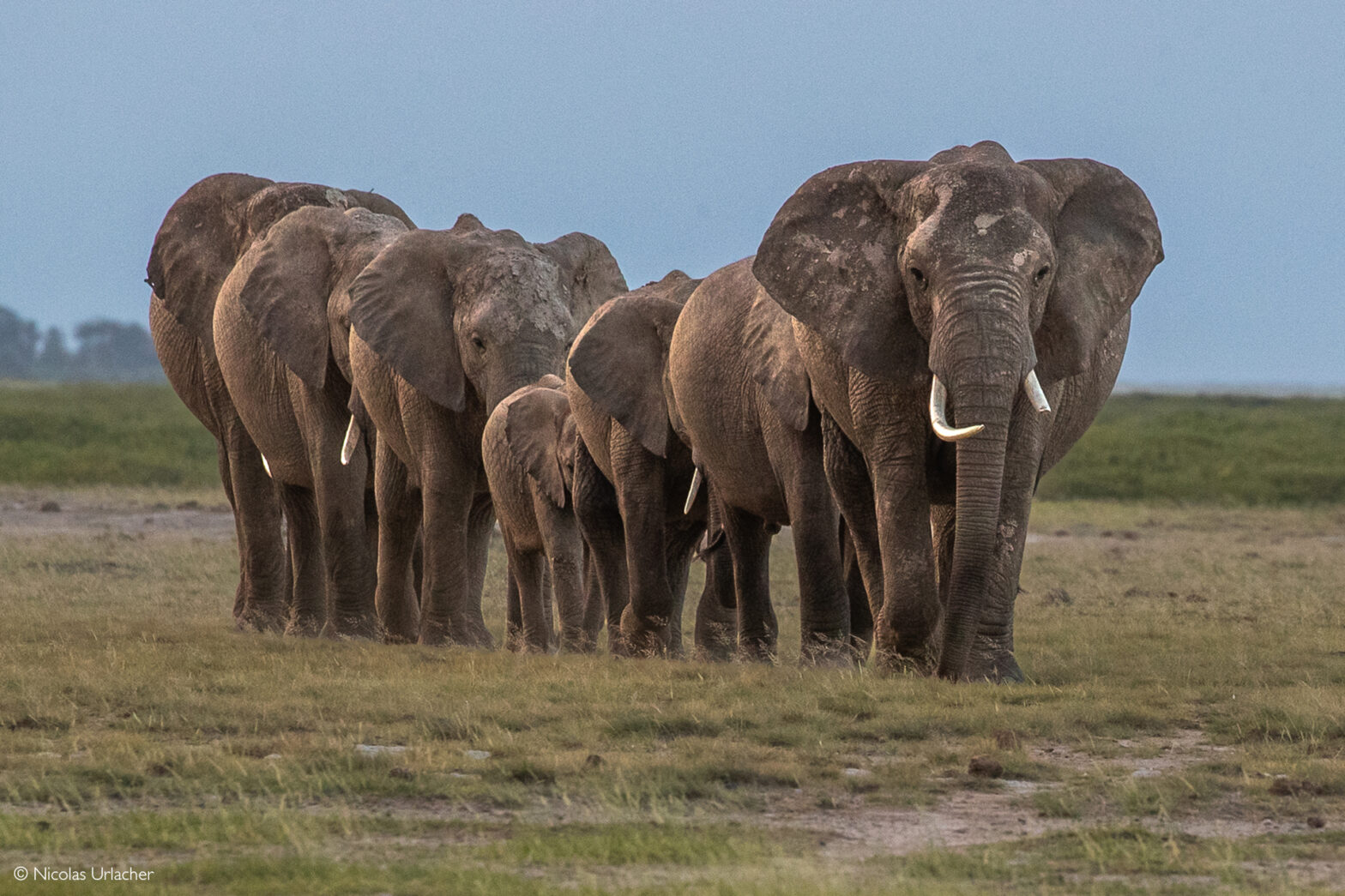
How do you call an elephant? By its name. This might appear to be the start of a bad joke, but the fact that elephants might have individual names for each other is a first in the animal kingdom. Do elephant rumblings contain names? New research has shown that it is possible that elephants have individual names, and they get one another’s attention by using these names.


Elephant name-calling

The nearest similar behaviour in animals has been observed in dolphins mimicking the particular calls of an individual whose attention they want to attract. Dolphins have their own unique set of squeaks and whistles, which self-identifies them to the group, but what is different about Bottlenose dolphins (Tursiops truncatus) is that when a dolphin wants to communicate with another dolphin, it mimics or copies that individual’s unique call signature.

Despite this being a fairly unique behaviour amongst wild animals, it is still cognitively simple to communicate to an individual by imitating that individual’s signature call. One step further is what humans do – attaching a non-mimicking, essentially arbitrary vocal label (aka “name”) to an individual. (My name, “Christy”, does not reference the sounds I make). This type of vocal recognition requires a new level of cognitive processing to connect a general sound “label” to one individual. It requires verbal learning (as individuals are not born knowing the names of their peers), memory, and assigning a symbolic meaning to individuals.

Africa Geographic Travel

How to communicate with an elephant

A recent study (which is yet to be reviewed) included some intriguing experiments to find out more about how elephants communicate with each other.

Firstly, we know that elephants are great communicators – they can mimic sounds and have a wide variety of low-frequency rumblings. Many travellers will have experienced these rumblings while on an African safari. For example, they have a “Contact Rumble” when the caller is far away, is visually separated from the herd, and wants to get in touch again. They also have a “Greeting Rumble”, for when they haven’t seen each other for ages and they meet up again.

elephant
Elephants communicate using various techniques, including rumbling

Researchers for this study, published on bioRxiv, recorded and analysed the calls and rumblings of elephant groups from the greater Samburu ecosystem in northern Kenya and the Amboseli National Park in southern Kenya. They observed the elephants’ interactions, noting calls and when a response was initiated by a call (through vocalising or approaching a caller). They then analysed the calls to see if vocal labels were uniquely associated with an individual and if different callers used the same vocal label (name) when addressing that individual.


Want to plan your African safari to spot elephants in the bushveld? We have ready-made safaris to choose from, or start planning a unique safari made just for you.


The results showed receivers of calls could be correctly identified from the call structure of other elephants and that there was a commonly used acoustic signal – like a label or name – in the calls to that individual. There were, however, varying sounds and rumblings in these calls, suggesting multiple messages encoded in these rumblings. The scientists suggest that results may be blurred by the fact that rumblings are not as simple as, “Hey you, Ellie, get over here!” but probably contain more information, such as in, “Hey Ellie, you want to join us? We’re thirsty, and we’re off to the waterhole while Mom isn’t looking.”

The fascinating result, however, occurred when the researchers played back recorded calls of specific herds back to these same herds in the field. They tested these vocal labels (names) in the field and compared the reactions of 17 wild elephants to the playback of calls. When the elephant heard its name in a call, it approached the recorder more quickly and vocalised more quickly than to calls without its name.

Africa Geographic Travel

Final thoughts

So, it’s not quite a cut-and-dried case of elephants definitively having names, but there is some evidence to support the vocal identification of individuals. Why would elephants want to call each other? Elephants are social creatures, and their groups tend to split and re-connect frequently. As humans tend to respond positively when their name is used in an instruction, so too might elephants.

Reference

Pardo, M. et al. (2023). African elephants address one another with individually specific calls. Or alternative link.

Resources

The hybrid elephants of Kibale: Read about a study from Kibale that has laid the groundwork to distinguish between forest/savannah elephant hybrids and different elephant species.

Putting elephants on the map – exploring connectivity in southern Africa: Read about how elephants move across southern Africa through protected areas and beyond

THIS WEEK – 26 January 2024

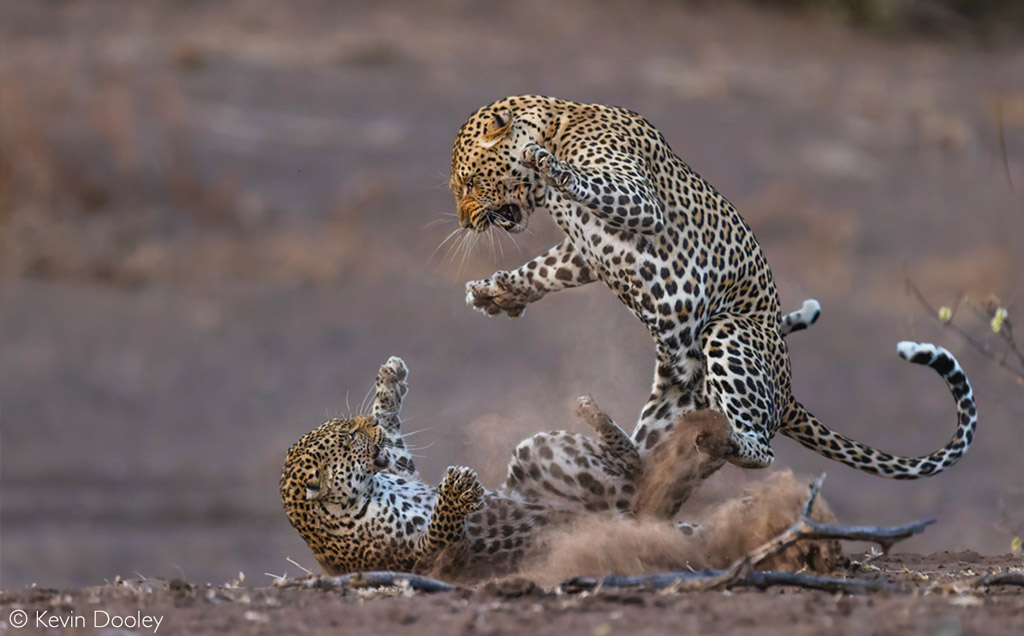
The mating game: a tense moment between two amorous leopards. Mashatu Game Reserve, Botswana. © Kevin Dooley. Photographer of the Year 2023 runner-up

This is a copy of our weekly email newsletter. Subscribe here to receive the newsletter.


Mashatu in colour + 90 hunted leopards?

The leopard mating experience is far from peaceful – as demonstrated in Kevin Dooley’s pic above. Did you know that leopards on honeymoon may mate as much as 256 times in four days? But, even with this radical number, these honeymoons are not always successful in producing offspring. One study found that only 28% of adult female leopards in the Kruger National Park gave birth per year. Little comprehensive research has taken place on the mating habits of leopards, as they are elusive and difficult to study.

This also means obtaining a reliable population count of leopards is notoriously challenging, if not impossible. Which is why we recently asked Botswana’s Department of Wildlife and National Parks how they calculated the trophy hunting quota of 90 leopards for 2024. We are still waiting for a response and will keep you posted.

This leopard-mating pic, taken in Mashatu Game Reserve, Botswana, was the runner-up in our 2023 Photographer of the Year. teamAG is busy warming up for our 2024 competition – coming soon – and we can’t wait to share the details with you in a few days!

The winners from our 2023 competition headed to Mashatu recently and found this area of the Tuli Block to be an extremely rewarding photography destination. Check out some of their pics in the gallery below.

Estimating population sizes of spotted hyenas is also a tricky process. But a new study from Tanzania has produced the first population density estimates of this kind for spotted hyena in Tanzania – check out our second story.

Happy celebrating Africa to you!

Taryn van Jaarsveld – Editor


Story 1
PHOTO SAFARI
Gallery: Simon Espley headed to Mashatu in Botswana’s Tuli Block with Photographer of the Year’s 2023 winners

Story 2
SPOTTING HYENAS
New research using camera traps has measured spotted hyena population density in southern Tanzania


Travel desk TRAVEL DESK: 

Bush & beach, Pinotage to predators – South Africa – 12 days/11 nights – from ZAR85,745pps

Dreaming of visiting South Africa? Enjoy this iconic 12-day bush & beach safari, showcasing the best that South Africa has to offer. Be prepared to be swept off your feet with wall-to-wall wildlife action – with exceptional Greater Kruger Big 5 game viewing. This safari also includes a full-day road trip taking in the stunning scenery and cultural delights of the Lowveld. And then, head on to vibey, sophisticated Cape Town & the nearby winelands.

Or, to plan your perfect, tailor-made safari, get in touch with our safari experts.


Trip Report

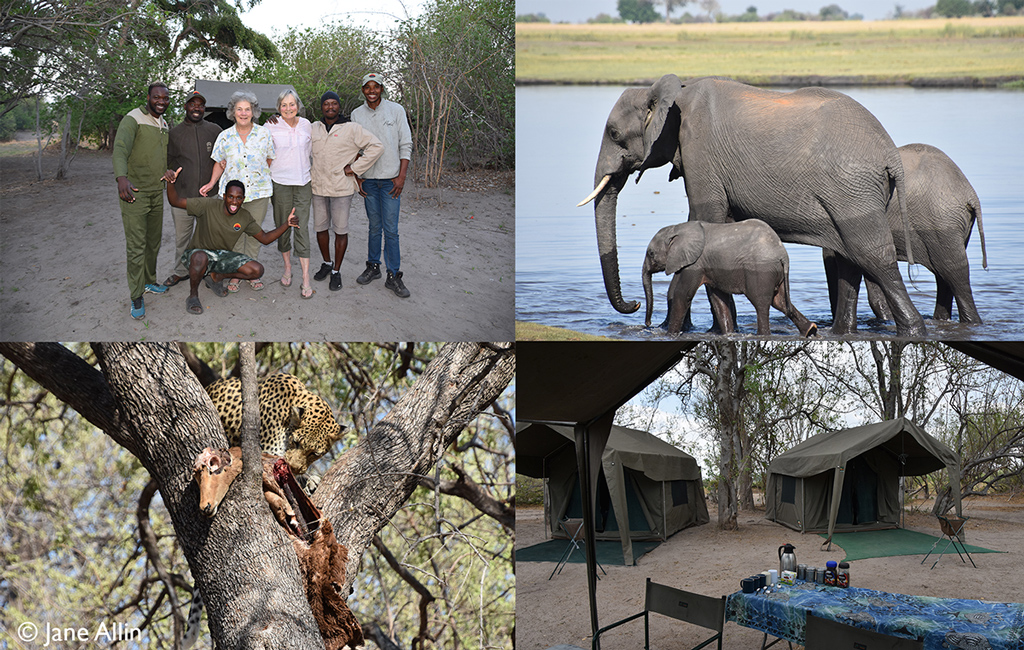
Superb Botswana mobile safari

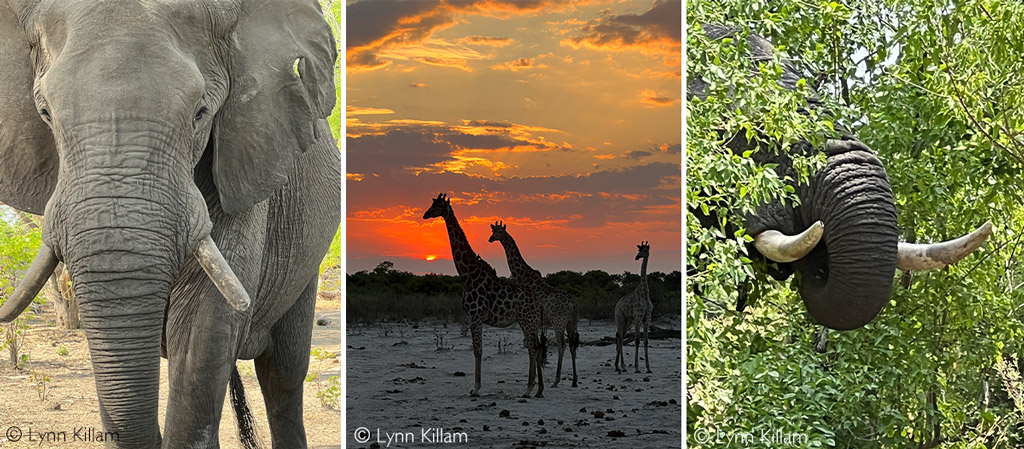
Lynn Killam and friends headed on a mobile safari to Botswana with us. Lynn says:

“The wildlife was fascinating. We loved the staff in camp, and were really happy to have visited. We loved camping and the outdoor areas. The mokoro was really great and we enjoyed the boat on the Chobe River. Our guide Paul was a delight. He was informative, helpful and funny, and told us the backstory on many of the animals along the way. I learned a lot from him, and we enjoyed his company very much. And he has the patience of Job!

But the absolute highlight was the animals. We watched wild dogs after a kill and saw them following a herd of wildebeest. We saw so many lions and listened to Paul tell us what he knew about each pride. The elephants were magnificent and the birds were fantastic. The wildlife – from the insects to the mega-mammals – were indescribably beautiful. Also – the baobabs! The experience was superb.”

Want to go on a mobile safari? Check out this classic Botswana fully catered mobile safari


WATCH: Most children living near South Africa’s Kruger National Park have never seen an elephant or lion. In many of these communities, children fall asleep to the sounds of lions roaring, but don’t get to see the animals for themselves. But the Future Rangers Program is working to change this reality – instilling a passion for wildlife conservation in future generations. (03:55) Click here to watch

For more videos celebrating Africa, check out our videos here

Mashatu Magic

My favourite moment in Botswana’s Mashatu Game Reserve was spending time with two magnificent male lions lurking on a rocky ridge high above the arid landscape below. They were new to the area and keeping a low profile – not keen to let the dominant pride males know of their presence. Our tracker, Goms, had somehow spotted the mohawk of one of the lions as we trundled along a bush track far below. These huge muscular specimens were about three years old – dispersed from their natal pride to seek their own territory and breeding rights. They were feral yet noble, and something about that steely look in their eyes told me that the new kings had arrived.

We also spotted six leopards in the first two days, a cheetah mom and her adolescent cubs on a kill, hyenas and many lions. We marvelled at huge blue-grey eland bulls going clickety-clack and even larger elephants as the herds sought water in this, the late dry season of September 2023. And we savoured rusks and early morning coffee under riverine canopies of Mashatu, sycamore fig, ana, boerbean and leadwood trees as Meyers parrots screeched hysterically overhead. We also enjoyed the most spectacular underground photographic hide sessions where the only way to rest the eyes was to gaze heavenward (scroll down for more about that). Safari heaven.

This was Tuli Block in southern Botswana – at its best. Lizz and I spent five glorious days here with our 2023 Photographer of the Year winners and their partners.

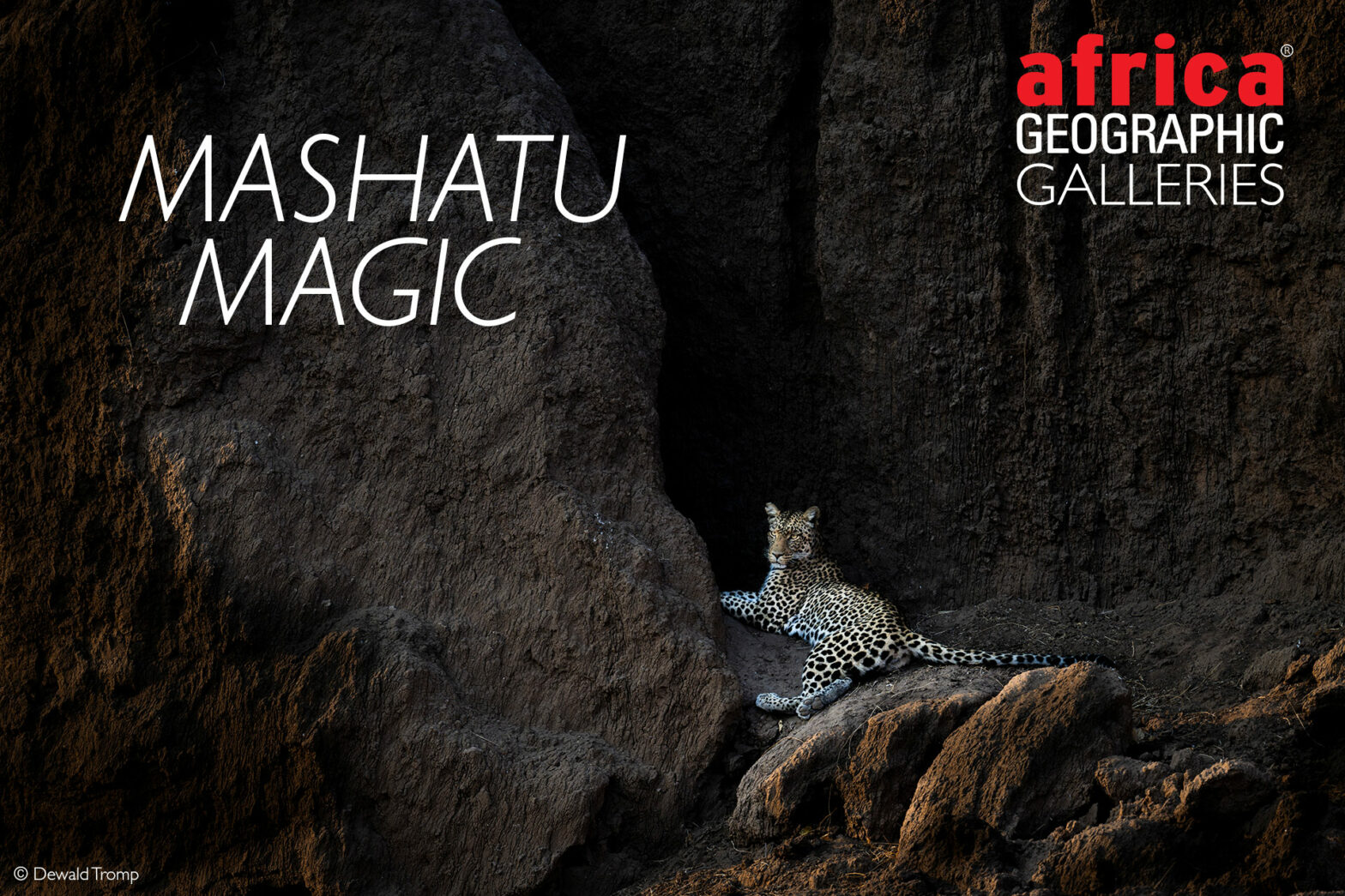
Cover photo: Our first game drive on a warm late afternoon delivered this beautiful female leopard resting in the shade of the Mojale River mudbank. © Dewald Tromp


Keen to head onto your own trip to this epic safari destination? Check out our safaris to Tuli Block here. We have ready-made safaris to choose from or ask us to build one just for you. 


African safari
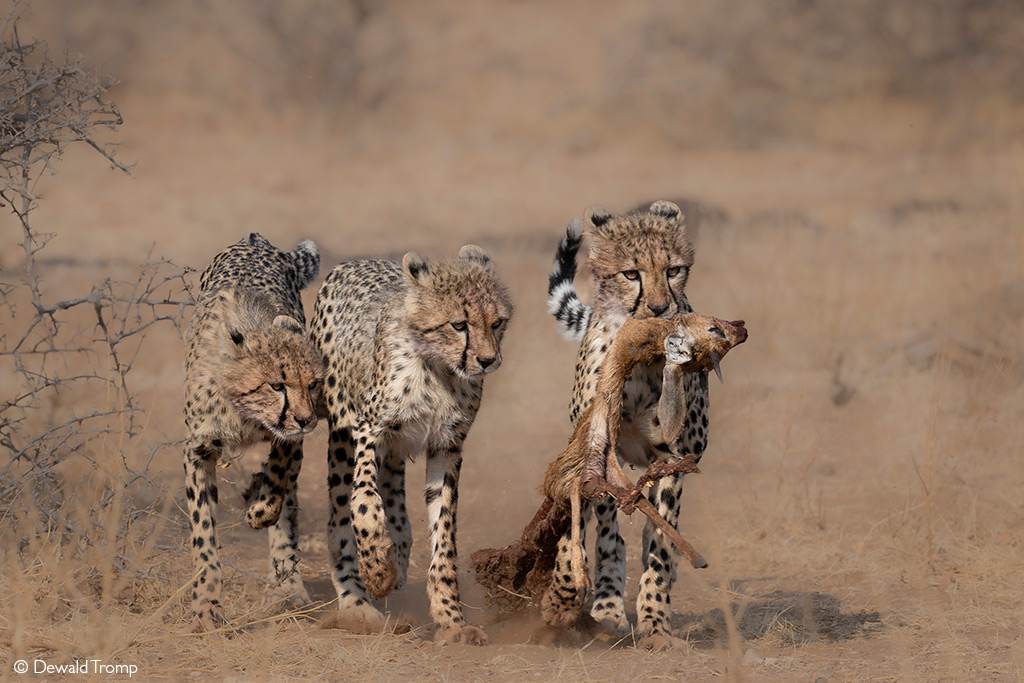
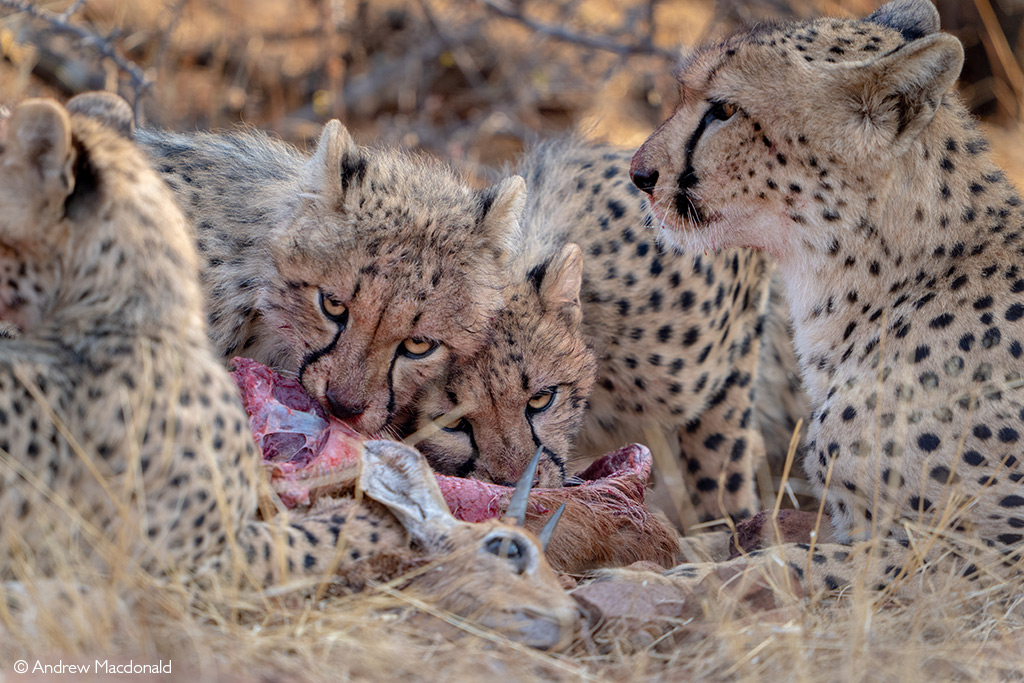
It was a hot, late morning, and their mother was issuing persistent warning chirps about being too visible with other dangerous big cats around. But that did not prevent this trio of cheetah cubs from parading around with what remained of the recently devoured steenbok. © Dewald Tromp
African safari
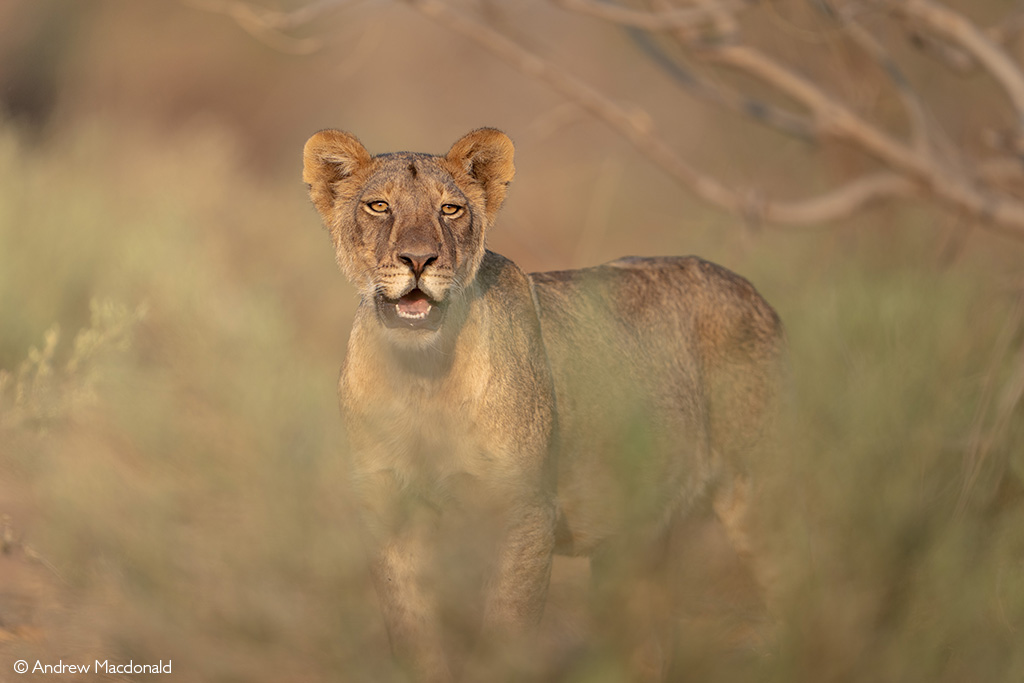
A young male lion peers across the scrub at us, uncertain of our intentions. He was part of a pride of seven lions we encountered most days. © Andrew Macdonald
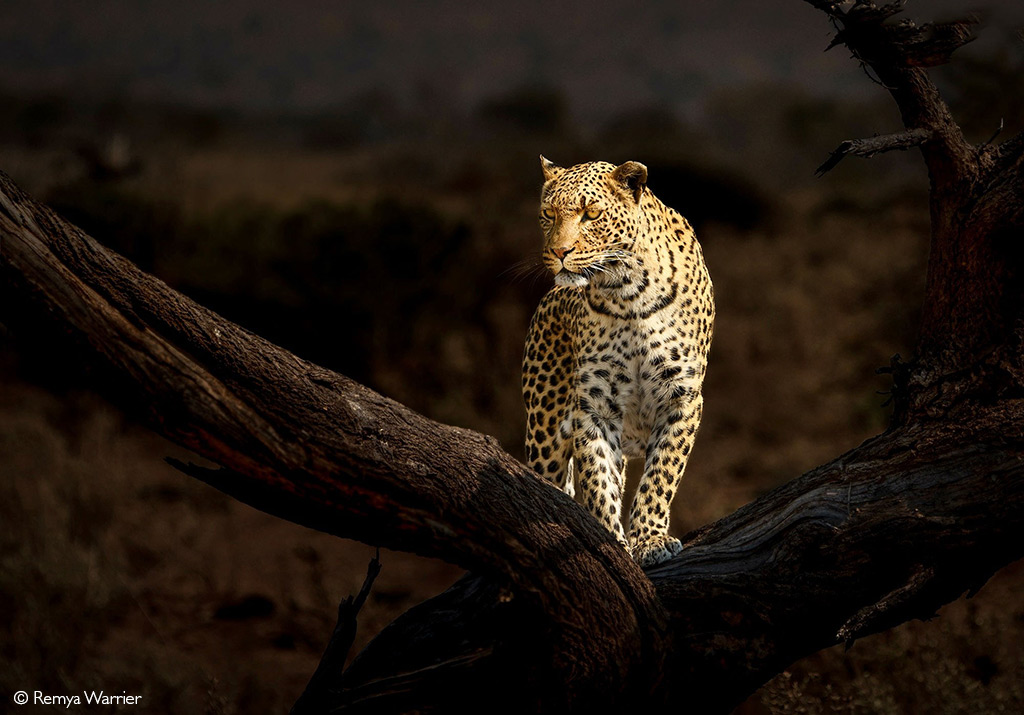
This svelt female leopard was very relaxed with us, walking around the vehicle and posing beautifully on this tree. © Remya Warrier
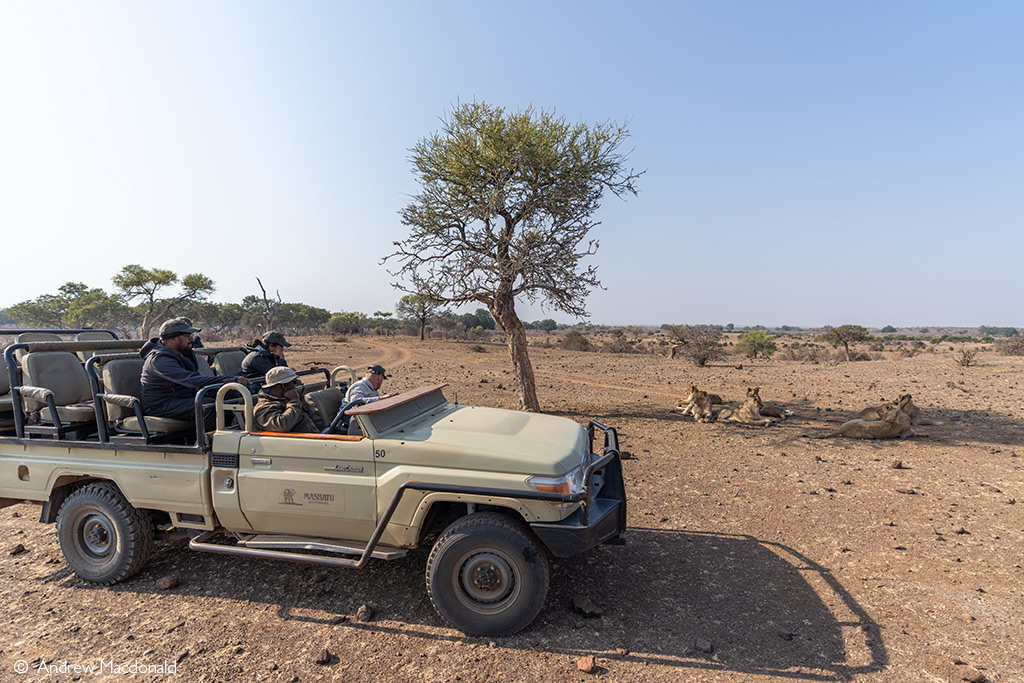
These lions were resting in the shade of a shepherd’s tree. We were not so lucky, enduring rising temperatures as we waited for the flat cats to do something. Eventually, they sauntered off to a nearby waterhole to slake their thirst. © Andrew Macdonald
Africa Geographic Travel
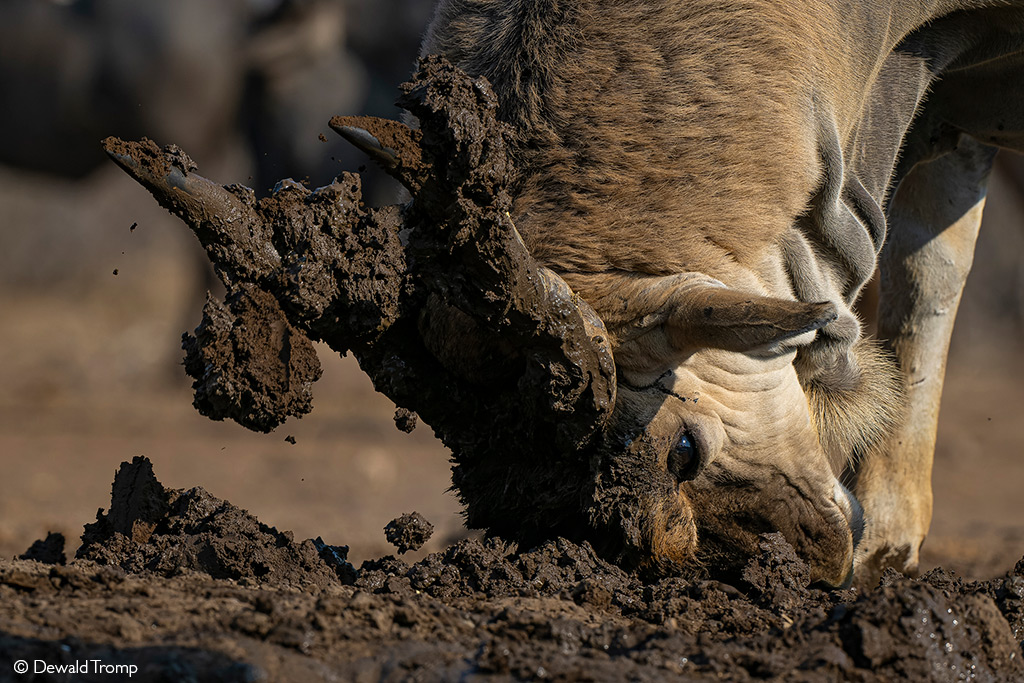
This huge eland bull enjoyed a spa moment, scratching his nose and caking much of his head and horns in mud. © Dewald Tromp
Mashatu
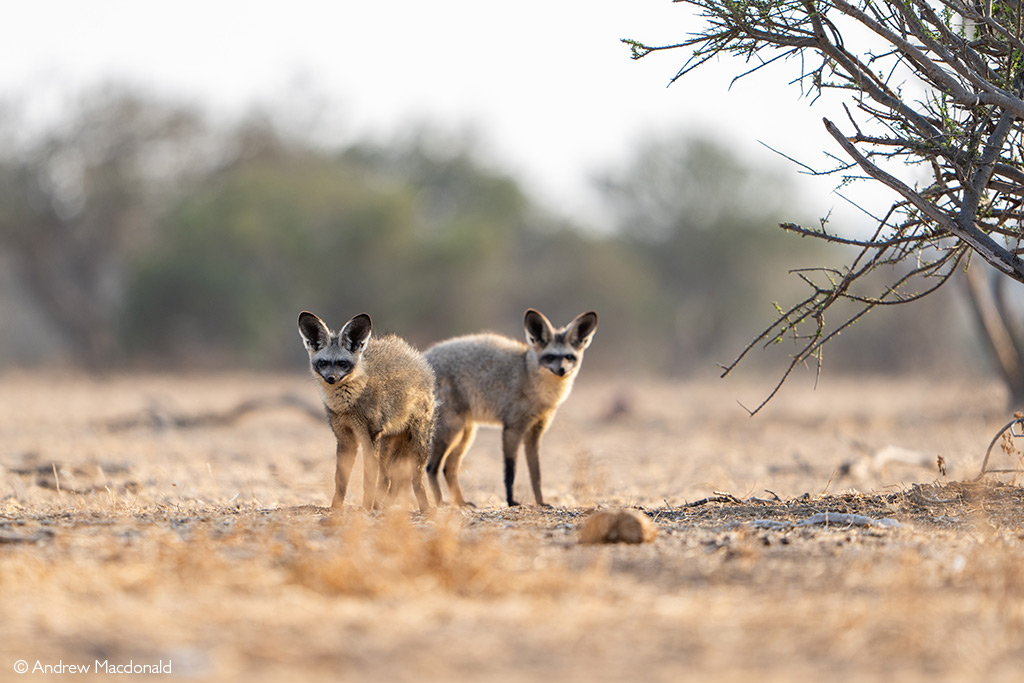
Early morning, and this pair of bat-eared foxes are still fluffed up to insulate against the cold. After considering us briefly, they dashed off in that mad-hatter fox way. © Andrew Macdonald
Mashatu
We spent a few hours in the company of this mother cheetah and her three cubs as they feasted on a fresh steenbok kill. It was a hot, late morning and we had this epic encounter to ourselves. © Andrew Macdonald
Mashatu
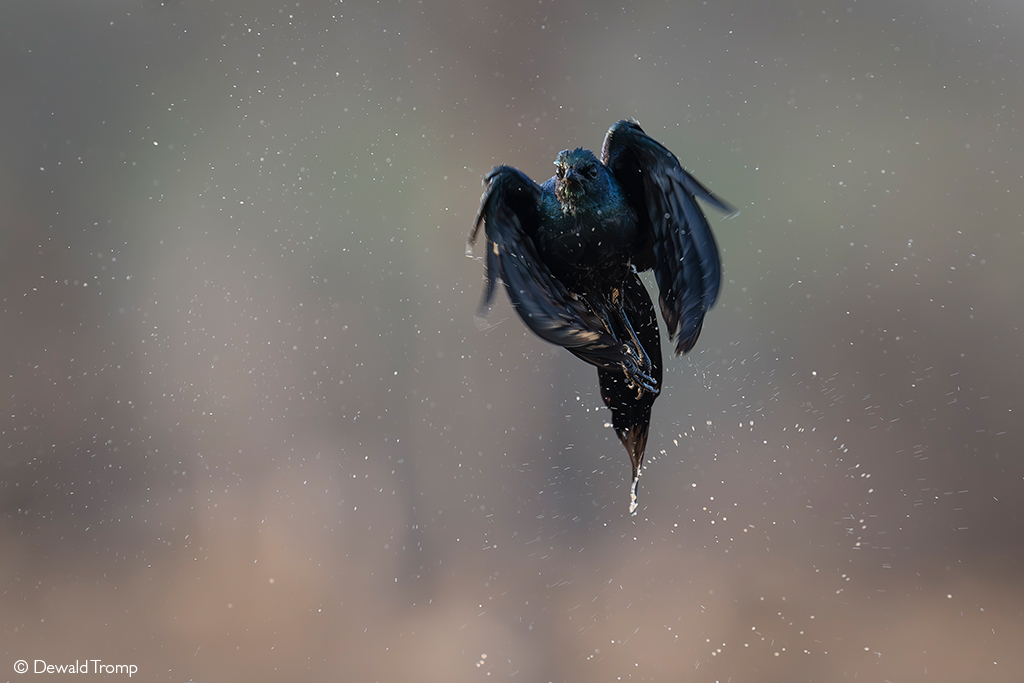
A Meves’s starling launches from the water after a bath, startled by the arrival of a legion of restless queleas. © Dewald Tromp
African safari
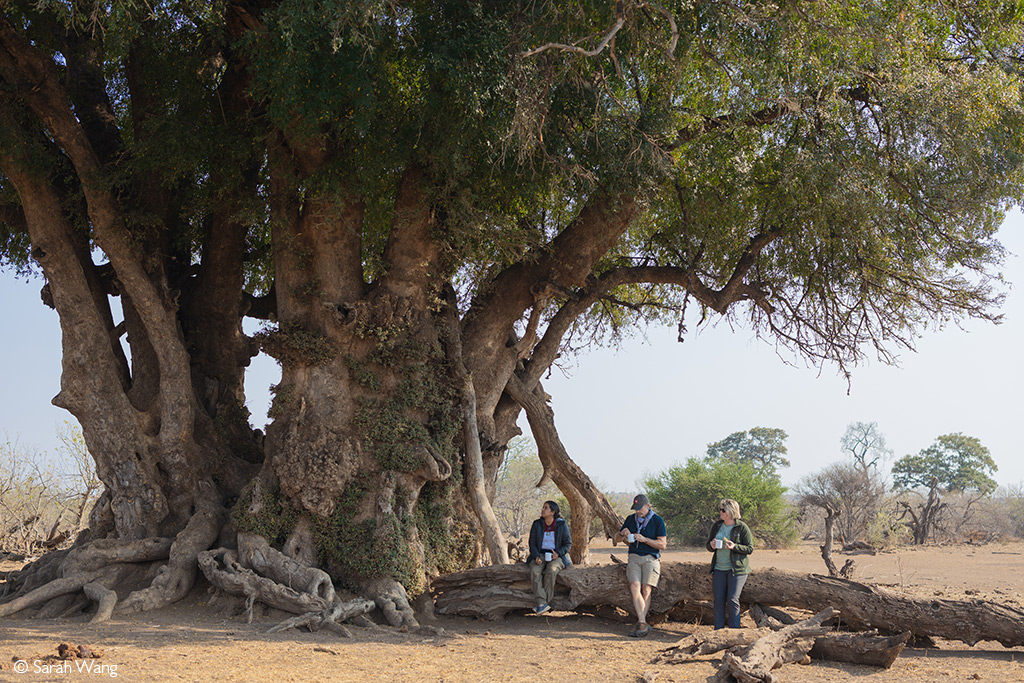
Late afternoon coffee break under a massive mashatu (nyala) tree. This tree had numerous cavities and signs of many inhabitants – an ecosystem of its own. Mashatu trees are common along the banks of the rivers of Tuli – although many have fallen victim to collapsing river banks. © Sarah Wang
Africa Geographic Travel
Mashatu
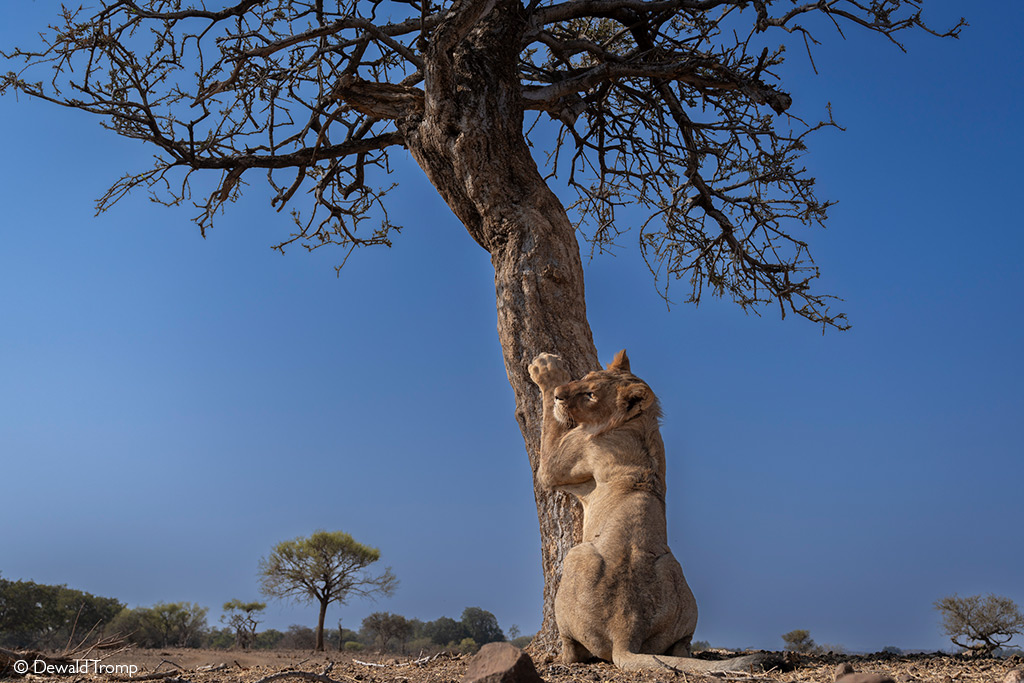
This young male lion was fascinated by a camera positioned on the ground and approached us for a better look. At about 2m away, he diverted to this shepherd’s tree while keeping an eye on us. After sharpening his claws, he followed his pride to a nearby waterhole. © Dewald Tromp
African safari
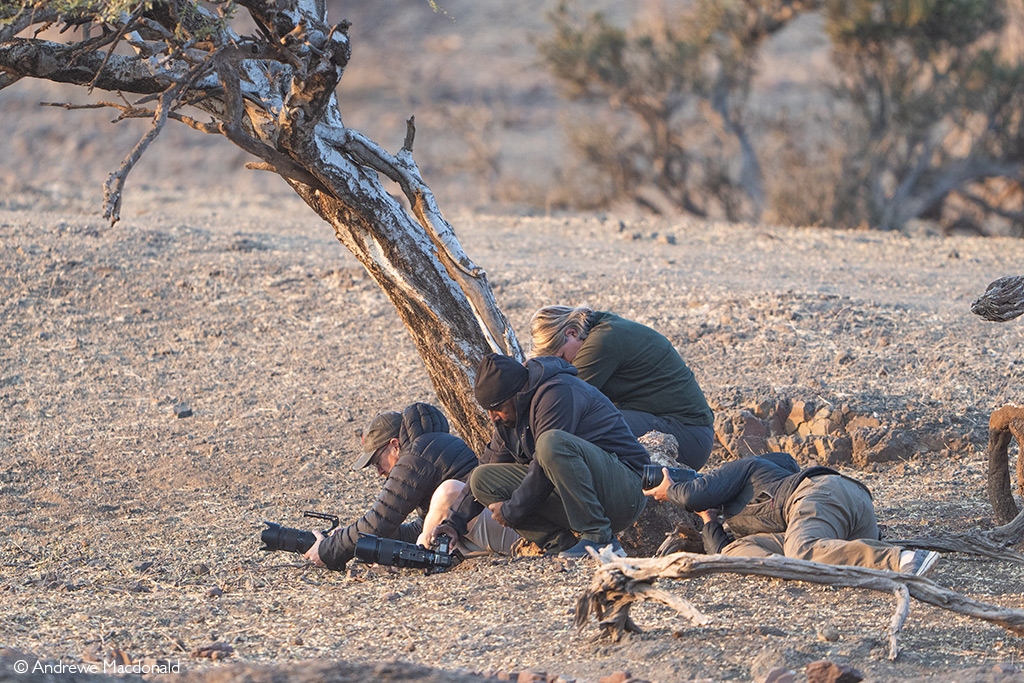
Early morning finds the crew attempting a backlit photo of a massive flock of guineafowl cavorting near a waterhole. Harsh backlight, swirling dust and a general sense of bush-chicken mayhem thwarted our efforts, but fun was had by all. © Andrew Macdonald
Mashatu
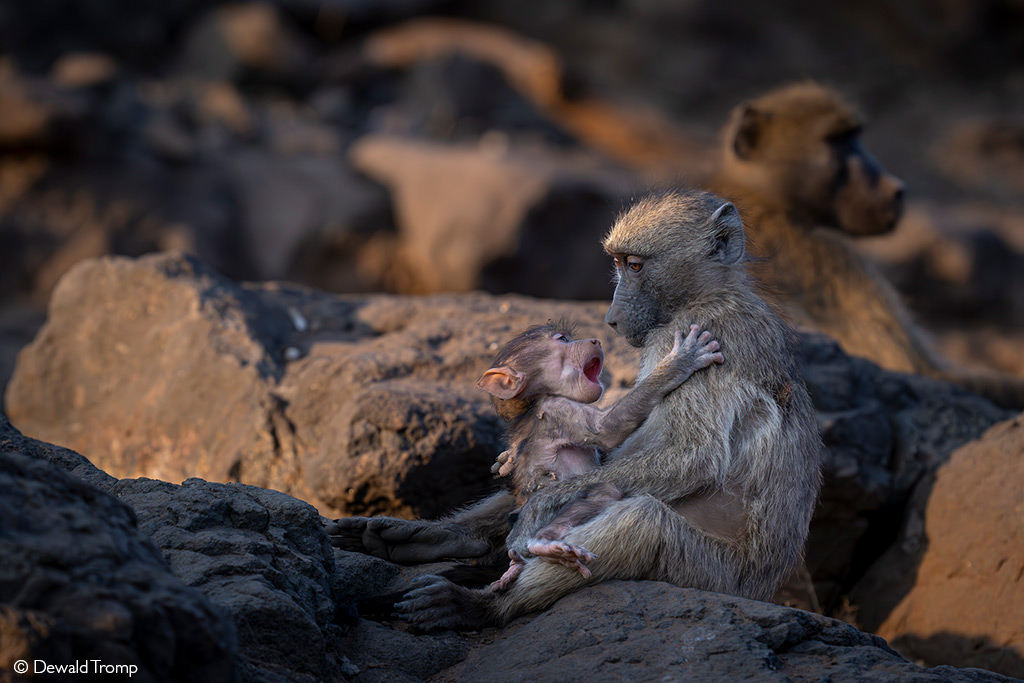
A tender early-morning moment as an adolescent baboon caretaker cradles a boisterous youngster. We were surrounded by a large troop and loved the antics of these entertaining performers. © Dewald Tromp
Mashatu
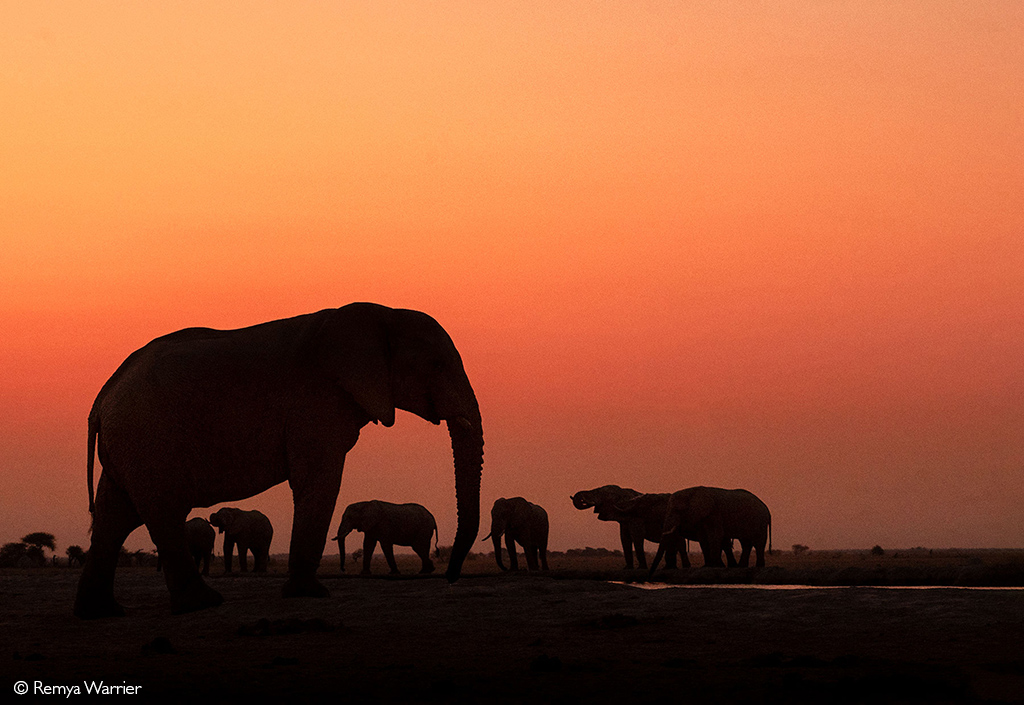
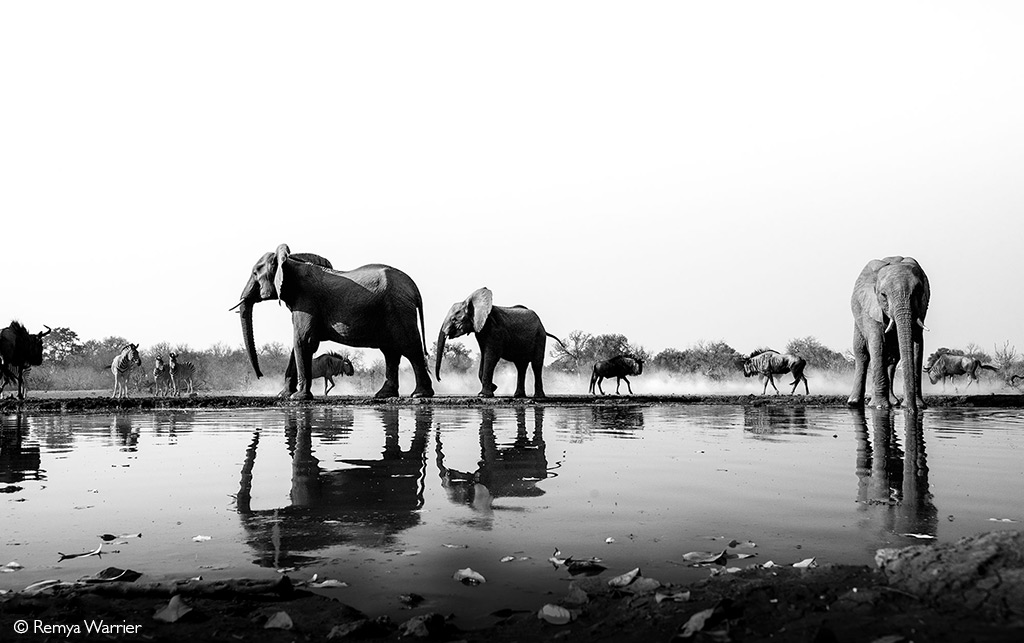
Elephants etched against the Tuli skyline as hordes of animals gather in the dust to take turns to quench their thirst at the waterhole. © Remya Warrier
Africa Geographic Travel
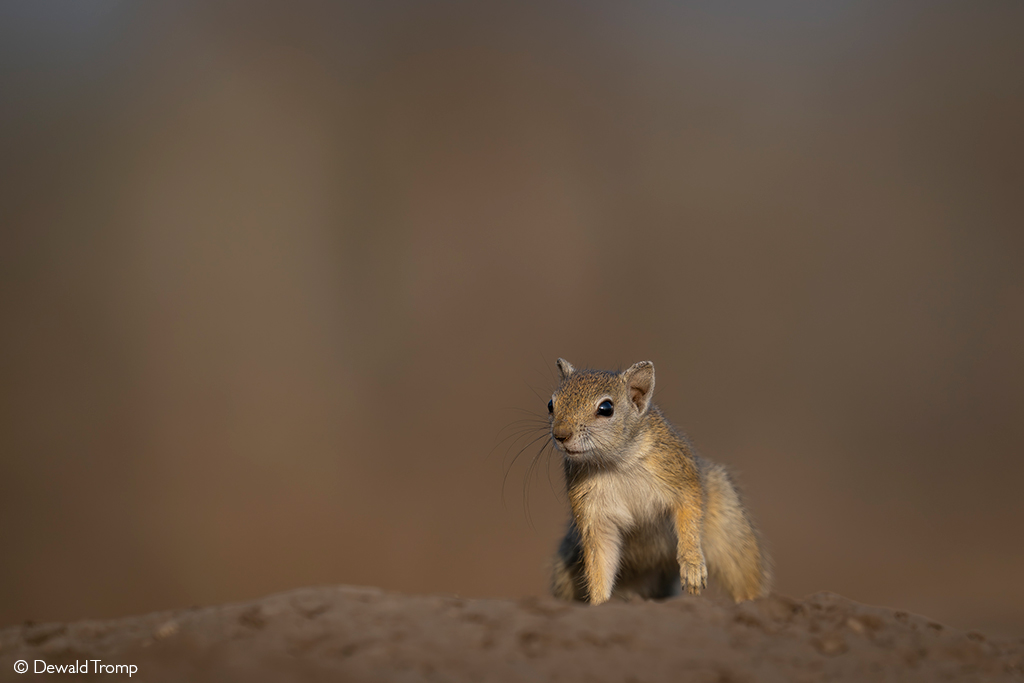
A tree squirrel approaches the water cautiously before satisfying its thirst. There are few trees near the waterhole, and these largely arboreal squirrels are exposed to predation when so far from safety. © Dewald Tromp
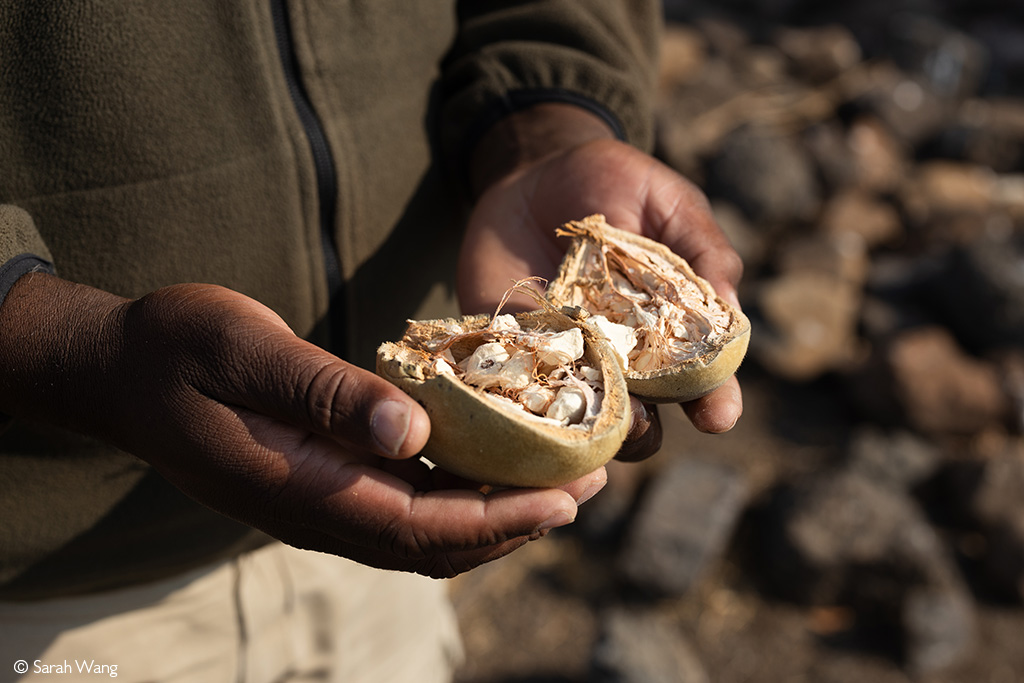
Our guide Goms shows what the inside of a baobab pod looks like © Sarah Wang
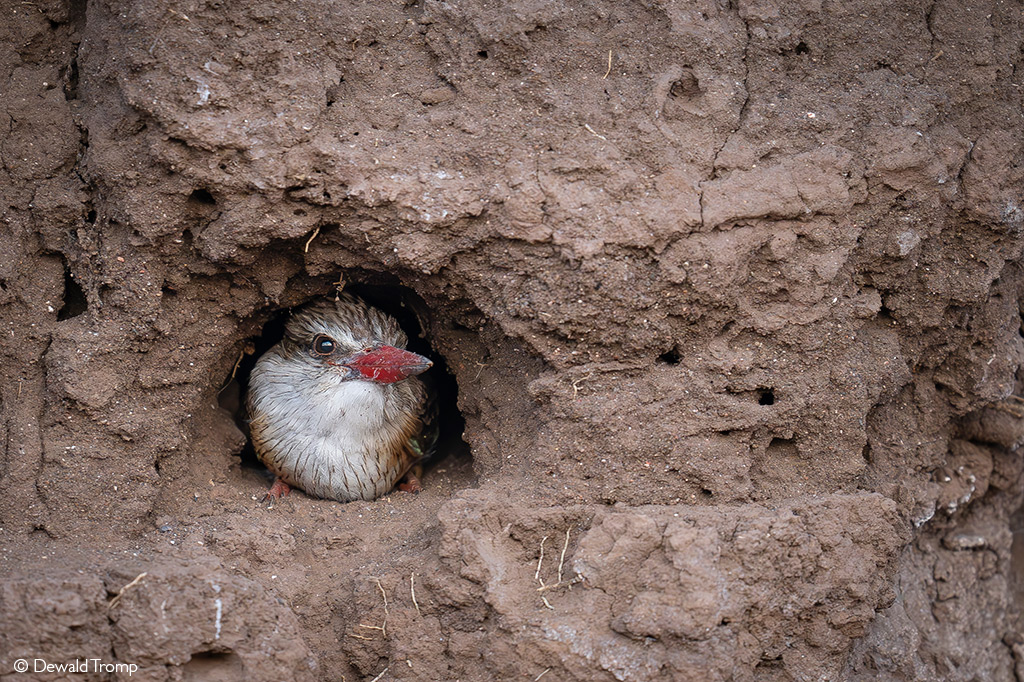
A brown-hooded kingfisher peers from its burrow in the bank of the Matobole River. © Dewald Tromp
Mashatu
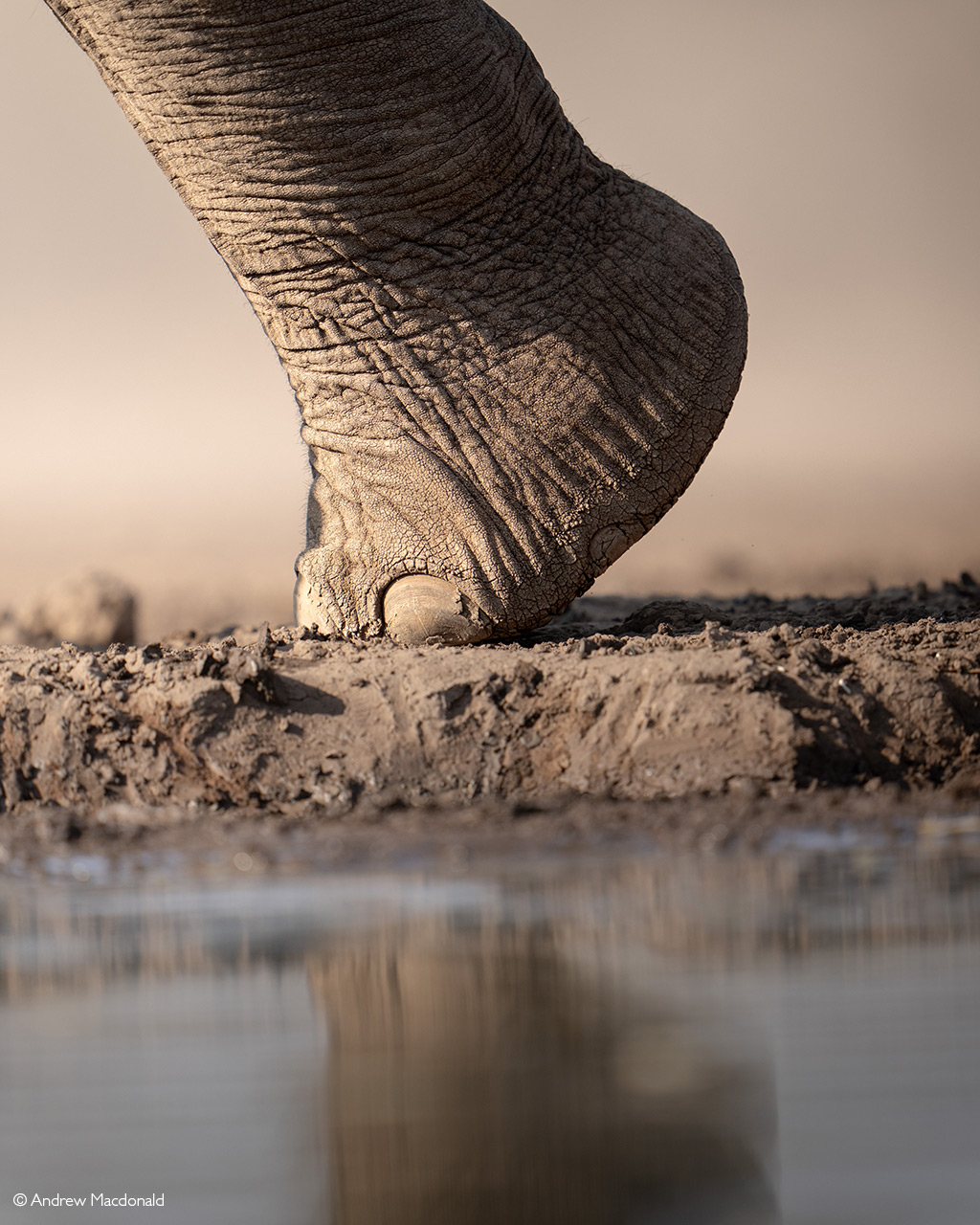
Ground-level view of an elephant’s back foot as it passes by the underground photo hide. © Andrew Macdonald

Underground photo hide

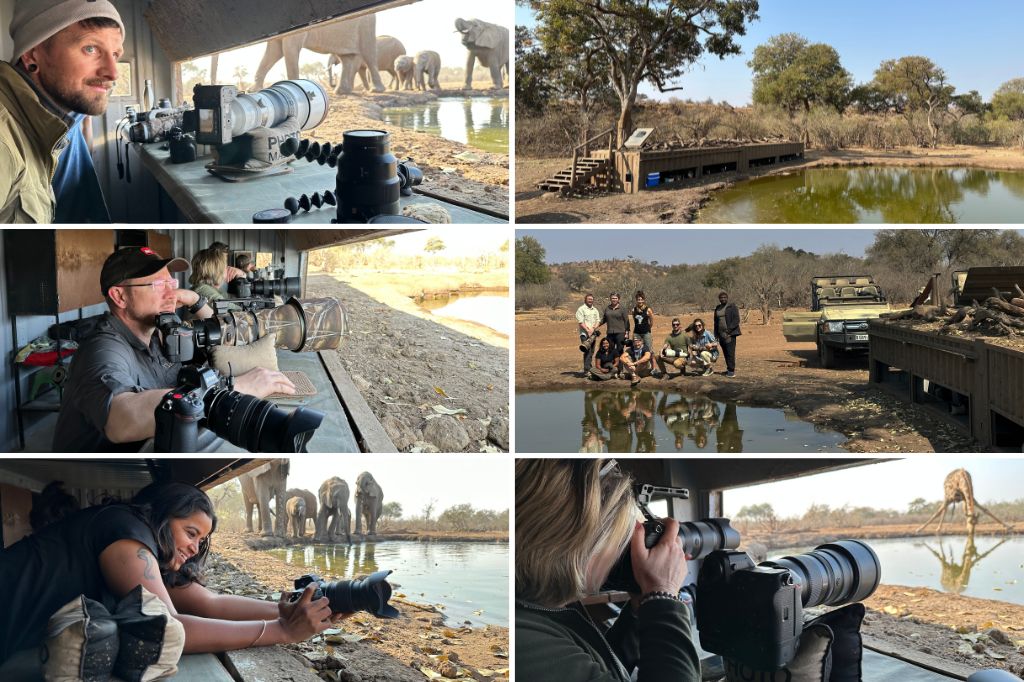
During our five days at Mashatu, we spent afternoon and morning sessions at the Mashatu Photo Hide. I attended as a non-photographer – armed with a mobile phone only. Both sessions were spectacular, but the morning session produced the most prolific wildlife encounters. The ground-level photos above were taken during these sessions, giving you an idea of the intimacy of the encounters. For an even better idea of what to expect, watch this excellent video by one of our crew – professional photographer Andrew Macdonald.

We sat in awe as squadrons of wildlife arrived, drank and left – vast herds of eland, giraffe, kudu, impala, zebra and wildebeest. We also enjoyed ogling green pigeons with their bright yellow socks, held our collective breaths as a pearl-spotted owlet worked the flocks of lark-like buntings and marvelled at the restless energy as wave after wave of queleas clambered over each other like a plague of mice. Usually, an alarm snort would scatter the crowds, and the resultant temporary silence seemed eternal. Then, it would start all over again as thirsty animals made their approach, gathering confidence as others joined. The elephants would then arrive to scatter the crowds and dominate the waterhole until they, too, had slaked their thirst and gone their way.

After hours of intense action, with full hard drives and aching eyes, we left to recharge our batteries with lunch or sundowners and canape nibbles. What an experience!

Mashatu
Capturing the action at Mashatu Photo Hide

Our lodgings

Mashatu
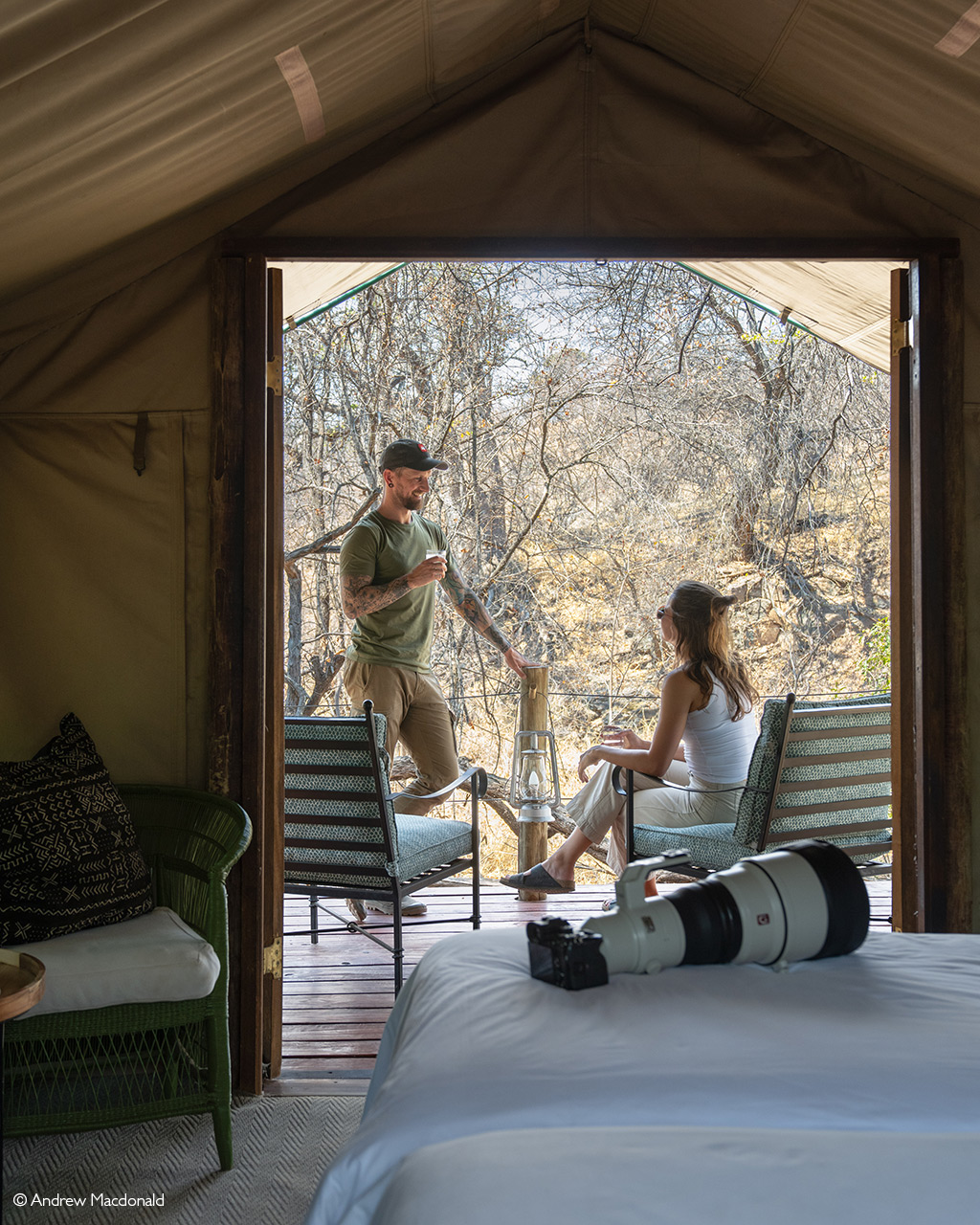
Enjoying the view from Mashatu Tent Camp

We stayed at two Mashatu lodges during our stay. Both were comfortable and offered service with a smile and superb food.

Mashatu Lodge offers 14 suites with private deck, air-conditioning, a double bed and extra-large single bed, a seating area that includes a single day bed, an en-suite bathroom with bath and shower facilities and a separate W.C. The guest common area features a day lounge, large swimming pool, the Discovery Room (a museum of all things Mashatu, past and present), dining area, Gin Trap bar and fully stocked curio shop with African crafts, clothing and jewellery. There is Wifi in the guest common area.

Mashatu Tent Camp offers eight tents tucked under the branches of shady trees, accessible via meandering pathways. Each elevated tent has private outdoor ensuite facilities, including a toilet and shower. The guest common area includes a lounge, dining and bar area plus an open-air thatched gazebo and boma (enclosure) overlooking the floodlit, well-populated waterhole (which has a small underground photo hide). The camp’s plunge pool invites guests to cool off and escape the relentless heat typical of the summer months. Wifi is available in the guest common area.

Resources

Watch Andrew Macdonald’s video on why wildlife photography hides on safari are a must-do – filmed while on our Photographer of the Year winners’ safari in Mashatu.

Spotting spotted hyena

spotted hyena
A spotted hyena photographed in Tanzania

How do you count spotted hyena? For many years, conservationists have struggled to find ways to estimate the population size of animals that are active at night and difficult to identify individually. To get an accurate estimate of the number of hyenas in a reserve, care must be taken not to count the same animal twice. In a new study, a team of researchers used camera trap surveys to determine hyenas’ spatial density across a Tanzanian landscape – providing the first population density estimates of this kind for spotted hyena in Tanzania.


Thriving or diving?

Hyenas have earned a bad reputation from movies like The Lion King, where they are portrayed as the drooling, ‘bad guys’ of the savannah. They have been considered relatively unaffected by human presence and are classified as “Least Concern” by CITES. But the species has lost 24% of its range in the last 40 years and is subject to increased threats from snaring, loss of habitat and a reduced prey base. And with limitations on counting hyena in the past, it is difficult to know if the species is thriving or diving.  Knowing how many hyenas there are in a landscape allows conservationists to assess how well a conservation intervention works – if the numbers are low, then something is amiss.

Despite this, there have been relatively few studies on hyenas, at least when compared to lions. Although possibly a more sought-after predator by many safari-goers, the lion is not more important than the hyena. Hyenas play an essential role as a predator and scavenger in the ecosystem. The recent study points out that only three “spatially explicit capture-recapture” (SECR) studies of hyena have been done in East Africa, and none in Tanzania. The “spatially explicit” part is essential: knowing the numbers of hyenas associated with specific habitats or regions gives us much information on what could be driving the numbers (e.g., an area with optimal prey habitat might have a higher density of hyena). The “capture-recapture” is crucial because it allows the researchers to ensure they aren’t double-counting individuals. Usually, this would require “marking” an animal with a ring or a tag, which puts animals under unnecessary stress. To get around this, instead of using tags to identify individuals (to avoid counting the same animal twice), the researchers used the hyenas’ spots.

hyena
Researchers used hyena spot patterns to identify specific individuals

Spot the difference

The study used camera traps in four surveys across an area recognised as a Key Landscape for Conservation – the Ruaha-Rungwa ecosystem in southern Tanzania. This 45,000 km2 landscape consists of different habitat and land-management types. The researchers used camera trap photos to guide the individual identification of spotted hyena, using the unique spot patterns of the hyenas’ fur to work out who was who in the hyena world. This allowed them to use SECR modelling to estimate spotted-hyena population density at the four survey sites.

Africa Geographic Travel

Where do hyena roam?

The four camera trap surveys were located in (a) the core area of Ruaha National Park, which is highly protected, productive and is used primarily for tourism; (b) an area of primarily miombo woodland in Ruaha (c) to the north in Rungwa Game Reserve, which is primarily miombo woodland used for trophy hunting activities, and (d) to the east of Ruaha in the community-managed Mbomipa and Waga Wildlife Management Area (WMA), which is similar in productivity to Ruaha but is adjacent to village lands. The Rungwa Game Reserve and Wildlife Management Areas buffer Ruaha.

Notably, there were almost twice as many hyena – 10.8 –  recorded per 100km2 in the protected and productive Ruaha National Park, compared to 5.82 in the game reserve and 5.11 in the Wildlife Management Area. Interestingly, a higher density of hyena was associated with a higher density of lions, which raises questions about the role of interspecific competition between lion and hyena. Studies have shown that lions can be a significant source of mortality for hyenas, but other studies have shown that hyenas benefit from lions by stealing their kills.


Want to plan your African safari to spot hyenas in the wild? We have ready-made safaris to choose from, or start planning a unique safari made just for you.


The lower number of hyenas in the WMA is likely due to the greater human disturbance in the WMA, which borders unprotected village land. The cameras recorded evidence of this activity, showing images of snared hyenas and illegal excursions. The closer proximity to humans increases the incidence of human-wildlife conflict, and studies have shown that hyena are often poisoned to reduce cattle predation. This study demonstrates that the protection offered to hyenas – by buffering human contact in the core national park by WMAs and games reserves – works. The core national park may serve as a source population, from which hyenas disperse into the WMAs and game reserves, which act as sinks, as the individuals in these areas face higher mortality risks.

The findings also provide some of the first insights into spotted hyena population ecology in miombo woodland habitat. Estimates from miombo woodland in Ruaha (3.55 per 100km2) and Rungwa (5.82 per 100 km2) were considerably higher than estimates from miombo habitats elsewhere (for example, at 2.62 in Majete Game Reserve, Malawi). Densities in the miombo woodland of Rungwa were likely highest as this area receives high rainfall and likely supports high prey density and, consequently, more hyenas.

hyena
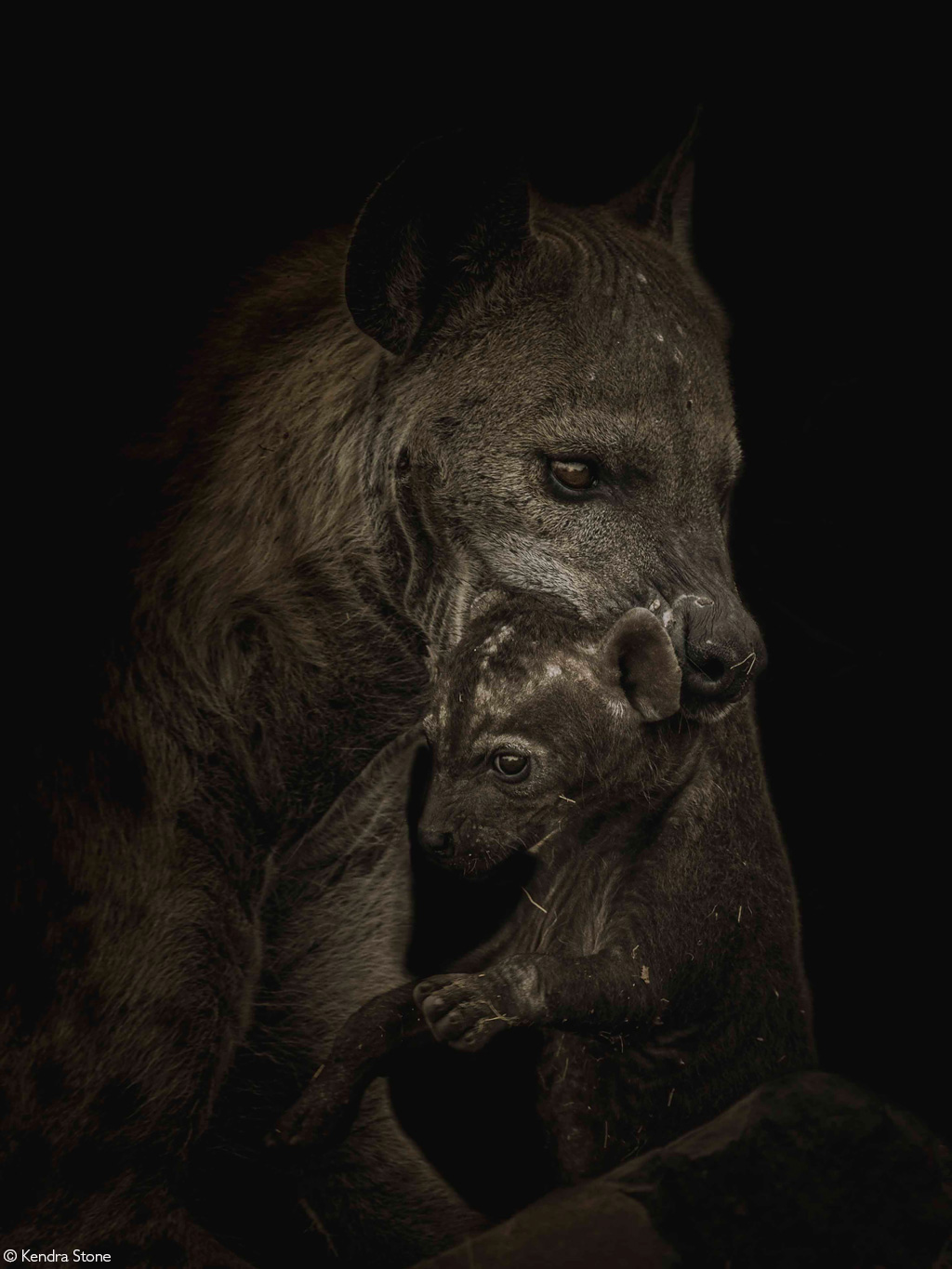
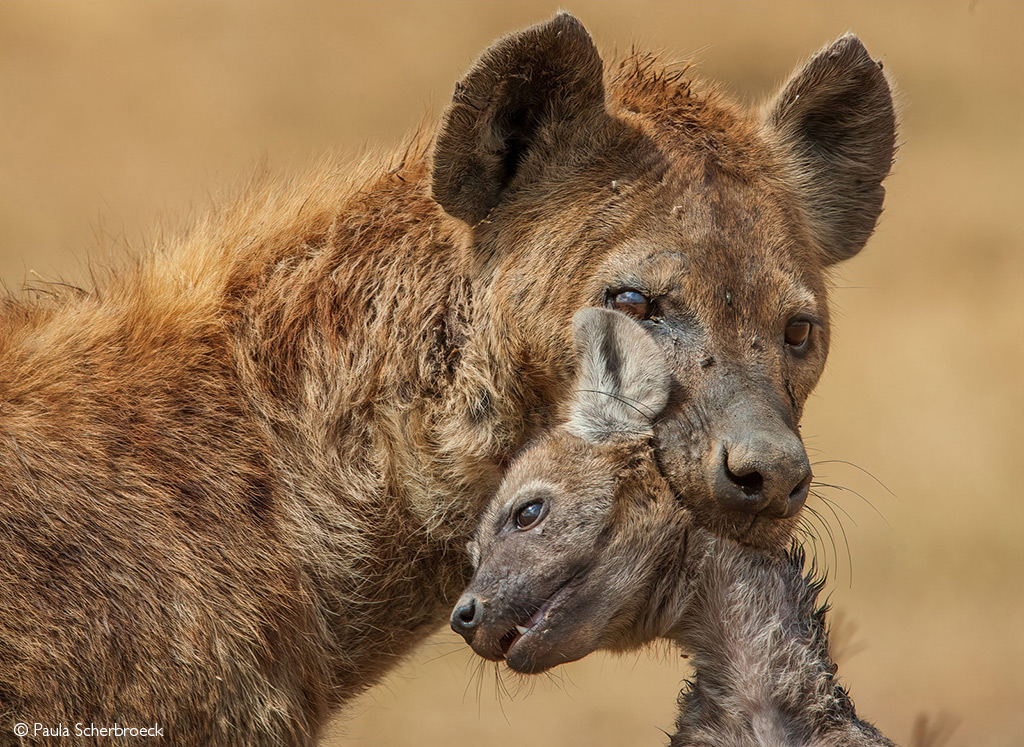
A hyena carries its cub to a new den site

The bigger hyena picture

Using spatially explicit density methods allows for a bigger picture to emerge. How the hyena uses the landscape depends on multiple factors that interact and impact population size. Habitat type (productivity in terms of supporting prey numbers) and protection from human-induced mortality (snares and disturbance) seem to have a more significant impact on digits than the presence of other predators (lion and leopard). Knowing this gives conservationists a better idea of what hyenas need to persist in landscapes of mosaic uses and habitats.

Reference and resources

Searle, C.E. et al. (2023). Spotted hyena population density across habitat and land use types in southern Tanzania. Journal of Zoology.

Learn everything there is to know on spotted hyenas here.

Read more about the social networks inherited by hyena here.

Learn about the self-sacrifices made by hyena cubs infected by a microscopic parasite.

Spotted hyenas have elaborate sex lives, and high-ranked male spotted hyenas are more reproductively successful than their low-ranked rivals – read why here.


THIS WEEK – 19 January 2024

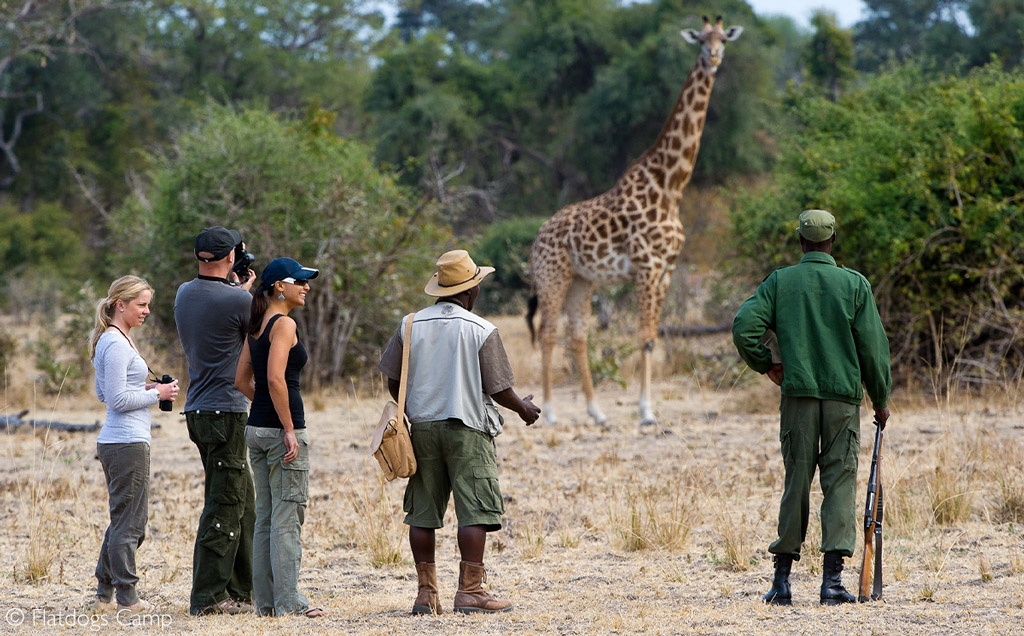
Up close and personal with a giraffe in South Luangwa, Zambia, while on a walking safari. © Flatdogs Camp

This is a copy of our weekly email newsletter. Subscribe here to receive the newsletter.


THE Big-5 guide + Lake Mburo + pro photo safari

Try this method to REBOOT your appreciation of Africa’s awesomeness when you are next on safari. Come game drive time, leave the camera and mobile phone back at camp. Separation anxiety is a real thing, but it will pass as you enjoy the theatre of the wild. Your senses will swell with a sense of purpose as you engage them more fully to extract the nuances of every natural signal that enters your personal space. You see, when we use our recording devices we deactivate most of these senses to focus purely on the mission to create a digital confirmation of real life. We outsource the experience to a device and focus instead on the device settings and lens view. Compare the wild celebrations of previous New Year’s Eve parties when that clock struck midnight to the current version: mute creatures pointing cell phones in the air. Get my point? Savour the moments on that game drive and think about a revamped relationship with your recording device – make it subservient to your appreciation and enjoyment of life.

Thanks to all who shared last week’s story about two more giant elephants – super tuskers – killed by trophy hunters. The article caused quite a stir on social media: there has been a slew of debate and we are proud to have triggered that essential process. Some important people have taken notice and we hope that wise decisions are being made. Thanks also to those who sent us additional information about the hunting parties involved – all useful info has been forwarded to relevant organisations. KEEP SHARING the article! A luta continua

Simon Espley – CEO, Africa Geographic


From our Editor – Taryn van Jaarsveld

How do plants survive droughts in arid areas? Well, in the semi-desert of the Karoo, South Africa, the hero of our story is none other than a tiny tortoise.

Did you know that the diminutive Karoo dwarf tortoise plays an essential role in the survival of plants in the Karoo? At 11cm long, the tortoise is one of the world’s smallest. Researchers have just found that the tortoises plays a vital part in helping plants to survive drought by dispersing seeds to suitable microsites for germination. The tortoise locates and eats rare plants, and passes viable seeds through its digestive tract. As an added bonus, the tortoise’s preferred habitat of ample shade and run-off water happens to be the ideal habitat for germination. And that is how this tiny, highly endangered tortoise packs a huge punch, highlighting the broad role that understudied species can play in a landscape.

Talking about dynamite in small packages, don’t miss our story on Lake Mburo, Uganda’s smallest national park – which offers ample wildlife and diverse habitats. And if you’re on a quest to see the Big 5 on safari, check out the essential tips and ready-made safaris in our second story below.


Story 1
LAKE MBURO
Uganda’s smallest national park offers ample natural diversity – from lakes to savannah, giraffes to leopards, and birding

Story 2
BIG 5 SAFARI
Seeing lions, leopards, elephants, buffalos & rhinos on safari is always a special experience. Here are our tips on how and where to spot them


Travel desk TRAVEL DESK: 

Maasai Mara specialist photographic safari – Kenya – 9 days – from US$7,255pps

Fancy a guided photographic safari in the Maasai Mara? Join award-winning photographer Arnfinn Johansen on this exclusive safari for four guests in Maasai Mara, Kenya. Highlights include guided game drives by an experienced Maasai guide in a modified photographic vehicle, and accommodation at Oltepesi Tented Safari Camp.

Or looking for something different? How about Kenya’s other top wildlife areas?


Trip Report

Olivier Billon and family went on a South African safari with AG. From Greater Kruger to Cape Town, the Billons had a whirlwind taste of the best South Africa has to offer. Olivier says:

“We had a marvellous family trip during the Christmas holidays. AG tailor-made a perfect trip for us. The choice of lodges in the Kruger area was very good and well sequenced – and we met very professional and smiling staff everywhere. The accommodation in Cape Town was very comfortable and well located. The communication with AG’s travel experts was very fluid and efficient. We highly recommend AG!”

Want to experience the best of South Africa? Check out this iconic bush & beach safari


WATCH: Not for the faint hearted. A rhino stuck in a muddy waterhole attracts the attention of hungry lions… But will a passing elephant be able to help? These tourists witnessed hours of wildlife action at Aus waterhole in Etosha National Park. (02:58) Click here to watch

For more videos celebrating Africa, check out our videos here

Lake Mburo National Park

Adventurer or birder, serious wildlife spotter or aquafile, or simply seeking that once-in-a-lifetime African safari –  Lake Mburo National Park awaits you. Lake Mburo is Uganda’s smallest national park, with an area of just 260 km2, but it packs a punch with its diversity of natural wonders. There’s a little magic for everyone, from lakes to savannah, from giraffes to leopards, from walking to fishing.

The Lake Mburo National Park (Lake Mburo)’s slogan is “whispers of the wild”, and indeed the soughing of wind in the trees and grasses brings peace to the city-worn soul. If one listens carefully, there are other whispers in the wind, voices from bygone eras, from people who have loved the land before.


Check out Uganda for your next African safari. We have ready-made safaris to choose from – or ask us to build one just for you. 


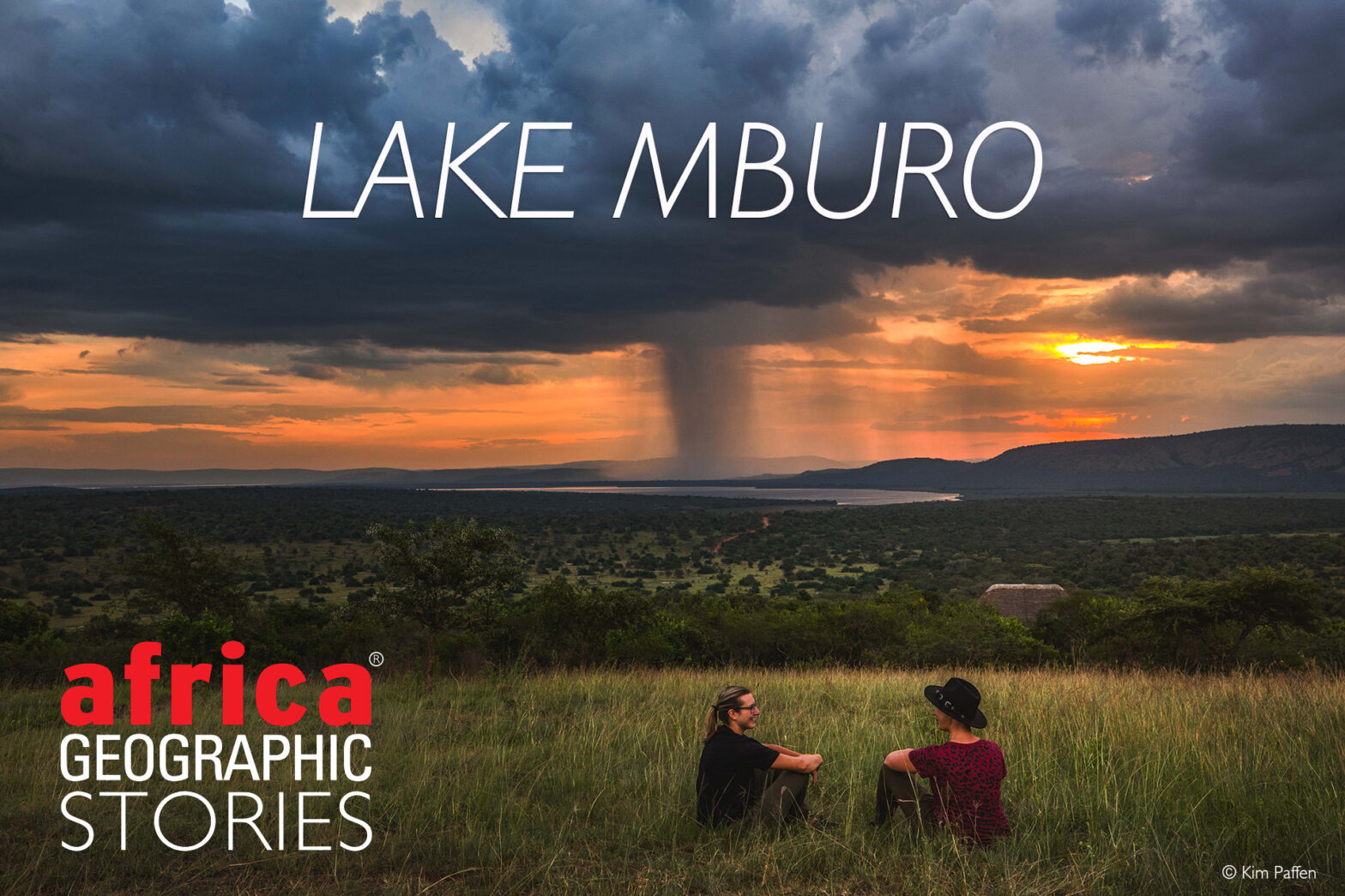
Cover image courtesy of Kim Paffen.

Lake Mburo’s call of the wild

A visit to the Lake Mburo National Park is often included on safari itineraries because it offers the sweeping vistas of the typical savannah habitat, and it is also the only protected area in the country with impala and Burchell’s zebra. Lake Mburo offers the quintessential African safari experience. One feels that at any moment, Hemingway may join you for a gin and tonic around the campfire.

Lake Mburo
Guided walks allow up-close encounters with Lake Mburo’s wildlife

But Lake Mburo goes one step better. Besides the savannah element, the park is a treasure trove of other habitats, including five lakes and 50km2 of wetlands. The park hosts hills and shrublands, grasslands, seasonal and permanent swamps, rocky outcrops and thickets. With each habitat comes its cast of inhabitants, from birds to otters.

Lake Mburo
The park hosts a treasure trove of habitats, including five lakes shrublands and grasslands

Africa Geographic Travel

The wild things of Lake Mburo

The birds are the jewels in Lake Mburo’s crown. With over 300 bird species recorded here, many associated with the acacia and water habitats in the park, this is a birder’s dream come true.  Birds adorn the trees like Christmas decorations, tiny dots of colour and chirp. Lake Mburo has given many a birdwatcher their first exciting glimpse of the elusive African finfoot with its bright red, big feet or the sighting of the brown-chested lapwing that arrives in November to hang out on the zebra trails.

Lake Mburo
More than 300 bird species are recorded in Lake Mburo, including saddle-billed stork

The rasping calls of the near-threatened red-faced barbet will draw you into the woodlands and, in the wetlands, there is the opportunity to watch the giant, solemn-looking shoebill (actually part of the pelican family), standing still and ponderous at the water’s edge. Other bird species with names that roll off the tongue include the green-winged pytilia, papyrus yellow warbler, African paradise flycatcher, black-headed gonolek, rufus-bellied heron and many more. Lake Mburo has the highest concentration of raptors in Uganda (35 species), including the African-Eurasian migrant the African harrier hawk.

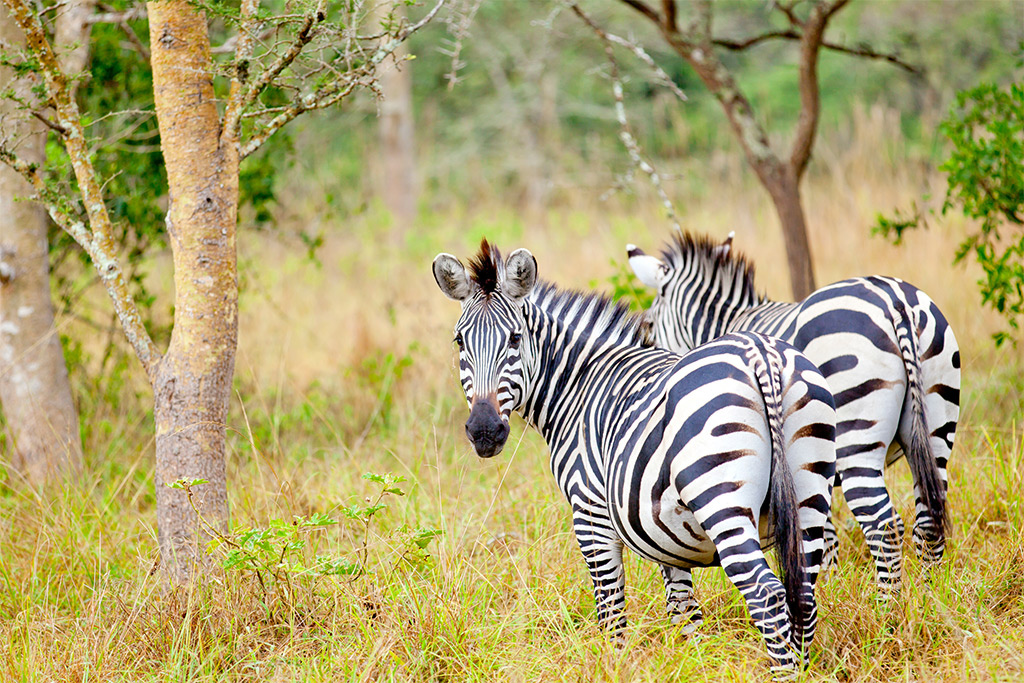
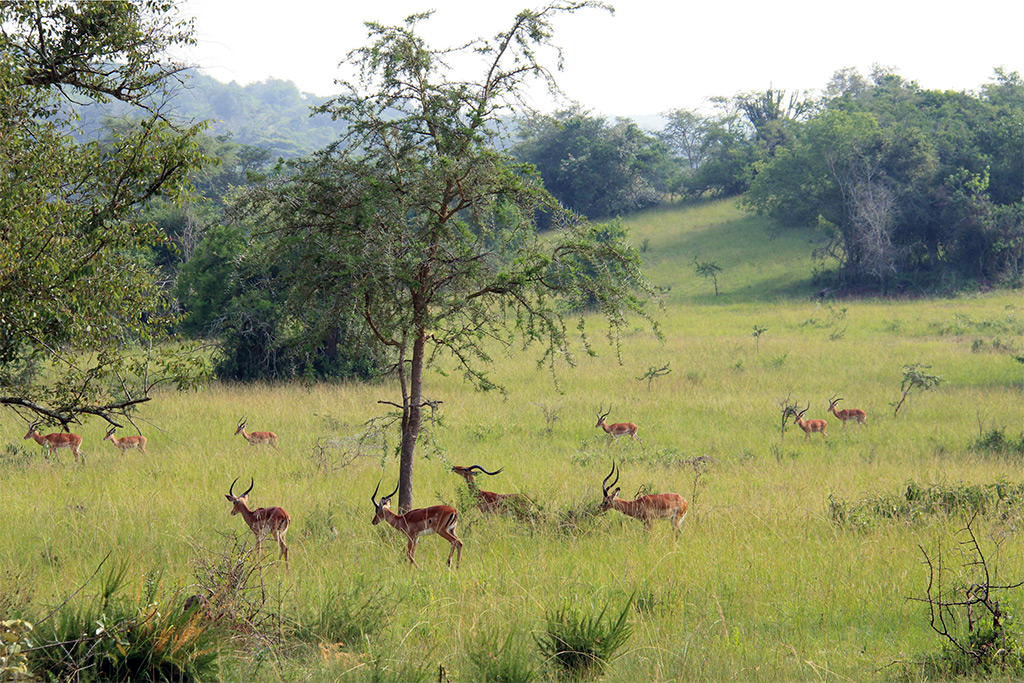
The national park is the only one in Uganda with eland, impala and klipspringer. It is also home to the largest zebra population in Uganda – estimated at 5,000 large – and probably contains the highest concentration of leopards found anywhere in Uganda (about 25 in total, according to a recent camera trap study). Other animals that inhabit the park include buffalo, waterbuck, topi, oribi, warthog, reedbuck, hyena, genet, bush pig and white-tailed mongoose. The lakes support about 300 hippos and a heap of Nile crocodiles.  Three otter species frolic in the lakes’ waters: Congo clawless, Cape clawless, and the spotted-neck otter.

Lake Mburo
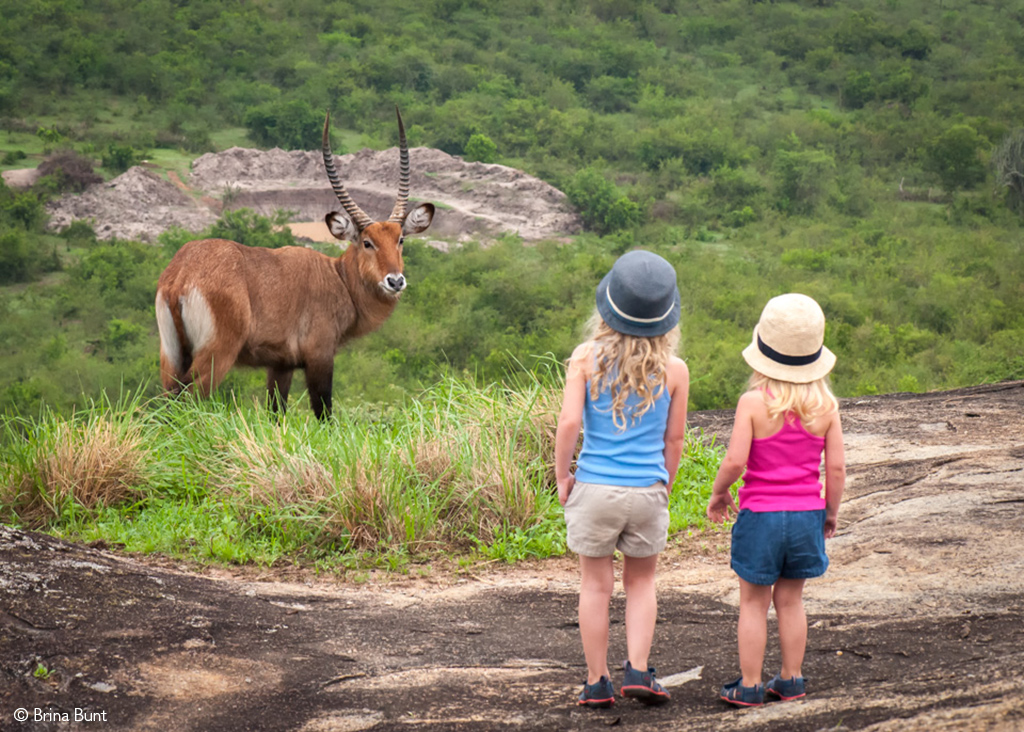
Lake Mburo is home to abundant wildlife, including defassa waterbuck
Lake Mburo is the only protected area in Uganda with impala and Burchell’s zebra
Large herds of impala can be found in the park

Africa Geographic Travel

The story of Lake Mburo

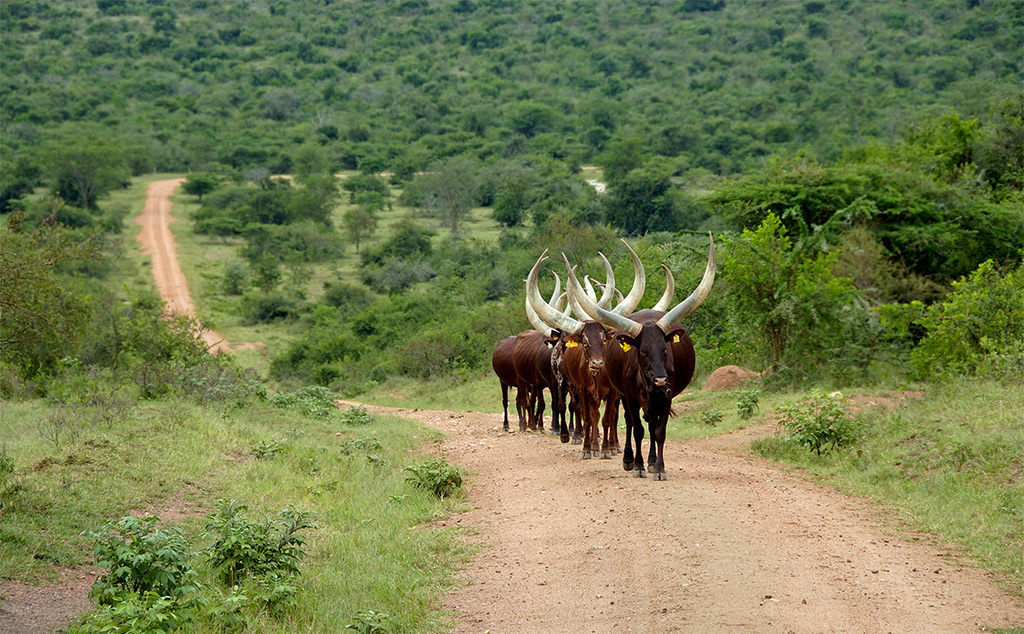
Lake Mburo’s history explains why it has remained a sanctuary of wilderness. Before it became a protected area, it was known for the culture of pastoralists who roamed its plains and hills as the “Karo Kurungi” (translated as “beautiful land”). The culture of the Banyankole Bahima people has been instrumental in preserving its beauty. Part of this is that the Bahima believed that the beauty of their Ankole cattle depended on preserving the pastoral beauty of the ancestral lands of Karo Kurungi. Ankole cattle, a breed of Sanga long-horned cattle, are well-adapted to living on sparse forage and minimal water and provide meat and very rich milk. The Bahima believed they had been charged with the care of the Ankole and that their cattle’s success depended on the land remaining beautiful – and thus unfarmed, uncropped and unfenced. This prevented other factions of the Banyankole – the Bahinda and Bairu farming class – from turning Karo Karungi into a production landscape of farms and fences.

Ankole cattle are an important part of the heritage of Bahima people

As rangeland grazing in the savannah biome is determined by the unpredictable vagaries of sun and rainfall, pastoralists needed to meander far and wide with their cattle. This intermittent grazing, unrestrained by fences, allowed the grasslands to rest and recover after grazing. The cattle grazing also kept the grasslands open from bush encroachment (when acacia tree thickets started to dominate the plains).  In essence, the pastoral nature of the Bahima kept the savannah intact.

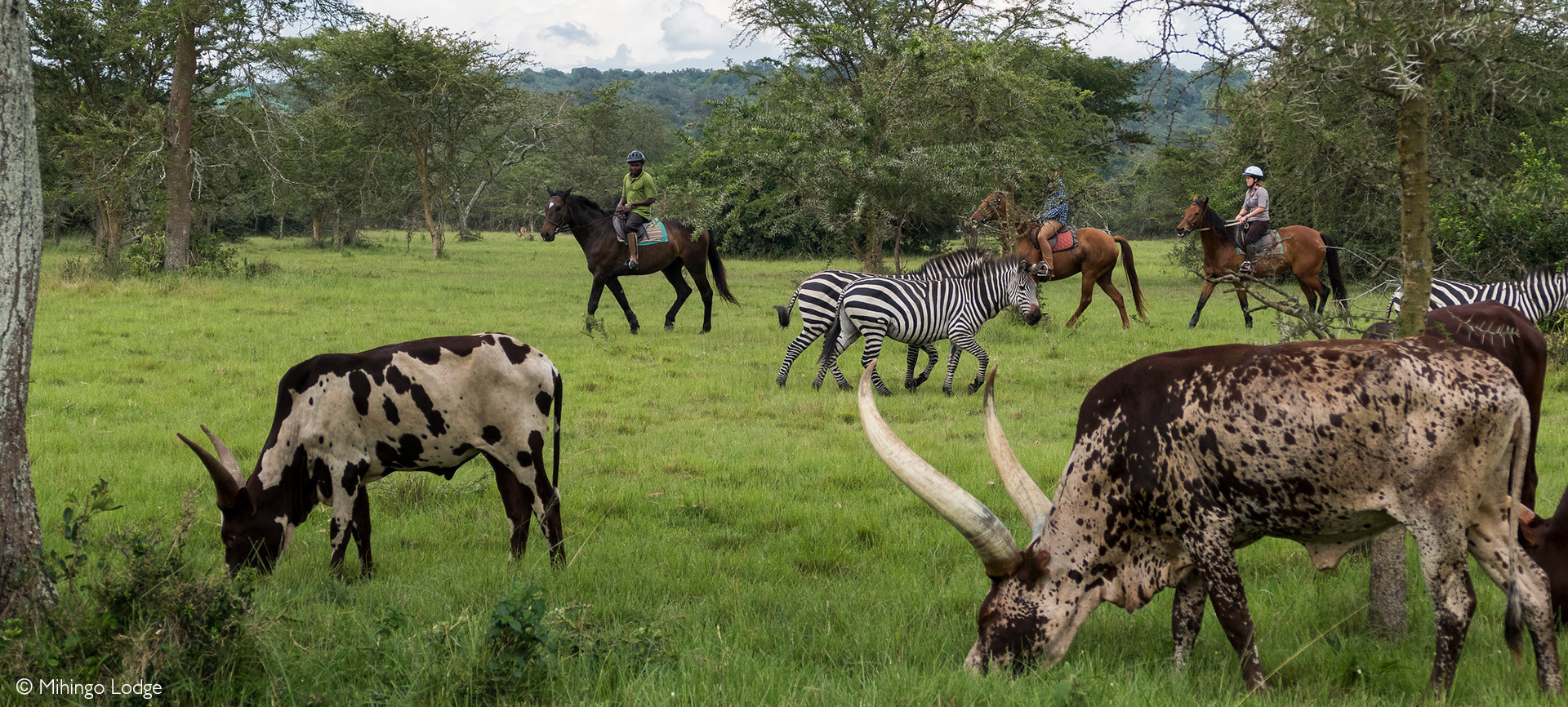
Visitors will sometimes see Ankole cattle grazing alongside zebra in the park

This, however, all went awry when the park was gazetted in 1983, and residents were evicted from the land with little consultation and no compensation. Effectively, the Bahima were abruptly disconnected from their “Beautiful Land” and their pastoralist identity. But the story does not stop there. People in power listened to the story of the Bahima’s Ankole cattle, of how the culture’s values were tied inextricably to the land, and the state reopened the park and degazetted some of the land in 1986. Now, the park is unfenced and managed to include the values of the Banyankole culture as well as the protection of wildlife. As a result, visitors will sometimes see these cattle, stippled with patterns that look like the dapplings of light through the trees, grazing alongside zebra in the park. The park and the people have started a new journey together, which is why Lake Mburo is so special. It is one of the few places left that reflects Africa’s fenceless, wild, untamed rangelands. It is an oasis amongst the surrounding landscape’s dairy farms and subsistence croplands.

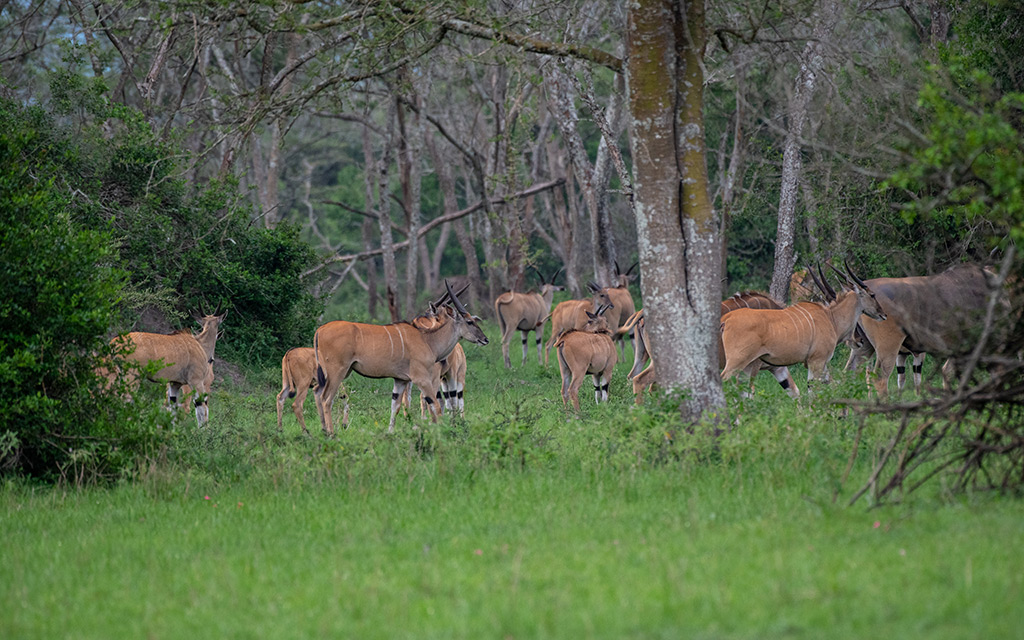
Eland grazing in Lake Mburo’s woodland

Activities in Lake Mburo

The park offers an array of guided activities – enough to whet the tastebuds of any explorer – from walking and cycling to horseback safaris and game drives. These provide a unique experience of moving amongst the giraffe and zebra in their habitat.

Admiring a defassa waterbuck

Night game drives can be arranged to increase your chances of seeing night-dwelling creatures, such as bush babies, genet, leopards and porcupines.

A guided game drive will take visitors to the heart of the action

Visitors can also take to the water in Lake Mburo on a two-hour boat cruise, which allows the opportunity to watch crocodiles and hippos, hear the iconic call of the African fish eagle and seek out exciting wetland birds. Private cruises can also be arranged.  Fishing permits are also issued by the Uganda Wildlife Authority to allow the chance to catch tilapia in the lake.

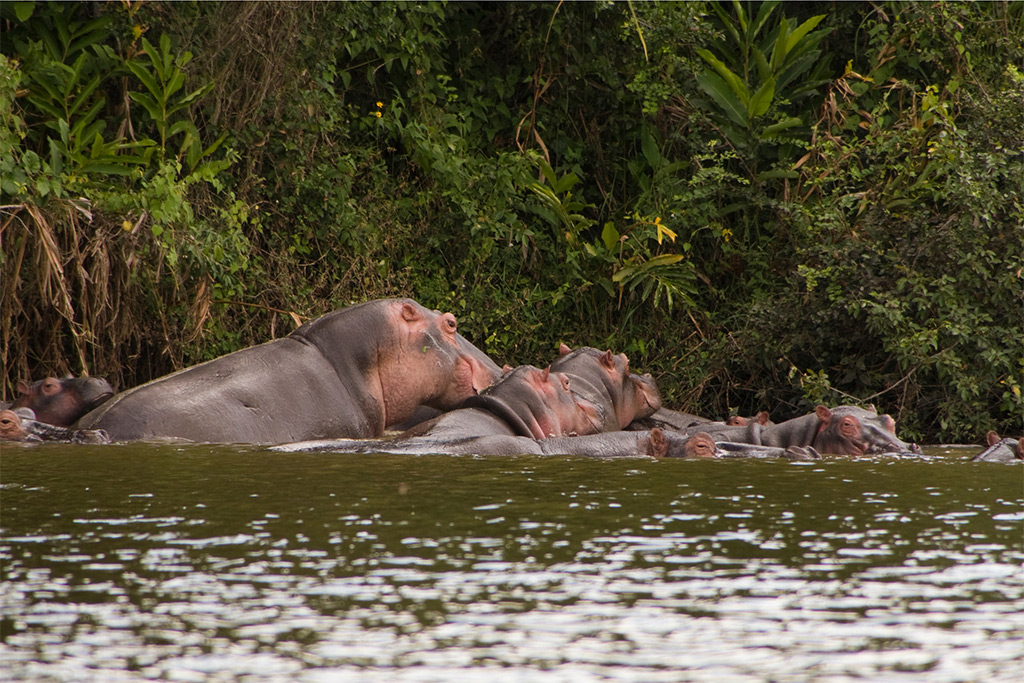
Hippos resting in one of Lake Mburo’s five lakes

Africa Geographic Travel

Explore and stay

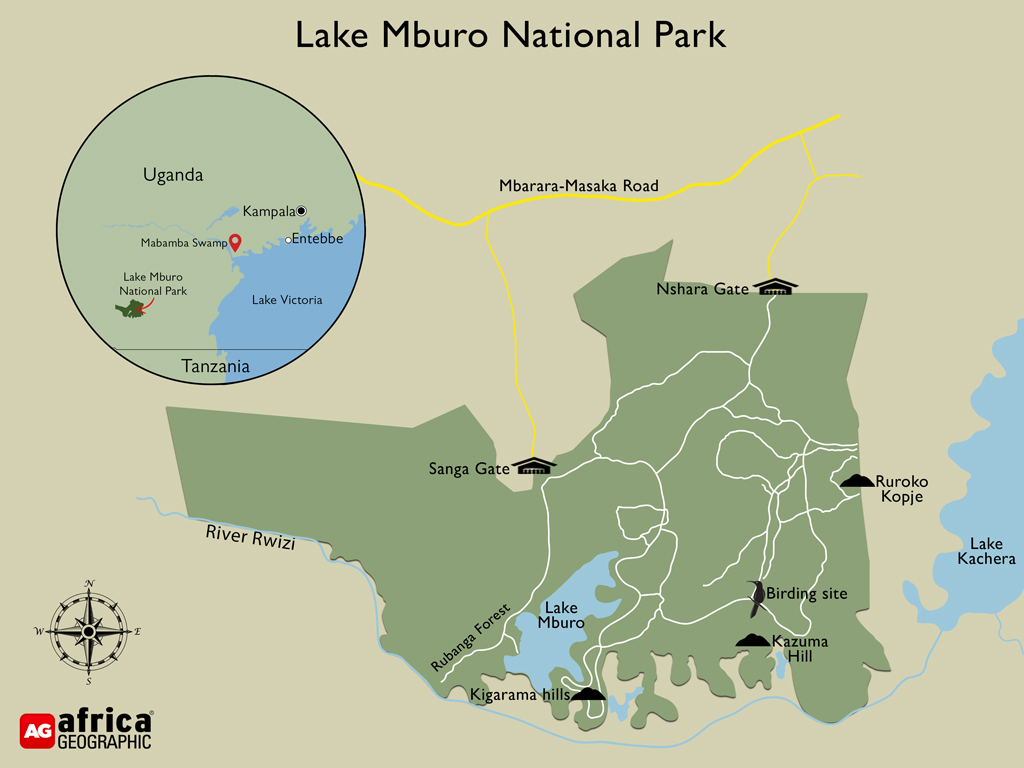
Keen on visiting Lake Mburo for your next African safari? The park offers a wide variety of accommodation options available in and outside the park, from affordable camping sites to luxury lodges. It is easily accessible and only a 3-hour drive from Kampala, though there are also chartered flights available from Entebbe International Airport to the airstrip in Mbarara, a 90-minute drive from Lake Mburo.

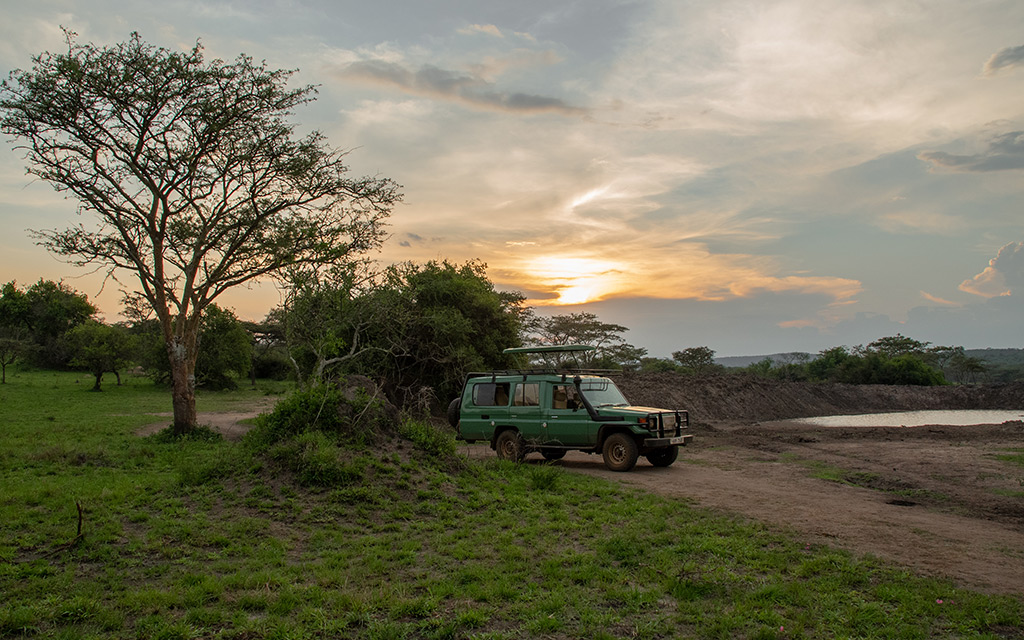
Sundowners with a view, anyone?

Lake Mburo NP is often included as a convenient and enjoyable halfway stop point on the long drive between Kampala and Bwindi Impenetrable National Park – popular for its gorilla trekking opportunities.

The park’s annual rainfall and temperatures average 800 mm and 28°C, respectively. The best times to visit are during Lake Mburo’s two dry seasons: December to February and June to August.

If you can visit this “Beautiful Land” with its abundant birdlife, speckled cattle, pronking impala and lissom giraffe, then don’t hold back – Africa’s magic awaits you.

Resources

Read more about the epic birding experiences on offer in Uganda, including in Lake Mburo

THIS WEEK – 12 January 2024

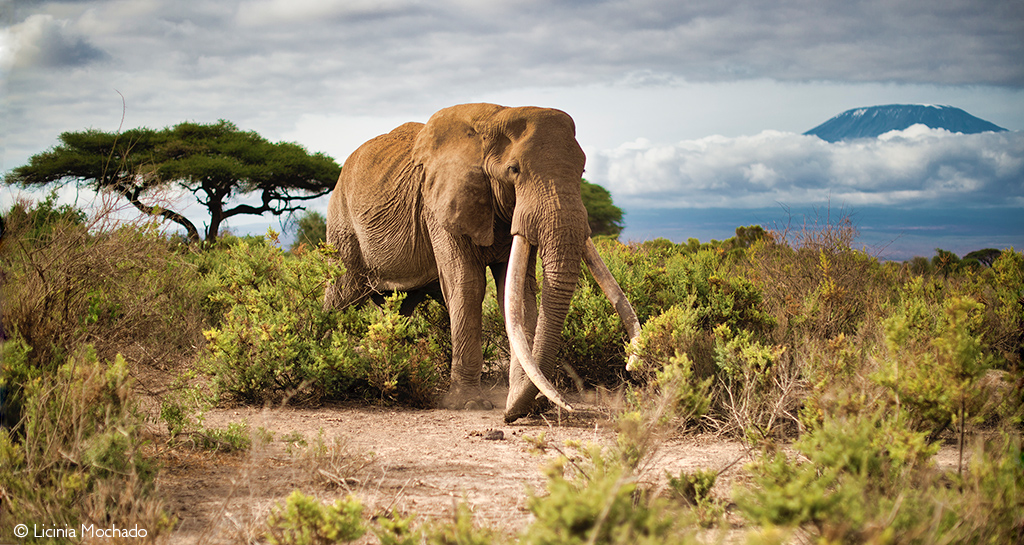
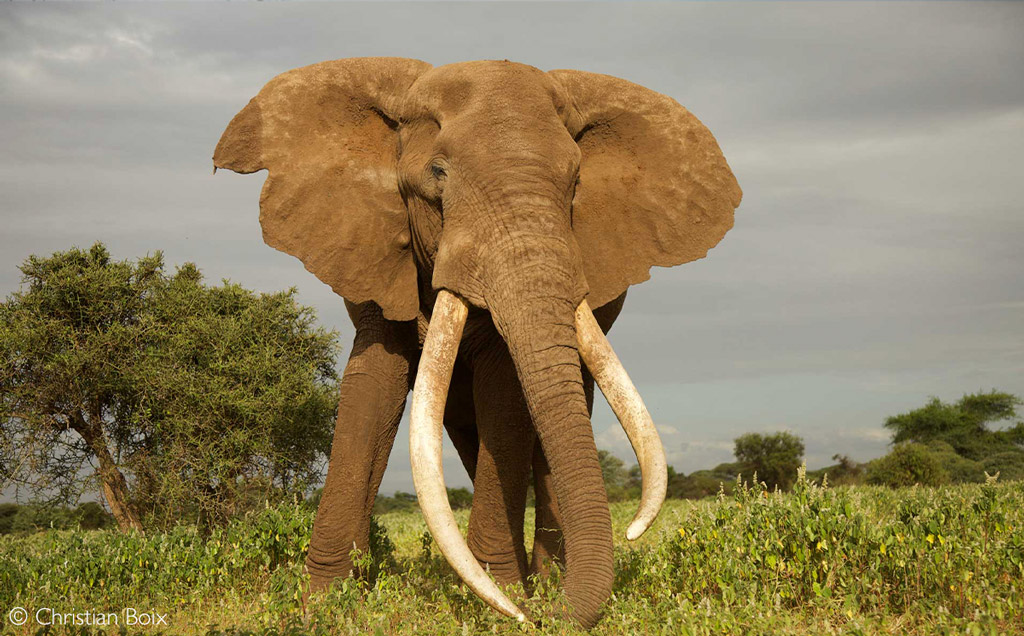
Well-known super tusker Craig, a gentle giant of Amboseli, is one of a diminishing population of 100-pounder elephants left in the world. © Christian Boix

This is a copy of our weekly email newsletter. Subscribe here to receive the newsletter.


2 super tuskers hunted in Tanzania

Yet again a concerning trophy-hunting report interrupts and postpones what was going to be a celebratory editorial.

Our story below is just another example of how individuals within the trophy-hunting industry are focussed on removing the extraordinary but dwindling populations of genetically gifted individuals amongst our free-roaming wildlife.

To our ever-supportive AGtribe across the planet, please share this article far and wide. Sparking just one relevant decision-maker could generate enormous conservation benefits. Even the hunters amongst you know that this is wrong and that things have to change.

This is a shout out to other safari tourism brands and individuals to get involved – join us in identifying and calling out this destructive, immoral behaviour. Share the link below with influential people in your networks – you know who they are. Go beyond your corporate handcuffs; stick your head above the parapet and condemn the evil ones. Yes, you may suffer insults, threats and sanctions (we certainly do) – but your clients and followers will know what you stand for. You know what to do – just do it. Please.

Keep the passion

Simon Espley – CEO, Africa Geographic


From our Editor – Taryn van Jaarsveld

Elon Musk has again warned that Artificial Intelligence is a risk to humanity that could lead to civilisation destruction, and called for its regulation. Musk’s foreboding has us all questioning – will AI be used for good, or evil?

In the hands of the right people, it can work wonders. Did you know AI is helping conservationists manage ecosystems and protect endangered species?

In Congo-Brazzaville’s Nouabalé-Ndoki National Park, the Elephant Listening Project uses AI to sift through the noise in a tropical rainforest to identify forest elephant calls – enhancing tracking and security. Peace Park’s Foundation uses AI for autonomous poacher detection in South Africa’s Hluhluwe-iMfolozi, while Save the Elephants uses the tech to alert rangers when elephants have slowed down or stopped moving.

Analysing masses of data on animal behaviour and habitat condition is the perfect job for AI – simplifying tasks that would take humans years. In the right hands, AI combats biodiversity loss, monitors ecosystems and identify trends – streamlining conservation efforts.

Happy celebrating Africa!


Story 1
TROPHY HUNTED
Two 100-pounder elephants have been hunted in Tanzania – raising questions about the targeting of Amboseli’s last super tuskers

Story 2
GIRAFFE BESTIES
Do giraffes choose social groups based on appearance? A recent study investigates if giraffes form bonds based on spot shape


Travel desk TRAVEL DESK: 

Art Safari with Alison Nicholls – Timbavati – 7 days/6 nights – from ZAR 67,315 pps

Whether you are a passionate beginner or a seasoned creator, this unique art safari offers the chance to hone your skills with professional wildlife artist Alison Nicholls. Soak up the atmosphere of the Big-5 Timbavati Private Nature Reserve in the Greater Kruger, South Africa and channel it into artistry. 21-27 September 2024 – only 3 spots left! Or, get in touch with our travel experts to plan your 2024 safari.


Want to make your mark for wildlife conservation in 2024?

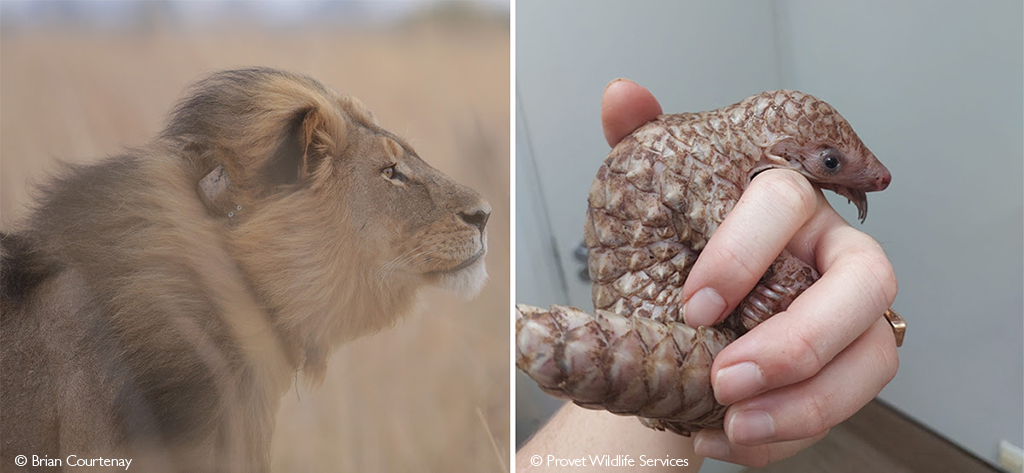
Consider lending your support to our Collar a Lion and Save a Pangolin campaigns. These key species and the experts tirelessly protecting them need our help to make an impact on their long-term survival.

Why do these projects need your support?

  1. The African lion is a vulnerable species – their population has decreased by 75% in just five decades. Any donation – large or small – will help finance collars and support this critical conservation project.
  2. Your donation will help shift the scales in favour of these pangolins – it will provide the funds to deal with the seasonal influx of these precious creatures – the world’s most trafficked animal.

WATCH: Our safari experts view January and February as the months to experience the calving season for wildebeest in Maasai Mara, and predator action in Kruger. The weather is fine on East Africa’s paradise islands, and clear skies make for excellent gorilla trekking. Here’s what’s on offer for your January and February safaris. (01:30) Click here to watch

For more videos celebrating Africa, check out our videos here

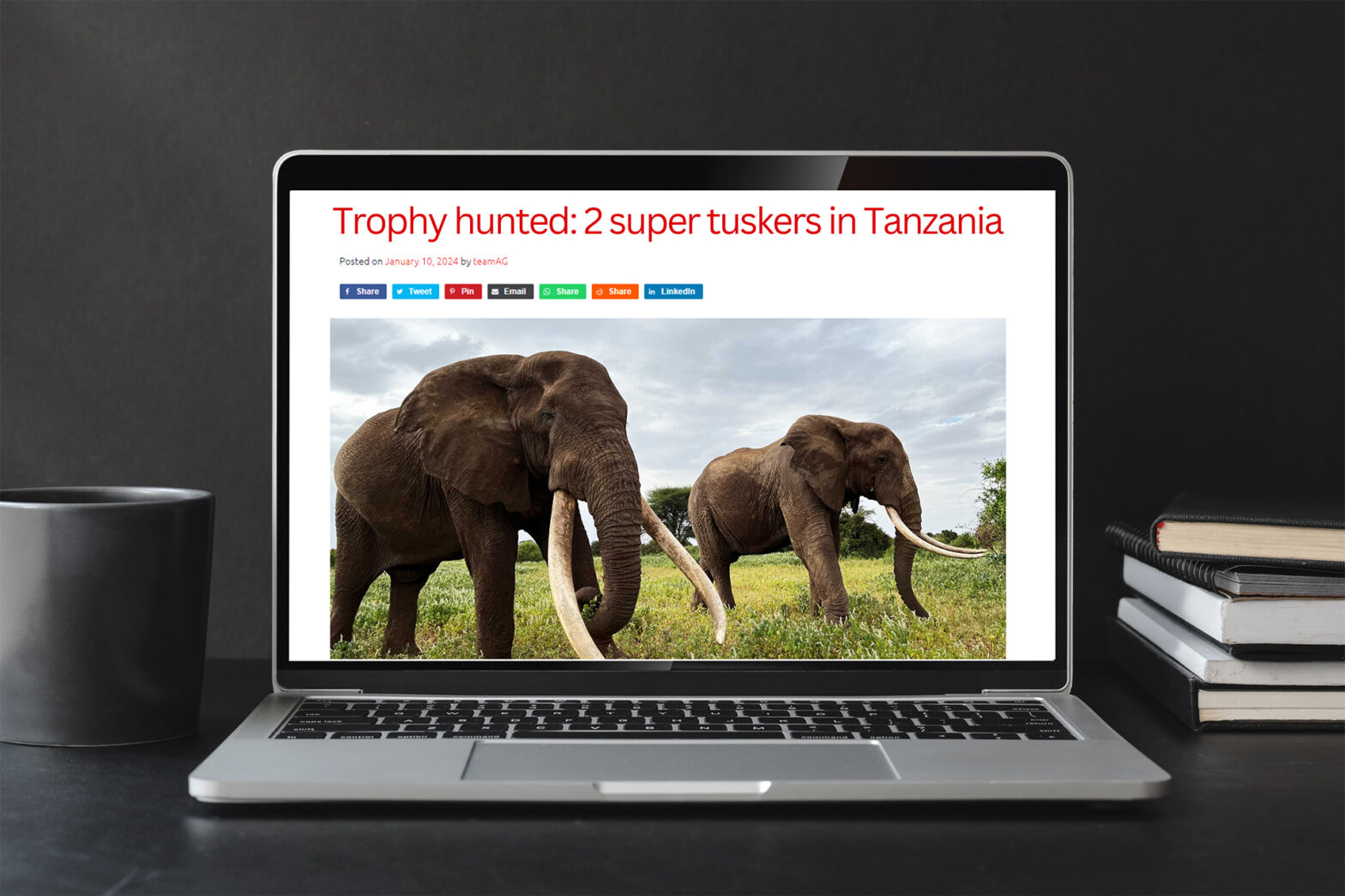
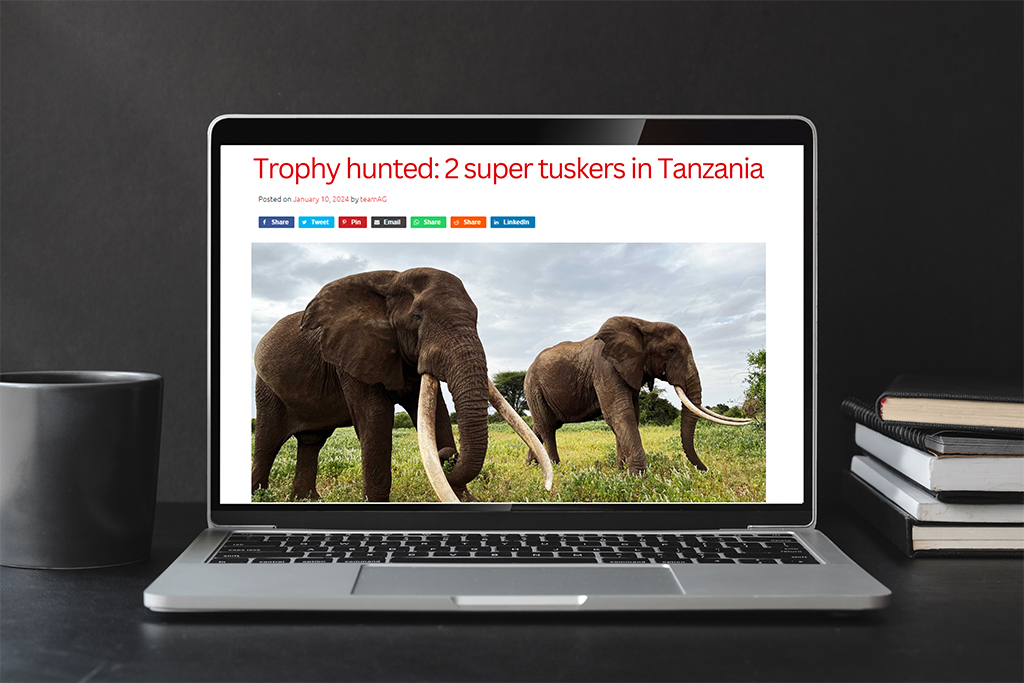
Trophy hunted: 2 super tuskers in Tanzania

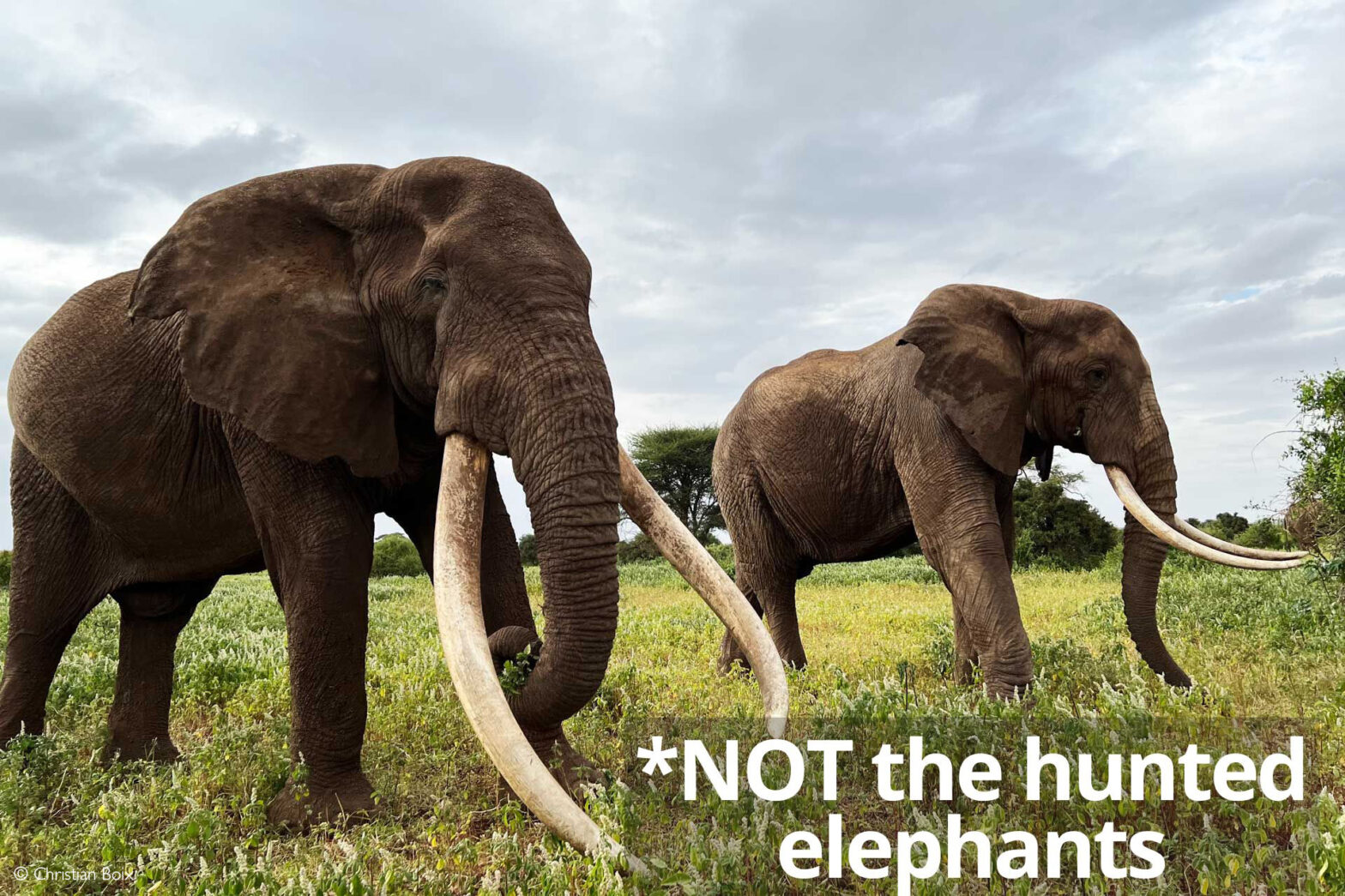
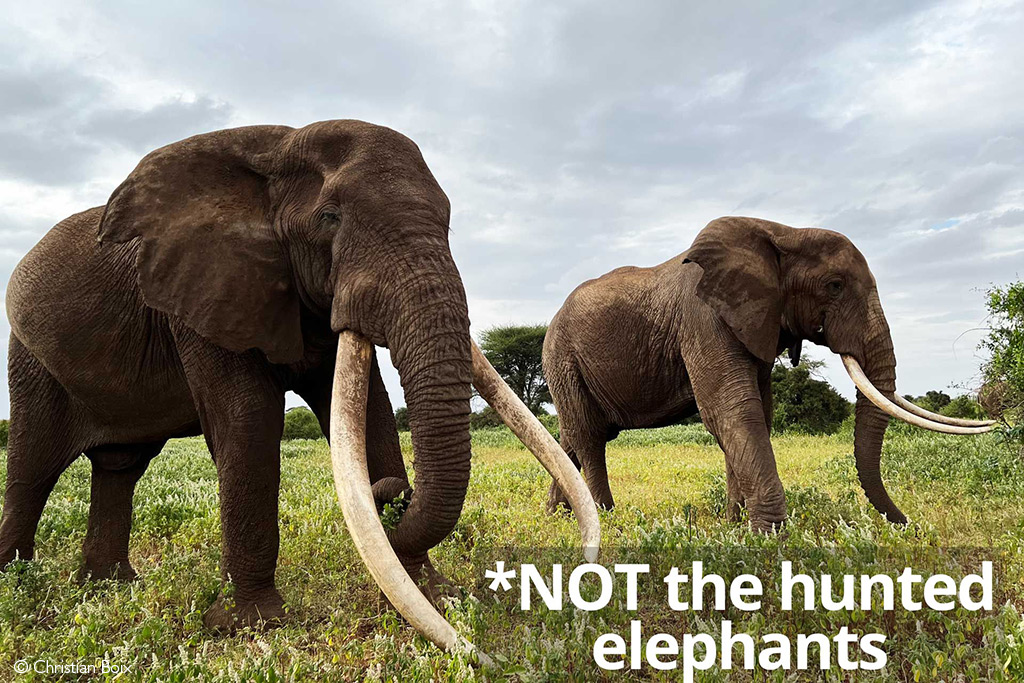
NOT the two elephants that were hunted. Super tuskers Craig (left) and Soldier in Amboseli, Kenya. © Christian Boix

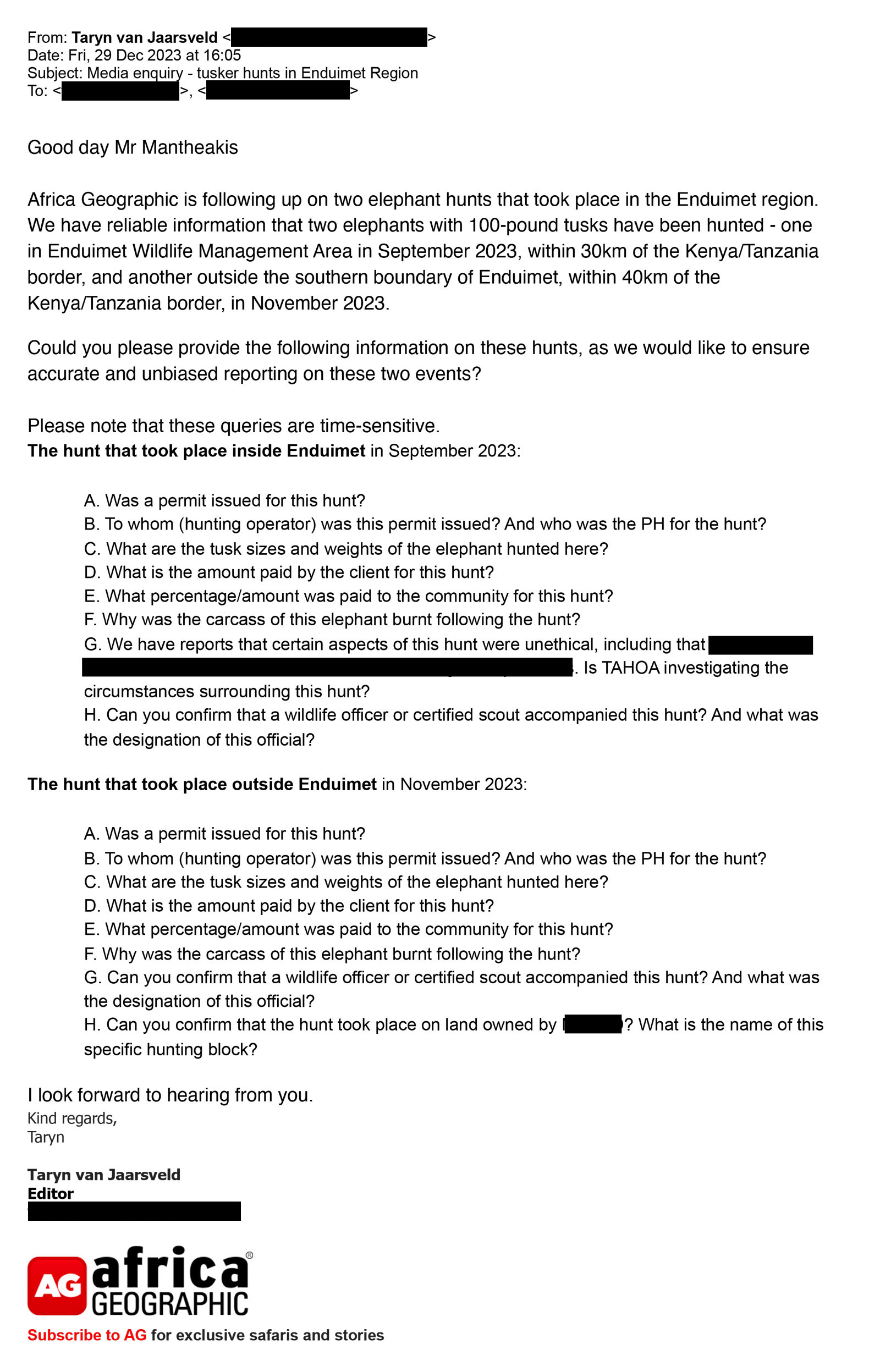
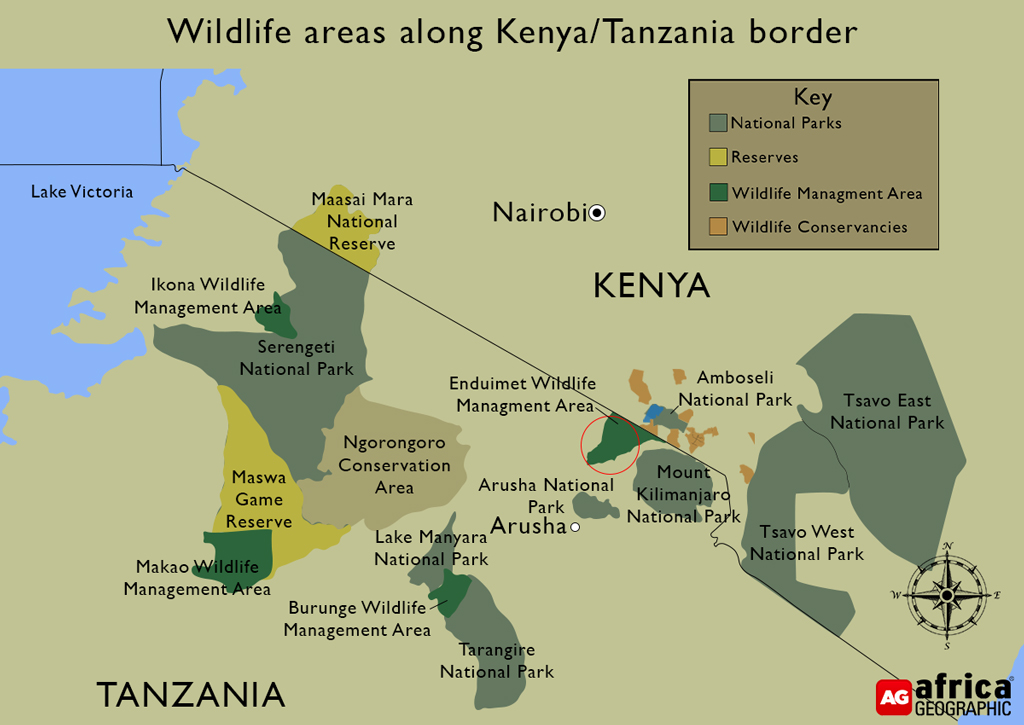
Update 23/04/2024: We can confirm that two more large-tusked elephants have been trophy hunted in Tanzania near the Kenya border. A fourth elephant was hunted in Enduimet on 11 April – likely from the Amboseli elephant population. A fifth elephant was hunted in Longido, to the west of Enduimet, during the week of 14 April. The hunts were allegedly conducted by the same hunting outfitter that hunted previous elephants in the area and involved high profile members of Tanzania’s hunting fraternity. Our sources advise that unscrupulous outfitters are willing to violate the moratorium on hunting along the Kenya/Tanzania border, with no regard for the precarious state of Amboseli’s dwindling super tusker population. Meanwhile, those with detailed information are on lockdown, nervous to reveal details for fear of persecution – while petitions to the Tanzanian government fall on deaf ears.


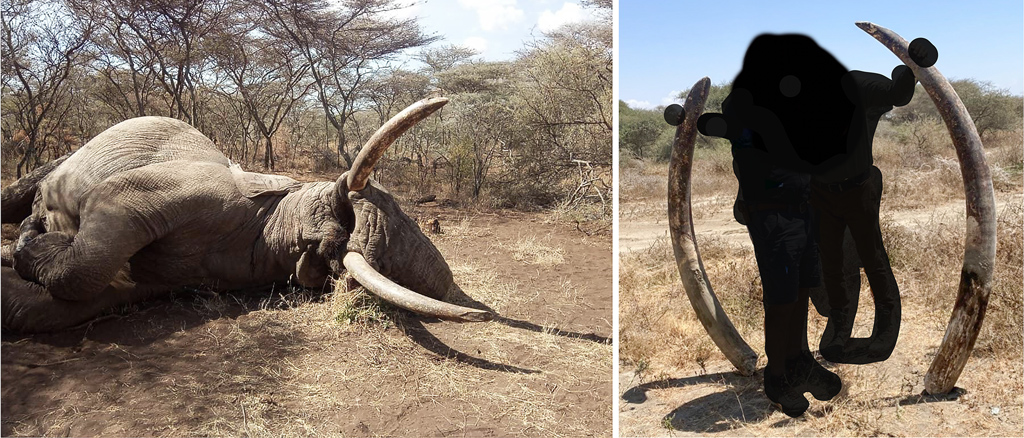
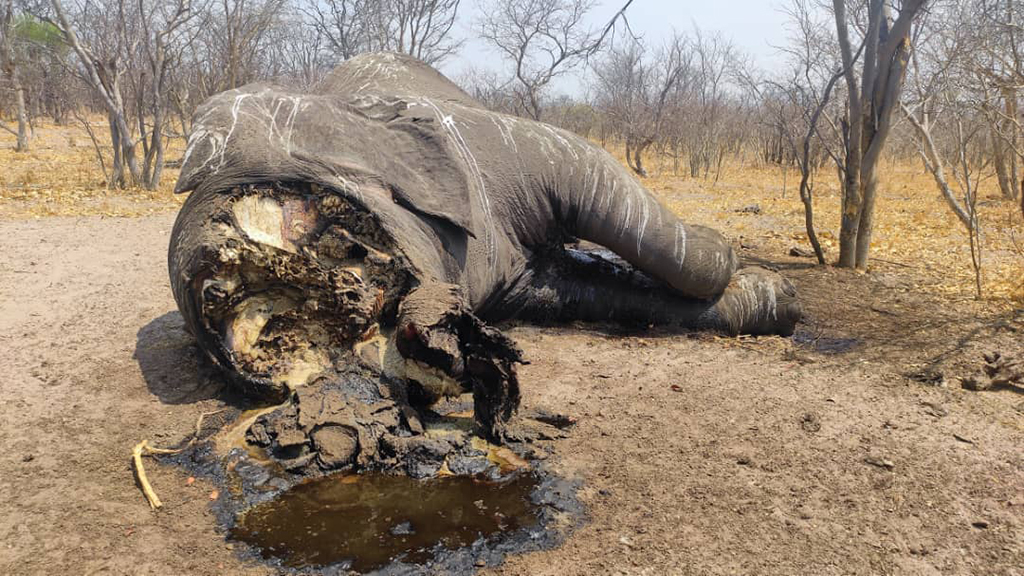
Update 28/03/2024: Africa Geographic is now able to share photos taken shortly after the first trophy hunt that took place in Enduimet, showing the carcass and tusks of super tusker Gilgil. In the first image, Gilgil’s carcass can clearly be seen, and in the second, the tusks, removed from the carcass (measuring 99 pounds and 110 pound), are visible.

super tuskers
The carcass of super tusker Gilgil, trophy hunted in Enduimet; and Gilgil’s tusks after being removed from the carcass. The men pictured here were not members of the hunting party

Update 14/03/2024: Amboseli Trust for Elephants has positively identified the first trophy-hunted bull as Gilgil, a breeding elephant aged 35, who would have been approaching his prime reproductive years. Male elephants reach their prime breeding years at or about 40 years. Our sources confirm Gilgil was a ‘100-pounder’, with one tusk weighing 99 pounds and the other 110 pounds. 


Trophy hunted: 2 super tuskers in Tanzania

10 January 2024 – A trend of Tanzanian trophy hunters targeting ‘100-pounder’ elephants has raised concerns of a new threat to the last few remaining super tuskers, of which as few as 50–100 may still be alive today. 

In recent months, trophy hunters have killed two super tuskers – bulls with at least one 100-pound tusk – close to Tanzania’s border with Kenya. This greater Amboseli ecosystem is a famous haven for these giant elephants, where many have become habituated as a result of close interaction with humans. The trend of targeting these ecologically and economically important animals requires immediate critical attention.

What we know about these two super-tusker hunts:

  • Two ‘super-tusker’ elephants (defined in East Africa as elephants with at least one tusk weighing 100 pounds) were trophy hunted in the West-Kilimanjaro area of northern Tanzania in the latter half of 2023. West-Kilimanjaro includes the Enduimet Wildlife Management area, surrounding government-owned land and private ranches.
  • Two different hunting companies were responsible. 
  • In both cases, the hunters burnt the elephant carcasses – an uncommon practice amongst hunting operators in Tanzania.
  • All super tuskers are individually known to conservation organisations, but the identity of these elephants has not yet been established. The burning of the carcasses made post-mortem ID impossible.
  • All information at hand suggests that the required permits were in place for both trophy hunts.


Super tusker 1 – September 2023

  • The first hunt took place in Enduimet Wildlife Management Area in September 2023.
  • The elephant was killed approximately 24km from the international border between Tanzania and Kenya. 
  • There are unconfirmed reports that the hunting operator identified the specific super tusker while the elephant was outside the hunting block and targeted the elephant shortly after it crossed into the hunting zone.
  • Africa Geographic contacted the relevant hunting operator and requested information about the elephant in question, such as images and tusk sizes. The operator responded to our message but refused to provide the requested information.

Update 14/03/2024: Amboseli Trust for Elephants has positively identified the first trophy-hunted bull as Gilgil, a breeding elephant aged 35, who would have been approaching his prime reproductive years. Male elephants reach their prime breeding years at or about 40 years. Our sources confirm Gilgil was a ‘100-pounder’, with one tusk weighing 99 pounds and the other 110 pounds. 

Super tusker 2 – November 2023 

  • The second hunt occurred in November 2023 on a piece of land neighbouring Enduimet Wildlife Management Area – approximately 36km from the international border between Tanzania and Kenya.
  • A helicopter was observed flying extensively in the area in the days preceding the hunt. Using an aircraft to find or coerce target animals is considered extremely unethical by responsible trophy hunters. 
  • Africa Geographic contacted the relevant hunting operator and requested information about the elephant in question, such as images and tusk sizes. The operator responded to our message but refused to divulge any information and was, unfortunately, somewhat disparaging of our requests for transparency.

About super tuskers and this cross-border elephant population

  • There are estimated to be between 50 and 100 elephants remaining in Africa with at least one tusk weighing 100 pounds or more. Most of these roam the unfenced regions of southern Kenya and northern Tanzania, but some are still found in Southern Africa. The population has been decimated by the combined impacts of the ivory trade (legal and poached), human-wildlife conflict and trophy hunting. Read more about the trophy hunting of super tuskers here (Botswana) and here (Zimbabwe)
  • There are regulations governing a minimum tusk size requirement for trophy-hunted elephants in Tanzania, but no stipulation of a maximum tusk or body size.
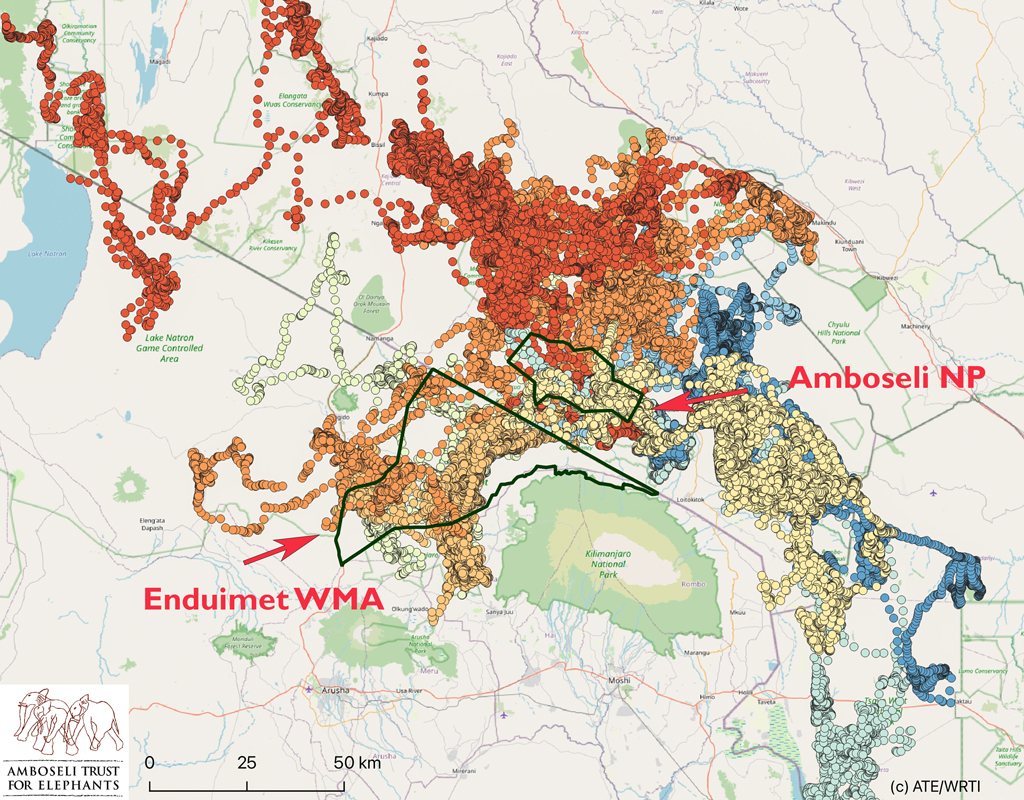
  • Decades of scientific research confirm that the West-Kilimanjaro region in Tanzania and Amboseli in Kenya, are part of one functional ecosystem with shared wildlife populations. Well-known tuskers such as Craig and Tee-Jay roam this unfenced region.
  • The Amboseli elephant population is one of the best protected in the world and the subject of the world’s longest-running population study. Being extremely habituated, this elephant population is also one of the primary attractions that make Amboseli National Park one of Kenya’s top three most-visited national parks. 
  • Eight young Amboseli males were recently satellite-collared to determine the behaviour and range of young males who had recently left their natal families. Two of these males spend most of their time in Tanzania, near Enduimet, Tinga Tinga and beyond. Earlier radio-collaring of older males also showed extensive and frequent movement between Kenya and Tanzania. 
  • Enduimet area: “For some of the big males, the Enduimet area is part of their non-musth range when they are fairly sedentary. Once in musth, they will range across most of the Amboseli ecosystem, which is cross-border,” said Cynthia Moss, director of Amboseli Trust for Elephants during an email discussion with Africa Geographic.
  • Amboseli elephants are habituated to vehicles and also to people on foot because they live among the Maasai people. Photographers lie on the ground to photograph the magnificent giant elephants as they stroll close by unconcerned. “Shooting an Amboseli bull is about as sporting as shooting your neighbour’s poodle,” said Moss in an interview conducted in 1996.
Africa Geographic Travel

The ‘value’ of elephants – the science and ethics

The debate on justification for sport-hunting elephants continues, and government policies vary widely across Africa. However, there are specific reasons why targeting ‘super-tuskers’ is ill-advised:

  • Genetic scarcity: Following centuries of selective removal by the ivory trade (legal and poached) and trophy hunters, genes for large tusks are becoming increasingly rare, as evidenced by the scarcity of big-tusked elephants. There are estimated to be between 50 and 100 elephants remaining in Africa with one tusk weighing 100 pounds or more.
  • Breeding value: Long-term research has shown that males between 40–54 years (which have the largest tusks) have the highest reproductive success
    “Elephant males continue to go through yearly musth cycles well into their 50s. When they are in musth, they roam far and wide to find females for mating,” said Moss.
    She further explained:
    “Females exercise choice, and they prefer to mate with older males in musth. Elephant males only start coming into musth in their late 20s, but it is the older males in their 40s and 50s that the females choose. Elephants grow throughout their lifetime, and their tusks grow faster in their last decade of life. When a female chooses a mate, she chooses one for his age, which indicates health and robustness. These older males have proven their genetic quality because they have survived to an older age. We have no indication that the females are choosing males with larger tusks. However, the larger tusks are an advantage to a male in a fight.”
  • Social value: Older bulls are also important in elephant society for their control of behaviour in younger bullsOlder male elephants – whether they have big tusks or not – are important to other, younger males in teaching and setting examples. They are also important friends and companions to other elephants.   
  • Economic value: The Greater Amboseli Ecosystem contains some of the most economically valuable and best-known elephants on the planet – like Craig –  that are a primary attraction for tourists to the Greater Amboseli Ecosystem and a pillar of an industry which generates millions of dollars in revenue every year. The trophy fee to hunt the largest category of elephant in Tanzania is approximately $20,000. The average elephant’s lifetime value from attracting tourists is estimated at $1,607,625 – while the value of a large-tusked individual would be much higher. Killing one of the last remaining giant elephants on Earth for the benefit of one hunting operator and client appears to be a huge waste of revenue opportunity, aside from other important conservation issues discussed here.
  • Ethical considerations: The debate about sport-hunting a highly social, long-lived, intelligent animal continues. However, these questions are amplified in this context when the elephants being killed are extremely habituated and trusting due to good protection and frequent interactions with tourists.

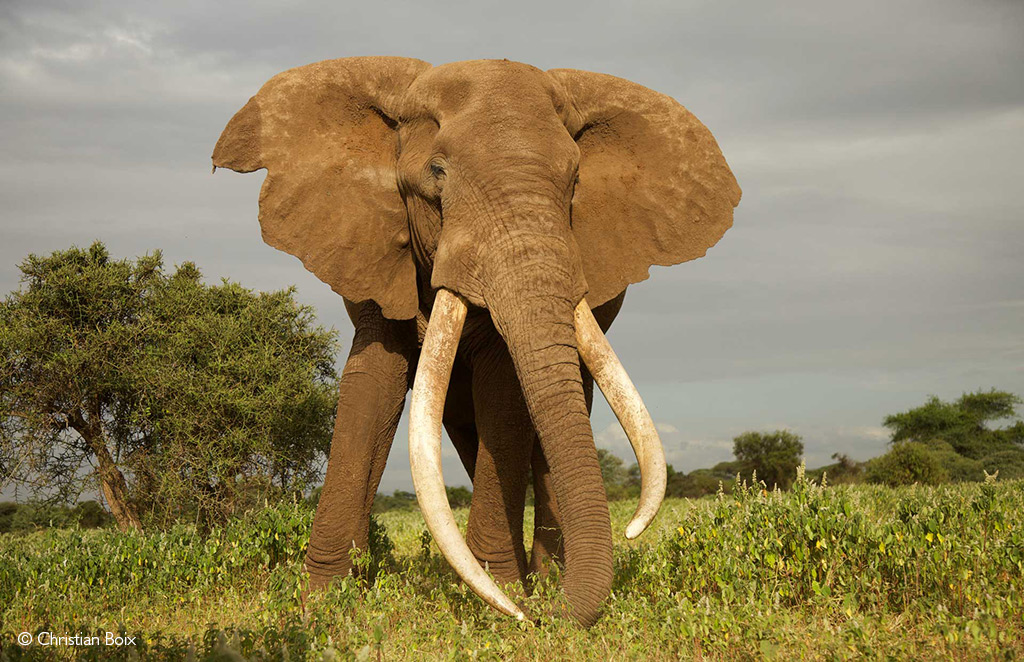
    Craig – Amboseli super tusker © Christian Boix

Historic ban on trophy hunting of these cross-border tuskers

When considering a solution, there is a precedent for exactly this situation. After three well-known Amboseli elephants were killed by sport hunters near the Kenya-Tanzania border in 1994, authorities from both countries were apparently able to reach an agreement to ban hunting “along the border” until Kenya and Tanzania could best decide how to manage hunting tourism in this area. According to a newspaper article, this agreement was announced by then Principal Secretary of the Tanzanian Ministry of Natural Resources, Tourism and Environment, Dr. Ben Moshi, but we have not been able to source a copy of such an agreement. However, it would appear that there was a historic solution that was mutually acceptable and respected until recently, and this could be revisited.

Our search for specifics about the hunting of these tuskers:

Enduimet management, the Tanzania Wildlife Management Authority, and the Tanzania Hunting Operators Association were all approached for comment and have yet to respond. Relevant information will be added to this article as we receive responses.

How giraffes choose their besties

giraffes
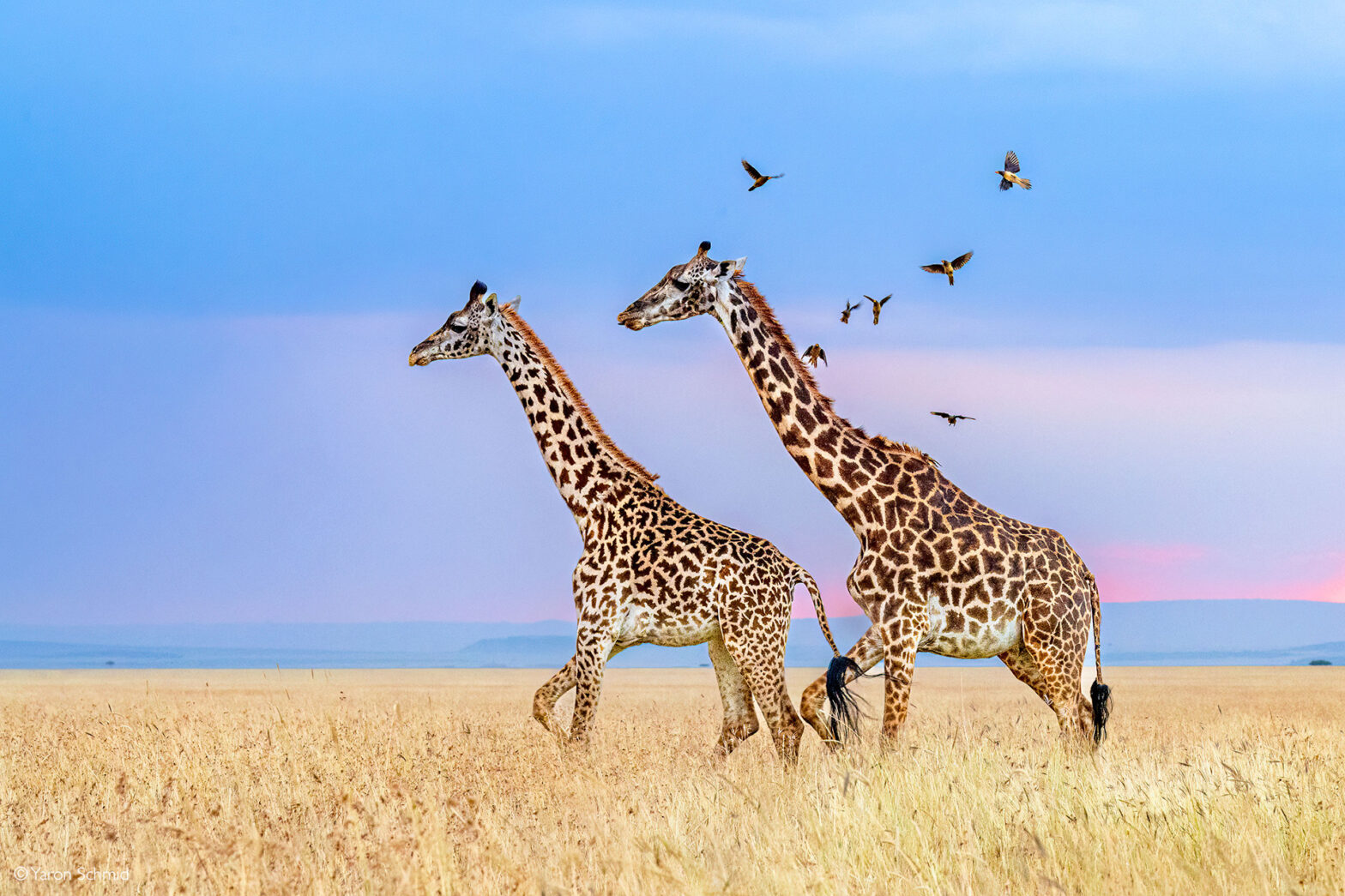
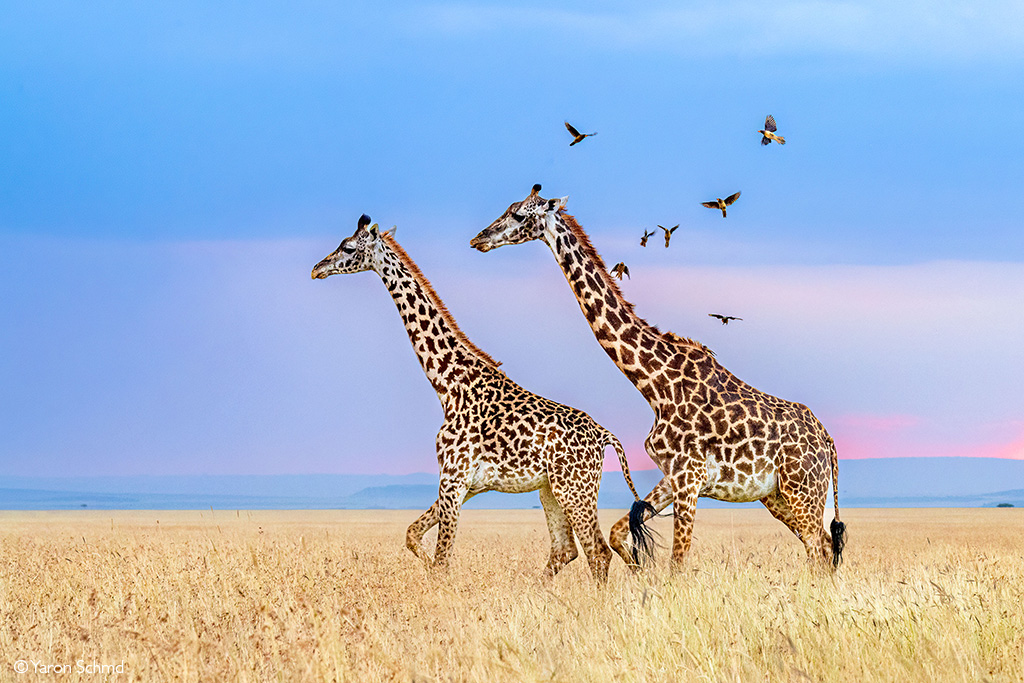
Maasai giraffes in Maasai Mara National Reserve

Giraffes are quite sociable creatures – a dynamic that is riveting to witness when on an African safari. So sociable that they get together with other giraffes and form little groups that join up and disband throughout the day, based on unknown giraffe social cues. This socialisation is referred to as fission-fusion dynamics, which sounds like something an atom would do, but is actually what giraffes do. But how are these bonds formed? Researchers studying Maasai giraffes have tried to find out.


Giraffes – the social butterflies

Females, in particular, like to form close-knit communities with other possibly related females, whereas the young males tend to disperse and form loose coalitions (bachelor gangs), and the older males are more independent and roam alone, searching for receptive females (the equivalent, I imagine, of a mature gent cruising for ladies).

Girl giraffes need their best friends, as they have higher survival rates when hanging together in herds. Also, hanging out with the girls means that mom has a babysitter to take care of the kids when she wants to get a drink at the waterhole. Studies show that females share nonparental offspring care in giraffe ‘creches’ (aka babysitting).

Africa Geographic Travel

Let’s get together, yeah yeah yeah

A group of researchers studying social associations in Maasai giraffe speculated that these females forming long-term associations were related. This could imply that staying with aunts and nieces confers greater fitness (increased survival). The authors decided to see if females might choose who they hang out with based on their appearance – according to their spot variation. As spot pattern is heritable, related giraffes should also have similar spot patterns.

So, the first thing to know about giraffe spot patterns is that there is an exceptionally high variation in spot patterns in the Masai giraffe (Giraffa camelopardalis tippelskirchi). The second thing to know is that the giraffe has exceptional visual acuity among mammals based on the anatomy of their eye and adaptations of their visual genes. Communication among giraffes could be primarily visual. The characteristic coat colour of a giraffe is reddish-brown spots set within a network of white lines. As their eyes are particularly sensitive to red pigments, this could mean that their excellent eyesight allows them to discriminate between individual giraffes.

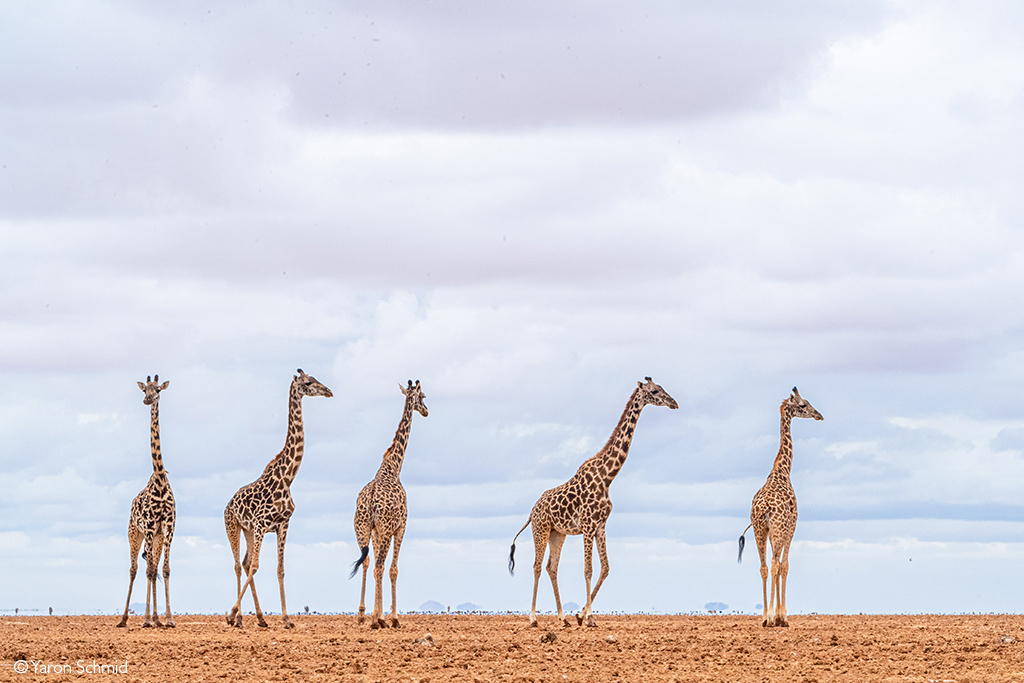
Masai giraffes in Amboseli National Park, Kenya
Africa Geographic Travel

What beautiful spots you have, dear

To understand if a giraffe chose friends with similar looks (spotty coats), the researchers first had to describe the differing spot markings of different giraffes. The authors described the spot pattern of 399 free-ranging adult female Masai giraffes inhabiting a large, unfenced landscape in Tanzania. They chose to measure ten traits of all the spots within one region on the flank of the giraffes and recorded characteristics such as the number, circularity, solidity, size, area, and orientation of spots. They then drove around the landscape to see which females were grouped.

They found that the shape of spots was mainly a predictor of female pairing or grouping. Females preferred to mingle with other females of similar spot shapes. Thus, they conclude that female giraffe associations may be based on kinship as reflected by heritable spot traits. The visual cue of coat spot pattern may enable kin recognition in general and potentially individual identification of familiar giraffes. The authors hasten to add, “…we do not suggest that giraffes are mathematically quantifying the shape of the individual spots of other giraffes they encounter, but they may be able to rapidly assess the general ‘gestalt’ of the patterns.”

It’s an exciting theory, and further research would identify whether giraffes are using smell to identify relatives (and not spots) or whether these similarities are genetic in origin. Meanwhile, I will enjoy the idea that giraffes choose besties based on their sense of dress; polka dots are the ‘in-thing’ in giraffe fashion this year!


Want to see a Masai giraffe in the wild? Search for the best ready-made Kenyan safaris on offer right now.


Reference 

Morandi, K. et al. (2022), Phenotypic matching by spot pattern potentially mediates female giraffe social associations. Journal of Zoology, 318: 147-157.

Resources

Read everything there is to know about giraffe here,  and learn more about the different species of giraffe.

Giraffe social structure is as complex as elephant. Read about their intricate levels of communication and stable kinship here.

The giraffe is an endless source of fascination for scientists. A new study reveals that giraffes are capable of statistical inference – read more here.

THIS WEEK – 05 January 2024

A curious leopard cub, framed by its mother’s tail, eyes the photographer. Maasai Mara National Reserve, Kenya. © Yaron Schmid. Photographer of the Year 2023 entrant

This is a copy of our weekly email newsletter. Subscribe here to receive the newsletter.


Mountains of the Moon + parent like a Wahlberg’s eagle

Apparently we are pouring $billions into humanoid bots, gene-editing therapies, and brain implants to ‘improve’ our lives. At the same time we are pillaging the planet that sustains us. What could possibly go wrong?

Meanwhile, at ground level in Africa, our Photographer of the Year 2023 winners witnessed a rather gritty incident during their safari in Mashatu Game Reserve, Botswana. We came across a stressed giraffe wandering around, after-birth dangling. A party of jackals were tailing her, hoping to snack on that juicy morsel. Having eaten her newborn shortly after it dropped, they were intent on cleaning up. We were all contemplative after witnessing this dramatic demonstration of natural processes. How different that was to the sanitised, packaged world our species is intent on creating, at the exclusion of real life.

Be the change you want to see in the world. Never give up

Simon Espley – CEO, Africa Geographic


From our Editor – Taryn van Jaarsveld

Life is tough for rodents in Africa. When they’re not dying out due to habitat loss or poisoning, they’re dodging predators of all shapes and sizes, bearing teeth, claws, beaks and thumbs. To survive as a rat in Africa, one must grow a thick skin. One must innovate: just like the African crested rat, found in East Africa.

Did you know that the crested rat coats its fur in a poison so lethal it can fell an elephant, to protect itself from predators?  The rat chews on the toxic poison arrow tree and transfers the toxins onto its fur. The poison then causes distress, or even sudden death, in its attackers. The rat’s other adaptations include a large stomach to detoxify poison, tough skin and a reinforced skull.

May you experience prosperity and opportunity in 2024 – and may you also develop a thick skin, strong stomach and hard head for any toothy challenges that come your way.

This week, don’t miss our story on Rwenzori Mountains for travel inspiration, and read about the fascinating parenting style of the Wahlberg’s eagle – all below.


Story 1
MOUNTAINS OF THE MOON
Rwenzori Mountains NP’s towering peaks & other-worldly flora beckons travellers to embark on a life-altering journey

Story 2
WAHLBERG’S EAGLE
Why does the Wahlberg’s eagle lay only one egg? The parenting style of these eagles is a story your financial broker will enjoy


Safari trip report – Birding in Madagascar

Colleen Krog went on a birding safari with us to Andasibe-Mantadia in Madagascar. Thank you for your 5-star review, Colleen! Here is what Colleen had to say about her experience:

“Based at Feon’y Ala, I was able to explore Andasibe-Mantadia thoroughly over a couple of days. This was the first time I did a birding trip like this – as I am usually an occasional birder.

Our guides, Tojo and Maurice, were really excellent and made all the difference. I am sure they often guide more experienced birders and photographers. But I am a novice, and really enjoyed the trip. They really went out of their way to show me incredible species – and went above and beyond! It really made all the difference. They were on a mission to find every bird that is found in the area. We walked plenty and bashed through dense forest. It was so much fun!”

Interested in travelling with AG? Plan your safari with us here


WATCH: Fancy a pick-me-up? Take a breather and enjoy a moment of Kruger lion cubs exploring, tumbling, huddling and roughhousing as they await the return of their grown ups. (02:54) Click here to watch

For more videos celebrating Africa, check out our videos here

Rwenzori Mountains National Park

Lying just 33 kilometres north of the equator, snug in the heart of the African continent, a world of mystery and unparalleled beauty awaits the adventurous – the Rwenzori Mountains. Rising majestically along the border between Uganda and the Democratic Republic of the Congo, these enigmatic peaks evoke a sense of wonder and intrigue to all who visit – providing for an African safari like no other.

The landscape of the Rwenzoris is a dramatic blend of rugged peaks, deep valleys, and cascading waterfalls. Towering above the surrounding plains, the snow-capped mountains create a breathtaking panorama. Glacial lakes shimmer amidst the lush vegetation, and the thundering waters of the Mubuku and Bujuku Rivers add to the park’s pristine beauty. The diverse topography of the region and its location in the tropics offers a seldom-seen diversity of ecosystems, from bamboo forests to alpine meadows and moss-draped valleys.

Of rainmakers and mighty rivers

Recognised for its unique biodiversity and the value of water flowing from its mountainsides, the Rwenzori Mountains National Park was established in 1991. In 1994, UNESCO afforded it World Heritage Site status, and in 2008, it was named a Ramsar site for its value in the protection of wetlands. The park now conserves almost 1,000km² of this unique and vulnerable region with its five distinct vegetation zones and unprecedented levels of endemic species.

The Rwenzori Mountain region has been home to many diverse people and societies for millennia. All recognised the value of the water flowing from the peaks and held them sacred. The Bakonzo people even named the mountains “rainmaker”, a fitting name for what is one of Africa’s most essential water sources.

Exploring the Mubuku River on foot

Ptolemy, the Greek-Egyptian astronomer, mathematician, and geographer, incorrectly identified the Rwenzoris as the source of the Nile River, giving the range its charming moniker “Montes Lunae” or the “Mountains of the Moon”. Not until much later was the true source discovered at Lake Victoria in Uganda.

Since becoming known outside of Africa, the region has captivated the imaginations of explorers, adventurers and scientists worldwide, sparking expeditions to try and unravel the mysteries and secrets of this primordial wonder.

The national park’s various trekking experiences are undoubted highlights
Africa Geographic Travel

Moody rainforests and misty Rwenzori peaks

The Rwenzori massif stretches for roughly 120 kilometres along the western leg of the Albertine Rift, its jagged ridges, glacial valleys, and lush vegetation creating an otherworldly landscape that beckons the adventurous. These majestic giants are adorned with a crown of ever-present snow and ice, defying their equatorial location and creating a unique alpine environment. The unique combination of high altitude, equatorial location, and calm, wet climate in the Rwenzori Mountains has resulted in distinct ecosystems and rich biodiversity. It is not only the imposing height and alpine beauty that define the Mountains of the Moon. Its exceptional biodiversity and remarkable flora characterise the region. Within its diverse ecological zones, from the lowland rainforests to the moss-draped afro-alpine zone, one can discover a wealth of endemic plant species, colourful birdlife, and elusive wildlife.

The central mountain massif, Mount Stanley (also known as Mount Ngaliema), comprises three 5,000m peaks, of which Margherita is the tallest at 5,109m above sea level. This is the third highest peak in Africa after Kilimanjaro and Mount Kenya, but is perhaps the most difficult to summit because of the very rugged nature of the terrain there.

The highest peaks in the Rwenzori Mountains are permanently snowcapped. Here, the snows of Margherita, part of Mount Stanley, can be seen

Trekking the Rwenzori grand trails

The Rwenzori Mountains National Park offers many attractions catering to nature enthusiasts and adventure seekers, making for a truly unique African safari experience. The park’s undoubted highlights are the Rwenzori Mountain trekking experiences available. Multi-day hikes, ranging from moderate to strenuous, allow visitors to immerse themselves in the grandeur of the mountains. The most popular trekking route is the Kilembe Trail, which allows adventurers to explore the lower slopes of the mountains and witness breathtaking views of the surrounding landscape without the exhilarating challenge of tackling the higher peaks.

If time is a challenge, a day trip with a trained and knowledgeable guide will take you along trails offering insights into the region’s unique ecology, while pointing out endemic plant species, identifying bird calls and revealing the cultural charm of the area. Participating in cultural activities, such as traditional dances, storytelling sessions, and visits to local villages, will help you gain a deeper appreciation for the region’s heritage while contributing to the livelihoods of the people who protect this environment.

Rwenzori
A trek up the Rwenzoris takes adventurers through five distinct vegetation zones, from grassland and plantations to a surreal afro-alpine landscape
Africa Geographic Travel

Rwenzori forest specials

A visit to this region will enthral and richly reward you with sightings and experiences beyond your expectations. Your trek up these “rainmaker mountains” will take you gradually through five distinct vegetation zones, from grassland to the surreal afro-alpine landscape and on to equatorial glaciers. This diversity of habitats is rewarding but naturally yields “specials” found nowhere else. Regardless of your passion, you’ll find yourself marvelling at far more than you thought you might have should you embark on a trip to the Rwenzoris for your next African safari.

The early stages of a trek introduces visitor to the rustic lowland surroundings of coffee, vanilla and banana plantations. These soon give way at around 2,500m to shady and often misty montane forests with moss-covered trees, closed canopies, waterfalls and streams.

Rwenzori
Multi-day hikes in the Rwenzori Mountains range from moderate to strenuous

Here, you will do well to scan for some of the elusive forest specials the park is known for. If you are quiet and lucky, you may catch a glimpse of the Rwenzori red duiker on the forest floor. At the same time, up in the canopy, Rwenzori colobus and blue monkeys and an intriguing diversity of bird specials await. For the sharp-eyed, hiding in plain sight is the prehistoric and somewhat comical-looking Rwenzori three-horned chameleon.

The park boasts seventeen of the twenty-four Albertine Rift endemic bird species, but they will take hard work and perhaps a little luck to find. Keep an eye out for the Rwenzori turaco, handsome francolin, strange weaver, Rwenzori nightjar, barred long-tailed cuckoo, Cassin’s hawk eagle, Shelley’s crimsonwing and purple-breasted, blue-headed and Rwenzori double-collared sunbirds.

Hiring a good bird guide will help you “grab” these species, which can be frustratingly elusive. Bring a good pair of binoculars, as the low-light forest viewing conditions can make viewing difficult.

At around 3,000m, trekkers enter an eerie and dark zone of giant bamboo grasses up to 30 metres tall, which will obscure the sky as if nature is covering one’s eyes for the surprise to come. Soon, a heather and moor wonderland is revealed as the equatorial peaks appear above.

Giant groundsels dotted across the Rwenzori Mountains

The real wonders of the Rwenzoris start above 4,000m, where botanical marvels, which evolved in isolation over millions of years, can be found. This is the afro-alpine zone – perhaps the most surreal part of this mountain world. Shrouded in mountain mists and inaccessible due to the challenging terrain, the area has been a refuge for plant life undergoing perilous evolutionary journeys. This isolation has allowed plants to evolve uniquely, adapting to the extreme conditions and carving out their niche in this montane ecosystem. The remarkable giants of the Rwenzori Mountains are a testament to the power of adaptation and the extraordinary wonders nature can create.

Enchanting giant lobelias (Lobelia gibberoa) stand tall, like sentinels, along the rugged slopes. These are among the most iconic plant species of the Rwenzori Mountains, reaching staggering heights of up to 10 metres, making them true botanical giants. Sharing their lofty habitat are giant groundsels (Dendrosenecio adnivalis), another botanical wonder of the Rwenzori Mountains. With their woody stems and tufts of silver-grey leaves, they seem to belong to a different era altogether. The groundsels bloom with clusters of bright yellow flowers that attract a myriad of insects, adding life to this surreal environment.

Africa Geographic Travel

Explore and Stay


Check out our selection of walking safari options for your next African safari. We have ready-made safaris to choose from – or ask us to build one just for you. 


Exploring the Rwenzori Mountains National Park is a thrilling adventure with a range of accommodation options to suit your preference, from comfortable lodges to campsites. The nearby town of Kasese provides a convenient base for trekkers, offering hotels and guesthouses for those seeking a more urban experience.

Staying in the park or its vicinity allows visitors to savour the tranquillity of the mountains and embrace the soul-stirring beauty of this unique destination. Nyakalengija Park headquarters and campsite is an excellent place to begin your trip. Register at the park office, obtain the necessary permits, and meet your experienced local guides and porters who will accompany you throughout your journey.

Kilembe Base Camp offers accommodations for hikers and provides basic facilities while also being a convenient starting point for that hiking route.

Mount Baker and Lake Bujuku can be seen from the Bujuku Peak hike’s camp

Bujuku Valley is a picturesque area renowned for its stunning scenery. Visitors can traverse this valley, crossing fast-flowing rivers and observing mesmerising waterfalls along the way. The challenging Bujuku Peak hike offers panoramic views of the mountains and valleys.

For those seeking a shorter trek, the Mahoma Trail is a popular option. This trail takes visitors up through pristine bamboo forests, offering glimpses of diverse bird species and the chance to see the elusive Rwenzori turaco.

The Rwenzori Mountains National Park is an enchanting world where nature’s wonders are magnificently displayed. From the towering peaks to the astonishing alpine flora, every facet of this extraordinary landscape beckons travellers to embark on a remarkable life-altering journey. For those who visit, the Rwenzoris will etch themselves on the soul.

Further Reading

Here’s our list of Africa’s must-visit mountain kingdoms – discover their magnitude, scenery and the creatures that call them home

Parenting, Wahlberg’s eagle style: making financial brokers proud

Wahlberg's eagle
Wahlberg’s eagle

Why does the Wahlberg’s eagle lay only one egg? Most other eagles in their genus (Aquila) lay a second egg as a type of insurance policy – and in most cases, the second fledgling is killed through siblicide. The answer to the Wahlberg’s unique parenting style is fascinating…


The hard truth about birds in the nest

Most eagle chicks in the Aquila genus are ‘siblicidal’. This means that siblings fight each other to the point of death. The chicks are fiercely competitive for the food brought to the nest by the parents, and often, the bigger chick in the nest kills the smaller one, either through monopolising the food or pecking the younger sibling to the point where it is too cowed to move or beg and starves. So, what are the possible (evolutionary) reasons for this?

Dr Rob Simmons has always been fascinated by eagles. He became particularly interested in why some eagle species laid two eggs yet only ever rear one chick (because of siblicide). Why not just lay one egg? There has long been a theory that eagles lay two eggs as an insurance policy – if the first egg fails to hatch or the fledgling dies, they still have the second egg. However, the insurance policy does not hold true for all species that lay two eggs. In some species, the second egg regularly fails to hatch, even if the first one is unsuccessful. Could other life-history traits or environmental factors explain why some eagles lay one egg and some two eggs? If second eggs are not energetically costly for eagles to produce, all eagles should lay two eggs as an insurance policy. But some do not. The Wahlberg’s eagle (Aquila wahlbergi) regularly lays only one egg per clutch.

So, Simmons hatched a plan. He realised he could learn more about why an eagle would want to invest in two eggs by experimenting with an eagle that typically lays only one.

Wahlberg’s eagle is one of the smallest Aquila eagles (weighing only 1.3kg). It is an African migrant that breeds at high densities throughout southern Africa. Unusually for its size (there is a general allometric relationship in birds – species with smaller body sizes tend to have larger clutch sizes), the Wahlberg’s eagle typically lays only one egg per clutch. However, very occasionally, they do lay two eggs. This makes them an ideal species to look for patterns underlying the costs and benefits of one versus two eggs. Dr Simmons based his post-doctorate on the breeding dynamics of this species and conducted his fieldwork in Sabi Sand Game Reserve – Greater Kruger. How does one measure breeding success in nests many metres above your head? Simmons spent much time hanging from the high branches of jackalberry trees on a swaying rope ladder, sometimes up to 15 metres above the ground, measuring and weighing eggs and fledglings in Wahlberg’s eagle nests. He also used extendible mirrors as a less energetic way to check on their family life.

Wahlberg's eagle
A Wahlberg’s eagle’s single egg in the nest
Africa Geographic Travel

One of the first things Simmons confirmed was that the incidence of natural two-egg clutches was very low in this species. In 88 breeding events, a two-egg clutch was laid naturally only twice and in one of these nests, the first egg was unsuccessful, and the second egg survived, so the insurance policy proved valid.

But then why don’t all the pairs lay two eggs? Are these eagles all talking to the same investment broker?

Could it be that they lay two eggs when food is abundant? Previous experiments where Simmons gave extra food to breeding pairs before they laid did not result in any two-egg clutches. The abundance of food doesn’t explain the low incidence of two-egg clutches.

Simmons then wondered if the chicks exhibited siblicide, given that the Wahlberg’s eagle usually lays only one egg. He brought some small, similar-sized Wahlberg’s eagle chicks into his field laboratory and paired them up with each other in nest trays. He then rapidly had to unpair them, as they showed intense sibling aggression. They even climbed out of their nest trays to attack their neighbours in their boxes!

So now Simmons knew he had a species that usually laid one egg but could also lay two, which would result in siblicide.

He then asked if these eagles could rear two chicks given the chance, so he decided to add an extra chick of similar size to eight Wahlberg’s eagle nests. To avoid the second chick being killed by the first one, he waited until the aggressive phase had finished (about 35 days) and then added the extra fledgling to the nest. Imagine coming home to discover, out of the blue, that you have double the number of mouths to feed!

Simmons watched the nests carefully, and the parents accepted both chicks. There was no apparent aggression, and the adults appeared to feed both chicks equally. So, what happened to the chicks in these nests?

An eagle in the hand is worth two in the bush

Of the eight Wahlberg’s eagle pairs given a second chick by Simmons, only one pair succeeded in raising both chicks to the age of first flight. In all cases, the second chick lost weight and ended up smaller than the first. Simmons pinned it down to parental care. The parents just couldn’t cope with feeding two offspring. What was more fascinating was what the parents decided to do the following year. They rested! By tagging 35 adult Wahlbergs, Simmons found out that most breeding pairs returned to their territories every year – so he could compare the breeding success of birds that raised one chick and those that were given two. Significantly fewer of the pairs that had two chicks bred the following year compared to pairs that only had one chick.

Wahlberg's eagle
A Wahlberg’s eagle catching flying ants as they emerged from their nest, Kruger National Park
Africa Geographic Travel

So, let’s sum up what he has found out. It is costly for the Wahlberg’s eagles to have two chicks. Two are hard work to feed and have poor survival rates. Plus, the parents become too exhausted to breed the following year (so less eagle young is produced in the long run).

Egg-cellent investment

Could it be that hatching success is so great that the eagles don’t need a second egg for insurance? No, their hatching failure (ca 12,3%) is similar to that of other carnivorous birds that do produce two-egg clutches. So, what could be the advantage of producing a single egg? Simmons compared the Wahlberg’s eagle eggs to those of other species. The egg sizes of raptor species laying just one egg per clutch were 20-55% larger than the first egg of raptors laying two eggs per clutch. Simmons also observed that the sizes of hatched Wahlberg’s eagle eggs were bigger than the unhatched (unsuccessful) eggs. The bigger – the better. Big eggs might bring increased hatching success or chick survival.

All eagles are not equal. They don’t always choose the same insurance policy either. One might expect the Wahlberg’s eagle, with chicks demonstrating siblicide behaviour and small body size, to follow the insurance egg policy of having two eggs – but this is not the case. Simmons shows that clutch size might be a function of the number of chicks the parents can feasibly afford to feed, and they therefore ‘choose’ to make one larger egg.

Bigger eggs are more hatchable, so the Wahlberg’s eagles are putting their investment in a nest egg (excuse the pun) – in one big, successful egg rather than two smaller eggs. They are choosing egg quality over egg quantity. Single, large eggs do not require second-egg insurance as they are intrinsically more likely to hatch. Lots of studies point to the fact that chicks hatching from large eggs enjoy greater chances of nestling survival and enhanced growth characteristics than small chicks and eggs. This larger body size confers a measurable survival advantage and has been correlated with lifetime success. Therefore, large egg size can have a reproductive advantage in later life – what your broker would call a high-risk, high-reward strategy. Whereas eagles that lay two eggs in a clutch could be said to be putting all their eggs in one basket. The inevitable siblicide is the fine-tuning of getting bang for your buck – parent eagles tolerate siblicide as it optimises the quality of the remaining chick.

Cost-benefit analysis

Simmons qualifies that producing a large viable egg is most likely in long-lived bird species. Long-lived species would want to maximise adult survival and thus avoid the smaller two insurance eggs as this would compromise their ability to produce larger, higher-quality eggs. The intrinsically higher hatchability of large eggs offsets the need for second-egg insurance and results in large chicks with enhanced survival prospects. Put that in the bank!

References and resources

Simmons, R. (1997) “Why don’t all siblicidal eagles lay insurance eggs? The egg quality hypothesis.Behavioral Ecology 8 (5) pp. 544-550.

Read more about African eagles here.

THIS WEEK – The year that was: our best stories and safaris

safari
A brown-headed parrot adorned in a smorgasbord of tasty weeping boer-bean buds. Kruger National Park, South Africa. © Joschka Voss. Photographer of the Year 2023 entrant

During 2023 you engaged with our stories more than 2 million times. More than 27,000 new adventurers joined our tribe. And many of you travelled with us to the wildest corners of the continent for your safari fix.

This, in the context of the last decade, where 16 million of you have read our stories that reflect the complexity and reality of life at ground level here in Africa. That’s 16m caring individuals from across the globe – our tribe – that have taken on board the science and considered opinions, and helped us spread the word and CELEBRATE AFRICA.

Here are some of our highlights from 2023, the year that was:


Our 2023 story picks

Things to do in Victoria Falls
Victoria Falls is one of Africa’s most popular tourist destinations – for good reason. We shared our ultimate Victoria Falls to-do list, and our tribe started planning their adventures.

Trophy hunted
A male desert-adapted lion was hunted amidst suspicious circumstances in Namibia. We asked questions of MEFT and triggered international awareness and action

15 Top African wildlife experience
We prepared the ultimate guide to your African safari bucket list. Here were our choices of 15 top African wildlife experiences on the continent

Vet fences
Our most popular story showed you care about the welfare of Africa’s wildlife. Gail Thomson asked whether Namibia & Botswana should bring down their veterinary fences

Archeological magic in Makgadikgadi
Archaeological sites in the Makgadikgadi salt pans reveal how ancient humans used black silcrete formed from lake mud to make tools

Bush or beach?
There’s no need to choose! We brought you the best combo safaris featuring epic beach & bush destinations for the ultimate African holiday


Our most popular safaris in 2023

Big 5 + chimps + gorillas in Rwanda
Is this the best bucket-list safari out there? AG’s followers think so! This safari offers the chance to flatten three bucket-list items in one epic safari – in one country!
Maasai Mara migration season safari
This safari offers front-row seats to the greatest show on Earth – the Great Wildebeest Migration in Kenya’s Maasai Mara
Southern Africa mega safari
This safari-to-end-all-safaris will sweep you off your feet. An iconic holiday in southern Africa that combines Greater Kruger, Cape Town and the Winelands, Khwai, Chobe and Victoria Falls

Your top social media pics this year

safari
202,510 of you checked out this photo of a lion cub taking a breather between mouthfuls and absolutely loved it. Maasai Mara National Reserve, Kenya
safari
58,670 of you loved this image of a leopardess carrying her cub, her iron jaws made gentle by motherhood as she transports her precious cargo. Maasai Mara National Reserve, Kenya
safari
58,560 of you held your breath when you saw this picture. “A jackal pressured this tawny eagle into dropping its quarry moments after it had managed to grab the pup.” The mother rescued the pup and transported it to a new den, unharmed. Maasai Mara National Reserve, Kenya
safari
17,950 of you were enchanted by this young elephant. The calf seemingly snuggled up to its mother, showing affection that we all felt through the lens. Madikwe Game Reserve, South Africa

Your impact this year

This year, you helped make a difference for Africa’s wildlife by supporting our conservation campaigns.

As pangolin-poaching season kicked off in the cooler winter months, you stepped up to help treat pangolins rescued from trafficking. Thank you for supporting our Save a Pangolin campaign. You helped provide treatment and rehabilitation for pangolins saved from poaching and taken for treatment at Provet Wildlife Services, just outside Greater Kruger.

You also helped save Africa’s free-roaming lion populations by supporting our Collar a Lion campaign. By donating to our conservation partner, the Southern Africa Conservation Trust, you raised funds to purchase GPS satellite collars to monitor lion populations and drive the conservation of wild lions.


Looking to 2024

Our 2024 resolution is again to uncover new, responsible safari options and fascinating stories for you – our tribe of passionate travelling conservationists. Thank you for helping us to deliver on that promise in 2023.

We’ll be back with your regular dose of African celebration next week.

Don’t forget to set your safari resolutions for next year in motion, and start planning your epic safari adventure now.

Wishing you a very happy 2024!

From teamAG

THIS WEEK – Happy festive season, tribe!

This is a copy of our weekly email newsletter. Subscribe here to receive the newsletter.


Happy festive season, tribe!

It’s time to relax with family and friends as we enjoy the last days of the year. It’s been a wonderful year for teamAG and hopefully for you as well. This week, instead of our usual newsletter fare, we share with you a brief celebratory video (click the video above). Our last newsletter for the year next week will feature our favourite stories from 2023.

Our safari experts will be on duty over the entire festive season in case you decide to start planning your next epic safari!

Enjoy and take care.

Simon Espley – CEO, Africa Geographic


THIS WEEK – 15 December 2023

A rugged sleep out while on a walking safari in Akagera National Park, Rwanda. © Lowveld Trails

This is a copy of our weekly email newsletter. Subscribe here to receive the newsletter.


Botswana elephant poaching increase + walking safaris

Sometimes the revealing facts we publish come at great personal risk and cost. Our information comes from a variety of sources – including from within governments, parastatals and specific industries committing the foul acts. As you know, governments and industries hate the negative publicity that evidence of incompetence, fraud and corruption brings. The disturbing article below about the rise (again) of elephant poaching in Botswana is a case in point.

To the heroes who risk all to help us shine a spotlight on the truth: I SALUTE YOU. A luta continua …

Meanwhile, back in my bushveld hometown, dinner is served! Recent rains have brought out the flying termites and everything with a mouth is feasting on these nutritious morsels. From frogs to scorpions and eagles to doves – they’re all tucking in. Good times!

Keep the passion

Simon Espley – CEO, Africa Geographic


From our Editor – Taryn van Jaarsveld

The partnership between humans and honeyguides – birds who solicit the help of humans to break open bees’ nests – has long been known to science. The birds lead the human honey hunters to the bees, and then feast on the wax and bee larvae left after hunters have raided the nest. Scientists also discovered years ago that the birds and honey hunters evolve together, with humans developing calls to entice and summon the honeyguides when they have a hankering for honey.

But did you know that greater honeyguides learn the very specific dialects of their local honey hunters? It’s not the catchiness of the tunes that attracts the birds, but rather that they have learnt the traditions of their local humans.

A new study shows that “the birds recognise and respond to calls from their local area”. The call used by Yao honey hunters in Niassa Special Reserve in Mozambique, for example, is very different from the call used by the Hadza honey hunters in northern Tanzania. When scientists played the Mozambican calls to honeyguides in Tanzania, the birds were less likely to respond, and vice versa. The study shows that birds develop their own cultures, and humans and honeyguides sustain each other’s traditions in their specific locales.

If you’re longing to walk the bushveld and get in touch with these and other facts of nature, check out the guide we’ve put together on walking safaris. And don’t miss our story on increased elephant poaching in Botswana below.


Story 1
ELEPHANT POACHING
A spate of arrests points to an elephant poaching increase in Botswana, shining a light on anti-poaching systems

Story 2
WALKING SAFARIS
Walking in the bushveld with an experienced guide is a great way to learn about nature. Here are 11 top walking safaris


Travel desk TRAVEL DESK UPDATES: 

Want to go on safari in Zambia? Check out the irresistible special offer below and let AG plan your dream African safari.

Ultimate Kafue safari – From US$6,680pps
Visitors to Zambia’s vast Kafue National Park are treated to magnificent displays of Africa at its most spectacular. Explore this extraordinary wilderness – its waterways, floodplains and miombo woodlands – and encounter the park’s abundant wildlife along the way.


Saving Africa’s wild lions

You can help save African lions! Africa’s free-roaming lions are under threat from human-wildlife conflict. These lions are an essential part of the continent’s ecosystems, its tourism industry, and its livelihood.

Thankfully, the Southern African Conservation Trust (SACT) and partners have embarked on a project to conserve lions. They require GPS satellite collars to develop lion management plans. They also provide an early warning system to local communities about the whereabouts of lions, allowing them to react quickly to potential problems and avoid human-lion conflict.

You can help to save these wild lions by making a contribution to the SACT through our Collar a Lion campaign.

Find out more about how you can help save free-roaming lions and what your sponsorship will include.


WATCH: A Kruger walking safari will show you wild Africa, at your own pace. Stroll along ancient animal trails, learn about the region’s fascinating flora, and come face-to-face with some of the region’s Big 5 residents (01:40) Click here to watch

For more videos celebrating Africa, check out our videos here

Is elephant poaching on the rise in Botswana?

elephant poaching
These photos of elephant poaching incidents in Botswana were all taken recently

A recent spate of arrests of elephant poachers in Namibia has shone the light on an apparent increase in poaching of elephants in Botswana and led to questions surrounding the efficacy of anti-poaching systems in the region. 


Africa Geographic is aware of at least four separate incidents within ten days this past month, where arrests were made in Namibia of poaching groups smuggling tusks. Seizures totalled up to at least 68 elephant tusks weighing almost a ton. Arrests occurred in Namibia’s Zambezi region, which borders Botswana and Zambia.  Most tusks allegedly came from elephants recently poached in Botswana.

In one arrest operation, officials acted on information that the Zambezi region is being used as a transit route to smuggle the tusks of poached elephants from Botswana to Zambia. 

In addition, Africa Geographic has learned that 25 carcasses of recently poached adult bull elephants have been identified in Botswana’s NG15 wildlife management area (Linyanti Reserve), south of the Savuti Channel, in October and November 2023. These carcasses showed signs of suspicious human activity: skulls had been chopped, tusks removed, and spinal cords cut. Another elephant carcass with tusks missing was seen in Chobe National Park. The age of these carcasses showed that they were poached between September and November this year. 

“Over the last few years there have been several alleged cases involving poaching gangs from Zambia, some Namibians, and complicit Botswana enforcement personnel,” says Mary Rice, Executive Director of the Environmental Investigation Agency, “Most interdictions have taken place in Namibia, where it seems, the enforcement community are more effective – and proactive – in tackling the armed gangs involved; gangs who have moved through the Botswana landscape, laden down with firearms, expedition equipment and a massive haul of large tusks.”

Rice draws attention to the challenges of policing Botswana’s vast wilderness to intercept poaching incidents. “We know that poaching gangs have been exploiting the weak governance and enforcement of Botswana’s vast wilderness area for several years. Recent documented cases include significant rhino poaching incidents and interdictions of rhino horn. Still, with Botswana’s rhino population seriously depleted now, gangs are turning their sights increasingly to ivory,” says Rice. 

Africa Geographic Travel

With rhino poaching incidents in the region on the decline – most likely due to the depletion of rhino populations, poachers are seemingly turning to ivory to fill the gap.  

Elephant poaching cases in Namibia are also on the increase. Spokesperson for Namibia’s Ministry of Environment, Forestry and Tourism (MEFT) Romeo Muyunda said in a recent interview that “while we are winning the fight against the illegal killing of rhinos, elephant poaching is picking up.” When the interview was conducted at the end of November, Namibia had recorded eight cases of elephant poaching for 2023 to date, an increase from four cases reported in 2022. Myunda noted that elephants poached in 2023 were killed in the Kavango and Zambezi region communal areas. 

elephant poaching
An elephant with tusks removed and skull chopped

In 2018 and 2019, Africa Geographic reported on a spike in elephant poaching in Botswana, and it seems that a similar reoccurrence is brewing. But since 2019, little information has been published about elephant poaching in Botswana.

However, the 2022 KAZA Elephant Survey revealed that elephant carcasses made up an estimated 10.47% of the total population in the Kavango-Zambezi (KAZA) Transfrontier Conservation Area, which covers land in Angola, Botswana, Namibia, Zambia and Zimbabwe. Fresh and recent carcasses (elephants that died in the 12 months prior to the survey) represented 0.51% (1,165 elephants) of the total estimate. The highest ratio of fresh and recent carcasses was observed in Botswana (962 carcasses – 0.72%). A concentration of fresh and recent carcasses was identified in the border region between Botswana and Namibia along the Kwando-Linyanti-Chobe River system. This is a cautionary signal of a possible negative population trend requiring further assessment. Following the release of the results, Darren Potgieter, KAZA Elephant Survey coordinator, said, “Factors such as ageing populations, improved sampling methodologies, environmental conditions, and poaching could all be at play here.” 

The Environmental Investigation Agency database indicates that there have been 21 seizures of ivory linked to Botswana since 2017. Key countries linked to the illegal ivory trade in Botswana include Namibia, Zambia and Zimbabwe; Namibia and Zimbabwe (and Zambia) are transit countries for ivory sourced from Botswana involving Zambian nationals, according to Rice.  

“Whilst there was a lull in illegal trade during Covid, large seizures are now being made again, which indicates an ongoing illegal trade. Nigeria has emerged, and has been confirmed, as the key exit point for ivory and other wildlife en route to Asia,” says Rice. “It is also a consolidation point for products sourced from the region – Gabon, DRC – but also from southern Africa.”

The current state of affairs and alleged lack of action to subvert poaching in Botswana has conservationists questioning the Botswana government’s stance. 

Africa Geographic Travel

The poachers in Botswana seem to be able to pick and choose among the largest elephants in their area of operation… indicative that these poachers can take their time, travel around, follow elephant herds, camp out, select what they want,” said conservationist, Dr Pieter Kat, in a recent statement published on social media. “I am of the opinion that the poachers have established a collaborating network of people in Botswana facilitating poaching gunners, transporters, suppliers of food and other necessities to the ‘resident’ teams.”

Meanwhile, in South Africa, elephant poaching incidents are also on the increase. During the 2022-2023 financial year, Kruger National Park lost 32 elephants to poaching, compared to nine elephants poached in the previous year. SANParks, however, reported that this poaching was “driven largely by bushmeat, rather than ivory, demand.” One elephant was also poached in Mapungubwe National Park, which borders Botswana and Zimbabwe.

* AG contacted Boswana’s Department of Wildlife and National Parks for comment but received no response.

THIS WEEK – 08 December 2023

A wobbly newborn elephant calf is helped to its feet by its mother as it prepares to take its first steps. Chobe National Park, Botswana. © Charl Stols. Photographer of the Year 2020 entrant

This is a copy of our weekly email newsletter. Subscribe here to receive the newsletter.


Black leopard pics + malaria-free safaris + finding lost species

Yesterday, I booked our flights to the biodiversity treasure trove that is the jungles of Odzala-Kokoua National Park in Congo-Brazzaville. This is a bucket-list trip for me – seeking western lowland gorillas, forest elephants, bongos, dwarf crocodiles and huge flocks of grey parrots and green pigeons. I get all twitchy just thinking about it.

The cost and hassle of international travel got me considering why we all go on safari. African safaris are not just a voyage into the unknown; they are a call to action. They invite us to witness the intricate tapestry of life, urging us to protect it. In embracing nature’s raw beauty, there is a silent pact – a commitment to preserve habitats, respect ecosystems, and ensure the harmonious coexistence of every living creature. Your safari makes a difference at ground level for African conservation and local people living amongst wildlife.

Meanwhile, late last night, spotlight in hand, I escorted my two Jack Russels into the garden for their usual pre-snooze pee. The garden corner smelled strongly of fresh buttered popcorn – so I picked the lads up and took them back indoors. Do you know why I did this? The answer is in the footer of this newsletter*.

Keep the passion

Simon Espley – CEO, Africa Geographic


From our Editor – Taryn van Jaarsveld

Did you know that a blind mole with super hearing, missing for 86 years and listed as one of the world’s Most Wanted Lost Species, has just been rediscovered along the western coast of South Africa?

It took the olfactory powers of a border collie, surveys of 300km of coastline and the novel use of environmental DNA sequencing to confirm that De Winton’s golden mole is not extinct. The mole almost never surfaces above ground, and “swims” through sand dunes in tunnels that are almost untraceable – except in rare cases when they surface to forage for insects at night.

By collecting 100 soil samples from underground tunnels and matching them to a lone museum specimen of the mole, teams from Endangered Wildlife Trust, Re:wild and the University of Pretoria confirmed the species. Since the discovery, four more populations of De Winton’s golden mole have been found. The discovery is an exciting step in the use of environmental DNA tracking – using the DNA shed from animals as they move through the environment – for finding lost species.

For a look into another rare and fascinating animal – a wild panther – check out Dan Peel’s story, with photos, on the incredible black leopard of Laikipia. And for those of you planning a January safari, be sure to use the helpful resource we’ve shared below, with all the tips you’ll need.


STORIES AND DISCUSSIONS

Story 1
BLACK LEOPARD
Seeing a black leopard in the wild is an extraordinary feat. But Dan Peel has captured incredible photos of Laikipia’s black panther

Story 2
JANUARY SAFARI
Epic action + few tourists + low prices: January is calving season, and gorilla trekking is at its best. Here are our January safari tips


Travel desk TRAVEL DESK UPDATES: 

Fancy a malaria-free Big 5 safari? We’ve got you covered. Check out two tantalising options below and get in touch with our travel experts to plan your safari

Art safari with Alison Nicholls – Madikwe Game Reserve, South Africa – 8days – from ZAR61,100
Experience the bushveld while unlocking your creativity as you join professional wildlife artist Alison Nicholls on this art safari. Buffalo Ridge Safari Lodge in malaria-free Big 5 reserve, Madikwe, South Africa, will serve as your home base. Enjoy morning and afternoon game drives, attend daytime art workshops, and hone your wildlife-sketching skills in the best setting possible. Artists of all levels are welcome!

Special Offer: Save 15% at Kariega Main Lodge, Eastern Cape, South Africa
Kariega Game Reserve in the Eastern Cape, South Africa, offers excellent game-viewing and birding experiences in its diverse ecosystems. Take advantage of this special offer and save on your stay in this Big 5, malaria-free destination. Book a minimum three-night stay in 2024, and you’ll enjoy 15% off your booking. Valid for bookings 1 May–31 July 2024. Ts&Cs apply.


Safari report back – Botswana mobile safari

Jane Allin went on a mobile safari with us to Botswana, visiting Moremi Game Reserve, Khwai Community Concession and Chobe National Park. She also travelled to Kasane in Botswana, and to Hwange in Zimbabwe. Here’s what Jane had to say about her safari:

“Wow, what an incredible experience! A mobile safari is a great way to feel part of the environment and leave nothing but footprints. With no fences surrounding us, the animals were free to wander into our camp – which added extra excitement, especially when lions roared throughout the night VERY close to camp in Savute in Chobe. We had the best sightings I have ever had of leopards and wild dogs in Khwai. We also saw lions every day as well all as honey badgers, side-striped jackals, spotted hyenas and much more! Literally hundreds of elephants were the highlight in Chobe, many with tiny babies. The guides were great, the food excellent, the tents comfortable and camp was beautifully set up for us each evening.
We also spent two nights at Bakwena Lodge, Kasane – I cannot rate this place highly enough – and three nights at The Hide, Zimbabwe, which was truly spectacular!
This is the third trip I have done with AG and I highly recommend them. Every trip has been good value for money and impeccably organised. Thank you Christian. I will be back!”


WATCH: A rare sighting of Laikipia’s (Kenya) black leopard caught on film by Graham Boulnois. “We got glimpses of her as she approached. Suddenly she dove into a bush. There was a squeal and she emerged with a young dik-dik. Dik-diks are her favourite prey and she may take three each night.” (01:02) Click here to watch

For more videos celebrating Africa, check out our videos here


* Leopard scent marking smells like BUTTERED POPCORN *

The incredible black leopard of Laikipia

 Seeing a black leopard in the wild is an extraordinary feat. A wild encounter that dreams are made of. But tales of this magnificent creature reverberate from a small, wild county in Kenya. Dan Peel has spent hours with this rare black panther in Laikipia. He shares his story – and incredible photos – of this famous leopard.

Gazing out over the expansive vistas of Laikipia, a profound sense of tranquillity washes over me. A sudden chill in the air brushes against my face, descending from the snow-capped peaks of Mount Kenya in the distance. The sun falls rapidly towards the horizon in this part of the world; the rocky ridge I am sitting on in Laikipia Conservancy, Kenya, is just under 100km north of the equator. It’s the onset of the golden hour, my favourite time of day. Not only because the light throws a beautiful golden hue over everything it touches, but in this specific region, it signifies the leopard hour.

I watch the colossal storm clouds gather over the western horizon, above the scar traversing Africa – the Great Rift Valley. Emerging from the river below, a herd of elephants don their “black socks”, showing me they have been wading through the chilly, brown waters of the Ewaso Narok River. The scene exudes quintessential African charm; my thoughts wander, and I am in my happy place.

Suddenly, a single nasal whistle pierces the stillness, jolting me back to full alertness. Peering down the valley beneath, I hear another whistle, the distinctive alarm call of the dik-dik, a small knee-high antelope that thrives in this region.

This is precisely what I’ve been waiting for – an alarm call, the most dependable way to locate leopards in Laikipia. Scanning the valley below, the river, the luggas (Swahili for gullies), and the dark rocky outcrops. Inspecting every bush meticulously, I strain my eyes until they water, momentarily lowering my binoculars before resuming my search. I’m determined to pinpoint the dik-diks responsible for the call and, hopefully, the reason for their distress. A quick movement catches my eye, a mysterious shift in the scenery I can’t see. My entire focus narrows onto the specific bush that drew my attention. I hold my gaze there, unable to identify anything unusual. But still, I wait; I have been sitting on this ridge all afternoon waiting for this exact moment. In an instant, the dik-dik alarms intensify. In this area, I know what that means. There is a leopard on the move. Now to find it.

black leopard
Taking a pensive cat pose

The dark basalt rocks beneath the bush begin to move – a moving shadow. Immediately, the shape takes form. And there she is, as if she was never in hiding, strolling out of the trees into the open. The dik-diks redouble their efforts to let the world know there is danger lurking. But they are not even given a momentary glance.

Holding her tail high in the classic arch of a leopard at ease, she glides across the open ground down towards the river – pure grace and beauty held like a coiled spring of unfathomable power. There is no animal, in my opinion, that commands as much respect.

black leopard
The black leopard’s rosettes are visible in the sunlight
Africa Geographic Travel

But this is no ordinary leopard; this is a black leopard. A rare genetic variety, this black leopard calls Laikipia home. In fact, Laikipia is home to the largest known population of black leopards. This is an animal that I had previously only ever dreamt about, a mythical creature that was beyond any chance of sighting.

This individual, I know well. This is Giza, the black leopard of Laikipia. I have been privileged enough to spend the last two years of my life following her, photographing her, watching and learning from her incredible journey from a playful cub into a lethal huntress.

My experience in the African bush started as a young boy growing up on a wildlife farm in Zimbabwe. I had always been fascinated by everything natural. But above all, leopards held my interest. Something about their enigmatic presence, piercing eyes, and ability to unleash unbelievable power or just as quickly slink into the bush without a trace.

black leopard
Backlit while on the night prowl

Throughout my decade and a half of guiding, I had heard whispers of the existence of black leopards in Africa. Still, there was never enough to hold faith in – rumours of a fleeting glimpse or an unidentifiable blurry camera-trap photo. It was not until my career took me to Laikipia that these rumours became more credible. More than a myth, these were real animals, rare and elusive, but real.

A culmination of incredibly fortunate events led us to become acquainted with Giza Mrembo – which is the full name we at Laikipia Wilderness Camp gave her. Meaning ‘the beautiful darkness’ in Swahili, it is a name that she lived up to in the next two years we got to know her.

In early 2022, the drought had ravished this part of Kenya. Many plains game species moved large distances in search of even the smallest patch of grazing, or perished in their efforts. This mass devastation was hard to watch, but it did bring about a unique situation. In times like this, predators thrive – on a seemingly unlimited supply of meat – and their numbers grow. Amid this chaos, Giza’s mother, a regular golden spotty leopard, introduced us to her one-year-old cub, Giza. And so this incredible journey began.

A side profile portrait of Giza
Africa Geographic Travel

When we first crossed paths with Giza, she was a young leopard, still heavily reliant on her mother. She and her mother had been feasting on one of the unfortunate casualties of the drought. My initial encounter with her was a mix of excitement and deep emotion, a feeling impossible to put into words adequately. I had dreamt of encountering such an animal since I was a young boy.

Initially, she allowed only a brief glimpse, but over time, she grew bolder. Taking cues from her mother, she appeared at ease in our presence.

Giza’s life has been difficult, marked by close bonds and formidable challenges. Following in her mother’s footsteps, she has evolved into a skilled huntress, albeit with a unique technique. Her jet-black coat, advantageous in dense forests, or under thick undergrowth or moonless nights, offers little camouflage in the rugged acacia shrubland of this African region.

Leopards are renowned masters of camouflage, but Giza has never been one to blend in; she seems to have never grasped the concept. Her hunting strategy revolves around covering as much ground as possible, relying on surprise rather than stealth. She moves swiftly from one bush to another, hoping to catch a dik-dik off guard and pounce before it can successfully escape. She has skillfully harnessed the dense population of dik-diks to her advantage.

The black leopard’s coat provides little camouflage in Laikipia’s landscape

With such an efficient hunting technique, her prowess did not go unnoticed. After numerous nights of observing this, the resident male leopard in the area figured out that he could secure a free meal nearly every night by following Giza. His size and strength left poor Giza no chance, and the persistent male became an increasing problem for her. Losing almost every kill she made dealt a devastating blow, causing her condition to deteriorate. As challenging as it was to witness, it was nature’s way, and I had to let it unfold.

black leopard
Marking her territory
Africa Geographic Travel

After a few months of this struggle, Giza was visibly ailing. Her ribs and spine were showing. She devised a solution to her predicament as a tribute to her undeniable tenacity. She didn’t choose to challenge her male competitor because she couldn’t, or to abandon her territory in an area already teeming with leopards. Instead, her answer was to become an even more proficient hunter, and so she did. Almost overnight, she began killing two dik-diks each night, the first presented reluctantly as a peace offering to appease the male and the second to sustain herself.

The undeniable adaptability and resilience of Giza, the black leopard, is awe-inspiring. Beyond her breathtaking beauty, her presence and energy set her apart from any other leopard I have had the privilege of encountering.


Find out about Kenya for your next African safari. We have ready-made safaris to choose from, or ask us to build one just for you. Or start planning your safari to Laikipia with the help of our safari experts now.


Dan Peel is a professional safari guide. His book, Moving Shadows, offers a captivating collection of photographs capturing the story of ‘Giza Mrembo’, a black leopard of Laikipia.

Through a blend of vivid photographs and compelling narratives, the book follows Giza’s extraordinary evolution from a curious cub to a powerful huntress.

Amidst the harsh realities of the African wilderness, Giza learns to navigate her environment with skill and finesse, utilising the cover of darkness and moonless nights to her advantage.

You can follow Dan on Instagram here. Or, to purchase a copy of Moving Shadows, click here.


Unveiling the mysteries of the riverine rabbit

A riverine rabbit captured by camera trap in Sanbona Wildlife Reserve

In recent years, studies have shown that riverine rabbits frequent areas far outside of the riverine habitats thought to be their main domain. But why has it taken so long to discover additional populations outside of the riverine habitats of the Nama-Karoo? What technologies have helped study their behaviour, and how can new methods of study impact conservation of the species? Christy Bragg explains how methods of gathering significant information about the species has changed over the years.


Riverine rabbits. With a name like that, one would expect these creatures to live near rivers, and up until a few years ago, they were indeed considered to be riverine-habitat specialists. This species was believed to be restricted to the shrubby alluvial floodplains of the rivers in the Nama-Karoo in South Africa. But then, someone pulled the rabbit out of the hat: a riverine rabbit was spotted in renosterveld vegetation (a vegetation type of the Cape Floristic Region), in the southern Cape, on a hillslope. It has since been spotted in many other habitat types, including succulent-Karoo plains in the southern Cape. Indeed, its scientific name, Bunolagus monticularis, gives us a clue about the different places it likes to live. “Monticularis” means mountainous. And these rabbits have since been found to frequent mountainous areas – and not just flat river plains.

What do we know about the riverine rabbit?

But what has caused the delay in discovering populations outside of the riverine areas of the Nama-Karoo? Firstly, the riverine rabbit is not easy to study. They are nocturnal, shy and, in the dark, resemble hares (such as the scrub hare and Cape hare). Secondly, studies done in the Nama-Karoo in the 1980s showed that the population might be declining due to the conversion of natural riverine habitat to agricultural lands. And thirdly, because they were not expected to be found outside the Karoo floodplains; searches for them outside this habitat have been limited.

Despite this, they have been recorded in the Touws River region in the southern Cape. Subsequently, they have been spotted in and around Anysberg Nature Reserve, a provincial reserve near Laingsburg (also in the southern Cape), and near Baviaanskloof in the Eastern Cape. Rabbit roadkill later alerted the conservation authorities to the presence of riverine rabbits near Uniondale, also in the southern Cape. Today, there’s another way to detect riverine rabbits: camera traps have significantly contributed to our understanding of this species’ ecology and distribution in recent years.

Africa Geographic Travel

Surveying sensitive species

Through camera trap surveillance, the Endangered Wildlife Trust (EWT), has bolstered conservation efforts for the critically endangered riverine rabbit – having positioned at least a hundred camera traps in varying habitats to monitor the rabbits.

Before using camera traps, surveys for riverine rabbits were an intensive undertaking, where ten or more humans would walk through the habitat over several days, shouting and calling, hoping to flush a rabbit. But one camera trap in the hand is worth ten humans in the bush because a camera trap works 24/7. Now, using motion detection, these cameras are triggered to capture images of the rabbits in various habitats – providing invaluable insight into their secret lives.

Camera traps are the quiet, accurate observers in the habitat, scanning far more significant areas over more extended periods than walking-line surveys could ever accomplish.

Several camera trap studies have shown that the riverine rabbit is crepuscular, not purely nocturnal. This means they are more active during the dawn (early mornings) and dusk (late evenings). Some preliminary research also showed that rabbits and hares do not share habitat. This whet the interest of Dr Zoe Woodgate, from the University of Cape Town, who completed her doctorate on this fascinating rabbit. Woodgate wanted to know more about what determines the more peculiar habitat choices of the riverine rabbit, so she conducted her fieldwork in the Sanbona Wildlife Reserve, a private game reserve in the Western Cape.

Woodgate set up 150 cameras in 30 sites across the southern half of the reserve. This included setting up clusters of five cameras at each of the 30 sites to maximise detection of the species. Each group was spread over 15ha, and cameras were left out in the field for 45 days. She also measured some environmental factors, such as terrain ruggedness, site degradation (due to agricultural activities before the establishment of the reserve), and how close to drainage lines the rabbits occurred.

The results were intriguing. Firstly, she found that the territories of rabbits and hares did not overlap at all. Both hares and riverine rabbits had similar activity patterns, but although they were out and about at the same time of night, they did not live in the same places – likely due to the fact that they competed with one another.

The data also showed that the riverine rabbits were not closely associated with rivers. Woodgate’s model showed that rabbits are more affected by the presence of their competitors, the hares, than by rivers. She also noted that hares would choose living in less suitable terrain over sharing habitat with rabbits. Both hares and rabbits prefer level, rolling plains, but hares would choose less preferable terrain in areas where they co-occurred with rabbits. But what can be concluded from this? Do rabbits displace hares, or do hares outcompete rabbits?

There are mixed views. Some experts believe the hares are bigger and nastier and perhaps ‘bully’ rabbits out of their habitat. Some believe rabbits are the quiet kings of their habitat and displace hares to less preferable habitats. Only time and more research will tell.

Cameras, riverine rabbit conservation and wind farms

Camera traps are a critical component in the conservation toolbox. By setting up camera traps in more ‘unusual’ habitats, several new populations of riverine rabbits have been found, and more are expected to be discovered. Conservationists work with farmers and landowners to protect properties that host riverine rabbits under biodiversity stewardship or custodianship. These stewardships recognise landowners as the custodians of biodiversity on their land. And by protecting species such as riverine rabbits, their habitats are also protected – conserving many other plants and animals.

As South Africa increases its renewable energy supply, wind farm development proliferates in the Karoo. Camera traps have proven extremely useful for detecting whether this species occurs in proposed development areas. If firm evidence (from a camera trap) shows that a riverine rabbit is in the area, adequate mitigation measures can be implemented to protect the rabbit and its habitat. For example, turbines can be located a suitable distance from the rabbit’s habitat, and corridors can be developed to ensure its safe and secure movement through the landscape. However, more research is needed on how this species is affected by renewable energy development. For example, the jury is still out on whether the turbines’ noise impacts rabbit behaviour.

Africa Geographic Travel

Roll on, riverine rabbit

Searching for the riverine rabbit is like a giant Easter bunny hunt, with more and more bunnies being discovered in unexpected hiding places every year. So, if you are ever exploring the rolling hills of the Cape provinces, near Loxton, Sutherland, Montagu, Touws River, Barrydale or even Worcester and Robertson, keep your eyes peeled for this Easter bunny. If you spot a rabbit-like creature, how will you know it’s a riverine rabbit and not a hare? The riverine rabbit has a telltale moustache, a dark black line on its chin, big, satellite-dish ears and hairy bunny-slipper feet. Also, watch for their fluffy tails, resembling a big brown powder puff (whereas the hares have scrawny, black-and-white tails). If you spot one, consider yourself lucky, as they are shy and secretive, and few people have had the privilege of seeing them in the wild.

References

Duthie, A.G. (1989), “Ecology of the Riverine Rabbit Bunolagus monticularis.” MSc dissertation, University of Pretoria, Pretoria.

Woodgate, Z., Distiller, G. and O’Riain, M.J. (2021). “Hare today, gone tomorrow: the role of interspecific competition in shaping riverine rabbit occurrence”. Endangered Species Research, 44 pp. 351-361.

THIS WEEK – 24 November 2023

Evening descends, fireside, on the Indian Ocean. De Hoop Nature Reserve, South Africa. © Lekkerwater Beach Lodge

This is a copy of our weekly email newsletter. Subscribe here to receive the newsletter.


Use it or lose it + mongoose violence & other stories

‘Use it or lose it’ they chant from the sidelines – axes, guns and bulldozers at hand…

There is huge expectation in Africa that the remaining wild areas provide a variety of benefits for expanding local and regional human populations, IN ADDITION to high-level ecosystem services such as clean air, filtered water and sociocultural heritage.

Indeed many agitators draw hard lines in the sand, suggesting that these wild areas should be turned into something more immediately useful – such as timber, meat and farmland. That local communities need to benefit financially and culturally is non-negotiable, clear and obvious BUT how far can we push ecosystems to deliver to increasing demands and expectations?

Those of us in the wildlife industries are focussed on SUSTAINABLY utilising these precious remaining wild areas, and juggling many balls to ensure that local communities, wildlife and ecosystems benefit for the foreseeable future.

The photo safari industry has its challenges – including high capital setup costs, concession fees and staff overheads and a lengthy cashflow breakeven phase. And seasonality means months of no/low occupancies and losses. Also, the photo safari industry enjoys lower margins (and political support) than competing extractive industries such as mining, trophy hunting and hardwood extraction.

And yet teamAG would not consider any other vocation! This is our calling and our passion :-). Thanks for your safari bookings, donations to 3rd party campaigns and engagement with our stories – you fuel us to do what we do!

Keep the passion

Simon Espley – CEO, Africa Geographic


From our Editor – Taryn van Jaarsveld

Did you wake up and choose violence today? If you’re a female banded mongoose, the answer is probably yes. Banded mongooses – extremely social animals living in groups – are known for successful cooperative living. They forage, sleep, and defend and raise their offspring together.

But a study from a few years ago found that female banded mongooses will lead their rabbles into deliberate conflict with rival groups to increase their chances of mating with unrelated individuals. The females do this when they are in estrus – and the males of their group are grossly preoccupied with protecting their females. They use this state of distraction to incite violence with competitors and, during the chaos and confusion, mate with males from the newcomers. The sense of community is strong, but harmony – not so much…

Are you starting to plan your next December holiday? We have all the tips you need below. Plus, hamerkop’s nests are the largest bird nests (created by individual birds) in the world – but they aren’t the only ones using them! Read our second story for more.


Story 1
DECEMBER SAFARI
December is the month to seek out lush green landscapes, festive-season Cape Town & white sand beaches. Here’s all the tips you’ll need for your December safari

Story 2
HAMERKOP NESTS
Hamerkops create the largest nests of any individual bird in the world. But other bird species use these nests for breeding


Travel desk TRAVEL DESK UPDATES: 

Start planning your 2024 African experience now. How about a cultural extravaganza to Ethiopia or whale watching from a stylish beach lodge in South Africa? Reach out to our travel team today!

Ethiopia – Cradle of Humankind – 8 days/7 nights – from US$2,360pps
This historic tour takes you on a journey to discover churches hewn from rock, World Heritage Sites, castles, ancient tombs, art, and archaeological artefacts, in the cradle of humankind. You’ll enjoy historical city sites, boat trips to see monasteries, Ethiopian cuisine and traditional entertainment.

Special offer: Morukuru Beach Lodge, South Africa
Longing for beachside bliss? Take advantage of this special offer at Morukuru Beach Lodge in De Hoop Nature Reserve – in the heart of South Africa’s whale-watching region. Book your stay during whale season and take advantage of this stay 3, pay 2 special from 1 July – 12 September 2024


Safari report back – Chitake Springs

Brenda Hobday travelled with AG to Chitake Springs in Mana Pools NP, Zimbabwe, for a photographic safari. Here’s her 5-star review about her time on safari!

“Africa Geographic arranged the most amazing photographic trip to Chitake Springs. Most memorable was the buffalo stampeding into the springs: experiencing the build up as we realised we were between the buffalo and the springs, wondering which shute they might choose, and then witnessing the charge down to the springs. This was closely followed by the back-lit baboons and the Lilian’s lovebirds drinking (and finding out later that the lions were watching us as we crawled the river bed while trying to capture water-level photos…). Definitely one for the top of the bucket list!”

Want to go to Chitake Springs? Book your safari with us here


WATCH: A ban on poaching has positively impacted the wildlife of Zakouma National Park, Chad. No elephants in the park have been poached since 2016. Actress and environmental activist Shailene Woodley travels to Zakouma to learn how rangers from African Parks work with locals to protect the land and help it thrive (2:49). Click here to watch

For more videos celebrating Africa, check out our videos here

Who’s been sleeping in my bed? New study identifies the bird species that use hamerkop nests for breeding

The hamerkop nest is an engineering work of astonishing proportions. Breeding pairs of these medium-sized wading birds spend months meticulously placing carefully selected sticks to create one of the largest nests of any individual bird in the world. However, not every bird species is as diligent when it comes to nest building, and sometimes, it is more energy-efficient to take advantage of the hard work of others. Scientists from the University of KwaZulu-Natal in South Africa have trawled through existing research and combined this with observational research to determine which species use hamerkop nests for breeding purposes.


hamerkop

In all fairness to the somewhat cheeky nest usurpers, building a nest is an activity that demands considerable investment in time and energy. Like cuckoos outsourcing chick rearing, opting for the easy route and avoiding construction fuss where possible is a sensible breeding strategy. And in nest terms, a hamerkop nest is positively palatial. These twig structures may measure over 1.5 metres in diameter, weigh over 50kgs, and can include 8,000 sticks. They include a sizeable internal chamber where chicks can be raised to fledging in relative luxury. It should come as no surprise that these structures offer appealing housing alternatives to other species. This is even more true because some hamerkop pairs are what researchers have termed “compulsive” nest builders and may construct and then abandon several nests every year.

A hamerkop nest in Kruger National Park
Africa Geographic Travel

So which birds have learned to adopt the natural version of possession being nine-tenths of the law? Using data from 18 different African countries, the authors found 251 reports of 20 bird species utilising hamerkop nests. Six of these – barn owls, knob-billed ducks, Egyptian geese, Dickinson’s kestrel and Verreaux’s eagle-owls – actively kicked the hamerkop pairs out of their nests. Knob-billed and African black ducks, Egyptian and African pygmy geese, Dickinson’s and grey kestrels, barn and Pel’s fishing owls and Verreaux’s eagle-owls were all found to utilise the inner chamber.

In contrast, spur-winged geese, several stork species, hooded vultures, martial eagles, and spotted eagle-owls were only observed using the top of the hamerkop nest. In some cases, the hamerkop pairs continued to occupy the inside of the nest while other species settled on the roof.


Keen to see hamerkops in the bushveld? Check out our many options for travelling in Africa. We have ready-made safaris to choose from – or ask us to build your perfect African safari just for you.


hamerkop
Knob-billed ducks and Verreaux’s eagle-owls actively kick hamerkop pairs out of their nests

Most of the identified species can and do make nests of their own, suggesting that their use of hamerkop nests is mainly opportunistic. However, the barn owl – which was by far the most commonly reported species – does not make a nest at all and appears to be heavily reliant on hamerkop nests in some areas. There is a possibility that grey kestrels may also exclusively breed in hamerkop nests. The authors also emphasise that the list of species using these nests will likely be far more extensive than those identified in this paper. As such, they suggest that further in-depth field studies could be highly worthwhile.

Reference (available through a paywall)

Gula, J. and Downs, C. T. (2023) “Second-Hand Housing: A Review of Avian Species Using Hamerkop Nests for Breeding,” African Zoology, 58(1), pp. 1–5

THIS WEEK – 17 November 2023

The lion known as Bon Jovi – a living legend of Lady Liuwa’s legacy. Liuwa Plain National Park, Zambia. © Andrew Macdonald. Photographer of the Year 2022 entrant.

This is a copy of our weekly email newsletter. Subscribe here to receive the newsletter.


Fragile lion kingdoms + South African safari

As you read this, we are in Zambia’s Liuwa Plain National Park documenting the soon-to-be-launched Liuwa Camp. This awesome tented safari lodge is tucked away on a floodplain island under a shady canopy of tall trees. Every year at around this time the rains transform the landscape – sand lilies pop up like fireworks explosions, countless waterfowl arrive and Africa’s 2nd largest wildebeest migration takes place amidst a growing population of lions, hyenas, cheetahs and painted wolves.

This is the erstwhile home of that iconic lioness Lady Liuwa – who I was fortunate to spend time with shortly before her death at the venerable age of 17. Lady Liuwa founded what is now a healthy population of lions. Her story echoes the rise of Liuwa Plain NP, under the management of African Parks, as a conservation success story and wilderness destination for those looking beyond the Big 5 and rim-flow pools. Watch this space for more about Liuwa Camp and the community that will benefit directly from your visit.

Speaking of lions, thanks to those who have matched teamAG by sponsoring a research collar to help reduce incidents of human-lion conflict – and those who have donated (no amount too small). I know that many CEOs, team leaders, decision-makers and other inspirational people read our newsletter – join us in making a difference? This is a vital project if we wish to keep dispersing lions safe from the ultimate predator.

Keep the passion

Simon Espley – CEO, Africa Geographic


From our Editor – Taryn van Jaarsveld

Does a starfish have a head? Scientists have for many decades been perplexed by the question of what comprises the head of a starfish. With their five identical arms, how can we tell which is the front, the back, the top, or the tail? One popular conclusion has been that the starfish does not have a head at all.

But a study has just found that the opposite is actually true. While analysing the gene signatures of juvenile sea stars, researchers found that those associated with head development could be found all over the bodies of the starfish, while genes that usually code for an animal’s torso and tail were missing. In short, starfish have evolved to lose their bodies, developing over time into nothing but hunting, crawling heads!

This week, we’re exploring the fragile kingdoms of Africa’s lions in our first story. In our second story, we’ve put together the ultimate guide to your next safari to South Africa – complete with a selection of ready-made safaris. See below.


Story 1
FRAGILE KINGDOMS
Lions are under threat. A new study examines the fragility of lion populations in Africa, probing socio-political & ecological factors

Story 2
SOUTH AFRICAN SAFARI
A safari in South Africa offers the world in one country – from the Big 5 & lodges of Greater Kruger to the fine dining & pizazz of Cape Town


Travel desk TRAVEL DESK UPDATES: 

Fancy a mobile safari in Botswana? Book now and you’ll save big time. Or plan that incredible beachfront holiday to KwaZulu-Natal, South Africa. Read on, and reach out to our travel team now!

EARLY-BIRD SPECIAL – Botswana classic: fully catered mobile safari – $5,990pp (save 10%) – 10 nights
Explore all of northern Botswana during prime season on a fully catered mobile safari. Beginning in Kasane and ending in Maun, and led by experienced guides, you’ll track big cats and wild dogs, and meander along the Chobe River. Book this authentic Botswana safari experience today and don’t miss out on the early-bird special, high-season rate of US$5,990pp, valid for 7–17 July 2024.

Special offer: The Oyster Box, Umhlanga, South Africa
Book your stay for 2024 and take advantage of this Stay 4 pay 3 or Stay 3 pay 2 special offer. The Oyster Box’s lavish interior spaces are adorned with attractive original artwork and unique furnishings, and the beautiful tropical gardens create an oasis of tranquillity against the backdrop of the Indian Ocean. Special valid 14 Jan–12 Dec 2024 (excluding block out dates). Specific room types apply.


Collar a lion

You can help save free-roaming lions by taking part in our Collar a Lion campaign.

Why are GPS collars important for lion conservation?

  • Collars help researchers study the effects that fences have on spatial & social behaviours of wild lions.
  • They allow the monitoring and tracking of lion prides and their natural movement between protected areas and on park boundaries.
  • Collars provide an early-warning system to protect local villages from lions, safeguarding their cattle and aiding in wildlife management.

Become a lion warrior by sponsoring a collar. You will be making an essential impact on the preservation of future lion populations. Read more about how to contribute here.


WATCH: Wouldn’t you rather be on safari? Let Africa Geographic take you there. Check out these epic safari moments to inspire. Choose from our carefully curated safari packages or customise your own adventure with our travel team. Why wait? Start planning your perfect trip now! (0:45). Click here to watch

For more videos celebrating Africa, check out our videos here

The fragile kingdoms of the African lion

The African lion is an iconic symbol of Africa, associated with strength and majesty. In reality, the kingdom of the lion is under pressure. In a recent study, researchers have given us greater insight into what is causing concern for the remaining populations of the African lion.


Paws for thought

  • The African lion is classified as vulnerable on the IUCN Red List of threatened species;
  • There has been a 36% reduction in the species range in the last 21 years;
  • Population surveys estimate that ca. 20,000 to 25,000 lions are left in the wild;
  • There are only 62 remaining free-ranging wild lion populations remaining in Africa, less than half of which have over 100 lions;
  • Lions are now confined to 8% of their historic range distribution; and
  • There are marked differences in how well lions do across different populations. Lion populations in Botswana, for example, are thriving and have increased by 12%, but in West and Central Africa, populations have declined by a worrying 66%.

The bigger picture

Conservationists have for years described the risk of extinction for a species through quantifiable metrics, such as a change in habitat, numbers of mortalities, or percentage of the animal’s population in protected areas.  But in a new study, Nicholson et al. (2023) point out that these measures are often based on assumptions. For example, just because an area has been declared a protected area by the authorities does not mean that protection is automatically conferred. Governance of protected areas varies across space and time; some reserves do not or cannot enforce this protection. Some countries do not have the resources to maintain anti-poaching units or effectively manage human-wildlife conflict. Context is always critical. In a reserve surrounded on all sides by livestock farmers, lions are more vulnerable to the consequences of human-wildlife conflict (due to lions preying on livestock) than lions in a reserve buffered by other reserves. Lions in a reserve in countries with stable political environments are more secure than lions in states facing political instability.

To integrate this notion of context, the authors introduce the concept of ‘fragility’. Fragility is, in essence, the opposite of resilience. The authors define fragility as the measure of how vulnerable to damage or harm a species is. Resilient populations bounce back after an adverse event. But fragile populations don’t.

Ecological fragility refers to those ecological factors that make a lion population vulnerable, such as lack of connectivity to other lion populations (this would impact genetic diversity and resilience to disease, etc). They then introduce the concept of socio-political fragility as defined by factors such as human population numbers, political stability and environmental policy. This novel way of assessing the fragility of different African lion populations gives conservationists a more realistic way of understanding which populations face high risk.

lion
A pride of lions in full stride on the plains of the Serengeti, Tanzania
Africa Geographic Travel

Where are the fragile lion populations?

Ethiopia’s Maze National Park lion population is ranked the most ecologically fragile due to its exposure to high cattle and human densities within the lions’ range. Other ecologically fragile geographic populations include Lake Manyara, Nechisar and Toro-Semiliki. In contrast, the lion populations in the Selous-Niassa (Tanzania and Mozambique) and Kavango-Zambezi (Angola, Botswana, Namibia, Zambia and Zimbabwe) systems are considered the least ecologically fragile.

When the socio-political context is considered, however, the analysis reveals that the lion populations in Somalia and South Sudan are considered the most fragile, as they score low in governance and conservation-policy categories. From a socio-political perspective, South Africa, Namibia and Botswana lion populations are considered the least fragile.

The combination of ecological and socio-political fragility gives a different index; thus, a different perspective emerges. Overall, Somalia’s lion populations were evaluated as being the most fragile, Botswana’s the least. Sadly, almost half the countries that scored a high overall fragility comprise 39% of the lion’s range and were primarily located in the northern parts of Africa. Poor governance, population pressure, conflict and poverty are prevalent in these northern countries, and these factors hinder effective conservation.

Using the lens of context to describe the fundamental fragility of this species allows conservationists to make different choices in prioritising scarce resources. For example, the DRC and Cameroon had similar high overall fragility scores, but other factors drove their scores. Cameroon lions had more increased ecological fragility, whereas DRC lion populations were considered fragile because of high political conflict and instability. Therefore, conservationists could decide to direct resources into working with the ecological fragility in Cameroon, which would arguably have more impact and be more accessible than expending resources in the high-risk environment in the DRC.

Africa Geographic Travel

Choosing which lions to save

Conservationists understand how to deal with ecological fragility. However, addressing the more complicated context of social and political barriers that limit effective lion conservation will require a different set of tools and encompass a far more comprehensive range of stakeholders. This would require levels of involvement from stakeholders such as policymakers, local traditional leadership, international role players and law enforcement. But tackling anthropogenic pressures at a national scale can take a long time.

The study raises interesting philosophical questions about our choices in conservation. Do we direct all our resources into the low-hanging fruit, i.e., the lion populations in stable, well-resourced countries? Is this a feasible long-term strategy? Do we ignore the small (<250) lion populations found in just under half of all lion-range countries in favour of larger populations? How do we do less harm by redirecting resources? Considering that the cost of effective lion conservation would exceed US$3 billion per year, based on rough estimates, how is raising this funding feasible when almost all African lion-range countries are in the top 50% (highest poverty) of the Global Multidimensional Poverty Index?

What is clear from the study is that more systemic interventions are needed in the lion conservation arena. This paper provides the first step in understanding more about the contextual threats facing our rapidly dwindling populations of the roaring icon of Africa.

You can help save wild, free-roaming lions by supporting our “Collar a lion” campaign – in partnership with the Southern African Conservation Trust. Read more here.

References

Nicholson, S.K., Dickman, A., Hinks, A. et al. (2023) “Socio-political and ecological fragility of threatened, free-ranging African lion populations,” Communications Earth & Environment 4, 302.

Further reading

There has been a 75% decline in Africa’s iconic predators in just five decades. Read about Africa’s vanishing lions here.

Research shows that translocating lions does not reduce conflict. Read about the research here.

Accurate counts of lions are essential to lion conservation. Read about the science of counting lions here.

THIS WEEK – 10 November 2023

A leopard tortoise with a swarm of brown-veined butterflies looking for moisture in Mabuasehube Game Reserve, Botswana © Hubert Janiszewski. Photographer of the Year 2019 entry

This is a copy of our weekly email newsletter. Subscribe here to receive the newsletter.


Elephants vs trees + Expedition Matusadona

On my drive home yesterday I saw a leopard tortoise on the side of the road, his head submerged in a puddle of water from recent early summer rains. Not the tortoise in the epic image above. I parked the car and walked up to him (or her; I didn’t check), thinking he had drowned. On closer inspection I saw that he was sucking water in, eyes closed in ecstasy beneath the surface – his skinny pulsing neck the only sign of life. After about a minute his eyes popped open underwater. He jerked his head out of the water, stared at me myopically and trundled off. I sat for a few minutes reliving the moment, absorbing the energy of what that small temporary puddle of water meant to him.

I need another safari. Chat to you next week, from some very remote spot in Africa. In the meantime, maybe its also time for your next safari – ready-made or crafted just for you. Enjoy the planning process – it’s part of the journey!

Keep the passion

Simon Espley – CEO, Africa Geographic


From our Editor – Taryn van Jaarsveld

Did you know that an obscure species of rain frog, only ever seen once before, has just been found live and kicking on the north-west coast of South Africa? Branch’s rain frog was first described from a single specimen found in the Northern Cape in 2008, and has not been seen since. Until last week, that is – when the Endangered Wildlife Trust and other researchers rediscovered the frog while surveying priority habitats on the coast. After spotting tiny footprints in the sand dunes, the team tracked these and found not one, but two of the elusive frogs – a major success for future conservation work in the area!

This week we’re showcasing the second in a series of stories from Kingsley Holgate’s Afrika Odyssey expedition – this time on the renaissance of Matusadona National Park. And in some good news, Elephants Alive have found that wire netting can help save Africa’s tree from elephants. Read more in our second story.


Story 1
EXPEDITION MATUSADONA
Kingsley Holgate & his Afrika Odyssey expedition team are connecting parks managed by African Parks. Read about their trip to Matusadona

Story 2
WIRE NETTING TO SAVE TREES
New research shows that wire-netting can be used to increase tree survival by reducing elephant impact on large trees


Travel desk TRAVEL DESK UPDATES: 

Journey to an island paradise in Malawi, or into the heart of the African bushveld in Zimbabwe. Both idyllic settings offer an irresistible chance to unwind and relax. Enquire today and let your African adventures begin!

Mumbo Island beach break – Lake Malawi – 6 days/5 nights – from US$1,470pps
Escape to an uninhabited island paradise in Lake Malawi to switch off and detox. For the active, there is kayaking, snorkelling, swimming, scuba diving and walks in the stunning island forest. Or flop into a shady hammock and chill. You decide! This island escape is ideal for couples, families and even groups of friends.

Emerald season special – $450pppn – Somalisa Camp, Hwange NP, Zimbabwe
Nestled in the heart of Hwange National Park, Zimbabwe, this intimate tented bush camp provides the perfect setting for a relaxing safari experience with your loved ones. Book a minimum two-night stay and take advantage of this irresistible discount. Valid 1 November–21 December 2023 & 05 January–31 March 2024


Client report-back – Zambia & Vic Falls

Ulrich Schmauke recently returned from his trip to Kafue National Park, Lower Zambezi National Park, South Luangwa National Park and Victoria Falls with AG:

Our trip to Zambia was unforgettable. I’ve never seen so much game as we did in just nine days. Sausage Tree Camp and Lion Camp were superb. Lunch in the Zambezi River, and in the bushveld, were unforgettable. Victoria Falls Hotel remains one of my favourite hotels in the world. Christian, as usual, organised the trip (he has organised a few for us before) and all worked out excellently.

Want to go on a safari like this? Browse our ready-made safaris and chat to our safari experts to plan your ultimate safari!


WATCH: Moving an elephant family to safety. Watch as the Sheldrick Trust translocates a family of elephants – two moms and two calves – off community land and back to the safety of Kenya’s Tsavo East National Park (5:01). Click here to watch

For more videos celebrating Africa, check out our videos here

Resilience and renaissance in Matusadona

To reach Matusadona National Park, the second destination in the Holgate Foundation’s Afrika Odyssey expedition, we cross Botswana’s Tuli Block en route to Zimbabwe and set up a wild camp in community-owned cattle lands. There are still plenty of signs of wildlife around. As it’s the school holidays, the next generation of Holgate explorers – Kingsley Holgate’s grandkids Miabella and Scarlett – have come along on this chapter. They love expedition life and certainly add colour and humour to the journey.

As night falls, a clapped-out bakkie comes rattling down the dirt road, screeches to a stop in a cloud of dust and then bumps across to where we’re pitching our tents. Out tumble four friendly Tswana locals, a big-stomached jovial gent in a holey T-shirt is carrying a 12-bore shotgun. It turns out they’re the community’s anti-poaching/stock-theft brigade. “You are most welcome,” he says with a chuckle, “but please be careful – plenty of elephants around here.” The girls’ eyes go as round as saucers, and they quickly pull their chairs closer to the campfire.

Renowned African explorer Kingsley Holgate and his expedition team from the Kingsley Holgate Foundation recently set off on the Afrika Odyssey expedition – an 18-month journey through 12 African countries to connect 22 national parks managed by African Parks. The expedition’s journey of purpose is to raise awareness about conservation, highlight the importance of national parks and the work done by African Parks, and provide support to local communities. Follow the journey: see stories and more info from the Afrika Odyssey expedition here.
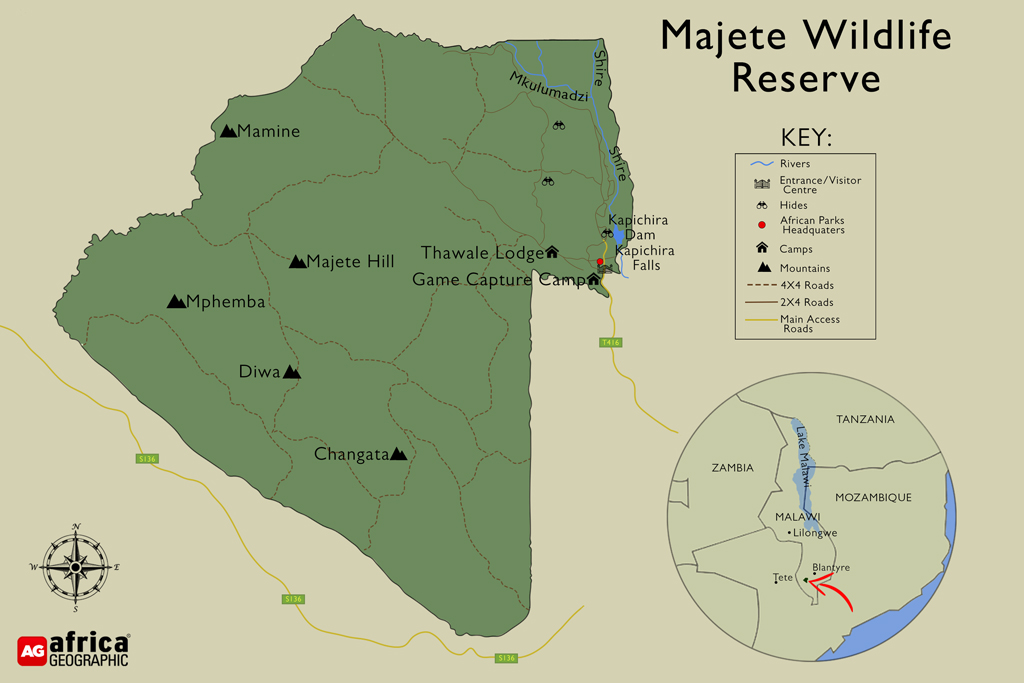
We dislike busy commercial border crossings, so leave Botswana from the remote Mabolwe Border Post. “You can cross into Zimbabwe only when the Shashe River is dry,” says the friendly border official before selling us hot, fresh magwinyas (small doughnuts) baked by his wife. Then, we’re off across the wide, tree-lined, sandy riverbed. In the small 10mx10m Mlambapele Border Post office on the Zimbabwean side, we can only write good things in a dog-eared notebook marked ‘Compliments and Complaints’. Whilst we go through the rigamarole of checking passports and vehicle papers, Scarlett makes friends with a trussed-up black-and-white goat, which she names Oreo, much to the amusement of the locals, who have other plans for it.  We’re the only border-crossers, and there are smiles all around. The entry stamp comes down with a thump – welcome to Zimbabwe!

Elephants rushing to the shores of Lake Kariba

Zigzag to Matusadona

Across Matabeleland we encounter donkey carts, baobabs, friendly smiles and waves from kids in wide-brimmed, school-issue sun hats. We follow little-used dirt tracks through cattle country to enter the Matopos from the south. Our safari sees us camping amongst wildlife with forever views over this ancient place. At sunset, we sit quietly amongst the huge, lichen-covered granite boulders where ley lines are said to interconnect. Iridescent green-blue lizards scuttle over the rockface, and elephant shrews dash between the smooth, round boulders glowing gold in the fading light. A black eagle soars overhead, and the only sound to be heard is birdsong carried on the wind. There’s magnetic energy here.

We dodge potholes down to Mlibizi on the southern shoreline of Lake Kariba, where, around the evening campfire, we chat about our past expeditions on the Zambezi – our favourite river.

The final zigzag to our safari in Matusadona National Park is an adventure, and we pass giant, centuries-old baobabs and neat Batonka villages. We navigate narrow bridges with dangerously crumbling sides. Mopane flies share our roadside lunch of tuna sarmies with tomatoes bought at a village market.  We stop at a roadside craft stall and purchase a small, hand-carved wooden rhino from a Batonka craftsman, which we symbolically name ‘Dona’. Miabella buys a little wooden pangolin and calls it ‘Halo’. Black rhinos were once such an iconic species in the Zambezi Valley until poaching wiped them out, and pangolins are now the most trafficked animal in the world. How interesting that, out of this region’s iconic wildlife, the craftsman had chosen to carve these two endangered species.

Matusadona
Kingsley with the golden boulders of Matopos, where the Afrika Odyssey team camped en route to Matusadona
Africa Geographic Travel

Resilience

Matusadona means ‘where the dung falls’, referring no doubt to the steepness of this incredibly wild and beautiful escarpment that sharply drops 600m to the Kariba shoreline far below. It is said that on occasion, a round dung dropping can tumble far down the steep, well-pounded elephant tracks that crisscross this ancient gateway. In the rainy season, these tracks transform into a wonderland of waterfalls and adventure-filled treks through deep gorges.

Travelling into Matusadona National Park, we expect a difficult, rough and rocky track from the top of the escarpment to the Kariba lakeshore below. But then we witness something remarkable that this part of the world hasn’t seen in years. It’s a big, noisy, yellow and powerful endangered species: a brand new grader. Thanks to African Parks now managing this venerated Zimbabwean park, the machine is hard at work making the steeply sloping road easily passable, providing a further incentive for 4×4 travellers to make this fascinating journey.


Find out about Zimbabwe for your next African safari. We have ready-made safaris to choose from, or ask us to build one just for you.


Matusadona offers adventure in 147,000ha of wilderness. Apart from the newly restored lodges and serviced campsites, there are also genuinely wild, unfenced 4×4 sites. We come across some overlanders wild camping next to an inlet of Lake Kariba. Nearby, two big male lions feed on a dead hippo as squabbling vultures scrabble for a foothold in the surrounding trees. A substantial crocodile cruises out into deeper water festooned in green water hyacinth, a single, pale purple flower comically perched above one primaeval eye. We encounter a safari roadblock on the track down to Tashinga Camp – as lions block our path. At the camp, park manager Mike Pelham and his wife Tracey are waiting to welcome us. Surrounded by impala and visited by the occasional elephant, we pitch camp under the spreading branches of giant sycamore fig trees on the shoreline of Lake Kariba.

Matusadona
Wild camping at Tashinga Camp

In the morning, we head to the operations room, where we meet the team from the Matusadona Conservation Trust (MCT) – a vibrant partnership between ZimParks and African Parks that began in 2019. “I’ve never seen people work so hard to become part of the new MCT,” remarks Mike, as members of the law enforcement corps snap to attention. Tough, intelligent, disciplined and committed, the challenges of restoring this park are immense for Mike and his staff: fish and bushmeat poaching, illegal gold panning up in the mountains, destructive fire-burns and human-wildlife conflict. The challenges of restoring the Matusadona ecosystem, protecting the pristine rivers and springs on the escarpment and rebuilding community relationships are all taken in stride. To top it all off, there is also the training up a first-class law enforcement team that will ensure the protection of black rhinos and other vital species when the time comes for them to be re-introduced.

“There’s immense pride here; we don’t compromise on what’s become known as ‘Matusadona quality’. Resilience is the key attribute that we look for in all our staff,” Mike tells us as he stands in front of a map that shows the ruggedness of the park’s terrain, the Kariba shoreline and surrounding community districts. “As you know, things have been tough here in Zim, so a good job, decent living conditions and being paid on time means a lot. We’re also extremely fortunate to have the full support of ZimParks and excellent cooperation with the National Judiciary’s dedicated Wildlife Directorate. Despite the difficulties of the past few years, these two departments have remained solid.”

Matusadona
The African Parks team from Matusadona embrace the Afrika Odyssey expedition team
Africa Geographic Travel

“But in today’s world, conservation cannot be successful without the support of neighbouring communities,” he continues. “So a big focus of the MCT is working with community structures and district councils to build knowledge and ensure that local people also benefit from Matusadona.”  And this is where the African Parks model of community involvement is outstanding. Daniel Sithole, Matusadona’s Community Manager, tells us that tomorrow is Umuganda Day – an idea taken from the Rwandan practice of people coming together once a month to engage in community outreach and help one another.


DID YOU KNOW that African Parks offers safari camps (lodges and campsites) where 100% of tourism revenue goes to conservation and local communities? Find out more and book your African Parks safari.


The expedition team is all hands-on deck. The following morning, we load one of the expedition Defenders onto a small ferry and chug across the Ume River, pushed along by a noisy, belt-driven, single-cylinder engine to Masamba Fishing Camp. This is one of two commercial livelihood projects on the lakeshore, which have seen a seven-fold increase in the catch thanks to the MCT’s efforts to protect the legal permit holders and stop fish-poaching syndicates from plundering the Matusadona shoreline.

Matusadona
Crossing the Ume River to reach Masamba Fishing Camp

Jovial Chief Mola and the village councillors greet us warmly before we all get to work to give the community hall a colourful makeover. Dirty walls are cleaned and painted, and then, using the ample stencils we’ve brought from SA, the building is transformed into a kaleidoscope of colour with a wildlife theme. Rhino, elephant, giraffe, zebra, lion, cheetah and buffalo, and ‘Musoma Hall’ in big, bold letters are all painted onto the walls. It’s great to see the enthusiasm of the Matusadona staff and camp residents, all wanting their turn with a paint brush, as school children sit in the shade of a big knob-thorn tree, putting the finishing touches to their Wildlife Art assignments. There are bright colours, laughter and smiles all around with Chief Molo presenting simple prizes – building bridges between conservation and communities.

There’s so much good stuff to do and such a good vibe that the Umuganda events stretch into the next two days with Daniel and his community team. There are malaria-prevention drives for pregnant women and mothers with young children, and the distribution of reading glasses to poor-sighted elderly folk at local clinics. Then there is the decorating of the walls of Matusadona Primary School inside the tidy and freshly-painted staff village, and the judging of the regional finals of the children’s Wildlife Art Competition – all with an exciting conservation theme.

Children from the community colour in for the Wildlife Art competition
Matusadona
Painting Musoma Hall
Conducting eye tests at the local clinic

Tired, dirty and covered in paint, we stagger back to camp each evening. We love the golden glow of the sunsets over Kariba with views across to Bumi Hills. Lions roar at the full moon, we hear grunting hippos, and there is a hyena skulking in the shadows, hoping we’ve left the camp kitchen door open. Around the campfire at night, we get to chat more with Mike and his Matusadona team. We also meet fascinating characters like Richard and Gilly Thornycroft from the Flying For Wildlife Trust, who arrive in their light sport aircraft to fly volunteer aerial patrols. We listen intently to their stories of hope for the future of this magnificent piece of Africa.

Renaissance

One morning, there’s much excitement at the park’s headquarters: a large herd of buffalo has appeared on the Matusadona shoreline for the first time in weeks. “The staff say they can’t believe how the animals are returning to the lakeshore,” says Mike with a grin. “The wildlife isn’t scared anymore – even elephants with tiny babies are revealing themselves again.” What a wonderful sign of this legendary park’s renaissance.

Animals such as buffalo are returning to the lake shore

As always, some symbolic traditions are linked to this Afrika Odyssey expedition. Carrying his rifle as if it’s an extension of his body and reading faint tracks and signs, Mike gives us short cameos of wildlife movements as we track through the mopane woodland to a secret pool fed by the springs that bubble out of the Matusadona escarpment. It’s a beautiful spot; a hippo explodes through the long grass and scrambles up the opposite bank. Mike draws us into a huddle and, in a whisper, says, “In the old days, when Matusadona was a black rhino stronghold, I tracked many of them to their favourite secret drinking pools just like this one.” He reverently dips the expedition calabash into the crystal-clear pool. He collects a thimbleful of symbolic water – a ceremony that will take place in all 22 protected areas managed by African Parks on our 12-country journey.

Collecting water from a pool fed by the springs of the Matusadona escarpment, to add to the symbolic expedition calabash
Africa Geographic Travel

There’s a strong smell of elephant. We come across a mound of fresh dung, the leaves and grasses hardly chewed – a sign of old age and few teeth. Mike silently tracks forward and points out an elderly elephant cow, her bony head just visible as she browses from a tamarind tree, oblivious to our presence.

As we return to the road, Mike bends down and grabs a fistful of foliage from a grey-green shrub. “This is wild basil, which, along with many other herbs and plants that grow here, makes Matusadona a great habitat for black rhino. One day, if all goes according to plan and the communities approve, we’ll have them back here. It will be a full circle as they will be the progeny of the original Zambezi Valley black rhino, removed 30 years ago to places of safety to protect their genealogy – along with sable and roan antelope and eland, which are also needed to restore the entire ecosystem. When that happens, Matusadona will become an anchor of safety and security – not just for wildlife, but for the wider community. That’s our 10-year goal.”

Matusadona is becoming a safe zone for wildlife such as lions

It’s with a degree of sadness that in the expedition Defenders, we climb back up and over the escarpment trailing clouds of dust. Matusadona has touched our hearts, and we feel like we’ve had a master class in conservation excellence. That night, back on the Zambezi at Deka, we take out the expedition’s Scroll of Peace and Goodwill for Conservation and read the handwritten messages from the Matusadona team.

Mike writes: “The adventure of rebuilding Matusadona has started, and I am incredibly proud that it will be restocked from other protected areas within Zimbabwe. The biggest gift that you can provide from this Afrika Odyssey expedition is to spread the news that Matusadona and Zimbabwe overall are still on the conservation map. Wilderness areas and the possibility for true adventure still exist, and our greatest asset – our people – are friendlier and more welcoming than ever.”

We certainly second that. With a sense of excitement, we continue our journey to connect these irreplaceable African Parks-managed areas across the continent. A great story of hope is unfolding.


Net win – saving Africa’s trees from elephants

South Africans have a peculiar affinity for large, iconic trees. The country’s Limpopo province is home to Africa’s tallest tree and the second thickest tree in the world. South Africa even boasts its own Champion Trees Projects since 1998, run by the Department of Water Affairs and Forestry. Landowners and nature enthusiasts throughout the country are exceptionally proud – and rightly so – of the large trees on their properties and in the nature parks they visit, as they make for iconic landmarks and provide shelter to all kinds of species that call the savannah home. Are you wondering how to best protect trees from elephant damage? Which methods work and when? New research, originally published by Elephants Alive, may have the answers.


The threats faced by trees: elephants and other agents

Where nature reserves house elephants, Africa’s largest land mammal is often singled out as the leading cause of destruction of the large trees with which they share the landscape. Elephants break trees to get easier access to the leaves, roots and nutrients. They also remove the bark to access the nutritious cambium layer underneath. As bark often strips off circularly around the trunk, this may lead to ring barking, causing the tree to die off as the cambium layer is responsible for transporting nutrients upwards from the soil. Yet, elephant feeding on trees has been found to benefit other species: dispersing seeds in fertile dung and improving plant diversity by opening up grassland areas, to name a few. However, elephants are selective about the tree species and heights they forage on, and their presence can eliminate certain tree species or height classes from an area over time. This can have cascading effects on other species that depend on these trees, like raptors or vultures nesting in tall trees. 

Trees
An elephant bark-stripping

Besides elephants, tree survival in African savannahs can also be affected by other ecological factors, like fire frequency and intensity, termite infestation, and drought stress. High fire frequencies can negatively affect woody biomass and the regeneration of large tree saplings. Drought stress can cause hydraulic failure and vulnerability to biotic attacks, leading to large tree declines even without the presence of elephants. Smaller herbivores, like impala, have been found to decimate great numbers of tree seedlings, thus negatively affecting tree regeneration.

A divisive debate ensues, where concerns about elephants as an endangered species and their role in preserving biodiversity are juxtaposed with the wish and need to preserve large trees as Africa’s natural landmarks. The complex interactions between elephants, other ecological factors, and tree survival in African savannahs have been causing headaches for conservationists and reserve management for decades. Different strategies have been implemented to limit or redistribute elephant impact to protect large trees. For instance, as elephant foraging is primarily centred around water sources, reducing the number of water points may limit the overall effect of localised destruction and population growth.

Trees
A bark-stripped tree
Africa Geographic Travel

Protecting large trees: what & how?

Trees may also be directly protected using “wire-netting” to prevent elephants from stripping the bark, which can facilitate tree mortality from various other causes. Wire-netting has previously been found to improve large-tree survival significantly. Highly cost-effective due to the affordability of materials and ease of application, wire netting can be applied en-masse to protect large amounts of trees at little cost. However, little is known regarding the lifespan of wire netting if not maintained and how effective it is as a long-term tree-protection solution.

Offering an answer to this uncertainty, a newly released study by Elephants Alive shows how wire-netting and various environmental factors, combined with the impact of elephants, influence the survival of large trees. The research offers a better understanding of the conservation challenges that reserve management faces while protecting large trees.

Trees
Map of the study site © Robin Cook et al. 2023

The study was conducted over 12 years in the Associated Private Nature Reserves (APNR) in South Africa. The APNR shares an unfenced boundary west of the Kruger National Park. The Elephants Alive research team, led by Dr. Michelle Henley and Robin Cook, conducted field assessments of 2,758 trees in 2008, 2012, 2017, and 2020. The tree species under investigation were false marula, knobthorn, and marula trees. Approximately half (or 1,395 trees) were wire-netted at the beginning of the study period.

The main goals of the study were to:

  1. Investigate how many of each type of tree survived over the 12 years in the APNR.
  2. Examine whether using wire netting to protect the trees affected their survival during the same 12-year period.
  3. Understand how various environmental factors (drought, fire), combined with the impact of elephants, influenced the survival of these trees during three different surveys conducted within the 12-year timeframe.

During their field assessments, the researchers recorded the diameter of the tree trunk, fire damage, presence of termites, ants and bracket fungus, the level of elephant impact on each tree, whether the tree had wire netting, the condition of the wire netting, and its survival status. For each year, the researchers also collected data on the mean annual rainfall closest to the trees’ location, elephant-bull and breeding-herd densities, and the distance to the nearest surface waterhole. 

Trees
Robin Cook on a field survey of a stem snapped marula tree
Subscribe to our newsletter and/or app

Wire-netting to the rescue: a simple solution to a complex issue?

In total, 33% of trees survived the 12-year study period. The distance to water sources did not significantly affect tree mortality, as the multitude of artificial waterholes in the APNR provides ready access to water. This finding emphasises the importance of other methods to limit the detrimental effects of elephant impact on large trees in areas where limiting water sources isn’t an option.

The study showed that using wire netting significantly improved the survival of large trees. Wire netting prevents elephants from bark-stripping, but the trees remain vulnerable to heavier forms of elephant impact like stem snapping and uprooting. Wire-netting is thus most successful for trees with a more than 40cm diameter. The method of wire-netting is a second important aspect of the success rate. Nevertheless, the effectiveness of wire-netting decreased after four years if the netting lost its structural integrity. Over one-fifth of the wire-netted trees in the study had damaged or fallen-off chicken mesh, making the wire-netting ineffective against bark-stripping. This highlights that wire netting can lose its effectiveness if not properly maintained. Conservation managers should consider replacing the chicken mesh after about four years to ensure continued tree protection.

Trees
Wire-netting effect showing how wire-netting protects larger trees with a diameter of 40cm or more © Cook et al. 2023

The researchers also discovered tree survival was lowest during drought, particularly for false marula and knobthorn. This suggests that drought can negatively affect the survival of these tree species. Elephants, mainly, increase their impact on trees during drier months when grass quality decreases. This impact may be further amplified for trees with shallow rooting systems (like false marula and knobthorn), making them vulnerable to water stress and competition for soil water compared to trees with deeper roots. An increased percentage of dead marula trees during the final survey period (2018-2020) may be attributed to a fire that affected the area where many of these trees were located. Adult marula trees are particularly susceptible to intense fires, especially after experiencing elephant impact.

Left: A marula tree with wire netting and termite damage (the reddish mud covering the bark). Right: Elephant reaching for higher branches

Elephants Alive’s research provides evidence of how the complexity of environmental factors has affected the mortality trends of three large tree species within the APNR savannah system over 12 years. The results show that wire-netting can be used as a mitigation method to significantly increase tree survival by reducing elephant impact on these trees. However, conservation managers must replace wire netting every four years to maintain efficiency. The results have also shown that tree survival was positively affected by an increase in mean annual rainfall (for false marula and knobthorn) and negatively affected by fire events (marula trees). These results provide important insights into how various environmental factors have influenced large tree survival where trees co-occur with elephants.

Reference

Cook, R. M., Witkowski, E. T. F. and Henley, M. D. (2023) “Survival Trends (2008-2020) of Three Tree Species in Response to Elephant Impact, Environmental Variation, and Stem Wire-Netting Protection in an African Savannah,” Forest Ecology and Management, 545

Article originally published by Elephants Alive (read Battle of the Titans: Africa’s largest land mammal vs Africa’s largest trees here)


THIS WEEK – 03 November 2023

The Milky Way in all its glory, as seen from a campsite in Akagera National Park, Rwanda. © Mihir Bhatt. Photographer of the Year 2021 entry

This is a copy of our weekly email newsletter. Subscribe here to receive the newsletter.


Questionable desert-adapted lion hunt + wild pigs

The most frustrating part of our mission to tell Africa’s stories warts-and-all is trying to unearth the facts when members of the wildlife industries appear to have behaved badly. Our story below about the latest trophy hunting of a livestock-killing Namibian desert-adapted lion is a case in point.

The lack of transparency; in fact let’s call this what it is – a blanket of secrecy – is not conducive to finding solutions to the many problems that beset our wild places as humans and wildlife vie for territory. During our attempts to determine two critical issues – how the trophy hunters found this lion in that vast desert and where he was killed – we were stonewalled by those who have the info and the mandate to communicate and validate the facts so that there is no speculation. Both issues go to the core of whether this was a legal hunt. Legality is important in the quest for sustainable solutions, right?

Based on the facts at hand, we stand by our deductive reasoning as detailed in the article, but I have assured the Namibian powers-that-be that we will amend the article and issue a public statement if any requested contradictory evidence comes to light – via official or other channels.

Keep the passion

Simon Espley – CEO, Africa Geographic


From our Editor – Taryn van Jaarsveld

The dead walk among us. Or, at least, zombie ants do. Did you know that Ophiocordyceps unilateralis (cordyceps for short) – the zombie-making fungus featured in The Last of Us – is real?

The parasitic fungus infects carpenter ants, where its spores are picked up by the ant on the rainforest floor (check out this zombie ant in Sapo National Park, Liberia). In an extraordinary feat of mind control, the fungus forces the ant to leave the safety of its nest, climb to a height and lock its mouth around a leaf, before growing and then feeding off the ant’s vital organs. Luckily, this parasitic fungi cannot infect humans (for now…).

This week, don’t miss our incredibly important story on the questionable hunting of a desert-adapted lion, and our comprehensive guide to the many wild pigs of Africa – both below.


Story 1
TROPHY HUNT
A male desert-adapted lion has been hunted amidst suspicious circumstances in Namibia – we ask questions of MEFT

Story 2
WILD PIGS
Our guide to the six species of wild pigs in Africa: from warthogs, to bushpigs, hogs and boars


Travel desk TRAVEL DESK UPDATES: 

Explore these prime safari spots in Botswana and Zimbabwe – whether you’re looking for a brief adventure, solo trip or unique bushveld safari. Contact our safari experts and let us plan your dream African safari!

Okavango Delta – 4 days/3 nights – from US$2,045pps
A wilderness experience to get you hooked on the Okavango Delta and an excellent introduction to this watery paradise. Glide down the waterways on a mokoro, and encounter the big cats, magnificent elephants, hyenas, and wild dogs. And not to mention over 400 bird species that calls this paradise home!

Special offer: no single supplement – Vundu Camp, Mana Pools, Zimbabwe
Fancy a solo safari? Book your stay in 2024 at Vundu Camp, Mana Pools National Park, and take advantage of the low-season offer – minus the single supplement! You’ll be on the banks of the mighty Zambezi and see a parade of Africa’s finest wildlife. Specific low-season dates apply.


WATCH: Why are photographic hides a must-visit? Andrew Macdonald travelled with Africa Geographic to Northern Tuli Game Reserve, Botswana, as part of the annual Photographer of the Year winner’s trip. Andrew experienced the Photo Mashatu sunken hide for some epic photographic opportunities. In this video, Andrew shares the highlights of his time in the hide (8:23). Click here to watch

For more videos celebrating Africa, check out our videos here

The wild pigs of Africa

From the despotic Napolean and arachnophile Wilbur to timid Piglet and hardworking sheep-pig Babe, suids (pigs) feature prominently in literature and popular culture. This is perhaps unsurprising given that the domestic pig is one of the most numerous large animals on the planet. However, there are also at least 18 wild species in the Suidae family (depending on the taxonomist), indigenous to Europe, Asia, and Africa. Of these, six species of wild pigs are found on the African continent, rooting their way across savannahs, lurking along dark forest paths, and enjoying a mud wallow as much as the next pig – these are the wild pigs of Africa.

The warthogs (Phacochoerus africanus and Phacochoerus aeithiopicus)

With their wide distribution and diurnal habits (and iconic vocals of a free-spirited, animated representative), warthogs are undoubtedly the most famous of all of Africa’s suids, often spotted on the quintessential African safari. These hardy animals are ubiquitous across savannahs, and almost any safari is all but guaranteed to yield at least one sighting. Unbeknownst to most, there are two species of warthogs roaming the continent – the common warthog (Phacochoerus africanus) spread throughout much of sub-Saharan Africa and the desert warthog (Phacochoerus aeithiopicus), which is isolated to the Horn of Africa.

Adult warthogs attain a size of around 75kg when fully grown, though mature males may weigh as much as 150kg. Their grey, wrinkled skin is covered by a spare smattering of coarse hair and the characteristic facial “warts” (actually just outgrowths of thick skin) for which they are named are particularly well-developed in boars, often extending as much as 15cm from below their eyes. The tusks of the males are also usually longer than those of the females. These modified canine teeth exist in pairs – the impressive upper maxillary pair and the shorter but razor-sharp mandibular pair. Though built a bit like tanks, warthogs display an astonishing turn of speed when necessary, and if flight fails, the tusks can be utilised as deadly weapons in a fight.

wild pigs
The common warthog
Africa Geographic Travel

Like most species, warthogs subsist on a primarily herbivorous diet, using their specialised snouts to shovel the juiciest bulbs and roots. However, they will supplement this carbohydrate-heavy fare with insects, eggs and even carrion on occasion. After a day foraging, they retreat to underground burrows to pass the dangerous hours of darkness. Boars in their prime are usually solitary (except during the short, fierce breeding season), but females remain in small natal sounders and will care for each other’s piglets.

The other wild pigs

Four additional species of wild pigs prominently found in Africa are the bushpig, red river hog, giant forest hog, and the African subspecies of the Eurasian wild boar – the North African boar.

The bushpig (Potamochoerus larvatus)

The stocky, shaggy bushpig overlaps considerably with the distribution of its distant cousin, the warthog. However, in contrast, few safari-goers ever glimpse these shy animals. Their evasion can be partly explained by their predominantly nocturnal habits, but, in truth, despite their reputation as “aggressive” and “dangerous” animals, bushpigs are usually extremely wary of humans and avoid them where possible.

Though roughly the same average mass as warthogs, this is where the physical similarities between the two pigs end. Bushpigs are covered in a thick, bristly coat that can vary in colour from a reddish-brown to dark grey, often with a lighter underbelly and a white mane. Their eyes are tiny, and the tusks are all but hidden beneath the thick skin of the snout (though they are still present and capable of inflicting considerable damage). Bizarrely, despite significant and apparent differences, warthogs and bushpigs were considered the same species for most of the 20th century and bushpigs only attained species status in the early 90s.

wild pigs
The striking colours of the bushpig
Africa Geographic Travel

As the name implies, bushpigs prefer dense vegetation and are often found in thickets, forests, swampland or riverine areas. However, they are adaptable and will readily occupy disturbed habitats around agricultural areas, often to the dis”grunt”lement of the neighbouring farmers. Like warthogs, bushpigs rely heavily on plant matter for sustenance, and their status as crop pests is often well-deserved as they have a taste for anything from sugarcane and maize to sweet potatoes and carrots. However, their omnivorous palate is also highly developed, favouring eggs, fledgling birds and carrion in any state of decay. They have even been observed stalking and killing young antelope.

Bushpigs are social animals and live in breeding sounders of up to 12 or more members. The dominant individuals, especially the boars, are very defensive of their sounders and intruders (including two-legged ones) will be chased away at considerable speed.

Red river hog (Potamochoerus porcus)

A close relative of the bushpig, red river hogs (pictured in this story’s cover image) are found primarily in the rainforests of West and Central Africa and are perhaps the most winsome of all Africa’s porcine offerings. They are covered by a luxurious pelt of ochre-coloured fur, which contrasts dramatically with their black and white markings. The comically over-large ears end in long, thin tufts outlined by a shock of white hair. These curl at the tips, giving the impression that the hogs have donned the African equivalent of a court jester’s hat. In contrast, the tiny piglets are decorated with a delicate pattern of pale stripes and spots.

Red river hog
Red river hog piglets have patterned pattern pale stripes and spots on their fur

Their diet and social structure are similar to that of the bushpig, and they communicate continuously with other members of the sounder with a vast repertoire of grunts and squeals. Though primarily nocturnal, they may emerge to forage and wallow around water points during the day. The forest baïs of Odzala-Kokoua National Park in the Republic of the Congo are among some of the best places to encounter them in the wild.

Giant forest hog (Hylochoerus meinertzhageni)

In terms of averages, the giant forest hog is considered the largest of all living wild pigs but is also one of the world’s most mysterious. Like the red river hogs, they lurk in the depths of the thick forests in West and Central Africa. Despite their intimidating size and Gothic covering of jet-black fur, giant forest hogs are exceptionally retiring. They are seldom encountered in the wild, even by those who research their habits.

Consequently, there is still much more to learn about this porcine colossus, from subspecies (or even species) distinctions to conservation status. We know they live in family groups, and these sounders include a dominant boar that plays a hands-on (hoof-on?) role in protecting offspring. There is also a strong suspicion that the giant forest hog may be more threatened than its IUCN Red List status of “least concern” implies due to snaring and bushmeat poaching.

wild pigs
Giant forest hogs in Aberdare National Park, Kenya
Africa Geographic Travel

Eurasian wild pig/wild boar (Sus scrofa)

As the ancestor of most domestic pig breeds, the Eurasian wild pig or wild boar is a relatively well-known species (though one was somehow mistaken for an escaped lion in Berlin in mid-2023!). These dishevelled beasts are widespread across most of Europe and Asia and have been introduced to North America and Australasia (where they have become a problem in some areas). The African subspecies – the North African boar (Sus scrofa algira – also called the Barbary wild boar) – is smaller than its European relatives and is found in Morocco, Algeria and Tunisia.

wild pigs
The wild boar

Trophy hunted: Namibian desert-adapted lion – here are the facts

Another desert-adapted lion has been trophy hunted in Namibia. The collared lion, known as ‘XPL-107’ and ‘Mwezi’ by researchers, was the only remaining black-maned desert-adapted lion in the area. 

The established facts, as detailed below, led to us asking a few uncomfortable questions of a senior representative of Namibia’s Ministry of Environment and Forestry (MEFT). We use his replies, evidence gleaned from our sources and deductive reasoning to arrive at serious doubts about the legality of this hunt.   


desert-adapted lion
XPL-107 – this photo was taken a few years ago. © Ingrid Mandt

Facts & evidence:

  1. The location of the lion on the day of his demise – as evidenced by data from his collar GPS device – suggests he was hunted either in Skeleton Coast National Park (illegal) or in an adjoining concession operated solely for tourism purposes (unauthorised). The collar provides data every four hours via satellite, allowing for an accurate record of his movements on 11 October 2023 – the day he was killed: 
    • 12h00: XPL-107 was located 4km inside Skeleton Coast National Park. Lions usually rest up in shade during the heat of the day – especially during summer – and only move around or hunt during the cooler hours. He was located within 600m of this position for the eight hours between 04h00 and 12h00.
    • 16h00: failed collar ping. Collar pings have an almost 100% success rate. Failure would suggest that by 16h00, the lion was being transported in the back of a vehicle, GPS device facing the floor.
    • 20h00: XPL-107’s body is located at Khowarib hunting camp. This is 99km as the crow flies from his position at 12h00 – along very poor roads that would take a vehicle many hours to traverse. Ironically, this ping also triggered an ‘Early Warning System’ – designed to notify monitors that a lion has moved into an area of potential human-wildlife conflict. The above location pings suggest that XPL-107 was killed between 12h00 and 16h00. Bearing in mind that lions seldom move great distances during the heat of the day, deductive reasoning suggests that this lion was either killed inside Skeleton Coast National Park (illegal) or in neighbouring community land leased to a tourism company (unauthorised). Also note that if XPL-107 had moved outside of these protected areas, his collar would have sent an early-warning system ping. The only such ping occurred when his carcass was located in the hunting camp.
      XPL-107
  2. No designated officials within the relevant conservancies or concession holders were informed that there was a legitimate hunt authorised in the area. We are also informed that neither the Directorate of Scientific Services at MEFT nor the relevant MEFT lion-conflict manager were informed about the planned hunt.
  3. We questioned the MEFT representative during a telephone call as to how the trophy hunting party located XPL-107 in such a vast area and, specifically, whether the collar location data was used for this purpose. Research collars are for the purposes of research and human-wildlife conflict prevention. The representative denied the use of the collar location data by the trophy hunting party. However, we know that one particular MEFT official who did not show prior interest in the location data of any lions, logged in every day from 21 September 2023 (when XPL-107 was named a ‘problem-causing animal’) until the day the lion was shot. This particular official only looked at XPL-107 data and did not log in again after the day XPL-107 was killed. Deductive reasoning based on this information and the hunting party movements described below would suggest that the collar data was used to locate XPL-107 for trophy-hunting purposes.
  4. The movement of two vehicles carrying the hunting party (including two foreign nationals and a rifle) and MEFT officials was recorded as follows:  
    • The two vehicles entered the Palmwag concession at the Aub gate 
    • On being questioned about the rifle, MEFT claimed they were there for ‘policing’. No permit related to a hunt was presented
    • There is no record of the vehicles leaving the area via an official/manned gate

  5. XPL-107 was declared a ‘problem-causing animal’ by MEFT around 21 September 2023 – after being suspected of killing livestock on two occasions in July 2023. In the first incident, he was seen by a scout where 14 goats were killed, and data from his collar verified his presence. In the second incident, where a Brahman bull was killed, XPL-107 was not seen, but collar data confirms that he was in the area at the time. There appears to be little doubt that he was responsible for these livestock deaths. There do, however, seem to be doubts about whether MEFT followed the necessary procedures to declare XPL-107 a so-called ‘problem-causing animal’. Delhra, a Namibian non-profit working with local farming communities to preserve wildlife within the Kunene region of Namibia, has suggested in various social media announcements that the Minister must, in terms of section 53 of the Nature Conservation Ordinance 4 of 1975, declare a problem-causing animal as such via a notice in the Official Gazette. During our telephone discussion with a MEFT spokesperson, it was confirmed that MEFT had not done so. The same MEFT representative undertook to provide incident reports related to the two livestock attacks but has not yet done so.
  6. Unlike with other human-lion conflict cases in this area, no attempt was made to use established mitigation measures to avoid killing another desert-adapted lion. A few weeks before this, lion OPL24 was successfully relocated after killing a few goats. Further back, lion XPL131, who caused far greater damage than XPL107, was relocated by MEFT twice before finally being declared a problem-causing animal.
  7. The Ehi-rovipuka Conservancy has been allocated two male lions as trophies this year. The trophy hunting of XPL107 will not be counted as one of these trophies because his killing was enabled under the ‘problem-causing animal’ provisions. And so, two additional male lions will be removed from the threatened desert-adapted lion population for trophy-hunting purposes.
  8. XPL-107 was seen mating with the last surviving lioness of the Obab Pride from 29 September to 5 October 2023 – as reported by researchers – days before he was shot.  Researchers described him as ‘one of the most reproductively successful males in the population’.
  9. Follow the money: According to the MEFT official we spoke to, this trophy hunt generated a total of N$300,000 for local communities and N$20,000 for a fund for conservation and human-wildlife management. The total amounts to approximately US$17,000 – which is about 28% of the likely trophy fee of US$60,000 paid by the trophy hunting client (as per a recent trophy hunting advertising campaign for a ‘male lion trophy’ in Namibia). The important question is why African communities are continually being short-changed by the trophy hunting industry.

About desert-adapted lions and the communities that share their landscape

Desert-adapted lions occupy an area of approximately 40,000 km2 in Namibia’s remote and barren northwest. They share this landscape with about 19,300 humans – mostly small-scale pastoralists for whom drought and predation represent significant threats to livelihoods. Lions account for 20% of livestock losses. 

The population of lions in the Kunene Region to the northwest of Etosha National Park is only 57-60 individuals, BUT of these, an estimated 24 are desert-adapted lions (the far-westerly population). This population fluctuates significantly based on rainfall, prey base and human persecution. The entire population in the Kunene Region went from a low of perhaps 20 individuals in the late 1990s to an estimated high of 180 in 2015. 

Convincing livestock farmers that lions should occupy the same landscape at all is a tough ask, especially when there are no obvious benefits. The tenuous relationship between communal farmers and lions has engendered retaliatory and preventive killing of lions. Since 2000, retaliatory killings have accounted for 89% of recorded lion (non-cub) mortalities – with more than 130 lions killed during this period.

Some view trophy hunting as one model demonstrating economic benefits to local people – if the industry is managed sustainably and legally. Considerable effort is made to prevent and mitigate livestock losses resulting from lion predation. One such method is to track individual lions using satellite collars, which trigger warning SMSs when the lions are near livestock so that local people can chase the lions away. Another method is the provision of safe fenced areas where livestock can be moved at night.

The desert-adapted lion is not a separate species from lions found in less arid areas. They do, however, display remarkable adaptions that enable them to live in this inhospitable region – which non-adapted lions would not survive.


READ MORE about desert-adapted lions and measures to protect them.

SEE MORE photos of desert-adapted lions.

Read about the Desert Lion Conservation Trust here.

THIS WEEK – 27 October 2023

The herd brings the drama as it arrives at the springs to drink. Chitake Springs, Mana Pools National Park, Zimbabwe © Jens Cullman. Photographer of the Year 2022 entrant

This is a copy of our weekly email newsletter. Subscribe here to receive the newsletter.


Kruger rhino tally + salt pan archaeology + bad banks

Did you know that a handful of top banks have invested into companies that make traditional Chinese medicine from endangered animal parts? Think pangolins, rhinos, leopards and tigers.

Based in Australia, Canada, the EU, Japan, Switzerland, the UK and USA, many of these banks are signatories to the Principles for Responsible Investment or members of the International Corporate Governance Network, which has publicly expressed concerns about biodiversity loss and species extinctions. Seven are members of The Royal Foundation’s United for Wildlife (UfW) Financial Taskforce, which was launched in 2018 to stop the trafficking of wildlife. Trading in these animal parts is also strictly forbidden by CITES.

You will find further info and the list of the banks here. Boycotting them probably won’t achieve much. However, writing to their CEOs to express your disappointment – and persisting when the doors are inevitably slammed shut, will do more good than you may realise. CEOs are human too, and hundreds of weighty messages will achieve the desired effect. You know what to do …

Keep the passion

Simon Espley – CEO, Africa Geographic


From our Editor – Taryn van Jaarsveld

Invasive mammals are the main cause of animal extinctions on islands worldwide. Did you know that mice are eating their way through the Marion Island bird population – even giants like wandering albatrosses?

Marion Island is an important seabird stronghold in the sub-Antarctic Indian Ocean, and invasive house mice accidentally introduced to the island by sealers in the 1800s are devastating its populations. But, there is hope: Learn more about the Mouse Free Marion project here.

This week, we bring you the latest update on Kruger’s rhino population, and fascinating insights into the archaeological wonders found in the Makgadikgadi salt pans.


Story 1
KRUGER RHINOS
Rhino populations in Kruger National Park continue to decline despite innovative strategies implemented to prevent rhino poaching

Story 2
SALT PAN ARCHAEOLOGY
Archaeological sites in the Makgadikgadi salt pans reveal how ancient humans used black silcrete formed from lake mud to make tools


Travel desk TRAVEL DESK UPDATES: 

Choose one of the two safari options below or combine both for the ultimate Kenyan safari. Contact our safari experts and let’s start planning.

Maasai Mara secret season – 6 days – from US$3,500pps
Explore the northern-most limits of the Maasai Mara-Serengeti ecosystem. Using Sentinel Mara Camp as your base, you’ll go in search of resident lion prides, cheetahs and leopards. You’ll also find elephants, plains game and insanely gorgeous sunsets – all key ingredients to the quintessential Maasai Mara experience.

Special offer – Lewa Wilderness, Kenya – Stay 3, pay 2 or stay 4, pay 3
Take advantage of this incredible special offer at Lewa Wilderness and you’ll soon find yourself exploring one of Kenya’s oldest private safari destinations. This beautiful lodge is based in Lewa Wildlife Conservancy, Laikipia, and is shadowed by the magnificent Mount Kenya. Stay three nights and pay for two, or stay four nights and pay for three (specific dates apply).


Collar a Lion campaign

Long Shields Guardian Programme

How are men and women living around Hwange National Park helping to prevent incidents of human-wildlife conflict? The Long Shields Guardian Programme employs and trains people from local communities to protect villages from lions, safeguard cattle, and aid in wildlife management. GPS collars fitted on lions provide an early-warning system to the guardians, who are able to act quickly to prevent incidents from happening. Guardians patrol daily, alerting villagers through a WhatsApp group when lions approach, deterring them from community lands. This innovative ‘Mobile Boma’ concept helps protect livestock, enhances food security, and reduces lion killings. The programme’s expansion has led to an increase in crop yields, a reduction in predation, and fewer retaliatory lion deaths. Find out more about the programme and donate to support peaceful human-lion coexistence.


WATCH: Making contact: A K9 conservation story. This series tells the personal stories of companionship, perseverance and connection of those fighting the scourge of poaching in South Africa, while highlighting the key organisations and protected areas making a difference on the ground (4:53). Click here to watch

For more videos celebrating Africa, check out our videos here

Archaeological magic in Makgadikgadi

The salt pans of Botswana’ Makgadikgadi hold an unusual magic that I’ve heard described as “humbling”, “healing”, or even “disturbing”. What is it about this dusty old lakebed, jammed full of salt and grass and scrub mopane, that makes visitors feel this way? That seems to challenge our sense of self, irreversibly? That draws people back time and time again? In the Makgadikgadi, the skies are huge, and the sense of space is overwhelming. But there is more than the landscape. As part of a team of scientists who have spent time studying the magic of the Makgadikgadi, we have long known that, just below the saltpan surface of the pans lies an ancient story written in stone artefacts, thousands of years ago. Archeologists are now just beginning to find the ability to read it. 

Bounded by ancient shorelines, Botswana’s salt pans were once one part of one of Africa’s largest lakes. Running nearly 200km from east to west, this lake covered an area of 66,000km² –about the size of Sri Lanka. The lake has come and gone over the last hundred thousand years as tectonism has reorganised river systems. Natural climate cycles during the last 200,000 years have also periodically brought vastly different rainfall conditions to the region. Today, the site is made up of mostly mud and puddles, with the wettest parts in Sowa Pan in the east supporting an extraordinary diversity of birdlife in the rainy season – including a migration of up to 88,000 pairs of flamingos.

Makgadikgadi
Thousands of flamingos perched on the salt pans
Africa Geographic Travel

In the dry winter months, most of the surface dries out and firms up – a little like a giant bowl of porridge left out in the sun. Self-drivers know the risks here well: break through the hard-baked porridge top, and it might cost you days of digging, if not your entire vehicle. Many come here for that challenge. Others are drawn by the vast expanse of salt and sky, the baobabs that mark its boundaries, and the 20,000-body strong migration of zebra and wildebeest that covet the Makgadikgadi’s mineral-rich grasslands.


Find out about Makgadikgadi Pans for your next Botswana salt pans expedition. We have ready-made safaris to choose from, or ask us to build one just for you.


More recently, however, tourists are coming for another reason. In 2019, a controversial academic paper used mitochondrial genetic evidence to argue that the Makgadikgadi was once the ‘homeland’ of humanity, from which groups of anatomically modern humans migrated between 130,000– 110,000 years ago. That argument has not been persuasive for most scientists working on human origins, but it has thrown a spotlight on a little-known quirk of this ancient lakebed – that it is filled with the stone tools of ancient humans.

For a long time, the difficulties of operating in an ephemerally stable bowl of porridge kept all but the most eager of archaeologists at bay. But, over the last seven years, our small team of international scientists in collaboration with the University of Botswana have painstakingly pieced together thousands of fragments of worked silcrete to try to understand how long humanity has been hanging out in this lakebed and what on earth they might have been doing here.

Makgadikgadi
Remnants of the Late Stone Age
Makgadikgadi
Examining Paleolithic stone tools; handling raw material found in an excavated site

Logging over 80 new Stone Age archaeological sites and artefact scatters on the lakebed, the researchers excavated six of these in detail, stripping back the surface salt rind to carefully map every fragment of stone artefact deposited at the sites. The archaeologists then used an approach known as Chaine Operatoire – reconstructing the operational sequence of the stone tool makers to see what choices those humans were making in the past. How was the tool made? How was it used? Resharpened? Recycled? Why was it discarded?

All the excavated sites had a common theme – they withheld the fleeting remnants of a band of Middle Stone Age humans who sat for a few moments or hours on a dry lake bed, taking time out to fashion tools out of silcrete. Geochemical fingerprinting of both the artefacts and natural outcrops of silcrete in the basin enabled geologists to determine where the material for making the tools had come from. The chemical signatures suggest this was a landscape well-known to Middle Stone Age people, and evidence shows these people would move large lumps of suitable rock between 7 and 55km if they thought it was high enough quality. Nearly all the archaeological finds were made from black silcrete formed from the lake mud, its fine-grained texture perfect for fashioning tools.

Makgadikgadi
Excavation of one of the sites
Makgadikgadi
Taking it all in

The abundance of silcrete in the basin lent itself to perfectionism, with tool-makers happy to discard tools impaired by the slightest mistake. Bungled artefacts were often found a little way from where the rest of the knapped fragments were refitted, and the archaeologists like to joke that they might have been thrown in anger or frustration at the mistake – a 70,000-year-old tantrum recorded in mud and stone. No perfect tools were found at any of the sites – those had presumably been taken away for hunting elsewhere. Neither was there evidence of any of the imperfect remnants used in hunting. These were most likely retooling sites for groups of people rich in time and stone. Sometimes, the knappers produced knives and scrapers, but mostly, they made points that were symmetrical and not too thick, the kind that might be hafted as a spear for hunting. It is hard not to speculate that all those years ago, we too may have once been much like the lions that annually follow the herds of migrating Zebra into the basin today: walking a journey that offered rich rewards.

Sampling for Optically Stimulated Luminescence dating
Africa Geographic Travel

Perhaps the biggest surprise in this geochemically active basin full of migrating ungulates was how well-preserved these sites were. In some cases, locating where a single human sat and fashioned a tool 75,000 years ago was possible. As well as piecing together the archaeology, our team used Optically Stimulated Luminescence (OSL) dating to reconstruct how and when the landforms and sediments around the sites were deposited. From this, we concluded that several of these sites were rapidly buried by lake sediments not long after they were occupied. They remained buried for thousands of years until sometime in the last few centuries when the lakebed experienced some of the driest conditions of its long and dramatic history. Eroding as vast plumes of dust, removing these ancient lake sediments reveals older surfaces from past dry times. This unique landscape history has allowed the lake to preserve phenomenal snippets of our human story – windows that transcended extraordinary periods to open onto a few tangible moments of our collective past.

Giant hand axes of ancient humans

Time seems compressed in the Makgadikgadi, and it feels like one can almost touch the ghosts of humanity’s ancestors. Sometimes, I watch visitors sit on that lakebed; I see them take in the enormity of that connection. I see them reach out and touch a rock last held by a man or woman who walked here 70,000 years ago. I see them trying to picture a 66,000km² lake, already disturbed by the vastness of billions of stars above their heads, already in awe of the giant Baobabs that have witnessed so many of us come and go over thousands of years. I see their sense of place in the big picture being profoundly destabilised, and I see them clock the extraordinary collective journey of humanity. In a world that is now so obsessively focused on the self, this place provides a very different perspective, one that can be healing, humbling, and disturbing. That is the magic of the Makgadikgadi.

Kruger rhino population update – the losses continue

rhino

Rhino populations in Kruger National Park continue to decline despite innovative strategies implemented to prevent rhino poaching. The latest population count, reported in the SANParks Annual Report 2022/2023, reveals that the total rhino population has declined by 16.2%, from an estimated 2,458 rhinos in 2021 to 2,060 in 2022.


Despite investing in access control, air support, security staff, specialised detection technology, K9 Units, dehorning and ranger training, 98 rhinos were lost to poaching in Kruger National Park in 2022. This is a decrease of 49.7% in poaching compared to the 195 rhinos lost in 2021.

“Innovative strategies implemented in Kruger National Park, which has historically borne the brunt of this scourge, led to a decline in poaching numbers by 49,74% compared to the previous year,” says Pam Yako, Chairperson of the Board for SANParks.

7.1% of the white rhino population was lost to poaching and 3.4% of the black rhino population.

There were an estimated 1,850 (between 1,711 and 1,988*) white rhinos in Kruger by the end of 2022, compared to the 2,250 (between 1,986 and 2,513*) counted in 2021. For black rhinos, the 2022 survey estimated 210 black rhinos present in Kruger, compared to 208 for the 2021 reporting period*.

(*Editorial note: All population estimates are given a margin of error, as population counts over large areas carry uncertainty. When calculating the percentage decline/increase, these margins of error are included in the statistical analysis. Although the 2022/2023 annual report states that for “the past three years, black rhinos remained at an estimated 210 individuals,” actual estimates from these reporting periods were 208 for 2021 and 202 for 2020.)

rhinorhino

SANParks also reported that the lagging effects of drought contributed to the continuing decline in white rhino numbers. In contrast, black rhinos did not experience the drought effect, and births were slightly higher than total losses.

The Kruger National Park Rhino Management Plan zones the park into core areas with suitable rhino habitats. In these core conservation zones, there was an overall decline of 19.58% in the rhino population, “primarily due to white rhinos leaving these areas in response to poaching and moving to known localities of suitable habitat,” according to the report. On a positive note, the black rhino population in these core conservation zones increased by 12% since 2020, and substantial increases in black rhino populations were recorded in certain priority zones.

SANParks referenced an initiative to establish rhino strongholds outside Kruger to encourage range expansion. Furthermore, 702 rhinos were dehorned in Kruger, and by the end of 2022, approximately 70% of the park’s rhinos had no horns. (Dehorning has been highlighted as an effective strategy in reducing poaching).

rhino
702 rhinos were dehorned in Kruger in 2022

Despite the decrease in poaching incidents in Kruger, reports have shown a shift in poaching away from the Kruger National Park to private reserves in KwaZulu-Natal. However, no rhinos were lost to poaching in the six other SANPArks-operated parks hosting rhinos (Addo Elephant, Karoo, Mapungubwe, Marakele, Mokala and Mountain Zebra National Parks). The rhino populations in these parks increased by 7%.

Africa Geographic Travel

The annual report also highlights cause for concern regarding snaring for bushmeat in and around parks. SANParks removed one snare from a black rhino, treated 17 injured white and two black rhinos and recovered five white rhino orphans in Kruger, stating that many of these cases were linked to snaring targeting other species.

SANParks also reported that it has started removing disease-free rhinos from Kruger (cleared of bovine tuberculosis), but “this has limited options and can affect the dynamics between the remaining rhinos.”

While poaching rates have shown a significant decline, an analysis of Kruger National Park’s overall population estimates over the past ten years indicates a continued downward trend in rhino numbers despite an increase in anti-poaching initiatives. In the past ten years, Kruger’s total rhino population has decreased by 78%, from 9,383 in 2013 to 2,060 by the end of 2022.

“It has become evident that South Africa needs a species recovery plan for white rhino that considers the support required for conserving rhino across extensive wildlife systems,” says Minister of the Department of Forestry, Fisheries and the Environment Barbara Creecy. “Partnerships with private rhino owners will be important to the plan. SANParks has been requested to lead the development of such a recovery plan as a key element of its work in this coming financial year.”

Further reading

Read more about the science of keeping Kruger’s rhinos safe.

Read the previous update on rhino populations in Kruger for the 2021 period here.

THIS WEEK – 20 October 2023

A chimpanzee peers through the foliage at eager trekkers. Nyungwe National Park, Rwanda © African Parks | Marcus Westberg

This is a copy of our weekly email newsletter. Subscribe here to receive the newsletter.


Deadly electric fences + East vs Southern African safari

We are deep into my favourite safari months in Southern Africa. October and November see searing heat and clouds of dust – keeping most holidaymakers away and reserving the epic wildlife encounters for connoisseurs. The lack of fresh water sees wildlife congregated near the few remaining drinking spots, and high drama as tempers flare and predators cash in. Welcome early rains may take the edge off the heat and dust for a day or two, but the action continues unabated.

Meanwhile my sources tell me that elephant poaching is on the rise again in northern Botswana. Apparently the Zambian syndicates that have stripped Botswana of her rhino population have taken many tons of raw ivory in the last few months – including one of the few remaining tuskers (giant elephants with tusks that weigh 100 pounds each side). Northern Kruger National Park is also under siege, with lions and vultures being targeted. Perhaps one day our governments will protect their revenue-producing, job-creating wildlife with as much passion as they do their salaries and errant colleagues …

Keep the passion

Simon Espley – CEO, Africa Geographic


From our Editor – Taryn van Jaarsveld

What is the deadliest cat in Africa? The answer may surprise you. (Unless, of course, you’ve seen the videos of these cats surfacing in recent years).

Lions, mightily ferocious, have a hunting success rate of 19-25%. Leopards kill their targets 38% of the time. One of the most lethal predators in Africa, cheetahs, who snap up their prey on 58% of their hunts, could almost be named the greatest hunting cat. But the crown for deadliest feline in Africa goes to its tiniest: the black-footed cat. Weighing in at around 2kg, these cats have a hunting success rate of 60%. Though they may resemble domestic tabby cats, and their bright eyes and bushy tails make them incredibly endearing, these little killers capture more prey in a single night than a leopard does in six months.

Despite its status as one of Africa’s deadliest animals, these fatal felines are extremely rare and under-researched. Little data is available on black-footed cats, making conservation of the species very difficult. They are so tiny that they cannot even trigger regular camera traps. Thankfully, a small group of scientists is putting this “anthill tiger” on the map, having established a database on the cats and advocating for their protection. You can learn more about these kitty killer machines here.

Below, check out our handy guide that will help you choose between an East or Southern African safari, and read our story on the animal toll of electric fences.

Happy celebrating Africa to you!


Story 1
https://travel.africageographic.com/safari-advice/east-africa-versus-southern-africa-safari-which-is-best
EAST VS SOUTH
East Africa and Southern Africa offer distinct safari experiences, from high wildlife volumes to a diversity of landscapes and species. Here’s the lowdown on the highlights of each

Story 2
SHOCK VALUE
What is the animal toll of electric fences? Safeguarding protected areas comes at the expense of wildlife, says research


Travel desk TRAVEL DESK UPDATES: 

When booking your safari with AG, don’t hesitate to ask for the unthinkable – such as the chance to flatten three bucket-list experiences in one safari, in one country! Or to find that epic special offer on multiple luxury stays. Explore the options below and let us help you create an extraordinary safari.

Big 5 + Chimps + Gorillas in Rwanda – 10days/9 nights – from US$7,945pps
This could be the best African bucket-list safari out there… Go in search of the Big 5 on the rolling plains and lake shores of Akagera NP, visit the dense forests of Nyungwe NP to see chimpanzees, and traverse the highland forests of Volcanoes NP to find Rwanda’s mountain gorillas.

Tswalu Kalahari 6-night special offer: Save 23%
Fancy a huge saving on the ultimate off-the-beaten-track escape to the Kalahari Desert, South Africa? Combine three nights at family-friendly Tswalu The Motse, with three nights at the ultimate private wilderness retreat, Tswalu Loapi Tented Camp, and you’ll save 23% percent on your trip. Offer valid until December 15, 2023


WATCH: Wish you were here? Check out these riveting safari moments. AG can take you there – contact us to start the discussion (0:41). Click here to watch

For more videos celebrating Africa, check out our videos here

“Shock” value – the animal toll of electric fences

Electric fence

Pangolins, steenboks, and large reptile species, including rock monitors and tortoises – were the species most likely to be killed by electric fences in a new study published in the African Journal of Wildlife Research. According to the author, body size, defensive behaviour, and seasonal flux, all play a role in influencing the risk of an animal having a fatal encounter with an electric fence.


Throughout Africa, fences (and many other anthropogenic structures such as roads) have changed the face of the natural landscape. In some instances, they play an essential role in safeguarding protected areas, conserving endangered species, and reducing human-wildlife conflict. Equally, the deleterious effects of these barriers on wildlife regarding habitat fragmentation, migration and seasonal resource access are relatively well documented. 

In much of southern Africa, electrified fencing is utilised by both the state and private sectors to delineate property boundaries and constrain animal movement. In South Africa, private reserves, game ranches (usually for hunting purposes), and intensive wildlife farming operations have multiplied in recent decades, with a concurrent increase in electric fencing. Previous studies have raised concerns about the dangers that these electric fences pose to ground pangolin and tortoises. However, while the potential adverse effects of electric fences have long been known to reserve managers and ecologists, research quantifying the threat and risk factors to other species remains scant.

Electric fence
Slow-moving tortoises retract into their shells when shocked, and therefore remain in contact with the live wire

The new research was conducted on the Kalahari Oryx Private Game Farm in the Northern Cape Province of South Africa. 108km of electric fencing was monitored over nearly five years. During this time, Dr Darren Pietersen of the University of Pretoria recorded 782 wildlife interactions with the electric fence involving 43 vertebrates, including mammal, reptile, and bird species. Two hundred thirteen of these encounters were fatal. The species with the highest mortality rates were rock monitors (59), steenboks (40), pangolins (28), serrated tent tortoises (28) and kori bustards (15). Naturally, animals found entangled with the fence but still alive were rescued and either released or rehabilitated, including six pangolins, two rock monitors, two kori bustards and two red hartebeests.

Electric fence
Small wildlife, including amphibians and reptiles, are often victims of electric fences

Overall, Pietersen found that reptiles were most likely to be killed by an interaction with electrified fencing, followed by birds and then mammals. He identified three critical factors that influenced the outcome of such an encounter – size, season and defensive behaviour. Very small species, such as rodents and lizards, can pass beneath the wire strands unharmed, and large animals may damage the fence but are unlikely to become entangled or electrocuted. Medium-sized animals such as pangolins and monitor lizards large enough to touch the wires but still small enough to become entangled are most at risk. The wet season also increased the incidence of electrocution, possibly due to increased reptile activity and the dispersal behaviour of mammals. The moisture levels may also have contributed to the greater conductivity of the animals and the ground.

The effect of defensive behaviour is most clearly demonstrated by pangolins and tortoises, both slow-moving and which freeze when threatened. They then curl into a ball (pangolins) or retract into their shells (tortoises). As a result, they remain in contact with the live wires, subjecting them to continuous shocks until they eventually succumb. Of particular interest in this study was that rock monitors were the most frequent victims of fences. This was likely due to a low number of tortoises in the study site, but it is an important finding as rock monitors have not featured as a risk species in previous research.

This paper adds to the steadily growing body of available data on the impact of electric fences on African wildlife. The statistics are staggering: previous research by Pietersen and other authors estimates that over 30,000 reptiles are killed every year. Possibly worse still, they estimate that annual fence mortalities include between 377 and 1,028 ground pangolins in South Africa alone. That makes electric fences one of the greatest threats facing an already beleaguered species.

An impala shocked by an electric fence

There are well-documented mitigation measures that could help to reduce the number of wildlife mortalities. These include turning the fences off at certain times or purposely creating entry and exit points in the fence for the passage of smaller animals. “Smart energisers” can also monitor individual strands and turn off the current to low strands if there is any evidence of a trapped animal (if current is repeatedly drawn from that strand, for example). Raising the lowest electrified strand by just 30cm will also allow most reptiles and pangolins to pass unhindered beneath it. Many of these strategies are cheap and easy to implement, and widespread education is necessary to ensure that all stakeholders – from private reserves to livestock farmers – are brought on board to help protect the continent’s smaller and more vulnerable species.

Reference (available through a paywall)

Pietersen, D. W. (2022) “Body Size, Defensive Behaviour, and Season Influence Mortality Probability in Wildlife Interactions with Electrified Fences,” African Journal of Wildlife Research, 52(1)

THIS WEEK – 13 October 2023

Kayaking the waterways of Masoala National Park, Madagascar. © George Clad

This is a copy of our weekly email newsletter. Subscribe here to receive the newsletter.


Tanzania’s cheetahs + salt pans + hierarchy of fear

Life in the bushveld is tough! We have monkeys pillaging our attempted vegetable garden, kudus snapping young planted trees in their dry season desperation to find food, leopards snacking on pet dogs, squirrels chewing the roof lining, spitting cobras and scorpions in the garden…

I would not have it any other way.

My late mom told me that, when I was about eight or ten, I lectured our priest for using leopards as symbols for evil during his Sunday sermon. Apparently I was incensed at his reckless symbolisation of one of nature’s superstars. I have been swimming upstream ever since 🙂

My point is this. Enjoy every second of your life, every glimpse of nature doing her thing, every hint of changing seasons and sniff of rain in the air. This is it. The great safari of life. Peace out

Keep the passion

Simon Espley – CEO, Africa Geographic


From our Editor – Taryn van Jaarsveld

What is the scariest sound in the African savannah? The answer is fairly obvious…

The sound of humans – of course.

Researchers studying the hierarchy of fear in mammals in the South African bushveld revealed that wildlife were more fearful of the sound of human voices than that of lions. Researchers placed cameras and audio speakers near waterholes in Greater Kruger, and played a series of sounds – including birdsong, dogs barking, gunshots, lions growling, and humans talking – to animals passing by. Nineteen species fled instantly when hearing human voices, and reacted more quickly and fearfully than when hearing the snarls of lions.

Why? Because, according to the researchers, humans are “super predators”. We humans are lethal, and dangerous – evoking the greatest fear in animals. Hard to argue that one.

Below, you can check out our stories for this week. We’re revealing the secrets of southern Tanzania’s cheetahs, and giving you the low-down on all there is to know about visiting Botswana’s salt pans.

Happy celebrating Africa to you!


Story 1
SALT PANS
Botswana’s salt pans, including Makgadikgadi Pan, are of the largest on earth. The site of zebra migrations, the pans are an epic safari spot

Story 2
TANZANIA’S CHEETAHS
A new study, in aid of cheetah conservation, reveals the secrets of the cheetahs of the Ruaha-Rungwa ecosystem


Travel desk TRAVEL DESK UPDATES: 

Longing for an escape to warmer climates? To lounge beside the ocean? Here’s your chance to dive in and spend your holiday in paradise! Get in touch with our experts to book your balmy safari.

Expedition Blue Lagoon – from €3,850pps – 11 days/10 nights
Discover Madagascar’s pristine and raw beauty on this 11-day safari. Experience powdery white beaches, palm trees, rainforests, lemurs and impossibly blue waters on this tropical-island escape.
You’ll experience the Masoala rainforests and Ambodilaitry Masoala Marine Reserve’s Blue Lagoon on Madagascar’s northeast coast.

Honeymoon special: Partner receives 50% off at Azura Benguerra Island
Azura Benguerra Island lies within a marine national park in the Bazaruto Archipelago, Mozambique. Spend your honeymoon on this unspoilt heavenly island and receive 50% off for your partner and discounts on rates, activities, spa treatments & Champagne. Valid for a min 4-night stay before 15 December 2023.


Saving lions

You can help save African lions! Africa’s free-roaming lions are under threat from human-wildlife conflict. These lions are an essential part of the continent’s ecosystems, its tourism industry, and its livelihood.

Thankfully, the Southern African Conservation Trust (SACT) and partners have embarked on a project to conserve lions. They require GPS satellite collars to track the natural movement of lions between protected areas, and to develop lion management plans. These collars provide data to computer simulations, allowing all parties to monitor lion prides on park boundaries. They also provide an early-warning system to local communities about the whereabouts of lions, allowing them to react quickly to potential problems and avoid human-lion conflict.

You can help to save these wild lions by making a contribution to the SACT through our Collar a Lion campaign.

Find out more about how you can help save free-roaming lions and what your sponsorship will include.


WATCH: Our safari experts view November as the month of variety and for seeking out localised migrations and other unique safari experiences. From the world’s largest mammal migration, to fine weather in the Cape Winelands and low-season rates in Madagascar – here’s what’s on offer for your November safari (1:10). Click here to watch

For more videos celebrating Africa, check out our videos here

Botswana’s salt pans

In the heart of Botswana lies a land so strange, so otherworldly, that to visit is like walking across the surface of the moon. The air shimmers, and white clay crackles underfoot, baked hard by an unforgiving sun. From horizon to horizon, emptiness stretches for endless miles, broken only by the occasional stand of palm trees that stand stark against the sky. Botswana’s salt pans are among the largest on earth. For those who make the journey for this unique African safari, the reward is a sense of absolute isolation and remoteness against the backdrop of some of Africa’s most hauntingly beautiful landscapes.

Salt of the earth

Once upon a time, the mighty Okavango River poured south from Angola and emptied into a vast paleolake larger than Switzerland – Lake Makgadikgadi. Then seismic activity shook southern Africa, changing the shape of the earth’s surface and blocking the river’s flow. Lake Makgadikgadi gradually dried up, leaving behind a dry and apparently barren wasteland. Though often referred to as just Makgadikgadi Pan, the region comprises a series of salt pans stretching for hundreds of miles in every direction, interspersed by sandy desert and covering some 16,058 km2 (1.6 million hectares) of the Kalahari Basin. The largest are Ntwetwe Pan, Sua/Sowa Pan and Nxai Pan.

salt pans
The baobabs of Kubu Island

Rising from the flats of the pan-like fossilised Leviathans are iconic igneous rock islands dotted with the squat forms of ancient baobabs. The most famous of these are Kubu and Kukome islands in Sua Pan. Kubu Island is so important to Botswanan heritage that it is one of the country’s national monuments. Hidden here (and scattered throughout the pans system) lies evidence of our human history in the form of stone tools, walls and other relics. Some of these even pre-date the era of Homo sapiens, and several scientists have argued that Makgadikgadi should be considered the birthplace of humankind.

Though the landscape is rugged, it is anything but desolate: the rims of the pans are fringed with palm fronds, frayed umbrella thorn trees and scrubby savanna, where desert-adapted wildlife eeks out an existence in the extremes. And every year, when the first storm clouds darken the skies, the parched dustbowl transforms into a lush paradise, flushed with a soft blanket of green. Drawn to this profusion of mineral-rich grasses, zebras arrive in their thousands, following the ancient pathways of Africa’s longest terrestrial migration. They are accompanied by herds of wildebeest, oryx and other antelopes, while resident and nomadic predators alike stalk hot on their heels. Fed by the nearby ephemeral Nata River, the pans fill with water, attracting flocks of water birds, including ducks, geese, pelicans, and flamingos.

An aerial view of the Makgadikgadi Salt Pans
Africa Geographic Travel

Of twin parks and salt pans

Much of this vital habitat is protected by a twin pair of national parks: the 3,900 km2 (390,000 hectares) Makgadikgadi Pans National Park and the 2,590 km2 (259,000 hectares) Nxai Pan National Park to its north.

Makgadikgadi Pans National Park covers part of Ntwetwe Pan, with the remainder of the park consisting of grasslands and a scattering of smaller salt pans. The Boteti River runs along its western boundary, acting as the only permanent water source for miles around. Even at the height of the dry season, the Boteti is an oasis for thirsty wildlife, including throngs of elephant, giraffe, zebra and wildebeest.

Nxai Pan National Park is home to seven impressive baobabs made famous in the 19th-century painting by British artist Thomas Baines. This tranquil oasis had provided him shelter as he accompanied pioneer James Chapman on a journey through the Kalahari towards Victoria Falls. The “Baines’ Baobabs” still stand, almost unchanged over 160 years later.

salt pans
Elephants drink at the waters of Nxai Pan

Botswana’s great migrations

Unbeknownst to most people, Botswana is home to two impressive migrations, both of which centre around the Makgadikgadi-Nxai Pan ecosystem. These migrations offer astounding (often less crowded) wildlife sightings and testify to the genetically programmed instinct to migrate. Across the continent, fences have halted most of Africa’s large mammal migrations across the continent. But when veterinary fences in Botswana were moved in the mid-2000s, researchers and conservationists were astounded to see some of the zebra herds return to two ancient migratory patterns.

The first of these is the Chobe-Nxai Pan zebra migration. At a round trip of over 1,000km, scientists have only recently recognised it as the longest terrestrial migration in Africa. The herds spend the harshest of the dry months around the Chobe River flood plains from June until early November before over 20,000 zebras begin the journey southwards. These herds disperse throughout the Nxai Pan National Park and remain there for about three months, from December to February, gathering their strength before beginning the return journey north.

The Okavango-Makgadikgadi migratory route is a shorter and smaller migration that involves around 15,000 zebras that complete a 500km roundtrip each year. These animals spend the dry season around the Okavango Delta floodwaters before moving to the Makgadikgadi Pans area when the rains fall.

salt pans
Zebras have once again returned to their migratory routes centering around the Makgadikgadi-Nxai Pan ecosystem
Africa Geographic Travel

Survivors of the salt pans

Even once the zebras have departed from the salt pans, the Makgadikgadi and Nxai Pans regions still thrum with life. Herds of springbok, impala, giraffe oryx, eland and hartebeest are resident all year round. Leopards lurk in the denser forests and along the riverbank, while lions of the black-maned Kalahari stock spend their days in the shade and cover enormous distances at night. Cheetahs and wild dogs (painted wolves) frequent the open grasslands, and hyenas of both the brown and spotted varieties abound. Of the smaller predators, black-backed jackal are ubiquitous, as are the adorable families of bat-eared foxes. Aardwolves and aardvarks emerge at dusk, and some lucky visitors are even treated to the sight of the elusive striped polecat.

One of the region’s major attractions is the groups of habituated meerkats. These charming little characters have learned to treat visitors as part of their everyday environment, sometimes even climbing onto delighted guests to gain a higher vantage point.

Makgadikgadi has long held a reputation as a sterling birding destination – a concept that might seem strange in light of its harsh desert aspect. Yet during those rare years when the rains are good, and even the largest pans fill to the brim, the region turns into a wetland paradise, including the associated birdlife. Flocks of greater and lesser flamingos arrive in droves, decorating the pans in a delicate shade of pink, accompanied by trawling great white and pink-backed pelicans, ducks and geese. The community-managed Nata Bird Sanctuary on the northern edge of Sua Pan protects one of the world’s largest breeding sites of lesser and greater flamingos.

Wattled cranes, red-knobbed coots, pied avocets, African spoonbills, grey-headed gulls, white-winged terns and a variety of storks, ibises, and herons are all additional waterbird highlights. Away from the water, long-legged secretary birds stalk through the grasslands, and ostriches display their motley feathers.

Flamingos fly over the Makgadikgadi Salt Pan
Africa Geographic Travel

Explore & stay at the salt pans 

Want to go on a safari to Botswana’s salt pans? To find lodges in or near Makgadikgadi, search for our ready-made packages and get in touch with our travel team, scroll down to after this story.

Botswana’s salt pans are a rare safari gem in that they are equally spectacular as a wet or dry season destination. While the rainfall of the summer months (between late November to early March) does make the pans themselves largely inaccessible, the experience of desert-turned-sanctuary is hard to beat. Many of the herbivores give birth around this time of year, and migrant animals arrive by hoof or wing in their thousands. It is as though the very land itself breathes a sigh of relief, refreshed and sufficiently revived to survive the long dry months ahead.

Taking a bath at Nxai Pan

By contrast, the dry season from March to October offers the best opportunity to take advantage of the escapism for which the salt pans are so famous. The scenery is at its most evocative at this time of year, and, with the ground once again flat and hard, visitors can set out on foot, horseback, 4×4 or quadbike and head out onto the vast salt flats. Take a few steps in any direction and embrace a sense of isolation and space so profound that it seems to warp time itself. Even better are nights spent under the diamond-studded skies, enjoying some of the best star-gazing on the continent.

Budget campsites are available, and a self-drive adventure through the salt pans region is an excellent option for the well-prepared traveller. However, Makgadikgadi is famous for its more luxurious lodge options, many of which are styled as a romantic homage to a forgotten safari era. A stay at one of these lodges means that you have an expert guide at your disposal, along with many other salt pan-exclusive activities to add to the safari wish list.


Find out more about visiting the Salt Pans , and Botswana, for your next African safari. We have ready-made safaris to choose from, or ask us to build one just for you.


A view of the Makgadikgadi Salt Pans, with Jack’s Camp perched on its shores

The cheetahs of southern Tanzania

Cheetahs

With wild cheetah populations declining, the science of their conservation requires an understanding of their distribution across protected and unprotected landscapes. However, within Africa and East Africa in particular, studies on cheetahs are strongly geographically biased, with much of the research conducted in a handful of well-studied areas. In 2021, a multidisciplinary team of conservation scientists set out to thoroughly investigate the Ruaha-Rungwa ecosystem in southern Tanzania for the first time.


The Ruaha-Rungwa ecosystem extends over 50,000km² (500,000 hectares) of savannah habitat. It includes the Ruaha National Park, Rungwa, Kizigo and Muhesi Game Reserves, as well as surrounding “Wildlife Management Areas” and “Game Controlled Areas”. The level of protection and anthropogenic pressure varied across the different landscapes. Though the Ruaha-Rungwa ecosystem has long been believed to be home to Tanzania’s second-largest cheetah population, little empirical or current data existed to support this claim prior to this research. (Tip: to book your safari to see the cheetahs of Tanzania’s Serengeti, click here.)

In their ground-breaking study, the scientists used various methods to assess cheetah numbers, distributions and densities. The first involved using camera traps placed in different habitats across the study area and set up during the dry seasons of 2018 and 2019. The cheetahs photographed were individually identified using their unique spot patterns. This approach allowed conclusions to be drawn about the densities in the different habitats. The Ruaha Carnivore Project had also previously deployed camera traps in some of the surrounding unprotected village lands as part of a community engagement programme. The data from these 43 traps was analysed using the same approach.

Africa Geographic Travel

The researchers also relied upon expert trackers to systematically record any tracks from cheetahs spotted on vehicle-based transects conducted throughout all protected areas and the unprotected eastern village landscapes. And finally, all photo-tourism guides operating in Ruaha National Park recorded all cheetah sightings in 2018 as part of a collaborative effort with the Ruaha Carnivore Project. The guides recorded their GPS position and took digital images that were later identified to an individual level. (In their conclusion, the researchers suggest that a relationship between scientists and tourism operators is an under-appreciated and cost-effective data source when monitoring large predators in Africa.)


Want to plan your African safari to spot cheetahs in the wild? We have ready-made safaris to choose from, or start planning a unique safari made just for you.


In combining the data from these techniques, the scientists were able to draw several conclusions about the Ruaha-Rungwa’s cheetah population. Their findings confirmed that cheetahs are present in western Ruaha National Park and the contiguous Rungwa South Open Area, whereas previously, these areas were listed as within “possible” cheetah range. In fact, cheetah were found to be widely distributed throughout the entire ecosystem across various habitats administered by an array of land management strategies. These included areas reliant on either phototourism or hunting for revenue and surrounding rural villages.

Cheetahs Africa Geographic Travel

However, the cheetah appear to occur at low densities, so while they may be found across a large area, this does not necessarily equate to a large population size. Of those observed by guides in Ruaha National Park in 2018, only 11 individuals were identified, belonging to four separate groups. The spoor and camera trap data yielded similar results. The authors theorise this may be due to “biotic” factors rather than anthropogenic pressures. Most of the recorded cheetah were found to be utilising miombo woodland habitats, which adds to a growing body of evidence that woodlands and regions of dense vegetation, rather than just grasslands, are valuable habitats for cheetah. However, in the arid Ruaha-Rungwa landscape, these woodlands are associated with low prey densities, which would impact cheetah densities.

One particular cheetah was captured on two camera traps 64km apart in under two months, providing evidence of wide-ranging movement within this population. As such, the authors conclude by emphasising the urgent need for more surveys to the west of the Ruaha-Rungwa landscapes towards Katavi National Park, especially as this region would be vital for connectivity between populations. 

Reference

Strampelli, P. et al. (2021) “Insights into the Status and Distribution of Cheetah (Acinonyx jubatus) in an Understudied Potential Stronghold in Southern Tanzania,” African Journal of Ecology, 59(2), pp. 334–341

THIS WEEK – 06 October 2023

A forest elephant arrives just in time for tea on the waterways of Odzala-Kokoua National Park, Congo-Brazzaville. Read more about Gail’s mega safari with AG below. © Gail Robins-Browne

This is a copy of our weekly email newsletter. Subscribe here to receive the newsletter.


Hybrid elephants + Lake Manyara + prime-season Bots special

Last night, a lion roared closer to our home than usual – the husky groan reverberating through the thin night air. Lizz and I wondered if this individual had breached our wildlife estate fence and entered from the neighbouring Greater Kruger. We always keep close tabs on our dogs at night because of neighbourhood leopards, so after a brief moment of anxiety (prey species instinct?), we settled back to enjoy the moment.

We live in a brick house in a well-managed estate, so lions are a welcome presence – entertainment, if you will. Many of Africa’s rural villagers are not so fortunate. They have basic accommodations made of mud, sticks and grass, and their livestock spend the nights crowded into makeshift kraals – scant protection against a pride of lions. For them, lions represent a significant threat to lives and livelihoods. No wonder, then, that human-wildlife conflict is the biggest threat to lion populations. There used to be wild lions across Europe, but they disappeared as the human population exploded. Africa’s human population, too, is expanding. And yet Africa still has wild, free-roaming lion populations – a testament to our rural people.

I cannot stress enough the importance of wild, free-roaming lions for Africa’s ecosystems. And for her tourism industry – a vital source of empowerment, jobs and upskilling for local people. To learn more, please visit our website, search for ‘lions’, and enjoy years of science-based reporting.

Better still, help researchers save wild, free-roaming lions. Every amount helps – it really does. THANK YOU

Keep the passion

Simon Espley – CEO, Africa Geographic


From our Editor – Taryn van Jaarsveld

Did you know that scientists have just discovered a new species of pangolin? The extraordinary tale of its discovery speaks to the sorry state of affairs around these mammals: the new species was identified when analysing pangolin scales confiscated from the illegal trade. The investigation of these scales revealed genetic markers not seen in any known species –  this undiscovered pangolin had fallen into the hands of poachers.

With only eight previously known species of pangolin (four in Africa, and four in Asia), the addition of a ninth species – named Manis mysteria – expands our knowledge of their diversity and evolutionary history. Conservationists can now focus on protecting this newly identified species, working to tackle the supply and demand of the pangolin trade and ensuring the survival of pangolins.

In our first story below, we continue our look into interesting species, with a study focusing on identifying hybrid elephants. Plus, you can read all about Lake Manyara National Park, the perfect base from which to launch your Tanzania safari.


Story 1
HYBRID ELEPHANTS
A study from Kibale investigates how to distinguish between forest/savannah elephant hybrids & different elephant species

Story 2
LAKE MANYARA
Lake Manyara, home to millions of migratory flamingos & high elephant densities, is the perfect base from which to start your Tanzanian safari


Travel desk TRAVEL DESK UPDATES: 

Fancy a mobile safari in Botswana? Book now and you’ll save big time. Or plan that incredible family holiday to Maasai Mara, and kids will stay free! Read on, and reach out to our travel team now!

EARLY-BIRD SPECIAL – Botswana classic: fully catered mobile safari – $5,990 pp (save 10%)
Explore all of northern Botswana during prime season on a fully catered mobile safari. Beginning in Kasane and ending in Maun, and led by experienced guides, you’ll track big cats and wild dogs, and meander along the Chobe River. Book this authentic Botswana safari experience today and don’t miss out on this early-bird special, high-season rate of US$5,990pp, valid from 7–17 July 2024.

Kid’s stay free at Angama Mara, Maasai Mara National Reserve, Kenya
Stay on the edge of the Great Rift Valley and experience heart-stopping wildlife scenes year-round. Two children under the age of 12 stay free between 5 January – 31 May, and 1 October – 22 December 2024.
Angama Mara is a remarkable safari lodge overlooking Kenya’s Maasai Mara – offering a thrilling experience for the whole family.


Mega four-country safari

Our safari client, Gail Robins-Browne, and company, recently returned from a mega-safari (38 days) to Congo-Brazzaville, Rwanda, Uganda and Kenya. Gail enjoyed a boat trip on the Nile River, breakfast on the Mara River, kayaking and spotting forest elephants in Odzala-Kokoua National Park, and walking in Laikipia. Here is what Gail had to say about her experience:

“The itinerary planned was complex as it included Congo-Brazzaville, Uganda and Kenya. Nevertheless, the resulting trip was excellent. Christian (AG safari expert) was very responsive to all our queries. We had many amazing experiences, excellent guides and all camp accommodations – while varied – were very satisfactory!”

Want to experience a mega-safari like Gail’s? Come travel with us and let’s start planning!


WATCH: The Kwakuchinja Wildlife Corridor allows thousands of animals to migrate between two national parks: Lake Manyara and Tarangire. The Chem Chem Association is working to stem the tide of poaching and human-wildlife conflict along this ancient corridor. Here’s how (7:45). Click here to watch

Lake Manyara National Park

Africa is renowned for its spectacular sunrises and sunsets, blazing in a tapestry of red and gold that inspires artists and photographers alike. And, of course, these twilight displays are complemented perfectly by specific settings. One such example can be experienced in Tanzania’s Lake Manyara National Park, where the brilliance of light on the water blends into the rosy blush of over a million flamingos. There is no better way to set the tone for the majesty of a Tanzanian safari.

Lake Manyara

The world around Lake Manyara

Lake Manyara National Park is named for the eponymous lake along its eastern edge, and two-thirds of the 325 km2 (32,500 hectares) park extend over this shallow lake’s surface. The remainder of the park includes an astonishing variety of habitats sandwiched between the lake and the dramatic hills of the Great Rift escarpment to the west. The park is also part of the larger UNESCO Lake Manyara Biosphere Reserve, which incorporates the entire lake basin. To the south, along the escarpment, the national park is buffered by the Marang Forest Reserve, and both the Manyara Ranch and the Kwa Kuchinja wildlife migration corridor link Manyara to Tarangire National Park in the east. These vital connections allow the park to function as part of an enormous migratory ecosystem that includes the Engaruka Basin, Maasai Steppe, Lake Natron and Mount Kilimanjaro.

Lake Manyara
Lake Manyara’s water levels rise and fall seasonally, revealing vast salt flats in the dry season

The lake itself has no outflow but is fed by underground springs and streams originating in the Ngorongoro highlands, eventually tumbling off the escarpment walls in a series of delicate waterfalls and joining to form nine little rivers. Manyara is described as a soda lake, meaning the water is very alkaline, which has historically created perfect breeding conditions for the hundreds of thousands of flamingos wading along the shoreline (more on these below). Water levels rise and fall seasonally, revealing miles of salt flats during the dry season. Even at the height of the rainy season, the lake only reaches depths of around three metres and is only a few centimetres deep across most of its area.

In the park’s northern section, the same underground water that supplies the lake also supports an unusual and verdant groundwater forest. Apart from offering welcome shade in tropical temperatures, the dense stands of towering mahogany and lush fig trees are a breeding site for thousands of pink-backed pelicans. A bit further south, the forest gives way to open Acacia (Vachellia/Senegalia) woodland savannah, where the park’s elusive but famed tree-climbing lions are sometimes found. Thick clumps of sedges, luminous yellow fever trees and wild date palms line the lake shores, river systems and swamps.

Lake Manyara
Lake Manyara is known for its tree-climbing lions. For more photos from Frederica Vinci, follow @rica_red on Instagram

Along the park’s western boundary, the escarpment rises sharply over a thousand metres, the steep slopes dotted with the lumpy forms of ancient baobabs and the unmistakable spikey forms of pencil cactus (Euphorbia tirucalli), for which the park is named. “Emanyara” is the local name for this succulent plant, traditionally used to create fences around rural dwellings. The park also has hot springs at Maji Moto (literally “hot water”), where water bubbles out over 60˚C.

Despite the park’s relatively small size, it encompasses multiple habitats supporting its diverse fauna and flora. It is also perfectly positioned between Arusha and the more famous Ngorongoro Conservation Area and Serengeti National Park, making it the ideal launch pad for Tanzania’s northern safari circuit (click here to start planning your own African safari in the Serengeti).


Find out about Tanzania’s many options for your next African safari. We have ready-made safaris to choose from, or ask us to build one just for you.


Lions and elephants and baboons, oh my!

The national park was established to safeguard the region’s substantial elephant population and tree-climbing lions. Lake Manyara and Tarangire National Parks are home to some of Tanzania’s highest elephant densities, and at certain times of the year, there are grey pachyderms seemingly around every corner. The tree-climbing lions are also a major drawcard, though they have probably since been eclipsed by the lions of the Serengeti and Queen Elizabeth National Park in Uganda, which are also often observed leopard-like in the boughs of trees. Exactly why some lion populations display this arboreal tendency remains unconfirmed, though it may be motivated by a desire to escape tsetse flies and other biting pests.

Lake Manyara
Lake Manyara is home to some of Tanzania’s highest elephant densities
Africa Geographic Travel

Of course, to focus solely on elephants and lions would undermine the other equally thrilling animal offerings of the park. For instance, several habituated troops of olive baboons provide endless hours of entertainment, and vast herds of buffalo, wildebeest, zebra and Thomson’s and Grant’s gazelles move across the grasslands. Squadrons of banded mongoose trot across the park in search of insect prey, and servals stalk the swamps while nimble klipspringer pairs leap along the cliffs above them. Bat-eared foxes, civets and honey badgers are commonly encountered on night drives in the park. Even otters lurk along the rivers that feed the lake, and jacuzzi-loving hippos languish in a pool below the park’s hot springs.

Vast herds of zebra, wildebeest and buffalo occupy Lake Manyara’s grasslands

Flamingos and their feathered friends

Yet for all that Lake Manyara National Park offers mammal viewing against a magnificent backdrop, the park’s feathered occupants have previously been the park’s true stars. In particular, Lake Manyara was famous as a gathering site for hundreds of thousands of migratory greater and lesser flamingos. One study estimated nearly two million lesser flamingos and around 40,000 greater flamingos had assembled in the lake, though numbers vary considerably each year, and global flamingo populations are declining. The warm alkaline waters of soda lakes across East Africa favour the growth of the algae upon which the flamingos feed. The shallow, caustic waters are the perfect place for them to construct mud nests away from predators.

However, Lake Manyara has experienced flooding in recent years, impacting safari experiences. While the park remains open, some areas are submerged, and access to certain wildlife viewing locations has been affected. The flooding has also led to ecosystem disruptions and affected wildlife sightings, particularly flamingos, which have largely moved on.

Lake Manyara
Millions of migratory flamingos gather in the lake in former years

Like neighbouring Tarangire National Park, Lake Manyara was one of Tanzania’s top birding hotspots. Naturally, the lake and surrounding rivers extended exceptional waterbird sightings during the wet seasons, including flocks of clumsy pelicans, elegant cormorants, gaudy grey crowned cranes, spoonbills, herons of every shape and size and an eclectic collection of storks ranging from motley marabous to the stately saddle-billed stork. Away from the water, the chatter of noisy silvery-cheeked hornbills filled the forest, and majestic Verreaux’s eagles haunt the cliffs. Vultures like the critically endangered white-backed and Rüppel’s ride the thermals, while pairs of Ayre’s hawk eagles hunt helmeted guineafowl.

It is best to check in with regards to the status of flooding before planning a trip here.

Lake Manyara hosts thousands of pink-backed pelicans. which breed in dense stands of towering mahogany and lush fig trees
Africa Geographic Travel

Explore & stay in Lake Manyara

Lake Manyara is just two hours’ drive from Arusha on good roads. While accommodation inside the park is luxurious (and limited), there are many options along its fringes to suit most budgets.

Lake Manyara
Guided night game drives are allowed in the park

Like much of East Africa, Manyara experiences two rainy seasons: the “short” rains in November and the “long” rains between March and May. As mentioned previously, however, flooding in the long-rains season has notably diminished its traditional safari highlights, especially flamingos, waterbirds, and easy lakeshore access. Visitors now may experience limited sightings, flooded roads, and replaced game-driving routes. To maximise your safari experience, aim for June–October, or plan for half-day visits/leeways if travelling during the wettest months. During these wet months, though, the park is at its most scenic: the lake is full, the vegetation verdant and the cliffs of the escarpment covered in a gleaming web of waterfalls.

Apart from the usual vehicle-based activities, there is also a canopy walk on narrow bridges through the treetops of the groundwater forest, which is especially good for birders searching for forest specials. And, assuming the lake is high enough, canoe safaris offer a different perspective and the best way to admire the escarpment from the water.

Hundreds of giraffes dot the plains surrounding the lake (composite image)

Final thoughts on Lake Manyara

The Lake Manyara safari experience is lowkey and less frenetic than the wildlife extravaganza of the Serengeti or Ngorongoro. Yet, this is not a reason to dismiss or overlook this hidden gem of a national park, which offers an intimate and beautiful destination to bookend your once-in-a-lifetime safari.


Lake Manyara
Aerial view of Lake Manyara

* Note that seasonal changes (and periods of heavy rainfall and drought) alter lake levels, grasslands and the movement of wildlife.

The hybrid elephants of Kibale – new research on how to distinguish types of African elephant

ElephantThere are two species of African elephant – the savannah elephant (Loxodonta africana) and the forest elephant (Loxodonta cyclotis). As the names imply, the two generally occupy distinct habitats and are theoretically easily distinguishable. However, forest and savannah elephants are known to produce fertile hybrids in regions where their habitats overlap, particularly in Kibale National Park in Uganda. Visual differentiation between the different species and hybrids is an essential aspect of research into their behavioural and ecological variations. Now, a newly published study from Kibale has laid the groundwork for this process. 


Astonishingly, despite decades of genetic evidence, forest elephants were only recognised as a separate species (rather than a subspecies of the savannah elephant) by the International Union for the Conservation of Nature at the start of 2021. The reasons for the delay in their recognition were complex, but the existence of known fertile hybrids played a significant role. 

In order to investigate the phenotype (the physical appearance) of the hybrids, the researchers first had to establish the most important (and easily assessed) differences between forest and savannah elephants. This they did by comparing nearly 300 reference images of elephants across multiple forest and savannah areas in Africa. As the direct study of shy elephant populations can be challenging, they aimed to identify morphological criteria that could be easily assessed on camera trap images. They also selected features that did not require precise measurements. Ultimately, six morphological criteria were identified: the position of the lobe of the ear in relation to the mandible, the distance between tusks and trunk, the tusk orientation (both in profile and when viewed face-on), the indentations of the temporal region/shape of the forehead and the curvature of the spine. The researchers were able to distinguish between forest and savannah elephants with 90% certainty using these criteria.

Elephant
The morphological criteria used to distinguish the different types of African elephant, including the savannah elephant (top), the hybrid form (middle) and the forest elephant (bottom). © Bonnald et al. (2023)

Both forest and savannah elephants are found in Kibale National Park, but little was known about the proportions of each species or the number of hybrids. Consequently, the next step of this study was to scrutinise the physical appearance of all elephants in the forested Sebitoli area of northern Kibale. Analysis of 1,408 videos from camera traps revealed that 36.8% of the elephants matched the savannah phenotype, 12.1% the forest phenotype and 51.1% an intermediate phenotype between the two. The latter probably includes the hybrids.

The difficulty arises because elephant hybrids are fertile, meaning that multiple levels of hybridisation are possible (a pure savannah elephant could cross with a pure forest elephant, or two hybrids could breed and so on). In addition, any population always has a degree of individual variation. Furthermore, forest elephants are known as a “paedomorphic form” of the savannah elephant. This means adult forest elephants more strongly resemble young savannah elephants, making it challenging to create a one-size-fits-all set of criteria.

Africa Geographic Travel

Thus, the authors recommend further study combining genetic analysis and phenotypic characteristics. However, while genetic methods are precise, they are expensive and time-consuming, so the goal should be creating an accurate “species assignment key” as a simple tool to distinguish savannah, forest and hybrid elephants. The authors emphasise the importance of this process in terms of conservation efforts. The forest elephant is classified as Critically Endangered, and the savannah elephant is Endangered. Any effective conservation actions require “precise information on the biology, behaviour and reproduction of each species”, which makes identifying them essential.

Reference

Bonnald, J. et al. (2023) “Phenotypical Characterisation of African Savannah and Forest Elephants, with Special Emphasis on Hybrids: The Case of Kibale National Park, Uganda,” Oryx, 57(2), pp. 188–195

Further reading

Read more about Kibale National Park here.


THIS WEEK – 29 September 2023

A desert-adapted lioness, collared for scientific research, strides across the harsh landscape. Namibia. © Vicki Santello

This is a copy of our weekly email newsletter. Subscribe here to receive the newsletter.


You can save lions + are Kruger rhinos safe?

Now and then I will ask you to break through the scroll of modern life to make a REAL DIFFERENCE on a specific issue. Today is such a day.

Dispersing male lions are the genetic lifeline for Africa’s rapidly diminishing free-roaming lion populations. They leave the pride at about two to three years of age – often forced out by the pride male/s – to team up with other outcast males to find territory with food and females. When you hear about lions that have ‘escaped’ from protected areas it’s often dispersing young males doing what nature intended. Many don’t get to sire future generations – this is nature’s plan to ensure that only the fittest survive to strengthen the gene pool.

There are plenty of natural reasons why many dispersing male lions don’t make the cut – but, increasingly, humankind is a significant factor. Human-wildlife conflict is probably the biggest threat they face – humans killing lions that threaten their livestock. And who can blame Africa’s rural villagers? They are following the example set by others across this precious planet. Another is the removal of habitat and prey species by humans as we ‘develop’ the remaining wild areas and create islands of our protected areas. A further threat is trophy hunters killing free-roaming male lions as they disperse. We have got to the point where every dispersing male lion needs to be protected. Killing them off for fun and ego is not conservation, no matter how powerful and aggressive the trophy hunting lobby is.

This is where you come in: Whatever the reasons that prevent male lions from playing their intended role, scientists need more information about their dispersal habits. Team Africa Geographic has dug deep into our pockets to sponsor a lion collar; you can too. Perhaps team up with friends or colleagues, or donate even just a small amount – it all helps. Please join us to empower researchers to better protect Africa’s iconic free-roaming lions.

Keep the passion

Simon Espley – CEO, Africa Geographic


From our Editor – Taryn van Jaarsveld

Did you know that two African gems have just been added to UNESCO’s list of World Heritage Sites? The forest massif of Odzala-Kokoua National Park in Congo-Brazzaville, which protects an enormous section of Central Africa’s rainforests and its critically endangered forest elephants, has been added as a new site (you can find safaris to Odzala-Kokoua here). The Adrefana dry forests of Madagascar have been added as an extension to the existing World Heritage area in Tsingy de Bemaraha National Park. This recognition can drive the international prominence of these sites, encouraging responsible tourism and sustainable development, while safeguarding local environments and traditions.

Here’s hoping their newly found status will foster global cooperation in their protection, ensuring they endure for future generations – and ensuring you can make your dreams of visiting these spectacular African destinations a reality. (We can help make this dream happen for you too – just get in touch with our safari experts).

Speaking of travel dreams – we’ve put together the ultimate to-do list for visiting one of South Africa’s most popular destinations – Cape Town. See below. You can also check out our guide to Botswana’s zebra migrations, and read about the efficacy of Greater Kruger’s rhino conservation interventions.


Story 1
KRUGER’S RHINOS
How effective are Greater Kruger’s interventions in keeping rhinos safe? A new report analyses Kruger’s rhino conservation

Story 2
CAPE TOWN
The city of Cape Town is one of South Africa’s most popular tourist destinations – for good reason. Here’s our ultimate Cape Town to-do list

Story 3
ZEBRA MIGRATIONS
Botswana hosts two zebra migrations, one of which is the longest mammal migration in Africa. The zebras travel in search of water and grazing


Travel desk TRAVEL DESK UPDATES: 

It’s prime time to witness both the Great Wildebeest Migration in Tanzania and the zebra migration in Botswana. To take advantage of the two specials on offer below, contact our safari experts – and they’ll plan your ultimate African safari

LAST-MINUTE SPECIAL – US$4,030 per person sharing (5 days) – for October 2023 only – 23% OFF
The Great Wildebeest Migration in Serengeti National Park, Tanzania is an event you WANT to experience. For this special offer, we’ve chosen specific dates and camps to maximise sightings based on where the herds are at the time. Don’t miss your chance to witness this epic wildlife event! Get 23% off when booking for October 2023.

Honeymoon special: 50% off for partners at Migration Expeditions, Nxai Pan
Spend your honeymoon at Migration Expeditions, located in Nxai Pan National Park, Botswana – a prime location for witnessing the extensive zebra migration. This seasonal camp is set up specifically to witness this vital event. This honeymoon special is valid until 21 December 2023 for a minimum 6-night stay.


Safari report-back:
My bucket-list holiday

Sugnet Toerien and her group of friends recently returned from their AG safari to Kenya, where they set out to experience the Maasai Mara migration. They stayed at Tamarind Tree Hotel in Nairobi and Sentinel Mara Camp in Maasai Mara National Reserve. Thanks for the awesome review, Sugnet!

“Booking a safari holiday to the Maasai Mara through AG was an absolute game-changer for my travel experience. From start to finish, their service exceeded all expectations, and I can’t praise them enough for helping me create memories that will last a lifetime.

What truly sets AG apart is their dedication to creating personalised itineraries. They took the time to understand my preferences and interests, ensuring that every aspect of the safari catered to my desires. Whether you’re a wildlife enthusiast, a photography enthusiast, or a cultural explorer, they can design an itinerary that perfectly suits your needs. A massive thank you to safari expert Christian for making our bucket-list holiday come true!”


WATCH: There aren’t very many scavengers that can do what vultures do – especially when it comes to removing dangerous diseases from the environment. But many of Africa’s vultures are either critically endangered, or endangered. Here’s how the Endangered Wildlife Trust is using their wealth of knowledge to drive conservation of these birds (4:00). Click here to watch

Cape Town: the ultimate to-do list

Nestled between a rugged mountain range and the Atlantic Ocean, the city of Cape Town is one of South Africa’s most popular tourist destinations – for good reason. From exquisite natural beauty and magnificent beaches to edgy urban delights and colourful histories, the city is a traveller’s paradise. But with so much on offer, what to choose and how to make the most of a visit? Here is our ultimate Cape Town to-do list to perfectly tailor your chosen activities.


Find out about Cape Town  for your next African safari. We have ready-made safaris to choose from, or ask us to build one just for you.


Cape Town

Cape Town’s mountains & adventures

Cape Town is one of South Africa’s foremost hiking and thrill-seeking destinations, and can perfectly round out any African safari. The city is defined by its unique position at a point where mountains meet the sea. The entire city is enfolded in the “armchair” of the Cape Fold Mountain Range, and everyone from casual ramblers to hardened adrenaline junkies will be itching to explore the great outdoors. Grab a pair of sturdy shoes and investigate the many adventures on offer.

African safari
The cable car ride to the top of Table Mountain offers incredible views of the city and beyond
  • Climb (or ride the cable car) to the top of the iconic Table Mountain and explore the paths that crisscross the top.
  • After a short hike, enjoy a picnic at the top of Lion’s Head beneath the full moon, looking down at the twinkling lights of the city. This is a very popular outing in the city, so be prepared for a busy trail on the way up. Also note the trail is quite technical and can be challenging at peak times.
African Safari
Lion’s head offers the perfect spot for picnicking
  • Silently paraglide over Camps Bay and take in the majesty of Cape Town from above.
  • Zipline over Elgin Valley and enjoy a bird’s-eye view of the rugged scenery below.
  • Gallop across the white sands of Noordhoek beach on horseback in a cloud of sea spray.
Horse riding on iconic Noordhoek Beach

Sand & sea

Along with the mountains, Cape Town’s beaches are one of her most popular attractions, offering everything from dazzling white sands and turquoise waters to ample space and calm coves. And while the waters of the Atlantic Ocean may be chilly, they are brimming with marine life. Don your swimsuit or squeeze into a wetsuit and enjoy a day at the seaside:

African Safari
A view of Table Mountain from Bloubergstrand
  • Walk the sands or laze in the shade on the world-famous beaches of Clifton 1-4, Camps Bay, Llandudno, Long Beach and Bloubergstrand.
  • Grab a surfboard and test out your skill on the waves of Muizenberg.
  • Enter the murky underwater world of the kelp forests and free dive or snorkel in search of fascinating sea life.
A sevengill shark at the depths of a kelp forest. See more pics from Tracey Jennings on Instagram via @scubabunnie 
  • Take to the calm azure waters in a kayak (day or night!) and admire the views of the city from a different perspective. 
  • Meet the charismatic little African penguins of Boulders Beach (look, don’t touch them – they are wild animals, and they will bite!).
  • Embrace new trends and water-bike your way around Simon’s Town and the False Bay Coast.
  • Join the Cape fur seals in the water and watch them transform from awkward land-dwellers to sleek and agile predators.
Seals frolicking amidst the corals in Atlantic waters
Africa Geographic Travel

Cultural Cape Town: history & art

Cape Town has always been a gateway to South Africa, setting the stage for a rich history and a melting pot of colourful cultures. There are undoubtedly some areas of the city that are steeped in the tragic and turbulent history of South Africa, but it is of vital importance that these stories are never forgotten. Set out to learn more about the past and indulge your inner aesthete in a cultural journey through the Cape: 

  • Look in on Woodstock’s bustling hub of creativity, offering everything from street art to furniture showrooms.
  • Take the solemn journey to Robben Island and tour the prison where Nelson Mandela and many other apartheid dissidents spent decades incarcerated.
The experience awaiting visitors to Robben Island
  • Head out to the District Six Museum, which documents the story of apartheid in one of Cape Town’s most politically and historically significant suburbs.
  • Take your pick of world-class art exhibitions and galleries from the Zeitz Museum of Contemporary African Art and the Ellerman House collection to the Norval Foundation and Iziko South African National Gallery.
  • Explore the Cape Town Holocaust & Genocide Centre, the first of its kind in Africa to commemorate the victims and survivors of Hitler’s Nazi regime. 
Visitors to the Cape Town Holocaust and Genocide Centre view a collection of photographs from family albums of South African Jews

Urban vibes and gourmet meals

Cape Town is as vibrant and diverse as the natural world that surrounds it. Every neighbourhood comes with its own particular ambience, ranging from hip and happening to arty and urbane. There is an endless array of cosy cafes to experience and a collection of some of the world’s best seafood restaurants. And that’s not to mention the psychedelic nightlife! Head out onto the streets and enjoy the best experiences the city has to offer:

  • Wander Kloof Street, exploring the exciting shops, cafes, restaurants, and bars along the way.
  • Feel hip and happening on buzzing Bree Street, the “coolest” street in town, and wash down a scrumptious meal with a designer cocktail or artisanal beer.
  • Explore the rows and alleys of the famous Victoria & Alfred Waterfront, Cape Town’s unofficial shopping and dining capital. Drop in to visit the Two Oceans Aquarium while you’re there.
Cape Town
Experience the hustle, bustle and ocean fragrances of the V&A Waterfront
  • Discover any of the many rooftop bars and markets scattered throughout the city, each offering its unique ambience. 
  • Support the city’s talented actors, singers and dancers at one of the many shows on offer at the time.
  • Blink dazedly at the kaleidoscope that is Bo-Kaap – a suburb decorated in almost every colour imaginable.
Cape Town
The colourful houses of the Bo-Kaap
Africa Geographic Travel

Cultivated Cape Town: gardens & vineyards

The Cape region is famous for its unique and astonishingly diverse indigenous plant life, but it is also home to many of the most beautiful and stately gardens in the country. Some of South Africa’s most famous winelands are found just inland from Cape Town, where wine enthusiasts can enjoy the best of South Africa’s bouquets against the verdant background of mountains and valleys. Grab a hat (or a glass) and revel in the Cape’s cultivated greenery:

Cape Town
Wine tasting at Babylonstoren
  • Check out the squirrels in The Company’s Garden, a green oasis in the heart of the city.
  • Continue the Bacchanalian delights at Boschendal Farm, in one of the most picturesque valleys in the Cape Winelands.
  • Spend the day exploring the cultivated and indigenous exhibits of Kirstenbosch National Botanical Garden before taking to treetops on the Tree Canopy Walkway
Cape Town
The Boomslang Canopy Trail at Kirstenbosch
  • Walk the paths of Stellenberg Gardens, a beautiful old estate surrounded by stately and ancient oak trees.
  • Sample the best wine Babylonstoren Farm has to offer, where oenophiles can wax lyrical about earthy aromas and smooth finishes, and amateurs can pretend they know the difference.
Cape Town
The magical grounds of Babylonstoren Farm
Africa Geographic Travel

Take a tour

Cape Town is a sedate city, but with so much to explore, it is well worth embarking on a tour designed to take in as many of the region’s attractions as possible. So, grab a bike, hire a car, or jump aboard a bus and let the exploration begin:

A view of the Atlantic Seaboard featuring the Cape Town City Bowl and impressive Table Mountain
  • Rent a bicycle or a scooter and join the lively throngs of cyclists, joggers, couples, and dog walkers wandering the length of Sea Point Promenade.
  • Change down a gear and navigate the scenic curves and precipitous cliffs of Chapman’s Peak Drive (check ahead of time that Chapman’s Peak is open – as it is sometimes closed due to bad weather).
Cape Town
The road snaking along Chapman’s Peak provides breathtaking views of the Atlantic Seaboard
  • Hiccup your way through the Constantia Wine Route and move between modern and stylish wineries to the more mature vineyards and ancient farmhouses.
  • Explore the wild and rugged ecosystem of the Cape Peninsula on a journey to visit the lighthouses of Cape Point.
Cape Town African safari
View the lighthouses at Cape Point
  • Take a day trip to visit each of the charming small towns and beaches of False Bay.
  • Hop on and off the famous red double-decker City Sightseeing buses, which offer some of the simplest ways to take in as much of Cape Town as possible.
African safari
The City Sightseeing bus offers a great way to explore Cape Town

The science behind keeping the rhinos of Greater Kruger safe

rhinos
Dehorning rhinos is the only intervention that shows strong statistical evidence for reducing poaching

Protecting Africa’s rhinos is monumental and requires courage, persistence, creativity and extraordinary strength of character. No single strategy is sufficient against the scourge of poaching that has annihilated rhinos in their thousands, and conservationists have had to employ a multitude of different interventions in an attempt to stem the tide. However, every intervention comes at a cost: financial, personnel-related, ecological or otherwise. Understanding what interventions have worked and to what extent is essential in forging a path forward. This requires robust statistical analysis and managerial insight based on years of operational experience. A new report from the Greater Kruger region in South Africa offers just that.


South Africa is home to the majority of Africa’s rhinos, and the largest remaining wild population exists in the Kruger National Park and surrounding reserves. High poaching rates and the need for holistic and evidence-based thinking led to the creation of Project FIRE (Framework of Interventions for Effective Rhino Protection Evaluation), bringing together a cross-disciplinary team of reserve managers, ecologists, scientists, and other stakeholders. The collaborative efforts of data analysts, representatives of two state reserves (including the Kruger National Park) and nine private reserves have culminated in a 17-page report evaluating rhino conservation efforts from 2017 to 2021.

They identified and evaluated several intervention areas, including access control to the protected area, camera technologies, K9 units, integrity (polygraph) testing, dehorning, detection zones, air support, ranger training and equipment, rhino monitoring, fences and fence alarms. Evaluating these indices (which could encompass several variables) required identifying exactly how each was expected to help, how its success could be measured and the extent of its limitations. In this manner, the data could be quantified and fed into statistical models for analysis. Naturally, any statistical analysis needs to be interpreted within the context of the situation, particularly in one as complicated as the anti-poaching reality in the Greater Kruger. Thus, the “manager narrative” and insight played an integral role in compiling the final report.

[Editorial note: The authors elected not to include an executive summary of the report to encourage the reader to read the full report and appreciate the results’ complexity, context and nuance. Though we have provided a summary below, we would reiterate the suggestion to read the report to fully understand the intricacies of the issues at play.]

A minimum of ZAR 1.1 billion (USD 61 million) was spent protecting rhinos from 2017–2021, of which ZAR 660 million was spent in the Kruger National Park (USD 37 million). The most costly interventions in the Kruger National Park were access control, air support, security staff and specialised detection technology. Similarly, security was one of the most significant expenses for the other reserves, but fences (maintenance and upgrades) and ranger training and equipment also featured as substantial costs.

Africa Geographic Travel

One of the report’s primary findings was that dehorning was the only intervention that showed strong statistical evidence for reducing poaching. As such, there is a strong statistical and logical case in favour of dehorning as an effective strategy. However, the authors emphasise that this does not imply that other measures were ineffective, but simply that evidence in their favour was inconclusive with the available data. Furthermore, many security measures, such as K9 teams and aerial support, successfully reacted to poaching incidents and captured poachers, which does not automatically translate to reduced poaching rates.

rhinos
A dehorned rhino in Greater Kruger

A lack of variation within the data (as most reserves have implemented most interventions and thus cannot be compared to those without) reduced the statistical power of the analysis. Many interventions may be effective in principle without demonstrating any statistical association with poaching. Furthermore, corruption or internal involvement may result in the circumvention of otherwise effective measures. A reserve may have a high number of poacher arrests, but this will do little to deter future excursions if the criminal justice system (from law enforcement to the courts) does not work successfully to punish the crime, as evidenced by multiple repeat offenders.

The report’s conclusion offers several insights into anti-poaching interventions’ current status and the authors’ analysis results. In particular, it highlights that “most interventions do not directly address, and are at the mercy of, significant external factors such as socioeconomic inequality, entrenched criminal syndicates, corruption and horn demand”. In addition, many of the analysed interventions are reactive (detecting and arresting poachers), and the effectiveness of dehorning may relate in part to the fact that it is a proactive intervention. The report also acknowledges that implementation and competence vary widely across the study region. Poor implementation, rather than the intervention itself, may contribute to its lack of success. They explain that “[e]ffective operation management is essential…It requires strong leadership, strategic planning and the ability to make informed decisions in a dynamic, challenging and ever-changing environment”.

Africa Geographic Travel

The report concludes with lessons for the future of the conservation of rhinos. The authors emphasise the power of shared learning and the importance of collaboration between scientists, academics and reserve managers. Perhaps the most encouraging words from the report are found in the foreword of the report, offering a message of hope from the custodians of our remaining rhinos: “We will succeed. The cause of protecting these magnificent creatures is too great, and the people dedicated to the cause are too dogged for any other outcome.”

Reference

Kuiper, T., Haussmann, S., Whitfield, S., Altwegg, R., Ferreira, S., Shaw, J., Polakow, D., Hofmeyr, M., Pierce, E., Nowak, I., Rowles, C., Zowitsky, H., Oliver, I., Boyd, W., Bird, J., Worth, E., van Tonder, M., Bourn, M., Greef, Z., Hartman, Z. (2023). Evaluating the cost and effectiveness of rhino conservation interventions in the Greater Kruger. A Greater Kruger Environmental Protection Foundation Report.

Further reading

– Missing the point: A new study suggests that dehorning can negatively impact the social behaviour of black rhinos. Read more here.
– Private rhino: More than half of Africa’s rhino are in private hands. With rising protection costs, what will it take to build a resilient private industry?

Read the latest update on Kruger’s rhino population numbers.

– The state of Africa’s rhino: Read our analysis of the IUCN report containing the most recent rhino numbers, trends, poaching incidents, conservation measures and trade updates.

THIS WEEK – 22 September 2023

A walk to remember. A bush walk with the kids in Samara Private Game Reserve, Karoo, South Africa. © Samara Karoo Lodge

This is a copy of our weekly email newsletter. Subscribe here to receive the newsletter.


November safari sorted + down with vet fences?

With so many clients on safari right now, out there somewhere in this extraordinary continent, my mind turned to WHY we do this. We are not the ‘usual’ safari company – in that we invest significant resources into compiling stories about Africa.

Over sixteen million of you have read these stories in the last decade – stories that reflect the complexity and reality of life at ground level here in Africa. That’s 16m caring individuals from across the globe – our tribe – that have taken on board the science and considered opinions, and helped us spread the word.

Based on these stories and our reputation for designing authentic experience-based safaris, some of you choose us as your travel company when you visit Africa. That revenue powers us to go further, do more. THANK YOU.

We have a manifesto – our ikigai – that fuels us and provides direction whenever we are faced with a fork in the road. There have been many such moments since we began this wonderful journey 32 years agoYou can read our manifesto here.
Keep the passion

Simon Espley – CEO, Africa Geographic


From our Editor – Taryn van Jaarsveld

Did you know that music can have similar effects on animals that it has on humans?

A beloved Kruger National Park camp recently hosted a popular annual classical music concert. A small social media storm broke out at the closing of the camp to host such an event. A wonderful setting for enjoying an orchestra, or harmful to the animals?

Well, as it turns out, classical music has a calming effect on a range of animals, including gorillas and dogs. It reduces aggression and increases sociability in chimpanzees. Cows soothed by classical music produce more milk. And birds’ brains react to music similarly to the way humans’ do. Crocodiles exposed to Bach’s Brandenburg Concertos in an MRI scanner were stimulated to produce similar brain patterns to those of birds and mammals (how did they get a crocodile into an MRI machine, you may ask?). Also pertinent to this question is that symphonic music peaks from about 120dB, but in an outdoor setting, there is likely a major drop off by the time it reaches animal ears. Researchers also question whether animals are stimulated by music because they find it appealing, or because the unfamiliar sound makes them want to flee. Food for thought the next time you are contemplating Baroque in the bush.

In more brain fodder for this week, Gail Thomson asks whether Namibia and Botswana should bring down their veterinary fences. We also explore the unique experiences you can expect when going on safari in November – so you can start planning now. See our stories below.


Story 1
NOVEMBER SAFARI
Our safari experts view November as the month of variety and for seeking out localised migrations and other unique safari experiences

Story 2
VET FENCES
Should Namibia & Botswana bring down their veterinary fences? Gail Thomson makes the case for livelihoods, migratory routes & economy


Travel desk TRAVEL DESK UPDATES: 

Whether on a guided photographic safari in the Maasai Mara, or exploring the plains of the Serengeti, we have offerings where you can safari in classic style in these tented camps. Take your pick or combine the two: our experts are ready to design your unique African safari.

Maasai Mara specialist photographic safari – 9 days/8 nights – from US$4,235pps
Join award-winning photographer Arnfinn Johansen on this exclusive safari for four guests in Maasai Mara, Kenya. Highlights include guided game drives by an experienced Maasai guide in a modified photographic vehicle, a permit to off-road responsibly and accommodation at Oltepesi Tented Safari Camp.

Special offer – Book 5 nights and only pay 4 at Olmara Camp
Don’t miss your chance to enjoy this special offer and stay in a tented paradise on the eastern plains of Serengeti National Park, Tanzania. Olmara Camp is located at the crossroads of endless grassy plains and woodlands, in an area surrounded by meandering rivers and dramatic ancient granite kopjes. Offer valid until 23 December 2023


“A powerful experience”

This is how our travel client Tracy McLachlan described her back-to-back art safaris at Kambaku Safari Lodge in Greater Kruger and Bush House in Madikwe Game Reserve. Thank you for the stellar review, Tracy!

“The attention to detail was incredible. Christian (AG safari expert) was thorough and responsive when arranging my two art safaris, as well as other accommodation. Everything was seamless and stress-free. All staff at Kambaku greeted me and other guests by name throughout my stay. They remembered my preferences and interests and seemed to anticipate my every need – making sure I was always comfortable.

Our guide, Gideon, and tracker, Eric, were such delights to be with. They were attentive, kind, and generous with their knowledge and time. They both had such lovely senses of humour. They understood what our safari group was trying to achieve and worked hard to ensure each guest had a good view for sketching wildlife. They were genuinely interested in what we were working on and shared their insights regarding the specific animals we were sketching. It was a very rich experience of viewing animals, and learning about them and the ecosystem. And we had incredible sketching opportunities.”

Want to go on an Art Safari? Our 2023 art safaris have already taken place – so email our safari experts and they’ll keep you in the loop about our 2024 dates.


WATCH: Chitake Springs in Mana Pools National Park is a growing talking point amongst photographers for producing raw wildlife action. Here’s what happened when Villiers Steyn led an Africa Geographic photographic safari to this untamed Zimbabwean wilderness, known for its large lion prides and massive herds of buffalo (9:23). Click here to watch

Op Ed: Should Namibia and Botswana bring down their veterinary fences?

If you have ever been on a road trip through Botswana or Namibia, you would likely have encountered a veterinary fence. A checkpoint comes into view at a seemingly random location along your route. When you stop, you are asked if you have any meat and told to walk through murky water. If you were carrying some meat for your next braai or barbeque, this is the last you will see of it. Each vet fence comprises two parallel fence lines that extend for thousands of kilometres. Veterinary fences were not erected to inconvenience tourists, but why is this necessary? The answer is complicated and not without controversy in both Namibia and Botswana. Gail Thomson asks if Namibia and Botswana should bring down their veterinary fences.


Botswana’s fences have caused the deaths of millions of animals, while Namibians living north of its fence see it as part of the legacy of apartheid. Despite the social and ecological ruptures they have caused, the fences remain. As you will soon discover, taking down these veterinary fences is about much more than dismantling thousands of kilometres of wire and wooden poles.

Why veterinary fences? A historical perspective

The Namibian fence is officially known as Veterinary Cordon Fence and unofficially as “the Red Line”, which is how it is depicted on maps. This 1,250km double fence line runs from the eastern border with Botswana, along the southern boundary of Etosha National Park and right through to the desert in the west.

The Red Line was initially developed as a concept rather than a physical fence as part of the German colonial government’s response to rinderpest in 1898. Starting in East Africa, rinderpest was a deadly disease introduced by cattle brought onto the African continent that wiped out over 90% of the cattle, buffalo and other antelope populations at the time. It also had a devastating effect on human populations due to the resulting starvation.

A series of police posts on the main roads were set up to prevent the movement of livestock from northern Namibia to southern Namibia along a line running east to west. Ultimately, these efforts were futile as rinderpest swept southwards through transmission between wild and domestic animals.

Despite its failure to control disease transmission, the Red Line was a useful political tool because it separated the southern part of Namibia that the Germans focused on colonising from the northern lands where they had less control. The area south of the fence became known as the Police Zone, i.e. the zone where colonising farmers could be ‘kept safe’ by the police.

When the South African government took charge of Namibia after World War I, they recognised the utility of the Red Line for political purposes and disease prevention. However, it was many years before a fence materialised from the concept. Instead, the Red Line was a 30–100km wide zone that was assumed to be free of livestock and most antelope due to a lack of natural surface water. The zone included the vast Etosha Pan and (at the time) its waterless surrounds. Strategically located police posts were used to prevent people from driving their livestock through the zone to access markets in the south.

An outbreak of Foot and Mouth Disease (FMD) in the 1960s finally created the impetus to turn the zone into a double fence line. Buffalo are primary carriers of FMD, which can be transmitted to cattle when they come into contact with each other. FMD can infect other antelope species (e.g. kudu) but these rarely transmit it to other species. Infected buffalo show few or no clinical signs of the disease, while cattle suffer from lesions in the mouth and feet that reduce their productivity (it is usually non-fatal for adult cattle).

veterinary fences
Buffalo are primary carriers of Foot and Mouth Disease

The fence line and associated police posts further restricted human movement from north to south, which fitted well with the apartheid government’s intentions to keep the ‘black homelands’ in the north separate from ‘white farmlands’.

Botswana’s history as a British Protectorate rather than a colony means that its fences do not have the same colonial undertones. However, the whole purpose of their veterinary fences is to satisfy the European Union (EU) by controlling globally recognised transboundary animal diseases that could threaten European cattle farms. Most of these fences were erected after Botswana’s independence in 1966 and are far more extensive than Namibia’s Red Line.

The first fence to be erected (completed in 1958) was the Kuke fence running from the Namibian border, along the northern boundary of the Central Kalahari Game Reserve (CKGR), then turning 90 degrees north towards the Okavango Delta. The Southern Buffalo Fence rings the Okavango Delta and meets the northern part of the Kuke fence. It was erected in 1982 to keep buffalo in the Delta and away from cattle farms, mainly to prevent FMD transmission.

The outbreak of Contagious Bovine Pleuropneumonia (CBPP), another recognised transboundary animal disease (infecting cattle but not African buffalo), prompted the construction of several more veterinary fences in the northern half of the country in 1995–1996. Due to the contagious nature of CBPP and its international trade significance, all cattle were slaughtered in Ngamiland (north-west Botswana) between 1995 and 1998. Two fences constructed at the time (the Setata and Nxai Pan fences) have since been removed. Altogether, Botswana’s many separate fences cover over 10,000 km.

Negative impacts of veterinary fences

While fences in Namibia caused some ecological disruption (hundreds of buffalo were shot south of the fence to prevent them from dying against the fence), the impact on Botswana’s wildlife was devastating. Millions of wildebeest and zebra died along the Kuke vet fence because it was inadvertently erected across their historical migration routes between the Kalahari and the Okavango Delta.

Besides the internal veterinary fences, the national boundary fences running between Namibia and Botswana cause severe disruption of wildlife movement in this central part of the Kavango-Zambezi Transfrontier Conservation Area (KAZA). The initial construction of these fences coincided with significant declines in buffalo, tsessebe, roan and sable antelope in Namibia. Recent evidence from satellite collars on elephants reveals that family herd movements are restricted by fences, even though elephants frequently break the national boundary and vet fences.

veterinary fences
Finding other ways of reducing disease transmission that do not include fences could open up international markets for meat and start to commercialise cattle farming
Africa Geographic Travel

The impacts of vet fences in Namibia and Botswana have been both socio-economic and ecological. In both countries, farmers living on the ‘wrong side’ of the fence (i.e. where FMD and other diseases are considered endemic) have access to few markets for their meat. Although many of these farmers keep cattle for cultural purposes and rarely sell their cows, limited market access makes a shift towards more commercial farming practices even less likely.

The continued strict separation between buffalo and cattle creates an economic and conservation problem. As a game species, disease-free buffalo are highly valued and sold in neighbouring South Africa for high prices. Still, game farms in Namibia and Botswana are prevented from stocking buffalo for fear of disease transmission. This limits the potential for the wildlife economy in both countries to outcompete the livestock farming industry and prevents buffalo from recovering its historical range.

veterinary fences
Disease-free buffalo are a valuable commodity, sold for high prices in South Africa

Finally, maintaining thousands of kilometres of double fences is a significant cost for both countries, although probably more so for Botswana. Elephants are constantly breaking the vet fences, allowing cattle to enter wildlife areas (e.g. the Okavango Delta) and mingle with buffalo. If these cattle are herded back out again, they could cause disease outbreaks affecting all livestock farmers in the country.

The symbolism of the Namibian Red Line as a means of oppression and separation cannot be ignored, although a detailed discussion of this is beyond the scope of this article.

Veterinary fences are bad, but…

Wildlife-proof fences can reduce human-wildlife conflict, whether erected for disease control or some other purpose. Fence breaks between Etosha National Park, the Okavango Delta and their surrounding farmlands often result in livestock or crop losses and subsequent killing of the wild animals involved.

One doesn’t need a crystal ball to predict what would happen if these fences were removed entirely. Cattle herders searching for better grazing in these protected areas would push further into them, where lions and other large carnivores would easily pick them off. Conversely, lions and other carnivores would expand their range into the adjacent farmlands and cause even more conflict than currently.

Finding other ways of reducing disease transmission that do not include fences could open up international markets for meat and start to commercialise cattle farming. While this could have positive implications regarding poverty alleviation, it may also intensify human-wildlife conflict by increasing the economic value of lost livestock. Both countries already struggle to provide sufficient payments for livestock losses due to human-wildlife conflict, even in places where livestock are not farmed commercially.

Finally, veterinary protocols in both countries that are associated with vet fences – e.g. livestock inspections and ear tags for tracing cattle ownership – maintain relatively high standards of disease control. If vet fences come down, such protocols could be relaxed or disregarded, leading to more disease outbreaks among livestock.

Many farmers in Namibia and Botswana keep cattle for cultural purposes

Looking to the future

If the negative impacts of vet fences generally outweigh the positives, why do these two independent African nations still maintain them? The short answer: to maintain access to the lucrative EU market for meat products.

The highest value market for livestock from both countries is the EU. If infected meat is imported into the EU, it is possible (though far from as likely as live animal imports) that FMD and other cattle diseases will infect European cattle. Consequently, if meat-exporting countries such as Namibia and Botswana cannot prove to the EU that their meat is not contaminated, they will be locked out of this lucrative market.

Therefore, solutions to the vet fence problem focus on reducing the likelihood of disease transmission to the point where it can be proven that meat from infected zones poses no threat to international markets. The first step in this direction is using an animal management system called Commodity-Based Trading (CBT) that combines livestock management, quarantine zones, and specific ways of slaughtering at abattoirs to reduce the chances of disease transmission to near zero.

This system is recognised by the international governing body World Organisation for Animal Health (WOAH, formerly OIE) which maintains standards for animal imports and exports to reduce the chances of disease transmission. However, the EU imposes stricter standards than those recommended by WOAH and thus is unlikely to accept meat produced through CBT methods.

A sudden increase in the supply of relatively cheap meat from Africa is seen as a threat to farmers within the EU, so this discussion goes beyond disease transmission and into the realm of politics. Until that changes, farmers may have to settle for using CBT to access markets within Africa and others outside of the EU, which are at least stronger than domestic markets in those zones.

The need for more intensive livestock management to implement CBT has a silver lining. If cattle must be herded and kept away from buffalo and other wildlife as much as possible (as per CBT guidelines), they will be better protected from predators. Better-managed cattle are also more productive, as young animals can be treated timeously when the herder notices they are ill. The Herding 4 Health programme in Botswana uses this approach to improve livestock health, open access to regional African markets, and reduce cattle losses to lions and other predators.

Commodity-Based Trading could reduce the chances of disease transmission amongst livestock to near zero
Subscribe to our newsletter and/or app

Bringing the fences down

Vet fences have been a constant presence in Botswana and Namibia for decades. The reasons for erecting and maintaining these fences go far beyond disease transmission. This means that any efforts to take these fences down must include, but not be limited to, technical fixes related to animal health. Political interventions, trade deals, and changing farmer and veterinary perceptions are essential. One must also consider the unintended negative consequences of taking fences down and have strategies in place to mitigate these wherever possible.

If Botswana and Namibia can navigate these uncharted waters successfully, bringing selected fences down could herald a new era for improving livelihoods, restoring wildlife migratory routes and further integrating the livestock and wildlife economy. Are these potential long-term benefits worth the extra effort and economic uncertainties? If so, we should seriously consider bringing at least some of the fences down.

Gail Thomson would like to thank Dr Mark Jago (Namibia) and Dr Mark Bing (Botswana) for their input into this article based on their veterinary expertise.

THIS WEEK – 15 September 2023

Late afternoon finds a female leopard resting against a mud bank of the Majale River in Mashatu Game Reserve, Botswana. © Dewald Tromp

This is a copy of our weekly email newsletter. Subscribe here to receive the newsletter.


Rhino crisis averted + KAZA elephants + South Luangwa safari

Just back from six days in Botswana’s Tuli Block with our 2023 Photographer of the Year winners. To say that we were blown away by the wildlife sightings and photographic opportunities is putting it mildly. Six different leopards in the first three days, lions everywhere and a relaxed cheetah mom with three cubs made for riveting days in this arid paradise. And a morning in a sunken photo hide that was so busy with comings and goings and epic photographic moments, we returned to the lodge elated and exhausted. Expect a gallery of outstanding photos in the months to come. Our featured image above is a brief hors d’oeuvre…

And what a wonderful group to spend time with! The fascinating discussions and hilarious banter set the tone and added layers of enjoyment to what was already an epic safari. Thanks to my teamAG travel experts for excellent planning and management of our safari and to Mashatu Botswana for hosting us at their superb lodges – and for the slick, effortless service and delicious food that catered for our diverse dietary requirements. Good times!

Keep the passion

Simon Espley – CEO, Africa Geographic


From our Editor – Taryn van Jaarsveld

What do African penguins and the James Webb Space Telescope have in common?

African penguins may have feathers and wings, but they cannot fly. The James Webb Telescope has neither, yet it is flying through space at about 1,200km/h. Their inability to fly puts penguins at a distinct disadvantage to their flying seabird relatives, as they are unable to find food on the wing. Thank goodness then, that penguins have a strong sense of smell – which helps them detect prey at sea at up to 2km away. A study conducted off the coast of South Africa found that penguins find their prey by smelling the compound dimethyl sulphide, emitted by phytoplankton in prey patches.

It turns out that the James Webb Telescope, too, can detect the same compound – produced only by life – by analysing the chemical signature of molecules in light. Now, for the first time, the telescope has detected dimethyl sulphide out there – on a planet 120 light years from Earth. This is the most promising possibility of alien life found to date. The telescope has also detected carbon dioxide and methane on the planet – possible signs of a water ocean underneath a hydrogen-rich atmosphere. Could the planet be harbouring phytoplankton, or feathered creatures, like planet Earth? Only time will tell.
You may also be fascinated by our tale of a flower sexually deceiving a beetle into becoming its pollinator in our second story below. Or take some time out to dream of your travels through Africa, as we focus on Nyerere National Park, a rugged wilderness area in Tanzania. See our first story.

Happy celebrating Africa to you!


Story 1
NYERERE NP
Nyerere NP, formerly part of Tanzania’s Selous Game Reserve, is one of Africa’s most rugged wilderness areas

Story 2
BEETLE BOUDOIR
How this longhorn beetle is deceived into copulating with a rare orchid, Disa forficaria, in order to act as its pollinator


Travel desk TRAVEL DESK UPDATES: 

Gorilla trekking in dense forests or a river-side Greater Kruger adventure? Take your pick and get in touch with us to plan your ultimate African safari:

Congo forest – including lowland gorillas – 9 days/8 nights – from $13,835pps
Experience Odzala-Kokoua National Park in Congo-Brazzaville, one of Africa’s oldest parks and the ideal destination for your bucket-list gorilla-trekking safari. Luxurious camps, pristine rainforests, peaceful river activities and habituated western lowland gorillas await. This is a safari like no other. Join us on this ultimate 9-day safari and trek for gorillas, forest elephants, bongos, dwarf crocodiles, huge flocks of grey parrots and green pigeons – and much more.

Special Offer! Book 4 nights at the new Tanda Tula Safari Camp & receive 1 night FREE!
We introduce you to the new Tanda Tula Safari Camp – with an irresistible special offer! The camp has been redesigned, taking full advantage of its location along the Nhlaralumi River in South Africa’s Timbavati Private Nature Reserve, Greater Kruger. It’s a place of endless space, privacy, and a true paradise! Book 4 or more nights at Tanda Tula’s new home and get 1 night free! Valid 01 October-15 December 2023 & 09 January-31 March 2024


Epic Tuli photo safari

Our 2023 Photographer of the Year winners are pictured here after a superb session in the Photo Mashatu underground hide. They enjoyed an epic Tuli Block (Botswana) safari, courtesy of our travel experts. Ask us to plan your next safari.


WATCH: Several of our safari experts view October as the best month for a safari in Africa. Click here to see why (2:00). With predators easy to spot at waterholes in southern Africa, fewer crowds at Mara River wildebeest crossings and warm weather at the beach, there are plenty of reasons to start planning an October safari now. Let us help you plan your next safari!

Nyerere National Park – Selous rebranded

In today’s onslaught of media content, words like “unchanged” and “pristine” are bandied about with reckless and inaccurate abandon. Few of Africa’s remaining protected areas are either unchanged or pristine, and to describe them as such is to whitewash the stories of the continent’s resilience. In a time of tremendous change for the Selous Game Reserve, the declaration of Nyerere National Park will be an important chapter in the history of one of Africa’s greatest wilderness regions.

A new chapter?

In 2019, the now-deceased former president of Tanzania, John Magufuli, announced that the vast Selous Game Reserve would be split in two. The northern, southern, and western sides became the Nyerere National Park, while the eastern section remained the Selous Game Reserve. At 30,893 km2 (over three million hectares – more than twice the size of the Serengeti National Park), Nyerere National Park is the largest national park in East Africa. It protects a magnificent mosaic of Vachellia (Acacia) savannahs, grasslands, miombo woodlands, marshes and riverine forests, features which once justified the Selous Game Reserve’s inclusion as a UNESCO World Heritage Site.

Nyerere protects Vachellia (Acacia) savannahs, grasslands, miombo woodlands, marshes and riverine forests

To the east, the park continues as the much-reduced Selous Game Reserve, which nevertheless encompasses some 20,155km2 (around two million hectares – the size of the Kruger National Park). Nyerere is also contiguous with Mikumi National Park in the northwestern corner, which, together with nearby Udzungwa National Park, helps to connect the greater Selous ecosystem to the Ruaha ecosystem in the west.

Nyerere National Park now extends over three sides of the Rufiji River valley, including such tributaries as the Beho Beho and Ruaha Rivers. The Rufiji River – the largest in Tanzania – dominates the landscape, plunging through Stiegler’s Gorge and eventually fanning out into an intricate network of channels, oxbow lakes and swamps. At the height of the rainy season, it transforms into an angry torrent of brown water that changes the face of the landscape each year. In the dry season, it supplies a never-ending parade of thirsty creatures of every shape and size, drawn to the water’s edge and offered welcome shade by towering Borassus palms. Its waterways define the Nyerere/Selous experience, with game drives taking place along the banks and boat safaris across the interconnected lakes – offering a unique African safari option.

Nyerere
The Rufiji River valley from above
Africa Geographic Travel

What’s in a name?

Regarding photo tourism, Selous Game Reserve has typically been overshadowed by the northern Tanzanian safari circuit. In contrast to the latter, a Selous safari has always been considered a more rough and ready experience, better suited to experienced safari-goers with a taste for a rugged and authentic wilderness. The same principle applies to Nyerere National Park, though there are plans to increase the park’s tourism footprint. 

Even before the creation of Nyerere, photo tourism organisations and lodges have always predominated in the region north of the Rufiji River system. The rest of the Selous was divided into hunting blocks, but this arrangement will no longer apply to those areas now included within the national park. Under Tanzanian law, national parks are afforded the highest levels of legal control over human activity and habitation and are managed by the Tanzanian National Parks Authority, TANAPA. According to government statements, the intention is to improve the road networks and general accessibility of the park and increase the number of camps and lodges.

Nyerere protects significant populations of elephant
Africa Geographic Travel

The ‘Selous’ safari

There is no question that, as a safari destination, Nyerere National Park is brimming with untapped potential, but this is not to say that its pleasures are entirely unknown. Wildlife connoisseurs and Selous enthusiasts have long revelled in the opportunity to visit this forgotten corner of Africa, losing themselves to the sheer vastness of the wilderness. The scenic Rufiji River is always a highlight, but the hills, plains, dry riverbeds, marshes, forests and even the park’s hot spring ensure that every day is filled with variety and excitement. 


Find out about Tanzania for your next African safari. We have ready-made safaris to choose from, or ask us to build one just for you.


Nyerere
Safari spotting in Nyerere

Unsurprisingly, such a vast area of diverse habitats would support an impressive array of fauna and flora. The park is home to the Big 5 (though sightings of its black rhinos are rare), protecting significant populations of elephant, buffalo and lion, as well as many leopards – the Big 5. Spotted hyena, giraffe, zebra, eland, Coke’s hartebeest, waterbuck, and wildebeest are all present in healthy numbers in the park, and hippo and crocodiles are abundant in the permanent waterways. However, the region is most renowned for its substantial African wild dog (painted wolf) population, which may be one of the largest on the continent. Other rarities include large herds of sable antelope, puku and the delicate and shy suni.

Nyerere
The park is home to the Big 5, including leopard

Over 440 bird species have been recorded in the park, including a profusion of bee-eaters, a kaleidoscope of kingfishers, and a chatter of hornbills. Specials like the Udzungwa forest partridge, rufous-winged sunbird, Pel’s fishing owl and African skimmer are bound to enthral expert birders, and the plethora of great white pelicans, storks and herons occupying the lakes and rivers add delightful splashes of colour to an already picturesque scene.

Navigating Nyerere

In a place as vast and untamed as Nyerere, any visit should make the most of the opportunity to explore in every possible way. Indeed, game drives are an essential aspect of the experience. Yet one day spent in a vehicle could be followed by a morning’s boat safari and breakfast on a sandbar – surrounded by hippos and without another human being in sight. The terrain unequivocally lends itself to exploration on foot, in the company of an expert guide to expose and translate the natural marvels of the park. And for those looking for absolute immersion in nature, some lodges offer fly camping, with tents set up in the middle of the wilderness, with just a thin layer of canvas between their occupants and the creatures of the Nyerere night.

African safari in Nyerere
Nyerere’s dry riverbeds deliver epic sightings

Other attractions include the hot springs and the grave of Frederick Courteney Selous, the British explorer, officer, hunter and conservationist for whom the Selous Game Reserve was named. He was killed by a German sniper during World War I near the Beho Beho River.

Africa Geographic Travel

Explore & stay in Nyerere

No matter the changes wrought over the next few years, it is doubtful that Nyerere will see the same number of tourists that flock to the north of the country every year. Instead, the park will likely retain the old Selous feeling of authentic, low-density, high-quality safaris centred around appreciating the surrounding wilderness. And while the scenery may be rugged, there is no shortage of luxury and ultra-luxury accommodation options – meaning that adventurous days end in the comfort of traditional East African hospitality. From rustic and simple to lamplit luxury, there are choices to suit most budgets.

Nyerere
Nyerere’s accommodation offerings have something to meet most budgets

The dry season from June until October offers the best wildlife viewing, as the vegetation is less dense, and animals are drawn to the banks of the Rufiji River. Much of the park becomes inaccessible at the height of the rainy season from around March to May. Tanzania’s second dry season, from mid-December until March, is also a good time for visiting birders looking to catch the incoming migrant species (and take advantage of low season rates). 

Nyerere
Cruising the Rufiji River

An important adden‘dam’

Along its journey through the Selous to the Indian Ocean, the Rufiji River passes through Stiegler’s Gorge, once considered to be one of the main attractions in Selous, where the water plunges through a narrow ravine with walls 100 metres high. Here, former president Magufuli has commissioned the construction of Stiegler’s Gorge Hydropower Dam.

Despite the considerable outrage from environmentalists, construction began in 2020, and the dam is now apparently a fait accompli. Beset with challenges, the date of completion has been delayed to 2024. While the dam is set to cover just 2% of the Selous area, it will flood vital riverine forests and inevitably impact downstream habitats. Consequently, those wishing to experience the “old Selous” would be advised to book sooner rather than later.

Final thoughts on Nyerere

An ancient baobab stands sentinel on the plains below the Beho Beho Hills, squat and silent. Just over a hundred years ago, it would have witnessed World War I in Africa as bullets flew and nations clashed. Today, its presence serves as a poignant reminder that, while all things eventually pass, no wilderness is free from the scars of human folly. Nyerere National Park and Selous Game Reserve will soon be irrevocably changed, but the very essence of their wildness will endure. Elephants will still feed, dwarfed by towering palms, hippos will find their feet in new waterways, and fleet-footed wild dogs will bound across open plains. And adventurous souls will still find refuge in the raw and ancient beauty of ultimately untameable Nyerere. And what better way to end your Nyerere safari than a few days with your toes in the sand of the Spice Islands.
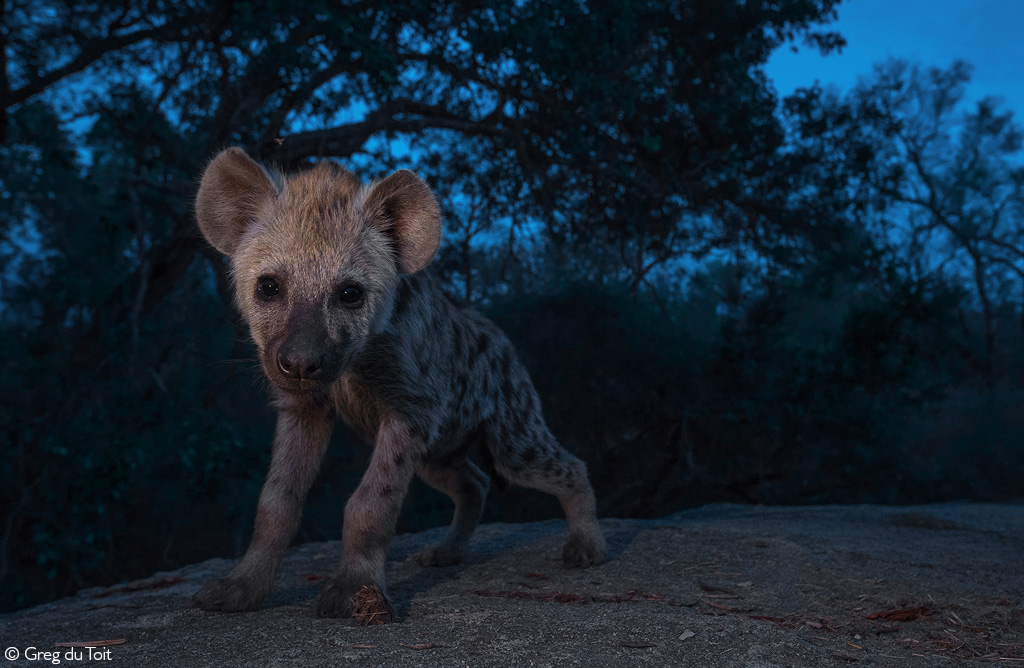
Nyerere African safari
River-side walking safaris take travellers to the heart of the action

The boudoir of beetles – how this orchid sexually deceives its pollinator

OchidDeep in the heart of the fynbos of South Africa lives a rare orchid, Disa forficaria, which has a fascinating relationship with its pollinator, the longhorn beetle, Chorothyse hessei. From the title of this article, one might think it should come with a PG rating but rest assured – this is simply nature at work in her strange and wonderful ways. The story of how the relationship between Disa forficaria and the longhorn beetle was discovered is fascinating in itself.


Disa forficaria is an orchid species identified from only nine plants from 11 records in the past 200 years and was considered extinct until one plant was rediscovered in 2016. Secondly, this orchid flowers only once every two years. Thirdly, only one flower opens at a time, and usually only if the sun is shining. Lastly, its pollinators’ activity is tightly linked to the midday hours. Nevertheless, after many visits to the lone specimen of Disa forficaria, biologist Callan Cohen struck lucky. One sunny day he found that one of the orchid’s intricate flowers was in full bloom, and he was taking photographs of this rare beauty when he saw what he thought was a wasp landing on the lip of the flower. He watched in amazement when the wasp-like insect started to copulate with the flower.

This looked like a case of sexual deception. The flower was attracting pollinators to its blooms by mimicking a female insect. But to prove this, further investigation was needed, and so Cohen assembled a team of scientists, each a specialist in either pollination, entomology, orchids or chemistry. They started to piece the remarkable puzzle together.

Africa Geographic Travel

The pollinator

The scientists established that the suspect was not a wasp but a wasp-mimicking endemic longhorn beetle, C. hessei, and so, after noting that the only insects that visited the orchid were individuals of the longhorn beetle, and only males, the scientists set out to discover what was attracting this beetle to this flower.

The flower

The flowers of the Disa forficaria don’t have any nectar or food rewards but instead sweeten the deal by providing a “boudoir” for the beetle-gentlemen. One could say that the flowers are “dressed up” to look and smell like female longhorn beetles. Orchid species generally have flowers with a modified median petal – the labellum – and, together with the two horizontal petals, the flower forms a landing platform for a visiting insect. The labellum of this particular orchid species is hairy and kidney-shaped and at its tip is a hairy cleft. At the other end of the lip are some narrow, hairy petals which curve backwards, have minute hairs, and resemble antennae.

The interaction between beetle and flower

So what is the motive for the beetle? The male longhorn beetle wants a female longhorn beetle. But the wool is pulled over the male longhorn beetle’s eyes. First, he gets the scent of a female beetle. He follows it, and on arriving at a flower of D. forficaria, he lands on the flower’s labellum and sees some fine, curved petal appendages. He begins to stroke these with his antennae and also even occasionally bites the petals (which is common mating behaviour described for other longhorn beetles). He then starts copulatory behaviour. The authors have even found beetle sperm in the petal’s cleft. So how does pollination occur?  The beetle is similar in length to the flower’s lip, and this means that it is perfectly positioned, whilst in the act of releasing its sperm, for the pollen packages attached to its thorax (gathered from previous foraging trips) to be deposited onto the orchid’s stigma. The authors observed that flowers that had been pollinated by the beetle later developed into fruit, thus showing the success of the pollination “event”.

orchid
The longhorn beetle attempting to copulate with the orchid. Photograph courtesy Callan Cohen and www.birdingafrica.com

The scent of a woman-beetle

But how did the beetle find his flower lover? The authors observed that the beetles used typical odour-tracking foraging movements, which was a clue to what attracted them: the scent. They then obtained an extract from the flower and, using complicated and intensive experimentation, identified the volatile compound in the floral extract which could be involved in the attraction. They called this compound ‘disalactone’ and proceeded to synthesise more of it. After establishing that longhorn beetle antennae reacted to puffs of this scent in the laboratory, they took this “beetle perfume” into the field to test it.

To determine whether the compound attracted the longhorn beetle, they set out an array of open glass vials, some containing the disalactone and others just acetone (to act as a control). They found that the jars of the disalactone attracted C. hessei longhorn beetles, all of which were male. The control jars did not attract any beetles.

In the meantime, as all this analysis and experimentation was happening in the laboratories, the original orchid plant in the field had sadly disappeared. But the scientists proceeded to do field experiments near the original orchid plant. This time they got creative and made model flowers consisting of dark beads on a dry reed, with ‘‘antennae’’ of plastic-coated wire and a small tuft of hair approximating the hairy lip of the flower at one end of the model. Some of the model flowers were treated with a droplet of disalactone in acetone, and the others with pure acetone (controls). Lo and behold, male C. hessei beetles were attracted to the disalactonen flowers and “frenetically” copulated with them too.

From this, the authors deduced that these orchids were luring the males to their flowers with a particular scent, most likely a scent closely simulating female longhorn beetle pheromones. The shape of the fake flowers was important, too, in eliciting copulatory behaviour. This behaviour promotes the transfer of pollen from the beetle to the flower’s stigma, thus facilitating effective pollination. The case was solved: this orchid was sexually deceiving male longhorn beetles! Sexual deception of bees and wasps by plants has often been observed, but deceiving beetles is a relatively rare and unique phenomenon in the plant kingdom.

Africa Geographic Travel

And more good news

The field experiment also yielded another exciting discovery. Some of the male beetles that visited their fake flowers were seen to be carrying pollen sacs. So the scientists took samples of the pollen and, using DNA analysis, the pollen was identified as belonging to the Disa forficaria species, meaning that, happily, there are still other D. forficaria plants in existence out there – somewhere. Indeed, we might even be able to find them if we can work out a way to use male longhorn beetles to survey for them. This type of surveying would be a world first!
The authors conclude that the orchid’s sexual deception might be the reason for the ongoing persistence of this orchid species, even at such low population sizes.  The fidelity of the male beetles to their female beetle-mimicking flowers might enhance the transfer of pollen, thus achieving high pollination rates and fruit set. Therefore, ensuring the survival of one of the rarest orchids in the world. The wiles of the wild are fascinating indeed.

Reference

Cohen, C. et al. (2021) “Sexual deception of a beetle pollinator through floral mimicry“. Current Biology 31, pp. 1962–1969

Further Reading

Scientists are warning of an insect apocalypse. Read more on the second silent spring here.
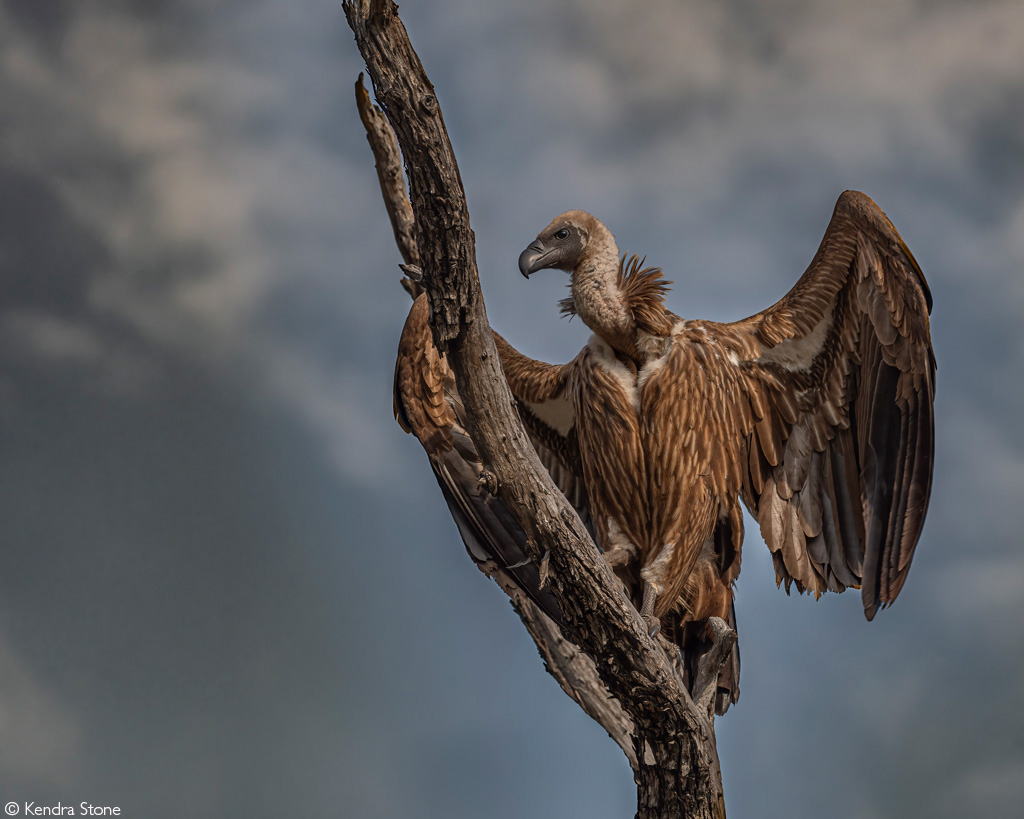
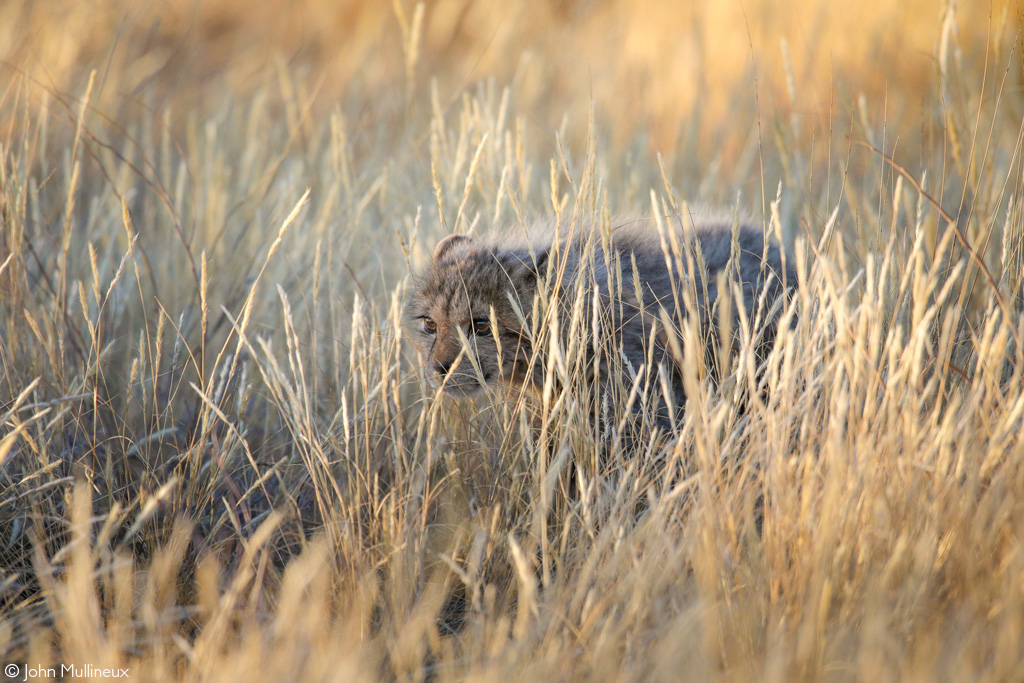
African safari

Why choose us to craft your safari?

Handcrafted experiential safaris since 1991.
Travel in Africa is about knowing when and where to go, and with whom. A few weeks too early/late or a few kilometres off course, and you could miss the greatest show on Earth. And wouldn’t that be a pity?
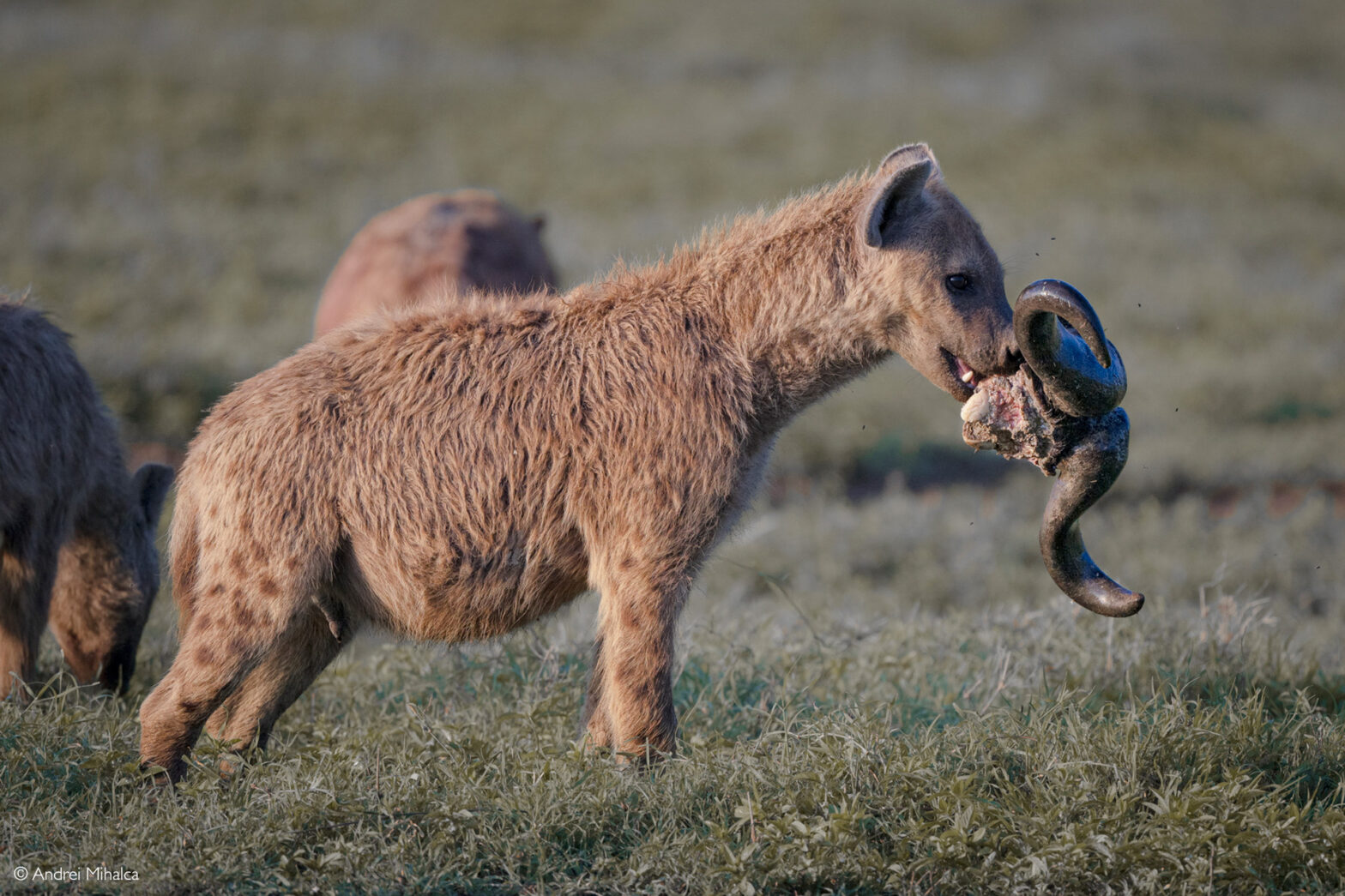
African travel

Trust & Safety

Guest payments are processed through Flywire, a leading international payment gateway known for its high safety and security standards. Also, we are members of SATSA, who attest to our integrity, legal compliance, and financial stability.

See what travellers say about us
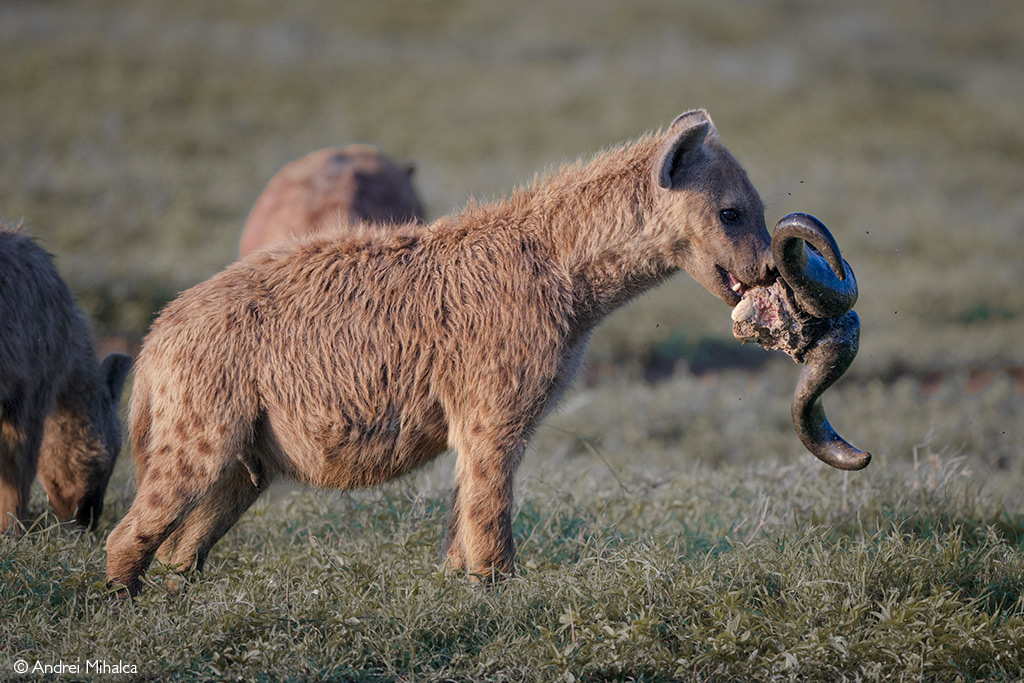
Responsible safari

Make a difference

We donate a portion of the revenue from every safari sold to carefully selected conservation projects that make a significant difference at ground level.
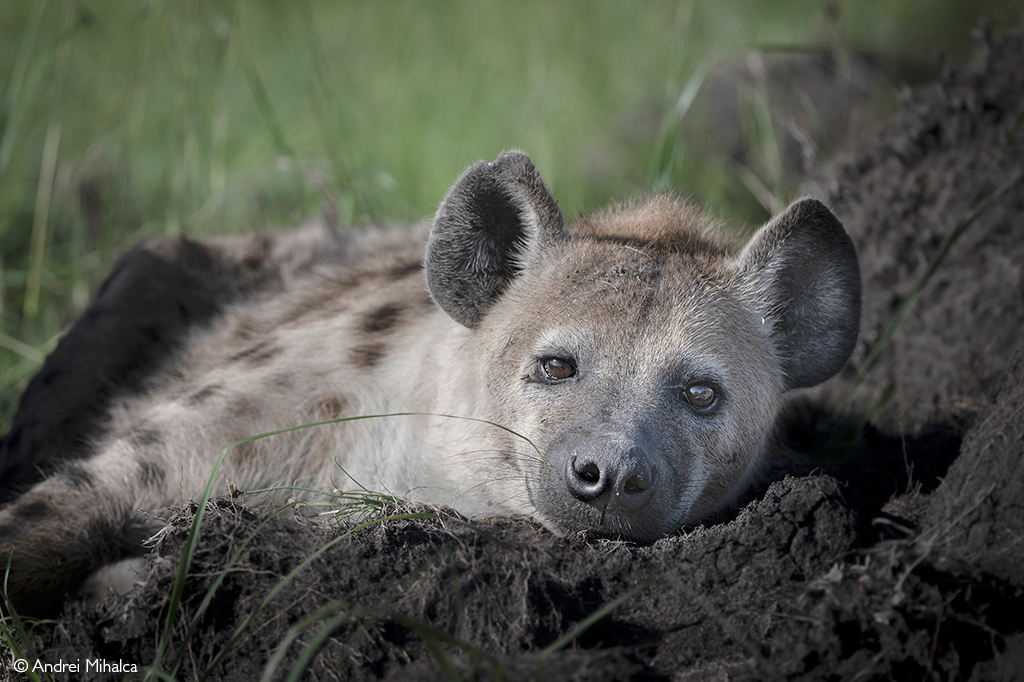
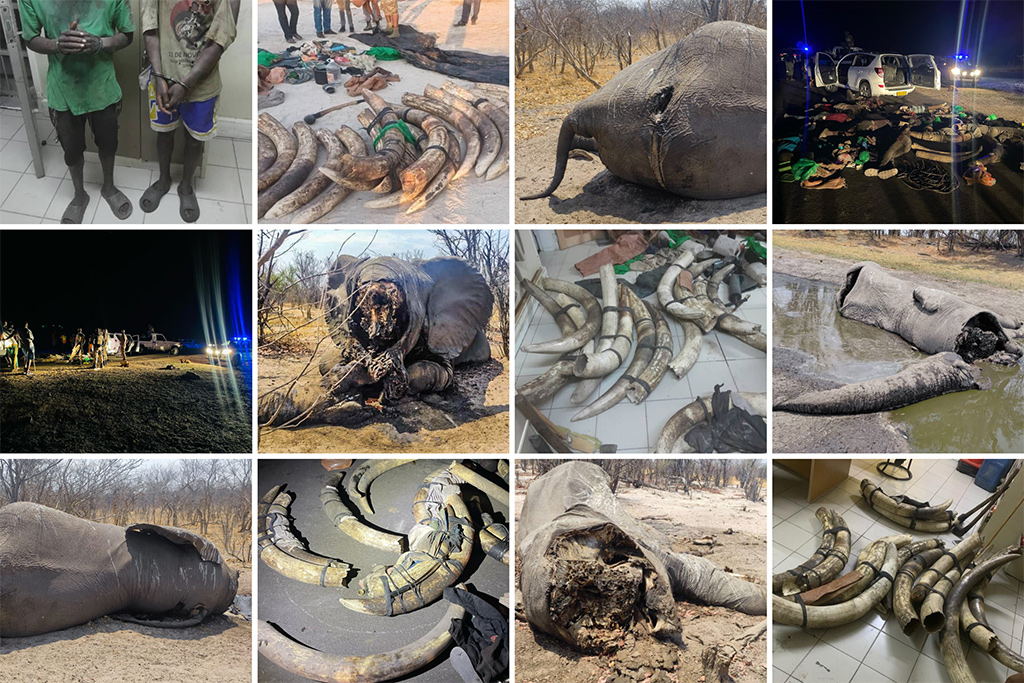
YOUR safari choice does make a difference - thank you!