


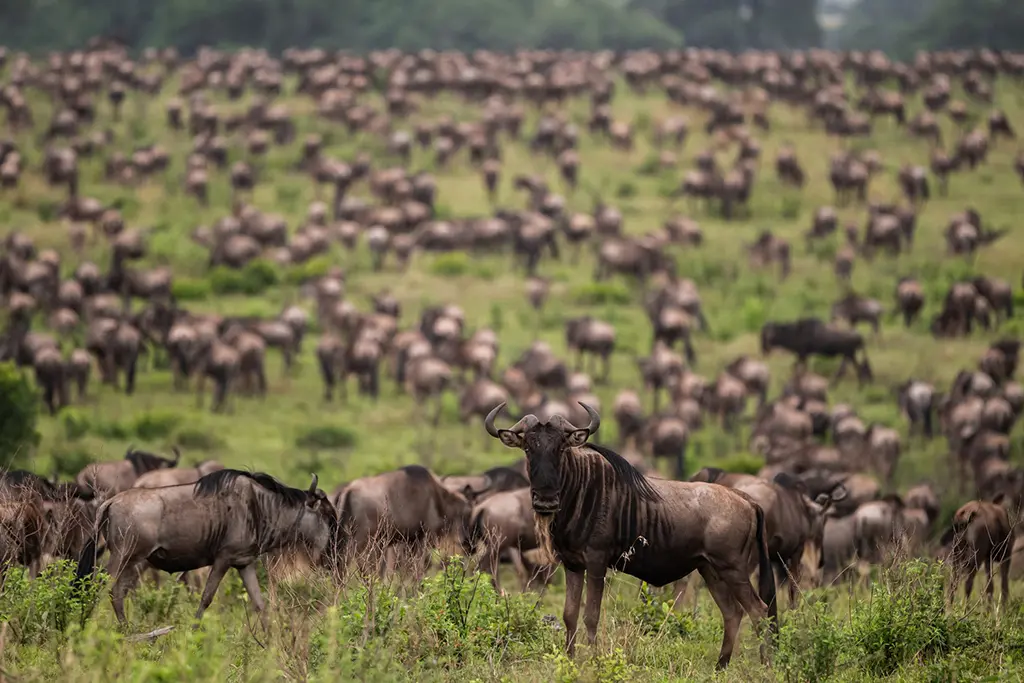
The Great Wildebeest Migration across the Serengeti–Mara ecosystem is one of Earth’s most spectacular wildlife events. This natural engine shapes vegetation, feeds predators, and drives the vital safari tourism industry in Tanzania and Kenya. The migratory wildebeest population has been estimated at around 1.3 million animals for decades. But a new study published in PNAS Nexus challenges this long-held figure, using satellites and artificial intelligence to produce an independent estimate that may reshape how we monitor wildlife.
Traditionally, wildebeest numbers have been calculated through aerial surveys, counts from fixed-wing aircraft flying over set transects. These surveys began in the 1950s, and they are the foundation of population estimates used by governments and conservation bodies. The latest aerial count, conducted by the Tanzania Wildlife Research Institute (TAWIRI) in 2023, covered nearly 4,800 km² and estimated roughly 1.3 million wildebeest, affirming assumed number estimates.
But aerial surveys have limitations. Because they rely on sample areas, researchers must statistically extrapolate results across unsurveyed regions, a necessary but imperfect process that introduces potential errors. Aircraft-based counts also pose safety risks and can disturb animals. As the new study notes, plane crashes remain a leading cause of death among wildlife biologists.
The research team, led by Isla Duporge of Princeton University and Tiejun Wang of the University of Twente, applied a radically different approach: high-resolution satellite imagery analysed by deep-learning algorithms.
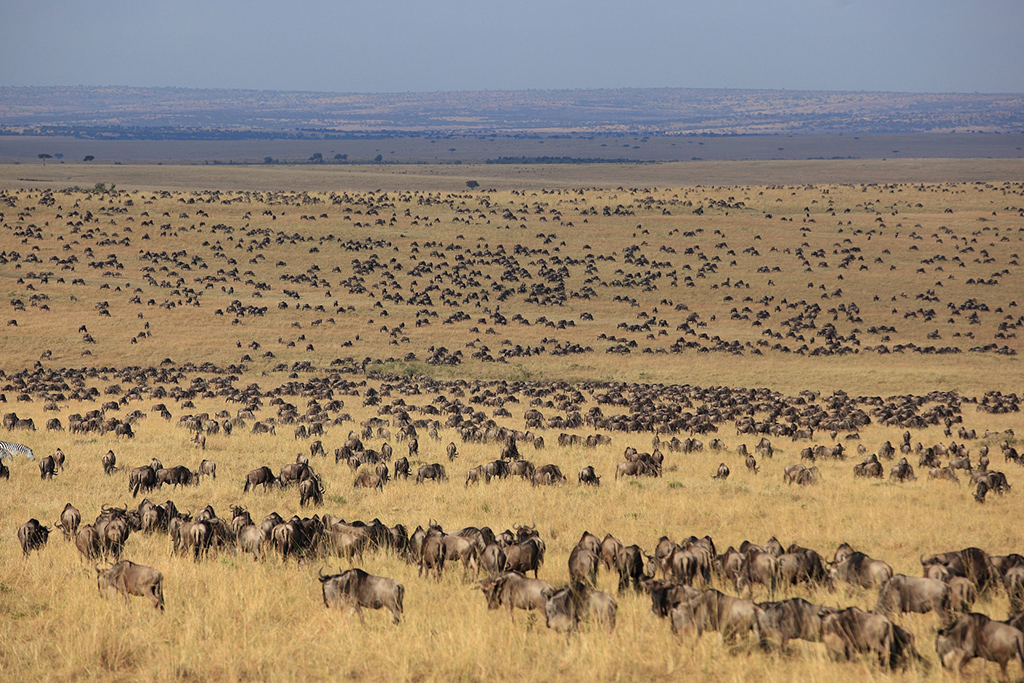
A new way to count the Great Wildebeest Migration
The study analysed high-resolution satellite images taken over two consecutive years, August 2022 and August 2023, covering more than 4,000 square kilometres of the Serengeti–Mara ecosystem. These months correspond to the dry season, when the bulk of the migratory wildebeest herds are typically found in the northern Serengeti National Park and Maasai Mara National Reserve regions. By surveying at the same stage of the migration across two years, the researchers could compare population estimates and assess consistency in herd distribution, while cross-referencing GPS collar data from individual animals to confirm that most of the main herds were within the satellite’s survey area during image capture.
Two artificial intelligence models, U-Net and YOLOv8, were trained to detect and count wildebeest in satellite images. These models (which are widely used in image recognition) find animals either by outlining their shapes or by spotting and labelling them in images.
Their detection accuracy was high, with F1 scores (a measure of precision and recall) reaching 0.83 in 2023. This is similar to or better than human accuracy. These results produced counts of about 500,000 to 530,000 wildebeest.

Want to see the Great Wildebeest Migration for your next African safari? Browse our top Great Migration safaris. Or, browse our other African safari ideas here.
Fewer wildebeest, or different data?
The finding is worrying. This AI-assisted satellite count of 530,000 wildebeest is less than half the long-accepted estimate of wildebeest migration numbers. Has the wildebeest population plummeted? Not necessarily.
The authors stress that their results should be viewed as complementary rather than contradictory. Differences in timing, coverage, and methodology between aerial and satellite surveys may account for some of the gap. Aerial counts often focus on southern areas of the Serengeti just after calving, whereas this satellite analysis covered northern Tanzania and southwestern Kenya later in the migration.
Nonetheless, the scale of the difference – hundreds of thousands of animals – demands attention. The researchers cross-checked GPS collar data from 48 female wildebeest across both years, confirming that most collared individuals were within the satellite’s survey area at the time of image capture. This makes it unlikely that large herds were missed.
The team also considered overcounting risks. At the 30-centimetre resolution of commercial satellites, zebras and eland cannot easily be distinguished from wildebeest, meaning some detections might not be wildebeest at all. In that case, the AI counts may actually be overestimates.
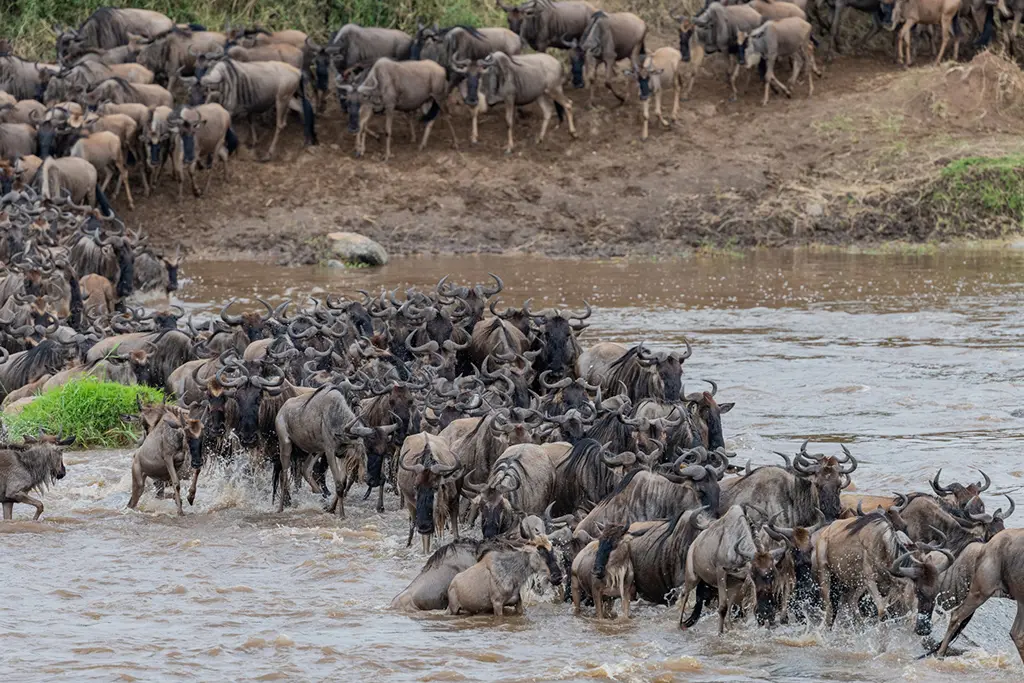
Ecology, technology, uncertainty and the Wildebeest Migration
If the satellite data do reflect reality, several ecological explanations are possible. Habitat fragmentation, driven by agriculture, fencing, and infrastructure, continues to constrain migratory routes. Climate change is altering rainfall patterns and grass quality, potentially disrupting the timing and cohesion of the herds. High predation on calves and persistent bushmeat poaching could also be contributing to lower numbers.
Alternatively, wildebeest may now be spread across a wider area than before. The migration could be fragmenting into smaller groups that respond flexibly to shifting conditions, a phenomenon scientists call “behavioural plasticity”. If so, traditional aerial transects may underestimate dispersed herds, while satellites may capture a snapshot of only part of the broader movement.
The only way to resolve these discrepancies, the study concludes, is to conduct synchronised aerial and satellite surveys, counting simultaneously and at the same location to compare results directly and calibrate both methods.
Why this matters
Beyond the wildebeest themselves, this research marks a turning point in conservation monitoring. Satellite-based AI surveys can cover vast areas without disturbing wildlife or risking human lives. They offer repeatable, scalable data that could revolutionise how populations of large, wide-ranging species, such as elephants, zebras, camels, and even seals, are monitored.
Yet, these technologies are not replacements for traditional fieldwork. The authors emphasise “methodological pluralism”: using multiple, independent approaches to cross-verify wildlife numbers. Each method, including aerial, ground-based, or satellite, offers distinct strengths and perspectives. Together, they can give a more accurate picture of ecological change in real time.
Beyond counting animals, the technology also opens a new frontier: understanding collective movement. The Great Migration is an emergent phenomenon. No single leader directs it, but order arises from simple individual cues. High-resolution imagery enables the study of how herds flow, split, and reform, revealing the physics of migration itself. In this way, satellites and artificial intelligence are not only helping conserve the Great Migration. It also illuminates the principles that make this spectacle possible.
The bigger Wildebeest Migration picture
The Great Migration drives nutrient cycles, sustains predators, and maintains grassland health across the Serengeti–Mara system. Understanding wildebeest numbers is not an academic exercise; it underpins policy, tourism, and conservation strategy.
Whether this new count indicates a decline or just a new way of seeing depends on how future studies build on it. What is clear is that artificial intelligence and satellite sensing now offer conservationists a powerful new way to see the movement of half a million animals from space.
Reference
Duporge I., Wu Z., Xu Z., Gong P., Rubenstein D., Macdonald D.W., Sinclair A.R.E., Levin S., Lee S.J., Wang T. (2025). AI-based satellite survey offers independent assessment of migratory wildebeest numbers in the Serengeti. PNAS Nexus, 4(9), pgf264.
Further reading
- The Great Wildebeest Migration is the second largest overland migration in the world – a magical spectacle that tops many bucket lists. Discover ethical Great Migration safaris with Africa Geographic here.
- The vast Serengeti in northern Tanzania is home to an extraordinary amount of wildlife and plays host to the greatest show on Earth – the Great Migration. Read more about Serengeti National Park here
- This interesting introduction to Kenya’s Maasai Mara will have you contacting Africa Geographic to book your next African safari. Read more about Maasai Mara here
- The wildebeest, star of the Great Migration, is one of Africa’s toughest animals. Seeing this comical antelope on safari is very entertaining. Read everything there is to know about wildebeest here
- The Great Wildebeest Migration is the quintessential African safari experience. Here’s our detailed guide on everything you need to know
To comment on this story: Login (or sign up) to our app here - it's a troll-free safe place 🙂.