



There is no known photograph of a live Shelley’s crimsonwing other than a few caught during biodiversity netting surveys. Cryptospiza shelleyi is a species of forest finch occurring in the highland forests of the Albertine Rift in East Africa. It is classified as ‘endangered’ due to habitat loss and is likely to have a small, severely fragmented and declining population.
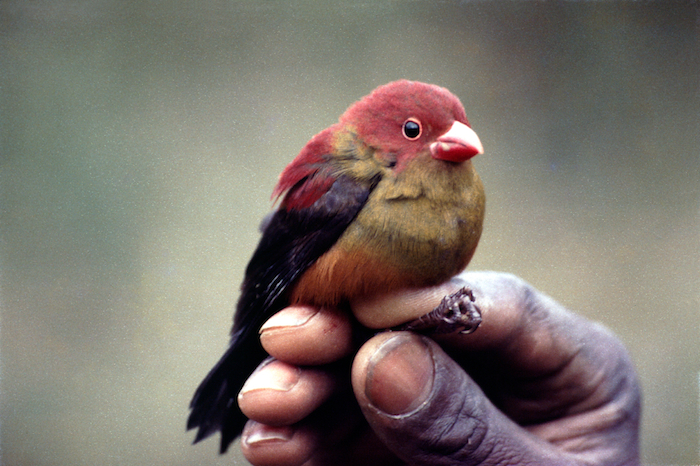
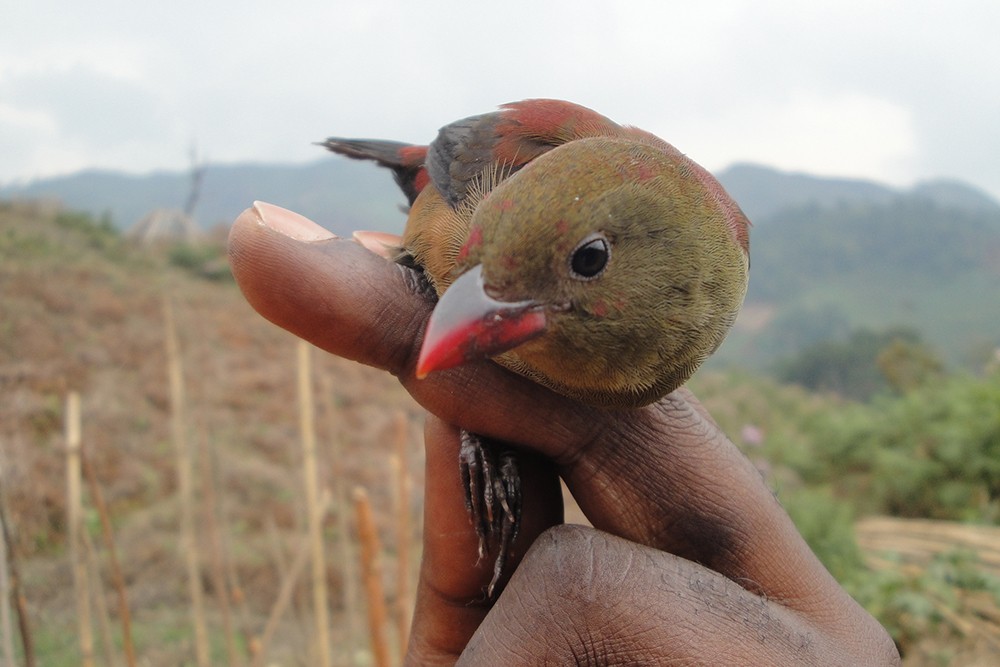
We spoke to researcher Colin Jackson, who photographed a Shelley’s crimsonwing during a biodiversity netting expedition in the Mt Tsiaberimu area of the DRC in 1997. The only other photo of this species, also of a netted bird, was taken in 2008 in the Mt Tsiaberimu area of the Virunga National Park, DRC.
Jackson said, “Very interesting to hear of the story behind the other image of the crimsonwing – that it also came from Tsiaberimu…. We caught ours in the heart of the forest, not far from where we first camped, in nets going through the edge of bamboo and bordering an open area with some swampy vegetation. The expedition was conducted by staff of the National Museums of Kenya, funded by the Berggorilla and Regenwald Direkthilfe and the Atlanta Zoo. A key objective of the expedition was to survey the surviving gorillas, and Titus Imboma (whose hand is holding the bird in the image) and I were taken along to do bird surveys.”
About Shelley’s crimsonwing
Distribution: A narrow strip of highland forest sandwiched between Burundi, eastern Democratic Republic of the Congo, Rwanda and western Uganda.
Habitat: Inhabits closed moist understory in montane forest, low secondary growth at the forest edge, clearings with Sericostachys, mixed bamboo thickets; sometimes in more open areas near streams and forest clearings.
Habits: Occurs singly or in pairs. Forages on the ground for seeds, known to associate with dusky crimsonwings Cryptospiza jacksoni. Shy, elusive, seldom seen; when flushed, flies rapidly for a short distance, dives for cover and does not reappear.
Conservation status: Shelley’s Crimsonwing (Cryptospiza shelleyi) is currently listed as Endangered on the IUCN Red List. It is a rare and poorly known estrildid finch endemic to the montane forests of the Albertine Rift, occurring in the Democratic Republic of the Congo, Rwanda, Burundi and western Uganda. The global population is estimated at only 1,000–2,499 mature individuals and is declining and severely fragmented, with no single subpopulation thought to exceed 250 birds. The primary threats are ongoing deforestation and forest degradation driven by agriculture, timber extraction and human settlement, which continue to reduce and fragment its specialised understorey habitat across its restricted range.

To comment on this story: Login (or sign up) to our app here - it's a troll-free safe place 🙂.