

Speak with a safari expert

phone icon

Guest reviews

5 star icon
Safari experts & storytellers. Since 1991
Book a call with a safari expert Book a call
Guest reviews Client reviews
×
SEARCH OUR STORIES
SEARCH OUR SAFARIS

The legend of the Mapogo lions

Author: Ben Coley

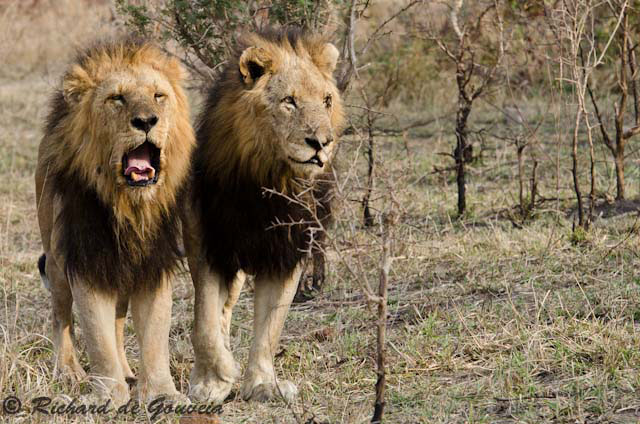
‘Legend’ is a word thrown around all too often in this day and age, but the term encapsulates the reign of the Mapogo lions in the Sabi Sands (Greater Kruger) to perfection.  For the last six years or so, this notorious band of brothers has ruled the area with an iron paw.  They are true warriors and have proved themselves time after time on the field of battle.  During their prime, 6 of these magnificent specimens patrolled their territory, dispatching all competitors and striking fear into the hearts of all that found themselves in their way.
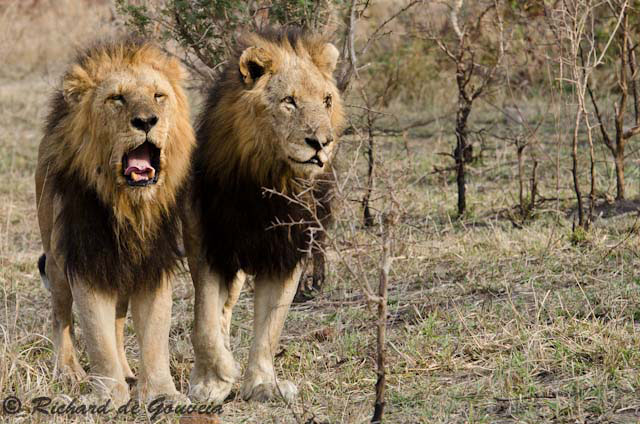

Mapogo lions
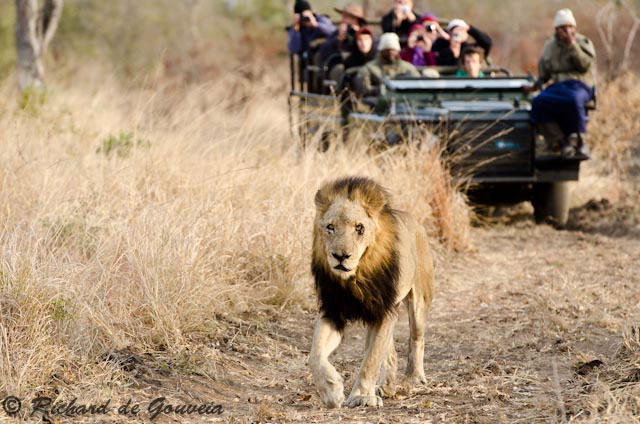
© Richard de Gouveia

Legend has it that the Mapogo lions were responsible for killing numerous males, females and cubs as they stamped their authority on their domain. Whole prides have been wiped out in their relentless march for dominance, and challengers have been eaten as acts of defiance. A former warden of the Sabi Sands has been cited saying that he believes them accountable for over 100 lion fatalities, although the true number will probably never be known.  Never before has the local lion population been so dominated, and it is stories like this that have elevated their exploits to legendary status.
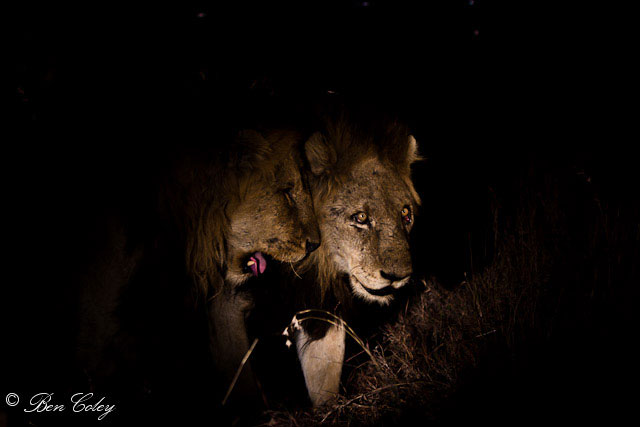
The lions of Mapogo, Sabi Sands
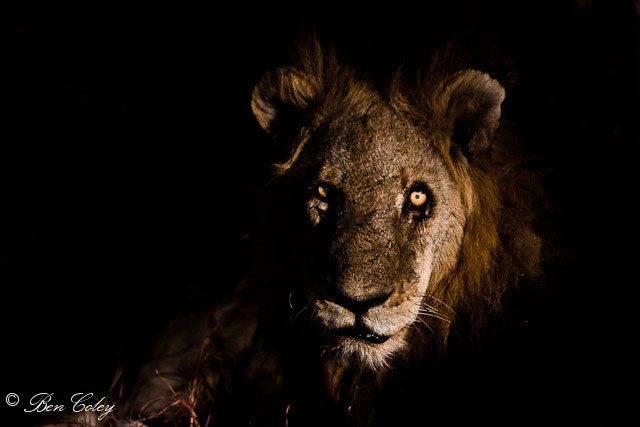
© Ben Coley
Mapogo lions
© Richard de Gouveia

These pride brothers may have a fearsome reputation, but in the world of the lion, they should be seen as the epitomes of what a successful coalition should be.  The Mapogo lions have been labelled as sadistic and remorseless, to mention only a few adjectives assigned to them, and yet their exploits have ensured safe breeding grounds and stability in an area of unusually high competition.  Their success has changed the dynamic of the lion population in this area forever, and it is no surprise that litters are becoming skewed in favour of male offspring.  This is inevitable as nature attempts to balance the scales and provide a more level playing field.
The lions of Mapogo, Sabi Sands
© Ben Coley
Mapogo lions
© Richard de Gouveia

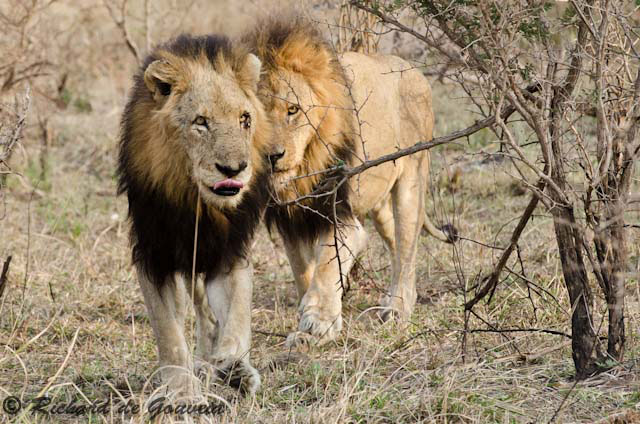
In recent years, new and equally formidable coalitions have been responsible for whittling down the Mapogo’s numbers as territorial lines were drawn in the sand and crossed, and repeated battles were waged.  The Majingilanes in the north and the Southern Pride males in the south have both had their say in shaping the new regime and now all that remains of the mighty Mapogo are two ageing specimens known as Makhulu and Pretty Boy.
Africa Geographic Travel

Since being overthrown by the Southern Pride males, the last of the Mapogo lions legends have been sighted regularly on Sabi Sabi as they search for new territory or maybe just sanctuary as they live out the remainder of their days.  At 14 and 11 years of age, they have surpassed the life expectancy of most male lions and carry the scars of years of conflict on the front line.

During my six years of working in the bushveld, I have been privileged to view and come into close contact with many different lions from different areas of South Africa and Tanzania, but I can honestly say that I have never witnessed such magnificent specimens as these two remaining legends.  Perhaps the stigma attached to them accentuates their aura, but they are the most intimidating lions I have laid eyes upon.  It is not merely their freakish size and musculature that raises the adrenaline levels and starts the heart pounding, but the look contained deep within their eyes.
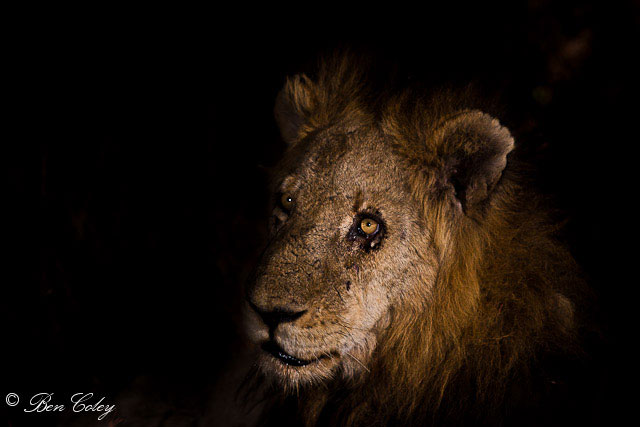
© Ben Coley

Peering into those yellow abysses, one can truly feel the history and experience of many a hard-fought battle in which the deciding factor was power and a will to survive.  Their eyes bore through you like no other lions I have ever seen, and I refuse to believe anyone who claims not to feel a slight pang of uncertainty when they stare back at you.  The uneasiness of their presence is something that I have never felt before when watching the Kruger males.  For fear of downplaying the current kings of Sabi Sabi, the last of the Mapogo make them look like kittens.
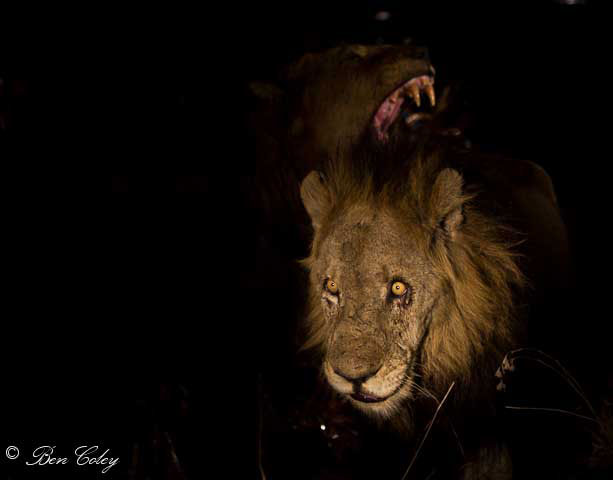
Mapogo lions
© Ben Coley

It is hard not to paint the Mapogos as terrifying, evil beasts due to the wrath they have rained down on the area, but I hope they are remembered as great rulers and protectors.  They have raised the bar as to the expectations of male coalitions in so far as protecting territory and ensuring their genetic success.  They should be seen as role models, not killers.

In conclusion, legendary status is hard to achieve, but ask anyone who has worked in the Sabi Sands for the last seven years, and they will tell you tales of the Mapogo.  Sadistic tyrants or protective fathers?  Both could be claimed true, but the fact is that their arrival heralded a new age of the lion population in the Sabi Sands.  Love them or hate them; their exploits will never be forgotten.  These tales will undoubtedly be embellished and exaggerated, but this is how great icons are born.  Over time, these stories will become myths, and myths will become legends: a fitting legacy for the most famous lions of the modern era.


Find out about the Greater Kruger for your next African safari. You can choose a ready-made safari or ask us to build one just for you.
 

Caracals count too: mesopredator research in the Cederberg

On a recent trip to the Cederberg with my 9-year-old son, I arranged to meet a young researcher working for the Cape Leopard Trust. I was keen to chat to her about the work of the CLT on caracals, and to try and expose my son to the blood, sweat, mud and tears side of scientific research and data gathering.

Unfortunately, on the day we had set aside to hook up, a fairly vicious cold front whipped in over the mountains, and the usually red-tinged rocks were being lashed by icy wind and rain. Our little mountain hut at Driehoek became the only viable warm, dry meeting place.

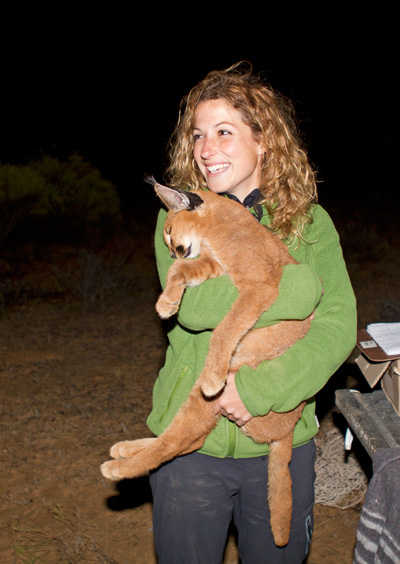
The diminutive, bubbly, French-speaking Marine Drouilly spent well over an hour with us, and we all huddled around her laptop, looking at all the incredible images from the various camera traps and learning all about her work.

Caracals
Rooibos and Marine © Cape Leopard Trust

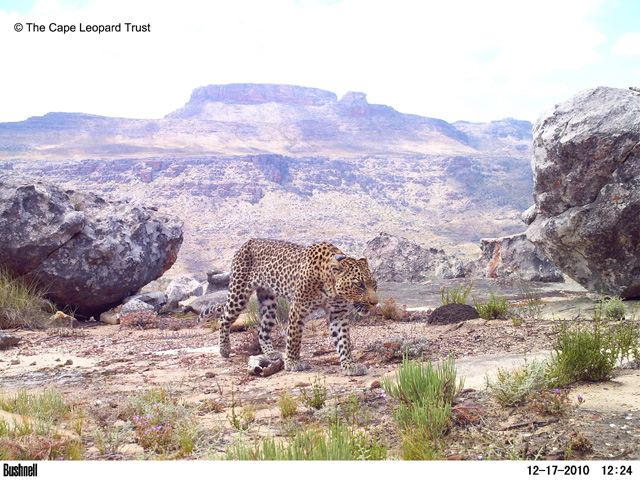
The main objective of Marine’s project is to study the spatial and behavioural ecology of the caracal (Caracal caracal) in a fairly extensive area of the Cederberg, including the Cederberg Conservancy. Very little has been published about this elusive species, particularly concerning interactions with the area’s apex predator, the Cape leopard (vital natural regulators of caracals).

Armed with up-to-date data and knowledge, effective conservation and management strategies can be designed and implemented. With a more solid understanding of the way these two species interact (with regards to interspecific behaviour, habitat use and prey preferences); it is more likely that local farmers will come to understand how critical it is to maintain ecological balance. Marine pointed out that there is a real paucity of data addressing even the most basic ecological questions for many of the smaller predators, not just caracal.

Thanks to almost a decade of tireless work by the Cape Leopard Trust (and with the support of local farmers), the level of leopard persecution by farmers has diminished significantly in the Cederberg.

Caracals
Before the CLT began, the area boasted the highest levels of leopard-farmer conflict in the Western Cape, with a staggering 17 leopards killed in one year. The last leopard killed in the area was in 2004 © Cape Leopard Trust

It is fairly well known that livestock farmers throughout southern Africa are less than partial towards caracals or ‘rooikat’ and they are very often persecuted because of the suspected damage to small livestock. Tragically, these beautiful cats are even classified as ‘problem animals’ in this country – along with jackals, badgers and genets. Beyond the Conservancy boundaries, caracals frequently come into conflict with farmers, where livestock become opportunistic prey items. In most natural areas, natural prey animals are still available to these cats.

Marine went on to explain that the caracal is considered a ‘mesopredator’ – a term that refers to its trophic ranking. What is important in this study is to get a handle on what would happen if the apex predators were persecuted to the point where they were removed from the system. Would there be what scientists dub ‘mesopredator release’? There are catastrophic examples of this from all over the world – from the removal of wolves in Asia, bears and wolves in North America to lions and wild dogs here on our continent. Such negative impacts on apex predators can have devastating ecological consequences. The ripple-down effect can often lead to an increase in populations of the mesopredator, which, in turn, can negatively impact the ecology of the prey species.

Caracals
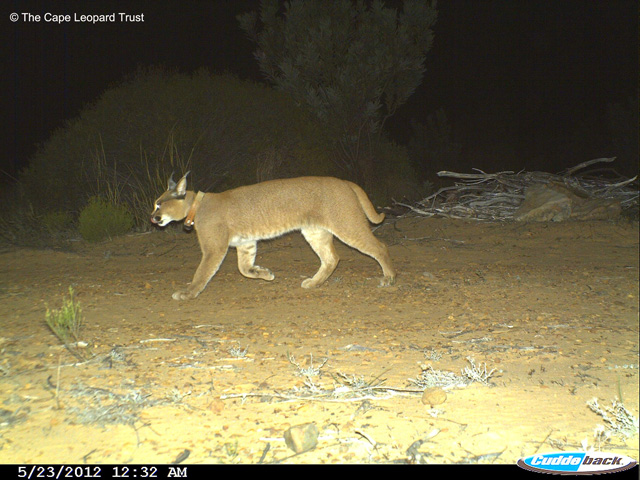
The research caracals all have scientific ID names and colloquial names: Rooibos (FC2), Rocky (MC2) and Easter (MC5) © Cape Leopard Trust

So just how will Marine be tackling this big research question? How does one search for and analyse the proverbial needle in a haystack? These animals are notoriously difficult to study given their elusive, nocturnal habits. Through a painstakingly slow process of capturing and collaring animals (with GPS devices), vital data on their movement can be gathered, and mapping can begin to take place. Plotting movements, verifying how feeding ecology compares to other species and establishing the extent of their home ranges all form pieces in the giant ‘caracal jigsaw puzzle’. Once the pieces are put together, it will then be possible to find and suggest practical solutions to reduce the inevitable human-wildlife conflicts that play out between caracals and farmers.

Marine has been working in the area since March 2012. What struck me about Marine is her real love for these much-maligned animals. This is no hard-arsed researcher – here is a soft-hearted soul who really wants to be sure that the animals do not suffer at all in the process of data gathering and she makes sure that the safest possible capture techniques are used (and has gone so far as to try out one of the methods on herself!)

Marine explained that CLT’s founder, Dr Quinton Martins, began collaring caracal in 2008 to assess the feasibility of conducting a full-blown study on the species. Martins and his team collared 3 male caracals before Marine’s arrival. The team have since managed to collar a female.

The data gleaned thus far shows that territorial male caracals can have ranges that extend as far as 100 square kilometres! They have also established that caracal prey ranges from klipspringer, grey rhebok, grey duiker, grysbok, dassie, bat-eared fox to (surprisingly!) black-backed jackal. What I found particularly fascinating and pertinent was that of the 21 caracal kills located in 2009 using GPS points, only one was a lamb. Food for thought, indeed.

Marine also showed us an impressive collection of photographs taken with the dozen or so cameras that have been placed in the field. From large and small-spotted genets leaping high into the air in response to the flash, to curious baboons with their noses pressed up against the lens, aardwolf, porcupine, African wild cat, honey badgers, nightjars and even a striped polecat. Getting up close and personal with the hustle and bustle of the Cederberg night prowlers was a rare treat indeed.

The Cape Leopard Trust is the main sponsor of Marine’s caracal project. The use of the research vehicle, the 4 GPS collars, fuel and traps are all courtesy of the CLT. When you consider that a single collar costs R 20 000 and a camera can cost up to R 3 000, this is no walk in the park when it comes to funding needs! Very often, the cost of research equipment is what limits the extent of scientific research. The project recently received funding from the Wilderness Wildlife Trust to cover the veterinary fees.

What is truly heartening about this project is how farmers and landowners in the area (particularly in the Conservancy) have allowed for studying a self-regulating population of caracal and leopard over the years. This project stands as a real beacon of hope and an example of how (with just the right level of intervention) landowner attitudes and behaviour can shift and human-wildlife conflict can be avoided.

Read more about the rooikat here.

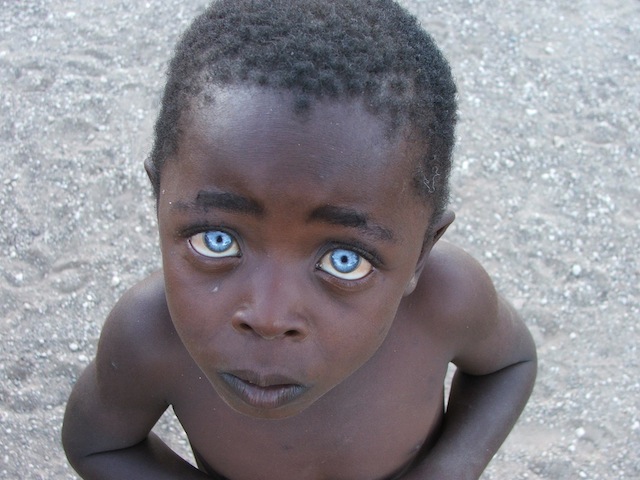
The boy with sapphire eyes

The boy with sapphire eyes
Photo copyright Vanessa Bristow

The above image was recently submitted by Vanessa Bristow, who called it ‘The Boy with Sapphire Eyes’.

Within minutes of posting this magical picture, there was an enormous flood of comments and feedback. Amongst much of the rumpus was a fair degree of suspicion, doubting and downright slander about the picture’s authenticity. Swoops of ‘blatant photoshopping’ were amongst the commotion. Most people came to their immediate conclusion that this photo was fake!

Africa Geographic Travel

Let us set the record straight. The photo of the boy with sapphire eyes is not altered at all. Here is a comment from the photographer herself:

“To all of you DOUBTING THOMAS’ out there who distrust the originality of this photograph: It is NOT Photoshopped. I was in the local communal lands in Zimbabwe looking for my lost Dalmatian dog, and I stopped to ask his mother if she had seen it. While I was talking to her, her son, who was playing with his siblings and friends nearby, caught my eye. I asked her if I could photograph him, and this is the first picture that I took of him – it was possibly his first interaction up close with a white person, and his fascination in me, or the camera, is evident. I took a few photos of him at the time and a few more later during a follow-up.  An ophthalmologist friend had this to say about his unusual eyes:

[quote]”The picture of the little boy with the blue eyes and dark skin probably represents Ocular Albinism or Nettleship-Falls albinism, or Juvenile uveitis. Both conditions cause the pigment of the iris to be less dense.”[/quote]

Thanks for all the support from those of you who like my picture.

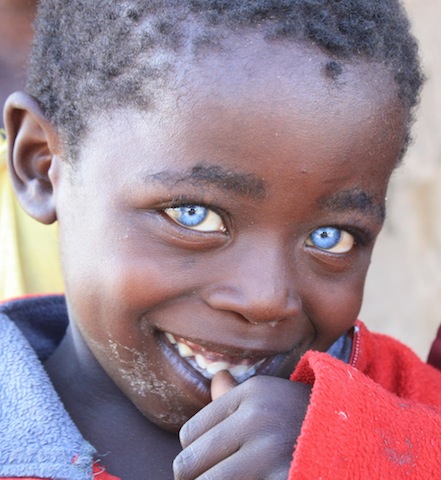
The below picture of Theuns was taken a week or two after the first. This time, he was much more relaxed with me, and I let him “click” the camera a few times to get him to engage with me.”

The boy with sapphire eyes
Photo copyright Vanessa Bristow

Continues Ms Bristow: “I must say, when I first saw the photo, I initially thought that blue eyes sometimes occurred in black people because of a recessive gene. If you are interested in reading a fascinating book – I recommend ‘The Sunburnt Queen’, by Hazel Crampton. Based in the 1730s, the book is about a seven-year-old English girl who was washed up on the Wild Coast of South Africa and adopted by her rescuers. She grew to be a woman of astounding beauty and wisdom and became the wife of a prince; thus starting a dynasty that extends to many of today’s Xhosa royal families.

Because of her recessive gene in the bloodline, now and then, a black child in the area is born with bright blue eyes.”

Rare spotless cheetah sighted in Kenya

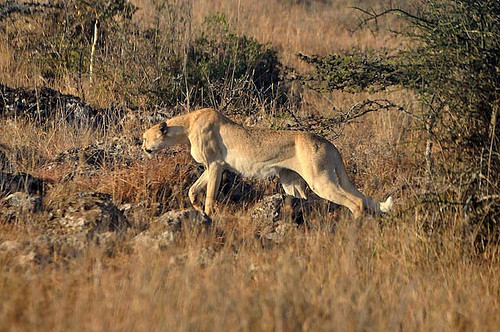
Armed with a spotter plane and a LandRover in hot pursuit, wildlife artist Guy Coombes searched for the elusive spotless cheetah.

“I was told about this incredible ‘morph’ phenomenon that has not been seen for over 90 years. The last one recorded was shot in Tanzania in 1921. ‘Morph’ means a genetic colour variation; the most well-known being the ‘king’ cheetah, specimens of which have only occurred in South Africa and Zimbabwe. The Mughal Emperor of India recorded having a white cheetah presented to him in 1608, saying that the spots were blue in colour and the whiteness of the body also inclined to blue-ishness. There are also reported cases of melanism or albinism, but the latter does not apply to this spotless cheetah. The only reported cases of this morph, which scientists believe is a recessive gene like the king cheetah, have been in East Africa from the subspecies, acynonix jubatus raineyii.” – excerpt from Guy Coombes’ account with a ‘morph’ cheetah

spotless cheetah
spotless cheetah

Photos © Guy Coombes

Guy Coombes photographed this rare ‘morph’ cheetah in the Athi-Kapiti area of south­ern Kenya over a year ago.

Cheetahs are the fastest land mammals, with documented speeds up to 115 km/hour in captivity and 93 km/hour in the wild, but they cannot maintain such speeds for more than a few hundred metres. By comparison, sprinter Usain Bolt hits a top speed of 45 km/hour over a maximum of 100 metres.
They are found in a wide range of habitats, from dry forest and thick scrub to savannah grassland and arid deserts. Read more about cheetahs here.

African safari

Why choose us to craft your safari?

Handcrafted experiential safaris since 1991.

Travel in Africa is about knowing when and where to go, and with whom. A few weeks too early/late or a few kilometres off course, and you could miss the greatest show on Earth. And wouldn’t that be a pity?

African travel

Trust & Safety

Guest payments are processed through Flywire, a leading international payment gateway known for its high safety and security standards. Also, we are members of SATSA, who attest to our integrity, legal compliance, and financial stability.

See what travellers say about us

Responsible safari

Make a difference

We donate a portion of the revenue from every safari sold to carefully selected conservation projects that make a significant difference at ground level.

YOUR safari choice does make a difference - thank you!