


-
Giraffe legs ease the heart’s burden: A new study shows that long legs reduce the energy needed to pump blood up the giraffe’s long neck, cutting the strain on its powerful heart.
-
Evolutionary advantage: By evolving long legs before a long neck, giraffes lowered their cardiovascular demands while gaining access to high foliage.
-
Energy efficiency trade-off: The leg design saves up to 5% of daily energy but sacrifices agility and makes drinking risky.
-
A model for high blood pressure: Understanding giraffe circulation may offer insights into managing hypertension and cardiovascular limits in other species – including humans.
 Want to see giraffes on an African safari? Check out our safari ideas here, or let our travel experts plan the perfect African safari for you by clicking here.
Few animals are as visually distinctive as the giraffe. Its extraordinary neck and towering stance symbolise evolutionary ingenuity, yet the biological costs of being tall have remained less well understood. A new study by researchers from the University of Pretoria and the University of Adelaide now suggests that the giraffe’s remarkable legs are not just for height – they play a crucial role in reducing the energetic strain on its powerful heart. Yet another fascinating discovery in the biological study of giraffes.
The cost of being tall
“The giraffe’s long neck allows it to access foliage that is out-of-reach for shorter animals. It is also used for fighting, and it provides a high vantage point from which to scan for predators,” says experimental physiologist Dr. Edward Snelling, who conducted the study along with comparative physiologist Dr. Roger Seymour. “However, there are also significant energy costs associated with having such a long neck. That energy cost is in the form of blood pressure. And it is a cost that must be paid by the heart.”
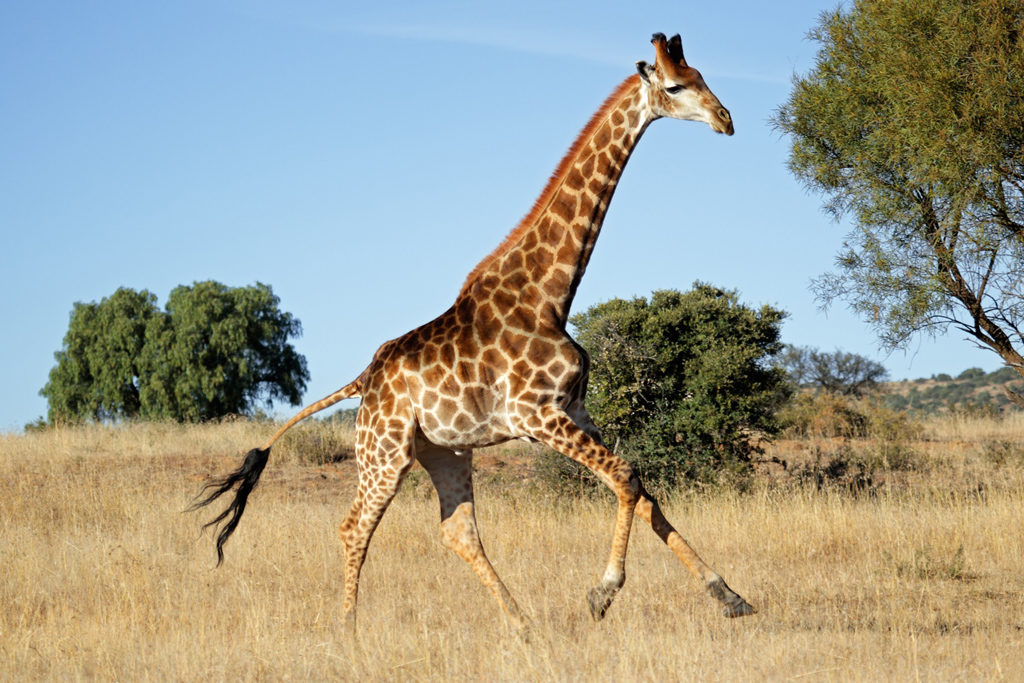
Adult giraffes have a mean arterial blood pressure of 200 to 250 millimetres of mercury (mmHg) at heart level – more than twice that of most mammals. This is because every metre of height adds about 77mmHg of gravitational pressure that must be overcome to deliver blood to the brain. Since the giraffe’s brain sits more than two metres above its heart, its cardiovascular system must work continuously against gravity. That means the giraffes you might see browsing the umbrella thorns of the Serengeti today owe as much to their legs as their necks.
The left ventricle – the heart’s main pumping chamber – performs this heavy lifting. The study, published in the Journal of Experimental Biology, calculates that a giraffe’s left ventricle uses around 16% of the animal’s total resting energy. By contrast, a typical large mammal of the same body mass, such as an eland, uses only about 9%. The giraffe’s heart alone uses more energy than the entire resting body of a human.
This relentless workload is the cost of height.

Simulating evolution of giraffes
A giraffe’s overall height (from ground to head) is fixed by its ecological needs — reaching high foliage, scanning for predators, etc.
To test how the giraffe’s body shape affects its circulation, the researchers created a computer model of an imaginary hybrid animal – the “elaffe”. This theoretical creature combined the body and legs of an eland with the neck of a giraffe, reaching the same overall height as a real giraffe. The researchers set out to find out which combination of neck length and leg length requires the least cardiac effort.

The researchers used the model to estimate how much energy the heart would expend if a giraffe’s height were achieved through neck length alone, rather than through both neck and leg length. In other words, their elaffe model stood at the same height as a giraffe, though it’s legs were much shorter and its neck much longer than a giraffe. The result was striking: the elaffe’s heart would have to use 21% of the animal’s resting energy – one-third more than an actual giraffe. In other words, the giraffe’s long legs save it from an additional 5% of its daily energy expenditure, the equivalent of around 3,000 kilojoules of food every day, or about 1.5 tonnes of leaves each year.
The explanation is straightforward. By standing on long legs, the giraffe raises the position of its heart relative to the ground, compared to if it was simply achieved through a long neck. This shortens the vertical distance between the heart and brain, reducing the blood pressure required to maintain circulation and easing the heart’s workload.
A case of evolutionary timing
The fossil record supports this conclusion. Long legs appeared in the giraffe’s ancestors before the evolution of its long neck. The researchers suggest that this sequence makes energetic sense: longer legs can reduce the heart’s effort, whereas a longer neck only increases it.
In early giraffids, limb length increased steadily over time, followed later by the elongation of the neck. Fossil genera such as Canthumeryx, Palaeotragus and Samotherium show this gradual progression over roughly nine million years. In modern giraffes, neck and leg length are now almost equal, suggesting a balance between the benefits of feeding height and the limits of cardiovascular demand.

The limits of adaptation
Even with these savings, the giraffe’s cardiovascular system operates close to its physical limits. The study notes that moving the heart much higher within the body would cause serious complications. The heart must remain at the same level as the lungs to ensure blood reaches them at low pressure. If pulmonary blood pressure rises above about 27mmHg, fluid can leak into the lungs, leading to pulmonary oedema – a potentially fatal condition.
The researchers calculate that if the giraffe’s heart were only 35 centimetres higher than it is, this dangerous threshold would be reached. This anatomical constraint prevents the heart from shifting further up the neck, even though such a position would reduce the effort needed to pump blood to the brain.
Want to see giraffes on an African safari? Check out our safari ideas here, or let our travel experts plan the perfect African safari for you by clicking here.
The trade-offs of long-legged giraffes
Long legs offer clear energetic benefits, but they come with trade-offs. They make giraffes less agile and limit their maximum speed. Because their legs act as long levers, their muscles cannot generate the acceleration required to outrun predators such as lions. Long legs also complicate one of life’s simplest acts – drinking.
To reach the water, a giraffe must splay its front legs wide apart and lower its head, creating an awkward and vulnerable posture. Observations in the wild show that giraffes are among the most cautious species at waterholes and are statistically the most likely to leave without drinking.
The study’s model suggests that if giraffes had slightly shorter forelegs and a correspondingly longer neck to maintain their height, their heart would need to work harder – increasing its energy cost from 16 to about 17%. The savings achieved by long legs, therefore, come at the expense of manoeuvrability and safety.

The energy equation of evolution
The researchers frame these findings within the larger question of how evolutionary design balances competing demands. The giraffe’s shape represents a compromise between feeding advantage, energetic cost and physiological limitation. By evolving long legs before lengthening the neck, early giraffes may have reduced the circulatory penalty of height while still gaining access to treetop resources.
This interplay between anatomy and physiology also helps explain why no other land vertebrate has matched the giraffe’s vertical reach. The study concludes that the vertical distance between the heart and head in adult giraffes – just over two metres – is likely the maximum ever achieved among terrestrial animals. Larger extinct species, such as the giant sauropod dinosaurs, would have required unsustainable blood pressures had they attempted to raise their necks much higher than shoulder level.

Why it matters for giraffes
Understanding how the giraffe manages its extraordinary blood pressure sheds light on broader biological and medical questions. The species offers a natural model for studying chronic hypertension – the persistent high blood pressure that affects many humans. Yet unlike humans, giraffes have evolved mechanisms to withstand such pressures without damaging their blood vessels or organs.
By analysing how anatomy and evolution solved this problem, scientists can better understand how blood pressure and cardiovascular efficiency interact across species. In the words of Dr Snelling, “Anything a giraffe can do to lower its blood pressure and save energy, while still getting enough blood to its brain, is going to be a big advantage for the animal. This is where long legs come into the story.”
Ultimately, the study shows that the giraffe’s long legs are not merely architectural supports for its famous neck – they are an integral part of a finely balanced system that allows the world’s tallest animal to survive the physical consequences of its height. The next time you watch a giraffe stretch for acacia leaves in the heart of Kruger, remember those long legs are doing more than just adding height – they’re saving a life’s worth of energy.

Reference
Seymour, R.S. & Snelling, E.P. (2025). “How long limbs reduce the energetic burden on the heart of the giraffe.” Journal of Experimental Biology, 228.
Further reading on giraffes
- The giraffe is a wonder of evolution, and a vital part of Africa’s ecosystems. Read all there is to know about the planet’s tallest creature here.
- Why do giraffes have such long necks? Various studies question whether feeding or mating played the bigger role in giraffe neck evolution. Read about Doug Cavener’s exploration into the driving force behind giraffe-neck evolution here, and Rob Simmons exploration into giraffe evolution’s tallest debate
- Under pressure – genetic research on giraffes reveals evolutionary secrets of how they cope with high blood pressure and maintain bone density. Read about the pieces of the giraffe evolution puzzle here.
- Do giraffes choose their social groups based on appearance? A recent study investigates whether giraffes form bonds based on spot shape
To comment on this story: Login (or sign up) to our app here - it's a troll-free safe place 🙂.