


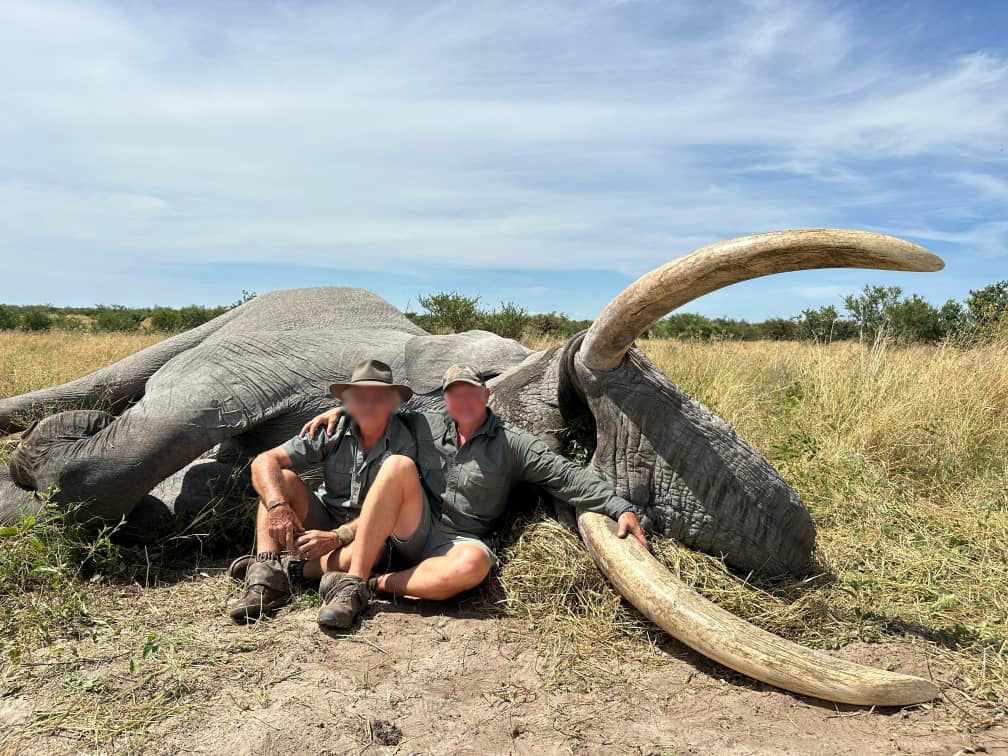
Another massive elephant bull was recently killed in northern Botswana, according to our trusted sources on the ground: the surgical removal of Africa’s large-tusked elephants by trophy hunters continues. This bull had at least one tusk weighing 109 pounds, ranking him among Africa’s largest elephants.
This magnificent Botswana tusker was trophy hunted in NG42, a trophy hunting concession leased and managed by Johan Calitz Safaris. The professional hunter (right) and the client featured in the photo above are citizens of Botswana. NG42 borders Chobe National Park to its north and Nxai Pan National Park to its south, and has been earmarked for possible inclusion into Nxai Pan NP to protect the annual Botswana zebra migration between the parks.
We estimate there are 86+ tuskers remaining across Africa. Southern Africa is home to 59+, while East Africa hosts 27+ tuskers. This count excludes Central African forest elephant populations, where tusk measurements are rarely estimated.
Botswana, a popular luxury photographic safari destination, hosts the largest fluctuating elephant population in the world, with many of these animals migrating seasonally across much of southern Africa, particularly in the Kavango-Zambezi Transfrontier Conservation Area (KAZA), where Botswana and Zimbabwe are the largest fluctuating populations. These elephant migrations are increasingly obstructed by human settlements, farms, mining, major roads, fences and other man-made obstacles, forcing free-roaming elephants into reduced areas. ‘Fear zones’, where elephants are persecuted by poachers, farmers and/or trophy hunters, also dictate elephant movements and stress levels.

Human-elephant conflict occurs in areas where humans and elephants compete for land and water – and many rural human lives and livelihoods are lost in the process. This is a major concern and focus area for African governments, and the Botswana government is no exception. Ecosystems, where elephants congregate in increasing numbers near water during the dry winter months because of the above pressures, are also suffering as elephants denude these areas of large tree cover.
Comment from our CEO, Simon Espley:
“The killing of Africa’s remaining large-tusked elephants by trophy hunters will not solve any human-elephant conflict or habitat issues. The volume of elephants hunted is not sufficient to reduce elephant populations. Instead, the likely result of selecting large-tusked elephants as trophies will be to hasten the disappearance of these genetically gifted icons from the African landscape. This probability in my lifetime will be a sad indictment of an archaic industry that promotes killing for fun and ego and that refuses to evolve to modern realities where the ‘resource’ is no longer abundant and inexhaustible.“
To comment on this story: Login (or sign up) to our app here - it's a troll-free safe place 🙂.