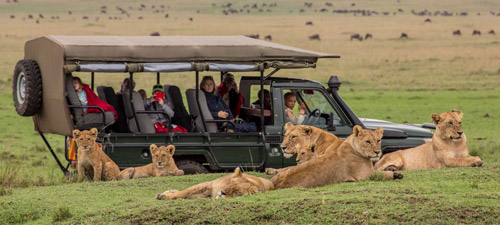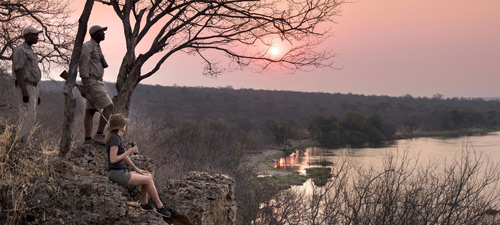



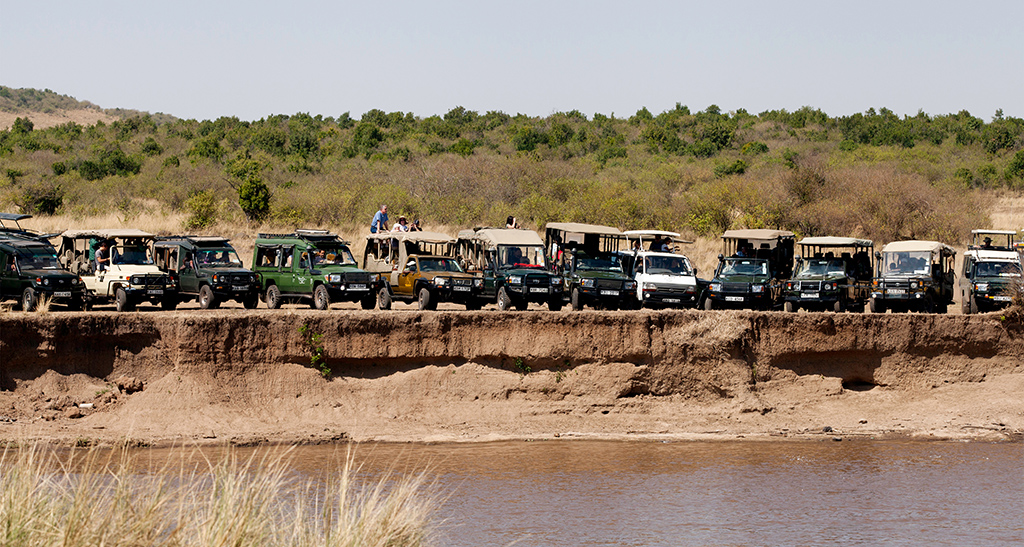
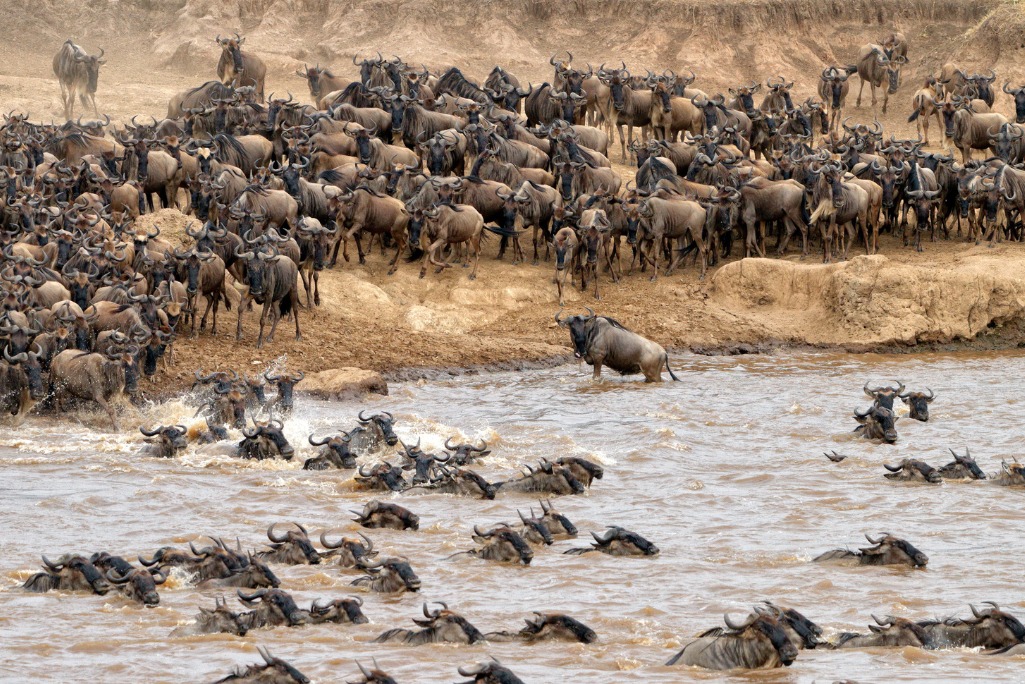
 They say that tourism is one of the best ways to pay for nature conservation. But is this always the case? When planning a safari to Africa, it is essential to remember that how we travel can be just as impactful as where we travel. Safari tourism has helped protect mountain gorillas in Rwanda and Uganda, and supported endangered African penguin colonies in South Africa; however, it has also placed a strain on ecosystems when not managed properly. Overcrowding at Wildebeest Migration river crossings, proposals for large-scale lodge expansions in the Maasai Mara and Serengeti, and poorly sited developments along migration routes show how quickly a positive force can tip into harm. As Africa’s safari destinations grow in popularity, travellers are increasingly faced with a choice: will their journeys contribute to conservation and community resilience, or will they inadvertently add pressure to already fragile systems?
There is a complex balance between tourism, conservation, and overtourism. Responsible decisions by travellers, operators, and policymakers can help ensure that nature truly benefits from our presence. To safeguard Africa’s protected areas, we would do well to heed the warnings from overtourism elsewhere, learning from the missteps on other continents to better reflect on – and improve – our own approach
In Bali, Indonesia, tourism can sometimes be a liability rather than a benefit. Sixty-five percent of Bali’s freshwater supplies are funnelled to tourism. A hotel room in Bali consumes up to 800 litres of water daily, whereas the Bali residents use only 200 litres of water per person per day. The impacts of tourism also ripple into culture – residents have complained about tourists’ disrespectful treatment of spiritual ceremonies, particularly the water cleansing Melukat ceremonies. Tourists have co-opted these ceremonies as opportunities for social media content, rather than as moments of inner reflection and peace.
Moving to colder climes: Antarctica, a sensitive environment with fragile ecosystems, received more than 100,000 tourists in the 2024 tourist season. This is a system where the risk of introducing invasive plant species is high, and where vegetation can take years to recover from just a single footprint. Each tourist arrival accounts for an average of 83 tons of snow loss, as the black soot emitted by cruise ships hastens melting by absorbing sunlight. Regulating tourism is tricky because the Antarctic Treaty is the only governance entity and operates on a consultative basis. There is currently no science-based regulatory framework in place to protect the Antarctic from the increasing impacts of human activities.
Clearly, the forces driving tourism can result in negative consequences if not properly managed.
This leads us to the question: how do we manage overtourism?
It’s not as simple as ‘cutting down the number of tourists’ visiting a protected area (or scenic hotspot or natural wonder). Money plays a big role in the equation, and at first glance, more tourism means more money. For years, conservationists have been advocating for ecotourism as a sustainable financial mechanism to fund and maintain nature and protected areas, and it has, indeed, succeeded in many instances. Some examples include gorilla tourism’s contribution to the protection of mountain gorillas and their forest habitat in Rwanda and Uganda, and how ecotourism has supported the conservation of the African penguin in South Africa (Michler 2024).
Globally, tourism generated a record US$1.6 trillion in 2024, and in Africa, the travel and tourism market is projected to reach a market volume of US$35.98bn by 2030. But this could potentially lead to environmental harm. For example, in January 2024, when the Serengeti National Park reported plans to increase the number of lodges in the park by 250% and the number of permanent tented camps by 300%, the UNESCO World Heritage Site authorities threw up their hands in horror. They asked the park about the potential environmental impacts of “the increasing density of… tourism infrastructure… on the wildebeest migration”. “And the Serengeti is not alone in facing such pressures. Elsewhere in East Africa, similarly troubling developments are underway. In the Maasai Mara, plans for a Ritz-Carlton hotel to be built in an established migration pathway appear to be moving forward.
Clearly, lines need to be drawn in the sand. Who decides where to place the lines, and how do they make their choice?
Existing measures to curb tourist numbers
Governments and other authorities have imposed bans on tourists and introduced restrictive measures to protect places of significance. In the Galapagos Islands, Ecuador, tourism is regulated by rules such as walking on marked trails, guided visits to protected areas, and prohibiting private yachts at key natural sites. In Okinawa, Japan, visitor numbers to Iriomote Island are capped at 1,200 per day to protect endangered species.
In Africa, the drive to prevent overtourism is also present.
For example, in South Africa’s Kruger National Park, SANParks enforces daily gate quotas (with advance pre-booking) so gates can close to further day-visitors once thresholds are reached, specifically to avoid overcrowding of roads and facilities.
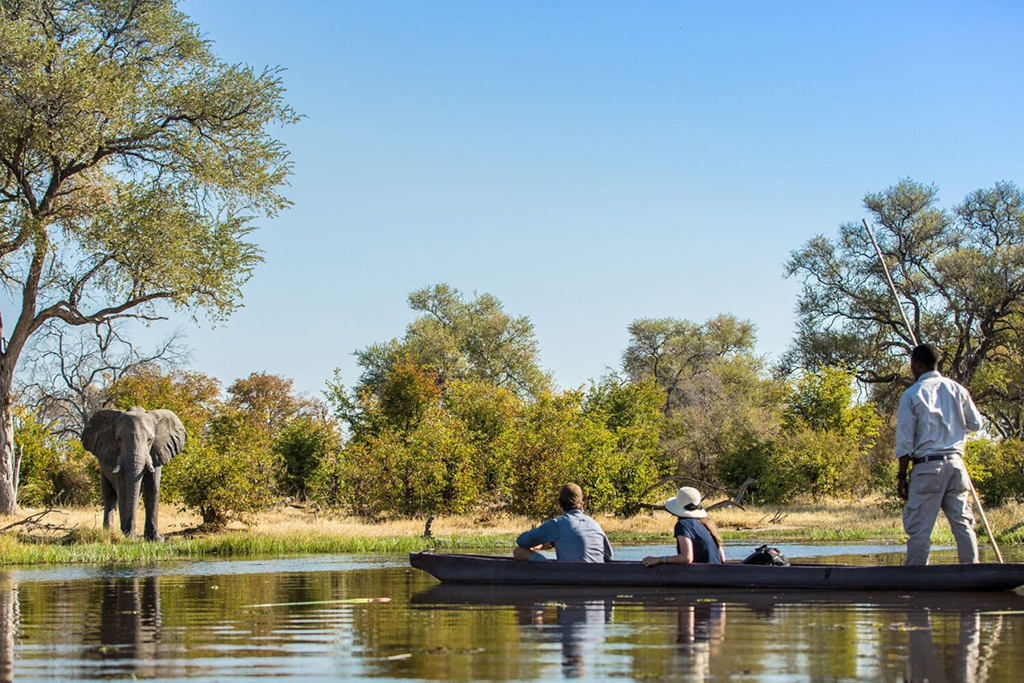
In Botswana, the National Ecotourism Strategy, launched in 2002, established a high‑value, low‑volume (HVLV) tourism model. This intentionally limits tourist numbers while encouraging higher per‑visitor spending. The goal is to minimise environmental impacts while maximising revenue for conservation and local communities. By focusing on fewer but higher‑paying visitors, Botswana avoids overcrowding in sensitive areas like the Okavango Delta, supports conservation funding, and preserves wilderness quality.
In Namibia’s Dorob National Park, situated along the country’s central coast, tourism activities are strictly regulated through zoning and permitting. Recreational uses like powered flights, commercial operations, structure-building, and wildlife disturbance (feeding, hunting, chasing, etc.) are prohibited unless with a permit from the Ministry of Environment and Tourism. Also in Namibia, Communal Wildlife Conservancies, legally recognised under the Community-Based Natural Resource Management (CBNRM) framework (since the mid-1990s), allow local communities to manage land and wildlife. Communities partner with tourism operators to offer guided tours, lodges, and safari services, while wildlife revenues fund community development projects. By distributing the economic benefits of tourism directly to communities – and giving them a stake in maintaining healthy wildlife populations – this model disperses tourism pressure more evenly across landscapes and promotes sustainable stewardship. This zoning and permitting scheme helps preserve fragile habitats, such as breeding areas for birds, and curtails reckless tourism that could damage ecosystems or lead to overtourism hotspots.
In Kenya’s Maasai Mara, park fees have increased as a means to curb overcrowding at wildlife sightings. Yet, this has not prevented chaos at some river crossings.
These measures have sometimes been implemented when the crowds have already had negative repercussions, and they require heavy regulation, which bears further costs. Is there a way to do things differently? Tourism is more than just tourists, so evidently, we need to look at the bigger picture.
What is tourism, and why does it sometimes become too much? The travel and tourist industry can be defined as “…essentially the renting out for short-term lets of other people’s environments, whether this is a coastline, a city, a mountain range, or a rainforest.” The crunch comes when the costs exceed the income, such as when costly externalities occur (for example, tourists littering the beach). When this happens, few prosper and many lose. Extending the beach-littering example, there are many cases where hotel owners happily collect accommodation revenue, but do not pay for the beach to be cleaned up, basically externalising the costs to the public purse.
Interestingly, the label of “overtourism” often comes first from the people who are being affected by the consequences, such as local communities. Therefore, to some degree, the categorisation of overtourism has been in the eye of the beholder. Not surprisingly, local communities often raise the red flag because they are recipients of the impacts, whether this is the inconvenience of their town being overrun by tourists or their parks’ vegetation being trampled flat by increasing foot traffic. The takeaway from this is that tourism needs to be done hand in hand with local people. However, the flow of tourists is also subject to broader forces beyond local stakeholders. For example, once destinations gain popularity, they tend to remain in high demand, even when they are already under pressure from overtourism, making it difficult to tip the scale toward lesser-known alternatives.
Environmental tracking and analysis site Murmuration noted that 80% of the world’s tourists visited only 10% of global destinations!
Is the concept of “tourist carrying capacity” a useful one?
There is comfort in numbers, and many have tried to pin down the ‘tourist carrying capacity’ of a place or park. Yet such calculations are often built on shaky assumptions and imprecise methods. For one thing, different carrying capacity assessments of the same area yield varying numbers, and, as Spencely (2022) notes, land does not have an inherent carrying capacity.
Carrying capacity does not take into consideration that what a park manager values from the land may differ significantly from what a resident values. Therein lies the crunch. How many tourists are too many, and when do you know that tourism impacts have crossed a threshold? When does Plant Species A’s population decline by 31,45%? When does the mayor of the town tell the residents to stay indoors to make room for the tourists? When do tourists use more water than residents do? How do you create one number that meets all of these criteria?
Tourism impact is not always directly related to numbers; it is often more linked to the behaviour and actions of tourists (Spencely 2022). Perhaps the question needs to be flipped: Will the destination use tourism or be used by it?
A systemic approach to overtourism
Instead of asking how many “too many” is, we could ask, “What are the desired conditions?” (Spenceley 2022). Overtourism management (aka crowd control) needs to encompass context, communities, visitor experience and the entire travel chain. It’s possible to turn tourism management on its head to become more proactive – by intentionally providing a suite of tourism opportunities and diversity of settings to maximise experiences, whilst minimising impact. This doesn’t sound very easy, but there are tools in the tourism toolbox that can guide this type of proactive, holistic approach. Take, for example, how the Interagency Visitors Management Council (IVMC) manages visitor use in the California State Parks in America through the use of a ‘Visitor Use Management Framework’ (VUMF). This Framework provides a planning process for the IVMC to find a way to maximise benefits for visitors while proactively preserving the environmental, social and managerial conditions that they prefer. They used the framework to develop clearly defined and transparent outcomes to be achieved and how these will be monitored. And by its very nature, a VUMF integrates the values and preferences of all the constituents (managers, travel agents, tourists, communities). These values are considered just as important to sustainability as the remediation of the biophysical impacts. In other words, there is shared commitment and accountability.
The IVMS Council needed a defensible, transparent decision-making process, and the four building blocks of the VUMF provide this. In a nutshell, the framework integrates (a) identifying desired conditions for resource, visitor experiences, and facilities, (b) understanding how visitor use influences the achievement of those goals, (c) developing and implementing strategies to manage visitor use, and (d) monitoring, evaluating, and adjusting management actions. Frameworks could be considered an ‘antidote’ to relying on the reactive strategy of using ‘tourist carrying capacity.’ Instead, the sweet spot of sustainability lies in the inclusion of all roleplayers’ needs, values and the shared responsibility of setting intentional goals and desired outcomes. The VUMF has been used by many other US parks and in many protected areas and tourist destinations around the world, including in Costa Rica, Belize, Chile, and Mexico. Other frameworks include the Visitor Impact Management (VIM), Visitor Activity Management Process (VAMP), the Limits of Acceptable Change (LAC) and the Visitor Experience and Resource Protection (VERP) (see Spencely 2022 for a review).
So, what is the tourist’s role in responsible safaris?
If you visit Africa’s beautiful nature reserves and protected areas, then you too can contribute to sustainable or responsible tourism:
- You could intentionally choose sustainable destinations and tour operators.
- You could opt to travel in green season, rather than peak season – reducing pressure on the ecosystem you are visiting.
- You could take responsibility for your behaviour and decisions while travelling. For example, tourists to New Zealand are encouraged to commit to the Tiaki Agreement, which promotes caring for New Zealand’s nature and communities, inspiring visitors to form a deeper connection with the place, and to reflect this in their attitudes and behaviours.
- You could support initiatives that prioritise local needs.
- You could offset your travel carbon footprint.
Overtourism is not just a distant problem – it is a challenge we face here in Africa’s most treasured landscapes. From the Serengeti to Kruger National Park, the choices of travellers, operators, and policymakers determine whether tourism becomes a force for protection or a source of pressure. By travelling responsibly, supporting sustainable destinations, and respecting local communities and ecosystems, each of us can help ensure that Africa’s wildlife, landscapes, and cultures continue to thrive. The future of these iconic places depends on thoughtful decisions today – because true adventure is only meaningful when it leaves the world better than we found it.
 When planning your African safari, who you travel with matters. Choosing a responsible tour operator ensures your journey supports conservation, uplifts local communities, and avoids the pitfalls of overtourism. By selecting destinations that prioritise sustainability over volume, you can experience Africa’s wild beauty in a way that protects it for generations to come. Check out our safari ideas here, or let our travel experts plan the perfect African safari for you by clicking here.
References
Michler, I. 2024. Ecotourism: An apparent panacea or a looming conundrum?
Spenceley, A. 2022. Briefing Paper on Sustainable Visitation Frameworks for Protected Areas. 10.13140/RG.2.2.26969.43368.
To comment on this story: Login (or sign up) to our app here - it's a troll-free safe place 🙂.