



Photographer of the Year 2026 winners


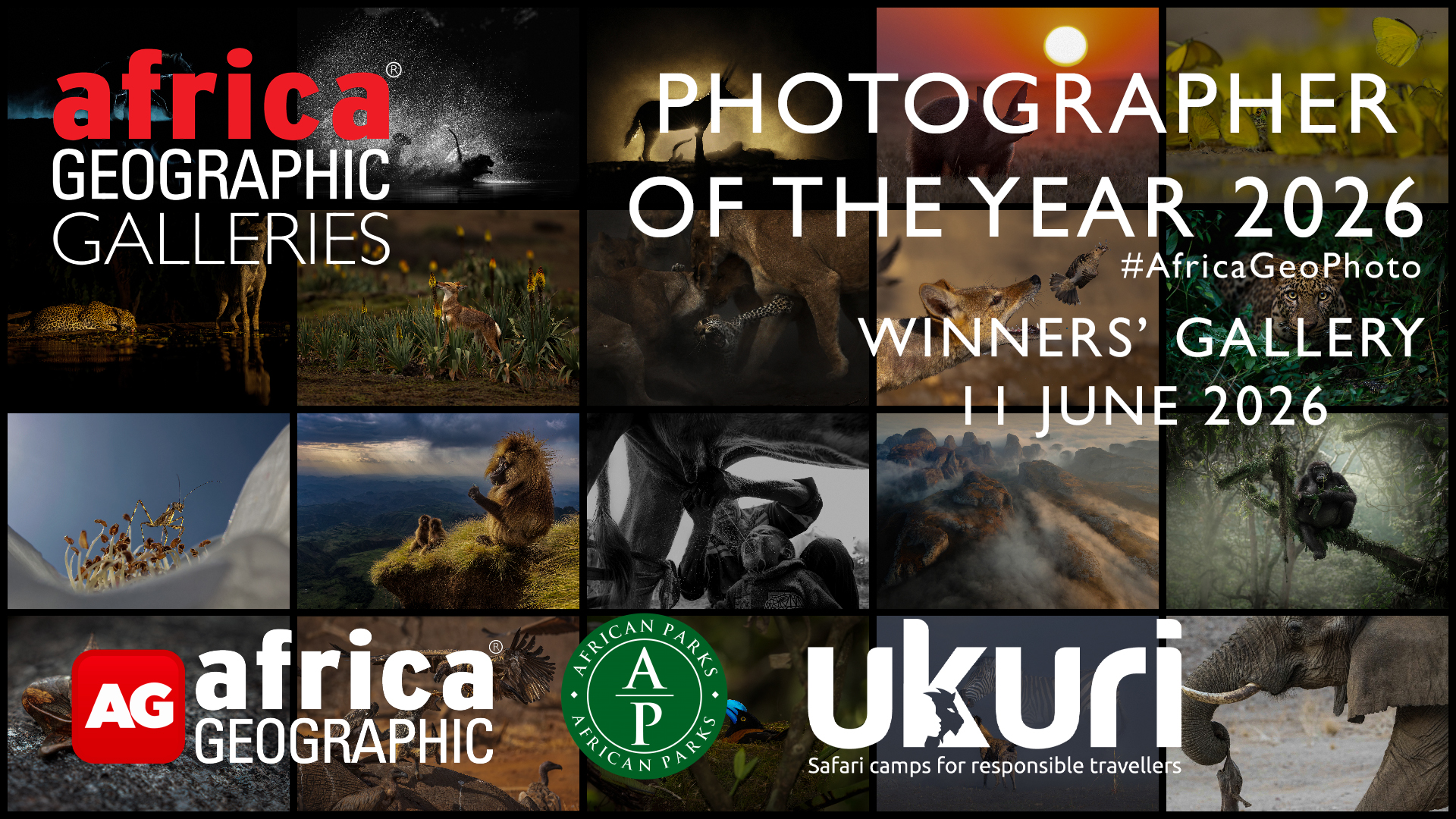
We are proud to announce the winners of Photographer of the Year 2026. This year, a theme emerged as if orchestrated by nature itself – revelation. Again and again, our photographers captured moments that challenged expectations: an Ethiopian wolf feeding from wildflowers, an aardvark emerging into the last light of day, a mountain gorilla high in the rainforest canopy, and a leaf-tailed gecko hidden in plain sight. Photographers documented the drama and unpredictability of life in the wild, from a leopard cub’s final stand against a pride of lions to a jackal and vulture locked in battle over a meal. Africa still has the power to surprise, revealing extraordinary stories to those patient enough to look.
Over the 12 weeks of the competition, we received 6,084 entries, of which we selected 285 in our weekly selections.
Thank you to our generous partners, Ukuri and African Parks, for supporting this celebration of Africa. The overall winner, runners-up and their partners will enjoy an Africa Geographic safari to Nyungwe National Park in Rwanda, staying at the newly built Munazi Lodge, the only lodge inside the park. Their adventure will include chimpanzee trekking, canopy walks high above the forest floor, waterfall hikes and encounters with black-and-white colobus monkeys in one of Africa’s most biodiverse montane forests. Read more about the Photographer of the Year 2026 prizes here.
A note from our CEO
These photographs are far more than beautiful images. They are acts of patience, devotion and wonder that reflect a fierce respect and unmatched artistry. Again and again, the photographers behind these images have shown us Africa not as a destination, but as a living, breathing masterpiece.
To every photographer who entered: thank you. For the early mornings, the sleepless nights, the long journeys, the uncomfortable hides, the dust, the rain, and the uncertainty. For caring enough to look deeper, to wait longer, and to share what you found.
In a digital world increasingly flooded by the synthetic wave of AI-generated slop, hollow fabrications that dominate our screens, fool the masses, and distort biological reality, your work is a sanctuary. Thank you for refusing to become slaves to the algorithm. For rejecting the cheap distractions of fake perfection that disconnect us from the most vital thing we have: the natural world. By staying true to your lens, you have stayed true to the authentic, unvarnished soul of Africa.
As judges, we have marvelled, debated and been inspired. As lovers of Africa, we are simply grateful. Grateful that so many talented storytellers continue to reveal the soul of this continent through their lenses, and generous enough to share that gift with all of us.

Simon Espley – CEO, Africa Geographic
WINNER – PHOTOGRAPHER OF THE YEAR 2026
Judges’ comment:
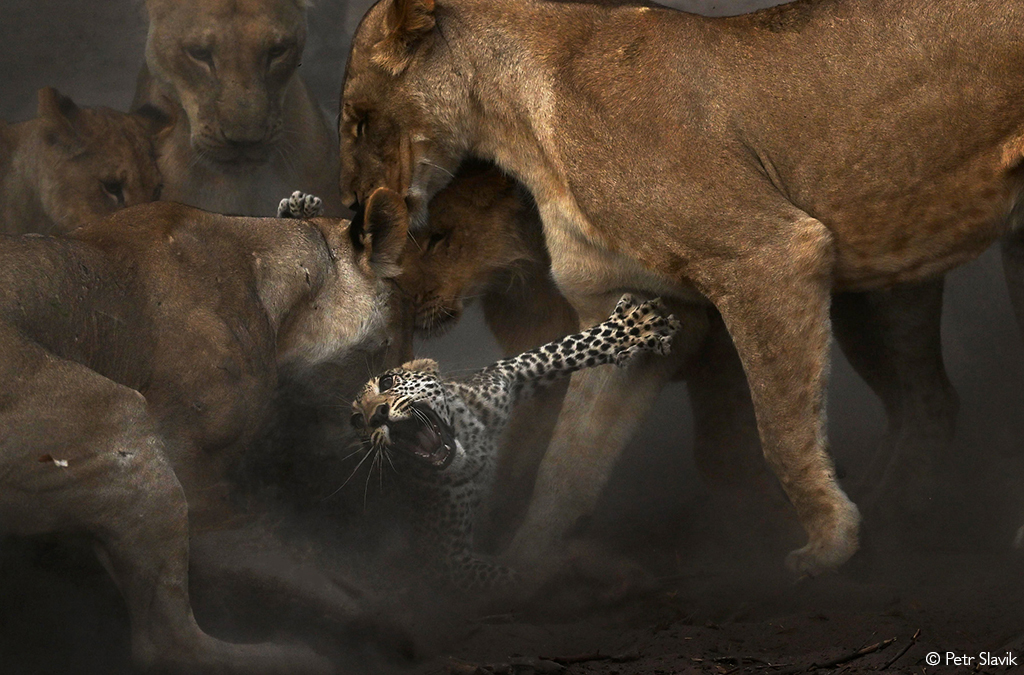
Some photographs stop you in your tracks, while others challenge what you believe is possible. This image does both.
At first glance, the scene appears almost unreal. The dust, the tangle of bodies, the desperate struggle at its centre – it resembles a dark allegory rather than a wildlife photograph. Yet the closer one looks, the more remarkable it becomes. Every subject remains legible within the chaos. The eye moves from lion to leopard cub, from swirling dust to flailing limbs, discovering new details with each viewing. Maintaining focus, composition and exposure during a moment unfolding at such speed is an extraordinary achievement.
Beyond its technical excellence, the image forces us to confront one of nature’s most uncomfortable realities. The systematic elimination of future competitors is less often witnessed and even more rarely photographed. The emotional weight of the scene is impossible to ignore. The leopard cub’s final act of defiance transforms the photograph from a record of behaviour into a story of courage against overwhelming odds. What elevates this image above all others is its authenticity. Nothing here is embellished or staged. It is profoundly affecting. In an era where extraordinary images are often met with scepticism, reality can still surpass imagination. An exceptional and unforgettable piece of wildlife storytelling.
Given the extraordinary nature of the scene, the image, along with a sequence of photographs taken immediately before and after the encounter, was carefully reviewed and authenticated by our judges. It is not AI-generated and has not been manipulated using AI processes. The photograph accurately represents the original event: nature can still produce moments more astonishing than fiction.
Photo and photographer details – read more
Petr says: “An ordinary morning at the end of the dry season on the Chobe River quickly turned into one of the most dramatic wildlife encounters I have witnessed.
A pride of lionesses with cubs was resting on a rise. They had not made a kill for three days and were carefully watching the surrounding area. About 300 metres away, two leopard cubs, approximately five months old, emerged from the bush near the road. They drank quickly before disappearing back into the thicket. Unfortunately, one of the lionesses noticed them and immediately charged.
The cubs vanished into dense cover, but the entire pride followed. We slowly drove along the road towards the centre of the action. Suddenly, from a shrub only a few metres from our vehicle, we heard roaring, growling and then a piercing scream. The lionesses had found one of the cubs.
In the dust stirred up by the struggle, the leopard cub fought against overwhelming odds. One of the lionesses even allowed a lion cub to join the attack. Unable to stand properly, the leopard cub still managed to bite the young lion. Moments later, one of the lionesses ended the confrontation. The pride moved away. The elimination of competition between apex predators was complete. What remained was the lifeless body of the leopard cub. I tell myself in vain: But this is the law of nature.”
About photographer Petr Slavík
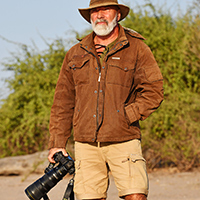 Wildlife photographer Petr Slavík was born in Mělník, Czech Republic. He is the winner of several international wildlife photography awards, including Photographer of the Year in the Czech Nature Photo competition.
Petr is the author of the photographic books Wild Hearts and Close Encounters, co-author of Wild Planet, and creator and producer of the documentary trilogy In the Track of the Predator, broadcast on Prima Zoom television. He also leads photographic expeditions to some of the world’s most remote wilderness areas and serves as a Nikon ambassador in the Czech Republic.
Instagram: petrslavikphoto
RUNNERS-UP
(in no specific order)
Judges’ comment:
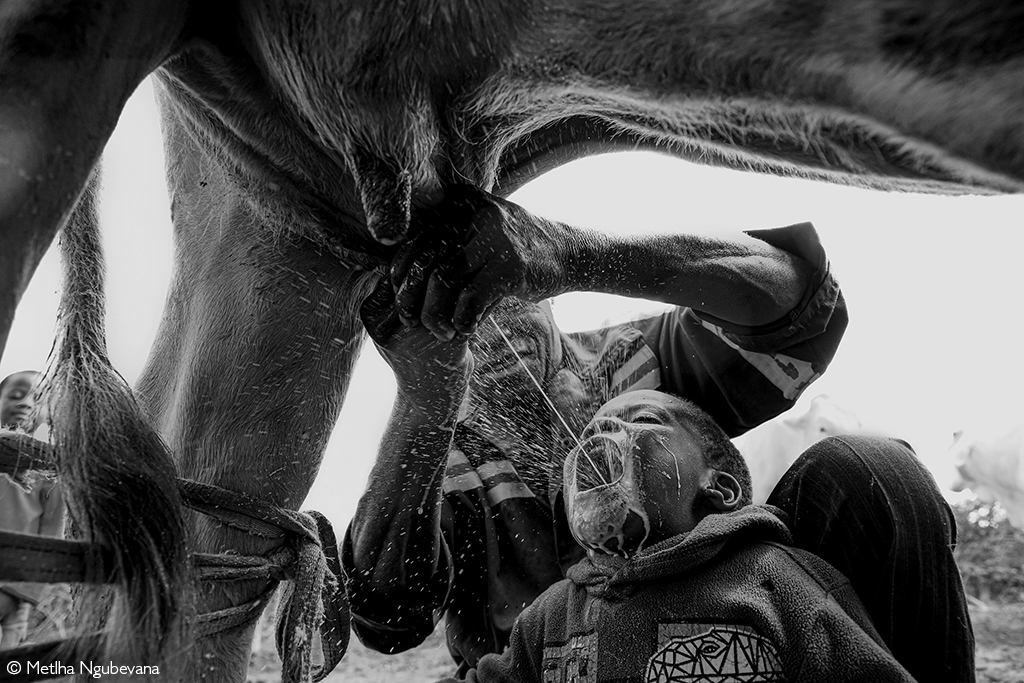
This photograph reveals something deeply personal while remaining profoundly respectful. The framing is exceptional. By positioning the viewer between the cow’s legs, Metlha transforms a farming scene into something far more immersive. The composition draws us into the centre of the moment while preserving the dignity of those within it. Every element feels deliberate: the father seated behind, the child receiving the milk, and the natural frame created by the cow. The monochrome treatment strips away distraction, allowing gesture, expression and symbolism to take centre stage.
More than documenting an event, the photo preserves a tradition. The act itself is simple, but it carries deep meaning: a blessing for prosperity, health and continuity. The photograph speaks of family, but also of heritage and the passing of knowledge from one generation to the next. Powerful cultural photographs often rely on trust. This image could only have been made because the photographer was accepted into the space and recognised the significance of what was unfolding before him. The result is an honest and beautifully observed portrait of Setswana life.
Photo and photographer details – read more
Metlha says: “I took this photograph in a village about five kilometres from Botswana’s capital city while on assignment for a news agency, documenting how climate change was affecting farmers.
Early one morning, I joined a family in their kraal. As they milked their cattle, they shared stories about how changing weather patterns were affecting their livelihoods. As the conversation flowed, the family became comfortable with my presence and I was no longer seen as an outsider. While photographing the morning routine, an unexpected moment unfolded. The father called his son over and, instead of handing him the milking duties, sat the boy on his lap and directed fresh milk straight from the cow into his mouth. With my Canon EOS 5D Mark III and Canon EF 24–105mm lens, I quickly moved to the opposite side of the cow to create a stronger composition and captured a moment I never expected.
Later, he explained that some people traditionally believed this act was a blessing, wishing children prosperity and a future filled with cattle. I later converted the image to black and white to reflect a tradition rooted in the past.”
About photographer Metlha Ngubevana
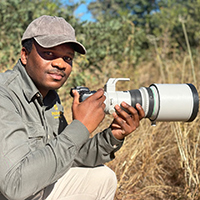 Metlha Ngubevana is a Botswana-based wildlife photographer and visual storyteller who uses photography to advocate for wildlife conservation and celebrate Africa’s rich cultural heritage. He began his career as a photojournalist with Botswana’s state-owned newspaper before joining Press Photo, one of the country’s leading news agencies. Through journalism, he developed a passion for storytelling and increasingly focused on wildlife, conservation, climate change and culture.
His work has been published internationally through Xinhua News Agency, bringing attention to African wildlife, conservation initiatives and cultural traditions. Today, Metlha works as a photographic guide in Chobe, where he continues to create imagery that connects people with nature and encourages a deeper appreciation for conservation.
Instagram: metlha_ngubevana_photography
Judges’ comment:
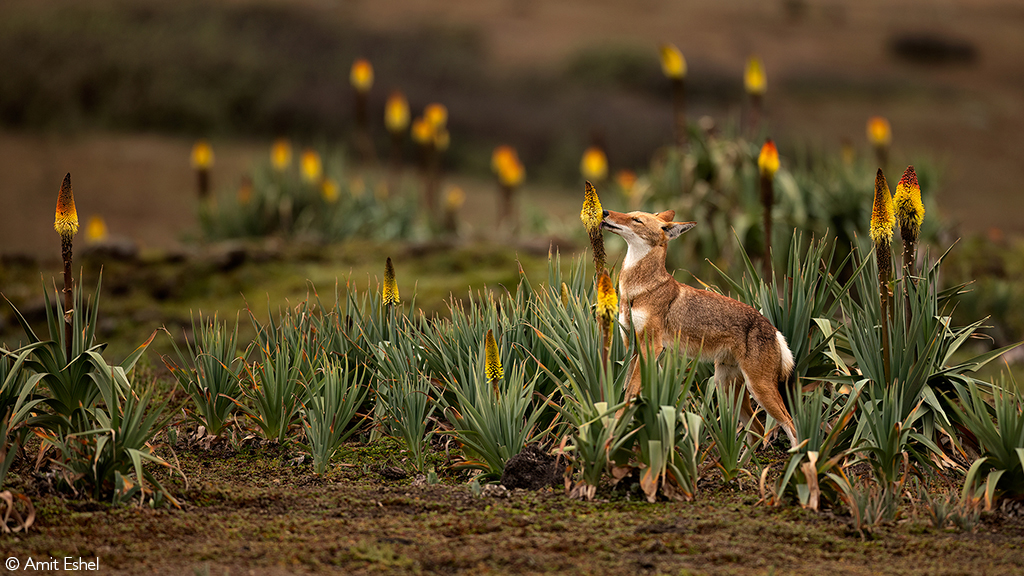
Few photographs combine scientific significance, conservation value and visual impact as successfully as this one. At first glance, the image appears beautifully simple: an Ethiopian wolf feeding among vivid red-hot poker flowers in the Afroalpine highlands. But the longer one looks, the more extraordinary the scene becomes. The rich reds of the blooms contrast strikingly with the wolf’s soft coat, while the clean composition isolates a behaviour that until recently was completely unknown to science.
The image documents one of the most remarkable natural history discoveries of recent years. Scientists only recently confirmed that Ethiopian wolves feed on nectar and may transfer pollen between flowers as they forage — making them the first known large carnivores documented acting as pollinators. Amit has transformed a scientific observation into a compelling visual story, allowing viewers to immediately grasp the significance of this behaviour. The photograph also carries considerable conservation weight. The Ethiopian wolf is Africa’s most threatened carnivore, with fewer than 500 individuals remaining in the wild. To photograph such a rare species engaged in newly documented behaviour is an extraordinary achievement. Even among the continent’s known wildlife, there are still stories waiting to be discovered.
Photo and photographer details – read more
Amit says: “Watching and photographing an Ethiopian wolf licking the bright red flowers while unknowingly serving as a pollinator was one of the most surprising moments I have experienced in the field. At first, I was not sure what I was seeing. The wolf approached the flowers calmly and focused on feeding from the blooms scattered across the Afroalpine grassland. As I realised what was happening, I noticed pollen collecting on its muzzle as it moved from flower to flower. Through my camera, I was witnessing a behaviour that had only recently been recognised by science.
This unique behaviour was only recently discovered and documented for the first time. In doing so, the wolves act as pollinators. As they forage, the wolves’ muzzles become covered in pollen, which they transfer from flower to flower while feeding. Individual wolves have been recorded visiting up to 30 blooms during a single feeding session, with members of different packs using the same resource.”
About photographer Amit Eshel
 Growing up in a small community in Israel, Amit Eshel developed a fascination with wildlife long before he picked up a camera. Nature was his playground, and his childhood was spent searching for animals, sketching wildlife and dreaming about encounters in the wild.
After graduating with honours in Illustration, Animation and Graphic Design, Amit combined his artistic background with his passion for animals, initially creating wildlife-inspired jewellery using his photographs as reference material. Over time, photography itself became his primary focus. Today, Amit leads wildlife photography expeditions and works on personal projects in remote locations around the world. His photography combines an artist’s eye for composition with a deep interest in animal behaviour and natural history. In 2018, he made the decision to pursue photography professionally and has since built a career dedicated to documenting remarkable wildlife moments.
Instagram: siberianart
HIGHLY COMMENDED
(in no specific order)
Judges’ comment:
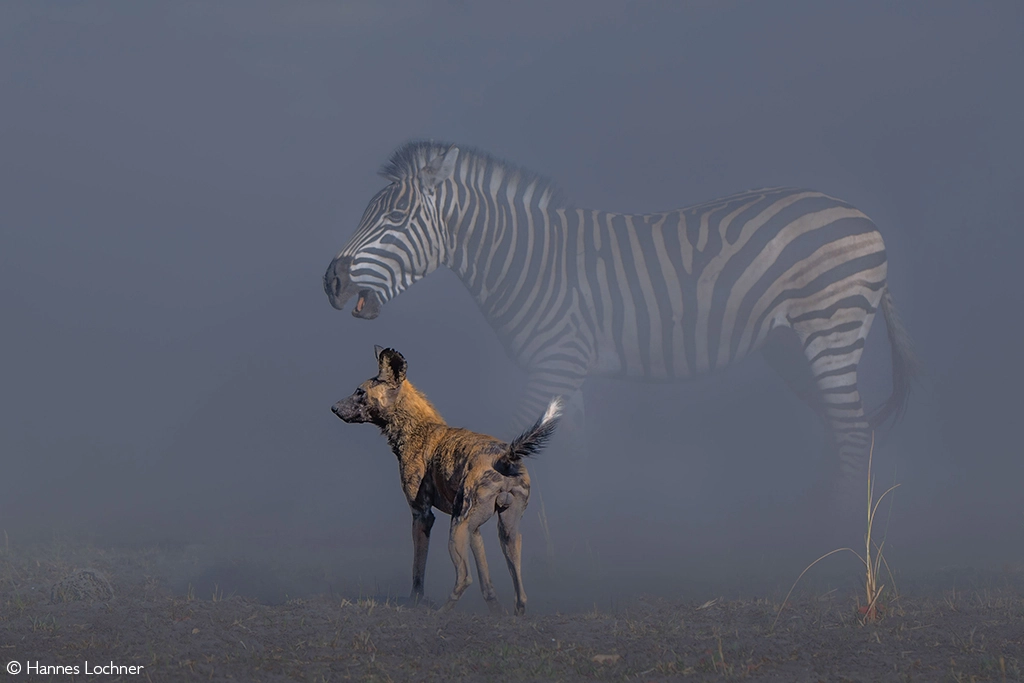
Atmosphere drives this image. Suspended dust softens the scene, reducing predator and prey to ghostly figures emerging from the haze. The wild dog stands alert in the foreground while the zebra materialises behind it, creating an unusual moment of visual symmetry between two animals that would normally be cast in opposing roles. The muted palette and layered dust transform a familiar wildlife encounter into something far more contemplative: a study of isolation, uncertainty and survival in the aftermath of pursuit.
Photo and photographer details – read more
Hannes says: “A lone African wild dog stands alert in the foreground while the rest of the pack moves through a haze of dust behind it. In the background, a solitary zebra watches the scene unfold. The muted tones and dusty conditions create a striking atmosphere, drawing attention to the contrast between predator and prey. Layers of suspended dust add depth to the composition, capturing a quiet moment of vigilance in the Kalahari.”
About photographer Hannes Lochner
Hannes Lochner is a South African wildlife photographer, author and safari guide renowned for his work in the Kalahari. His distinctive style combines dramatic light, atmospheric conditions and behavioural storytelling to create images that reveal the character of Africa’s wild places. Hannes leads photographic safaris across Africa, where he shares his knowledge of wildlife, conservation, and photography with guests from around the world. His work reflects a deep appreciation for nature and a commitment to capturing authentic moments in the field. For the past several years, Hannes and his wife, Noa Koefler, a wildlife videographer, have travelled and worked throughout Africa, continually building a body of work that celebrates the beauty, character, and diversity of the continent’s wildlife. His work has appeared in major international publications and has been recognised in numerous wildlife photography competitions around the world.
Instagram: hannes_lochner
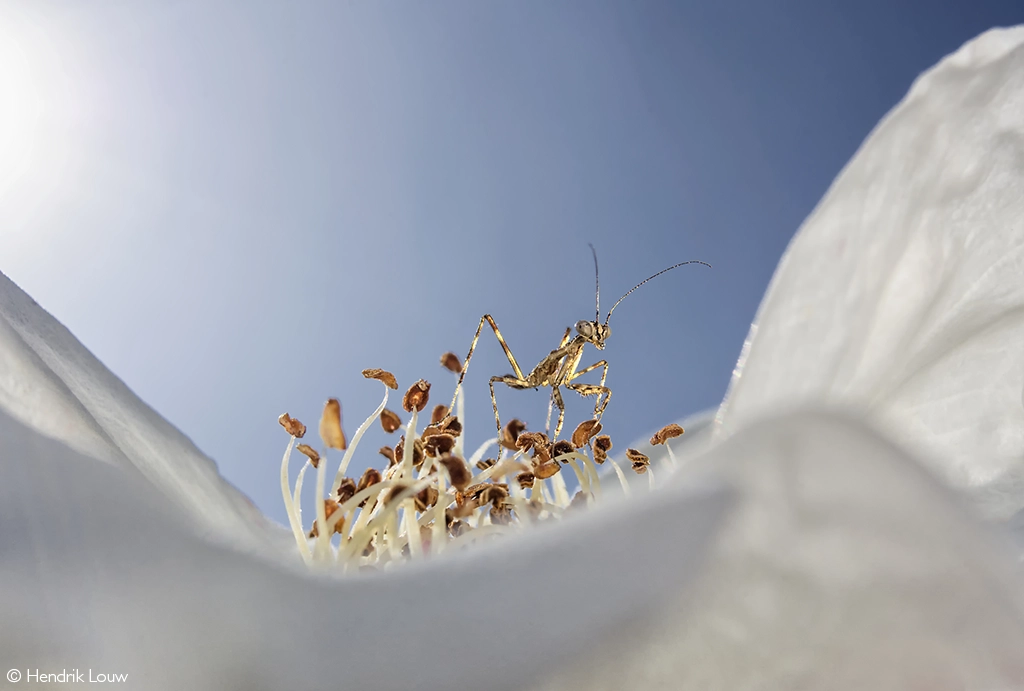
Judges’ comment:
The scale of this photograph is astonishing. A predator barely three millimetres long is transformed into the subject of a grand portrait, framed by glowing petals and delicate stamens that resemble flowing fabric. The soft backlighting illuminates both flower and mantis, creating a sense of shelter and vulnerability not often seen in insect photography.
Beyond the beauty of the image lies a testament to patience and fieldcraft. Finding a newly hatched mantis is challenging enough; presenting it with such elegance and intimacy is another achievement entirely.
Photo and photographer details – read more
Hendrik says: “As a macro photographer, I have learned to recognise areas where certain insects are likely to occur. After following what was probably the same female mantis for some time, I discovered an egg case and visited it regularly over a six-week period. This was only the second time I had witnessed common green mantis babies emerging. I was fortunate to spot a few of them as they scattered after hatching. This individual, which was about a day old and only 3mm long, paused among the stamens of a flower early one morning.
To create a greater sense of scale and intimacy, I used a 28mm lens with extension tubes and photographed from a low angle to capture the backlighting and early morning atmosphere. For me, this image best captured the balance between vulnerability and predatory instinct in such a tiny creature.”
About photographer Hendrik Louw
Hendrik Louw has been pursuing photography for more than 27 years, ever since picking up a second-hand camera and joining a photographic club in 1999. While he enjoys many genres of photography, his true passion lies in macro photography, particularly the fascinating world of frogs, mantises and spiders. Hendrik’s work reveals the beauty and complexity of often-overlooked creatures. His images have earned recognition in numerous international photography competitions, and he regularly shares his passion through workshops and photographic congresses. Outside of photography, Hendrik works as an environmental manager and climate change specialist.
Instagram: hempieslouw
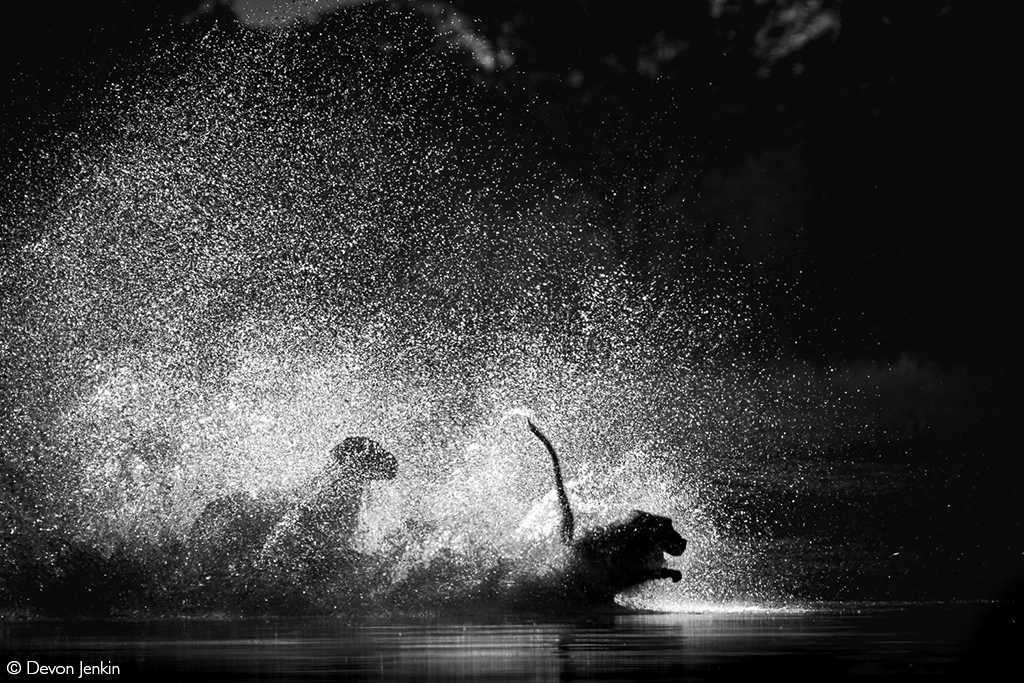
Judges’ comment:
Few images convey panic quite as effectively as this one. Backlit spray fills the frame as the baboon charges through the water, pursued by a lioness emerging from the chaos behind it. The silhouettes, illuminated droplets and monochrome treatment reduce the scene to pure movement and tension.
What makes the photograph compelling is knowing that this was only one chapter in a remarkable sequence of events. Devon recognised the moment instantly, reacted decisively and produced an image that captures the drama of the chase at its most intense.
Photo and photographer details – read more
Devon says: “I had been photographing hippos at sunset, hoping to capture a backlit spray image as one surfaced. Suddenly, chaos erupted on the far side of the pool when a large baboon began barking loudly enough to disturb everything around it.
Looking up from my camera, I saw the baboon running for its life with a lioness in pursuit. The baboon plunged into the water, apparently assuming the lioness would not follow. It was right: she turned away moments after this photograph was taken. However, the baboon soon found itself surrounded by hippos standing up in the shallow water around it.
The baboon eventually scrambled back to shore, where the lioness resumed the chase. The entire sequence lasted only seconds. Being able to react, recompose and adjust my settings came from years spent behind a camera, understanding animal behaviour, and, of course, a little bit of luck.”
About photographer Devon Jenkin
Born in Zimbabwe, Devon Jenkin has spent much of his life working in Africa’s wild places as a guide, camp manager and wildlife film crew support specialist. Today he works as a wildlife photographer and photographic guide, sharing his passion for conservation and authentic wildlife experiences through photography and small-group safaris.
Instagram: devonjenkinphotography
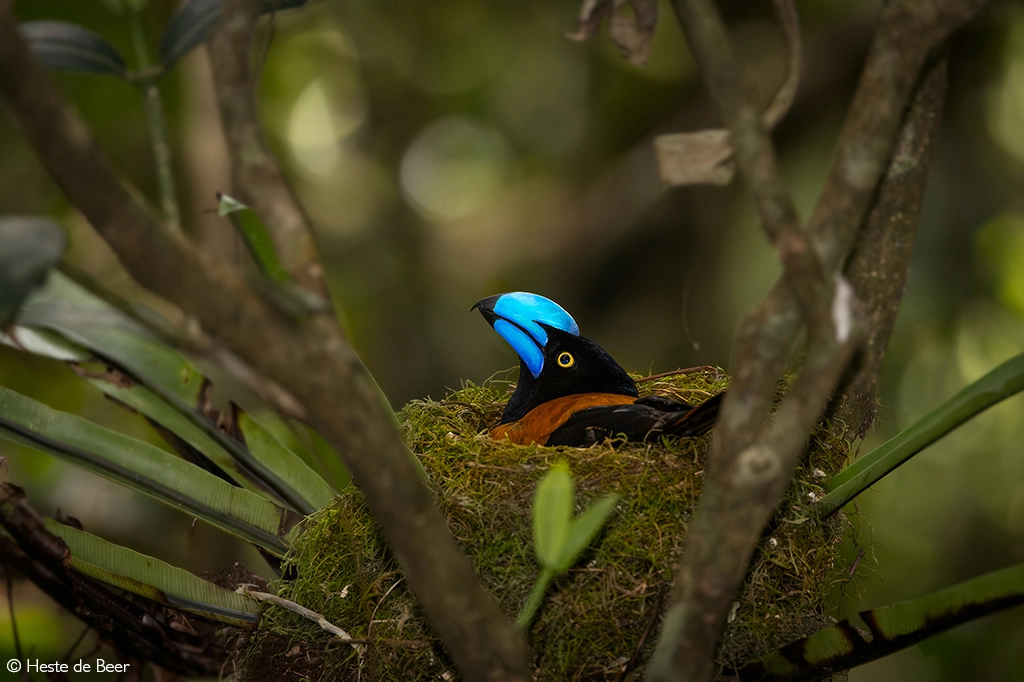
Judges’ comment:
This is a photograph built on patience, persistence and good fortune. The helmet vanga is one of Madagascar’s most sought-after endemic birds, rarely seen and even more rarely photographed at its nest. To find a helmet vanga is a privilege; to follow it to an active nest is an extraordinary stroke of luck. The vivid blue bill and striking eye immediately draw attention, while the fork of the tree creates a natural frame around the bird and her eggs. Beyond its visual appeal, the image documents a fleeting and privileged encounter with one of Madagascar’s most remarkable species.
Photo and photographer details – read more
Heste says: “To see the iconic helmet vanga (Euryceros prevostii), it is essential to have a local guide. The dense rainforests on the steep slopes of Marojejy hide some very special animals. I was fortunate to be guided by Volamamy Richelin from the nearby village of Manantenina. Our main objective was to find the elusive silky sifaka. While following a group of sifakas, Richelin spotted a helmet vanga. We followed the bird and were fortunate enough to watch her fly to a nest containing two eggs. Richelin worked closely with two local trekkers from the village, whose knowledge and experience helped us find these remarkable animals in very challenging conditions.”
About photographer Heste de Beer
Heste de Beer is a wildlife photographer driven by a passion for finding unusual and special animals in remote places. While photography is an important part of the experience, her primary goal is to spend time observing wildlife and documenting their daily activities and interactions. Through her images, she hopes to share the beauty of these encounters with others.
Instagram: heste_de_beer
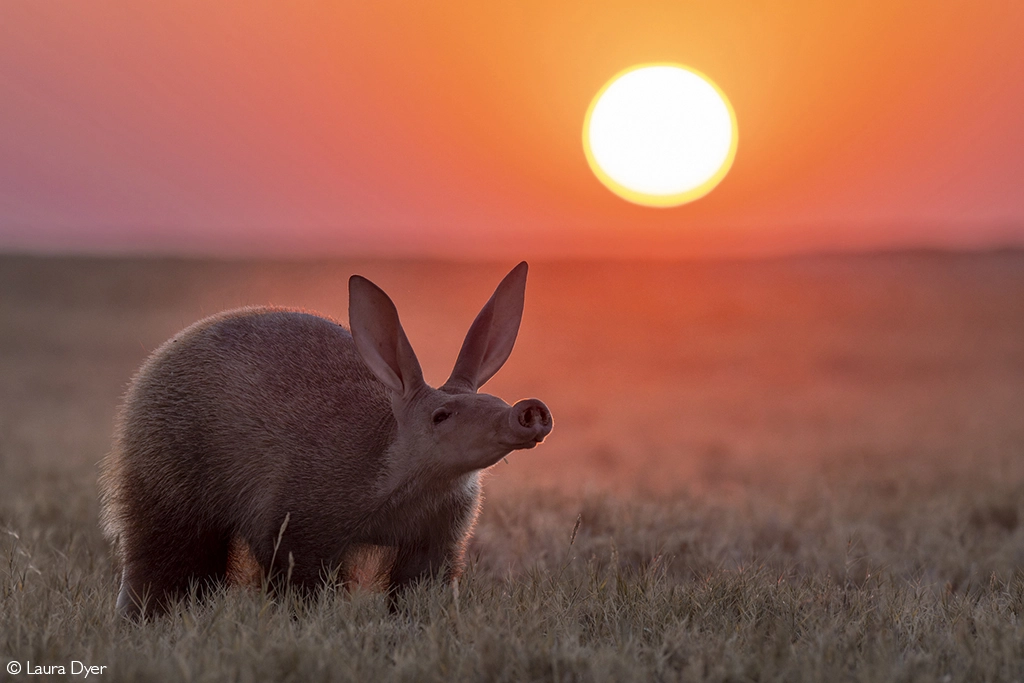
Judges’ comment:
Aardvarks are among Africa’s most elusive mammals, making any meaningful sighting memorable. To photograph one in warm afternoon light, fully exposed and going about its business before darkness has fallen, is rare. The rich golden tones, clean composition and alert posture of the aardvark combine to create a portrait that feels both intimate and celebratory, shining a spotlight on a species few people ever have the privilege of seeing.
Photo and photographer details – read more
Laura says: “An aardvark is one of the rarest African mammals to find, let alone photograph, and seeing one has long been a dream of mine. As a South African, I had grown up with only fleeting glimpses of this fascinating creature, usually at night and only for a few moments.
Aardvarks are nocturnal and typically emerge under the cover of darkness to feed on ants and termites. However, they are sensitive to cold and need to feed in bursts, returning to their burrows to digest and keep warm. A sudden cold snap in the central Kalahari caused temperatures to drop dramatically, limiting the amount of time this aardvark could spend feeding at night.
As it was shortly after a full moon, there was only a brief period of darkness before moonlight illuminated the landscape. Extending its feeding period into the early evening became worthwhile, creating an exceptionally unusual opportunity to observe an aardvark at sunset. For me, it was a once-in-a-lifetime experience to watch this individual digging, feeding and moving about completely relaxed and indifferent to our presence. It also offered a chance to appreciate the unique features of one of Africa’s most elusive mammals in beautiful natural light.”
About photographer Laura Dyer
Laura Dyer is a South African wildlife photographer, photographic guide and safari leader. She leads small-group and bespoke safaris throughout Africa and is passionate about inspiring a love of the natural world through photography. Alongside guiding and teaching photography, Laura works with lodges, conservation organisations and filmmakers to help raise awareness of wildlife and conservation issues across the continent.
Instagram: lauradyerphotography
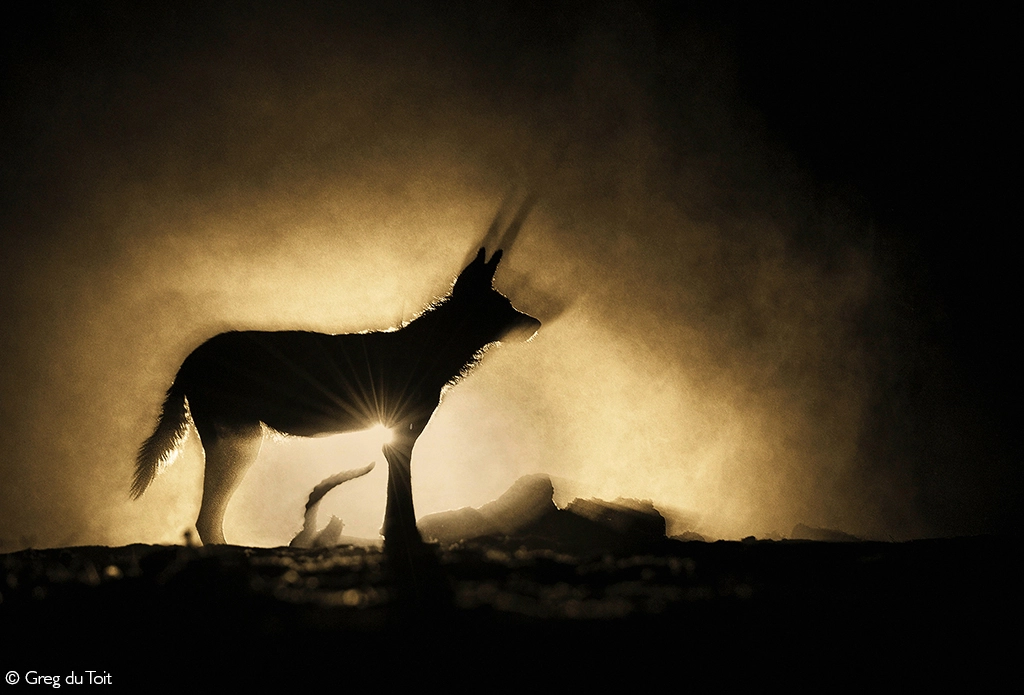
Judges’ comment:
This image transforms a familiar predator-prey scene into something almost dreamlike. Backlighting, dust and shadow combine to create a striking silhouette, while the wild dog’s projected shadow adds an unexpected layer of visual intrigue. The photograph distils the energy and chaos of a feeding frenzy into a single, elegant frame where shape and atmosphere become the dominant storytelling tools.
Photo and photographer details – read more
Greg says: “The day’s excitement seemed over. We were returning to camp at Chitake Springs after an afternoon game drive and dusk was settling over the dry riverbed. Suddenly, a pack of African wild dogs burst into camp and brought down an impala a short distance from where we were standing. What followed was one of the most exhilarating wildlife photography experiences of my life. The dogs fed frantically in the deep, dry sand, throwing vast clouds of dust into the still evening air.
I positioned myself at eye level and chose to shoot directly into the light. Rather than revealing detail, the backlighting transformed one of the dogs into a silhouette. The dust became an essential part of the image, acting like a natural screen and revealing the shadow of my subject behind it. For a brief moment, the combination of fading light, swirling dust and the intensity of the feeding created a scene unlike anything I had witnessed before.”
About photographer Greg du Toit
Based in Hoedspruit, South Africa, Greg du Toit is a fine-art wildlife photographer whose work is created entirely through authentic encounters in Africa’s wildest spaces. Describing himself as an old-school wildlife photographer, Greg uses light as his creative tool, simplifying and distilling natural scenes to create images that connect viewers with the essence of Africa’s wilderness.
Instagram: gregdutoit.photosafaris
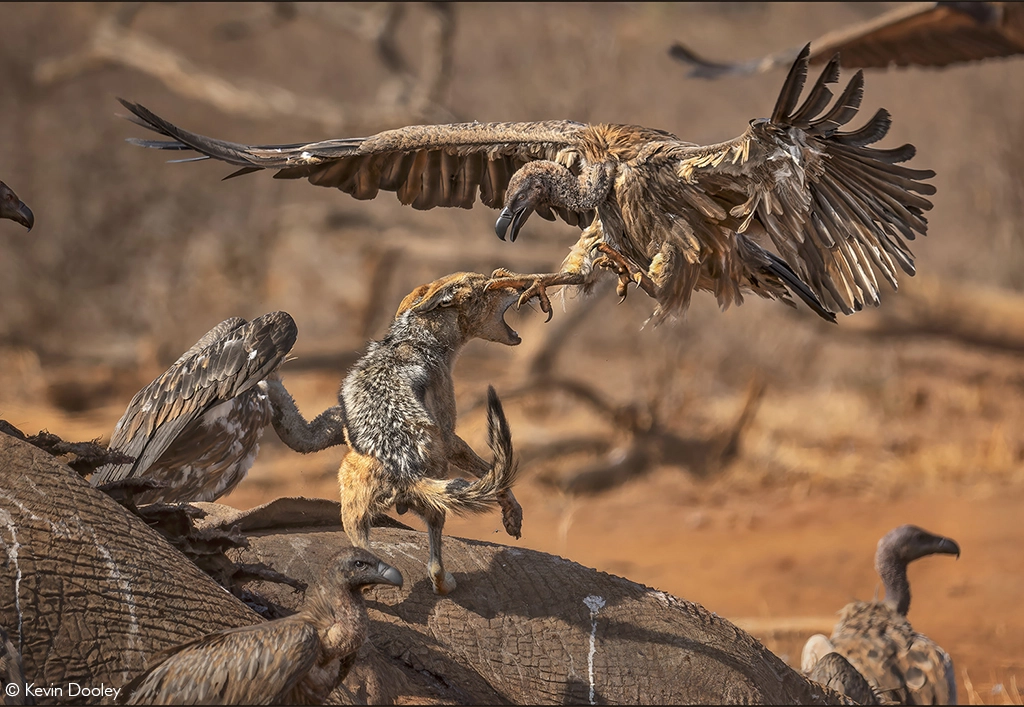
Judges’ comment:
Conflict unfolds in an instant, and Kevin has captured it at precisely the right moment. The jackal’s expression, the spread wings of the vulture and the extended talons create a frame filled with tension and movement. Scavengers are often overlooked in wildlife photography, yet this image highlights the fierce competition that surrounds every feeding opportunity and the risks animals take to secure a meal.
Photo and photographer details – read more
Kevin says: “I often search for interactions between jackals and other predators. I find jackals fascinating: they are clever, quick and remarkably brave. On this occasion, an old elephant carcass had attracted a variety of predators and scavengers. The interactions between the jackals and vultures were particularly intense and highly photogenic. The jackal in this image was doing everything it could to prevent the vultures from feeding.
At one point, the jackal grabbed a vulture by the chest and ended up with a mouthful of feathers. The vulture immediately retaliated, grabbing the jackal’s face with its talons and possibly injuring its eye. Fortunately, I had already set my camera for a fast shutter speed, allowing me to capture the action sharply at the decisive moment.”
About photographer Kevin Dooley
Kevin Dooley’s love for adventure and wild places began in childhood and eventually led him into a career combining portrait and wildlife photography. Today, Kevin and his wife Tricia operate a safari and photographic adventure company. As a certified African ranger and wildlife guide, he is passionate about sharing wildlife experiences and encouraging others to appreciate and care for the natural world.
Instagram: kevindooley_idubephotosafaris
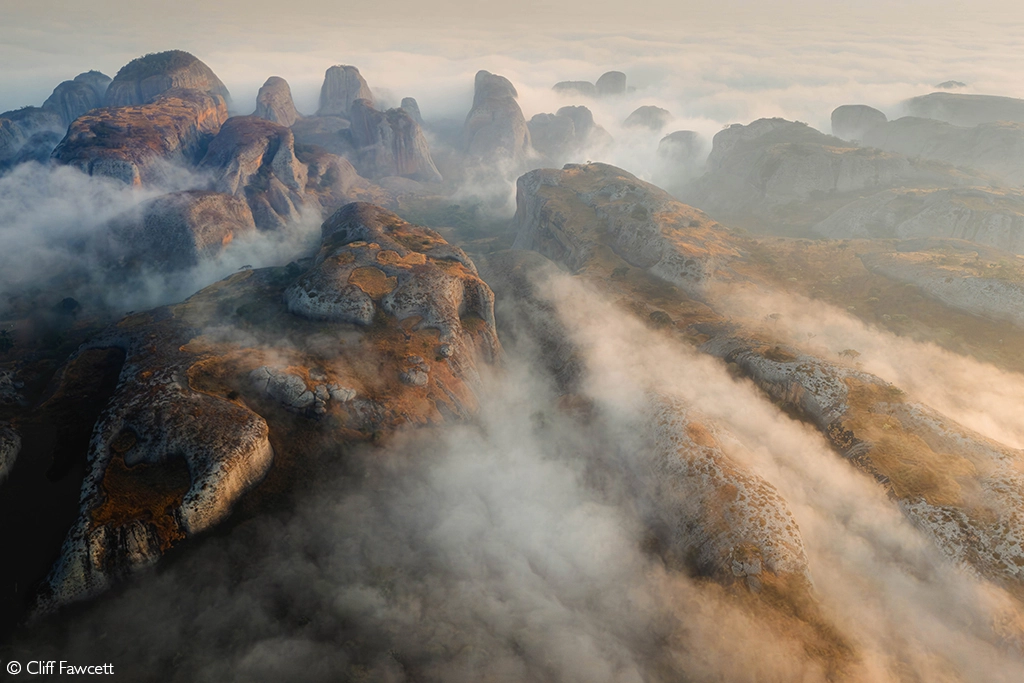
Judges’ comment:
This image succeeds because it reveals a landscape in an entirely unexpected way. Rising through a blanket of mist, the dark monoliths resemble islands adrift in an ocean of cloud. The photograph balances scale, atmosphere and simplicity beautifully, transforming one of Angola’s most extraordinary geological formations into a scene that feels almost surreal. It is a reminder that Africa still holds landscapes capable of surprising even the most experienced travellers.
Photo and photographer details – read more
Cliff says: “We were camped at the base of the Black Stones in Pungo Andongo, central Angola. These massive rock formations have stood here for hundreds of millions of years and have witnessed centuries of history.
At 5am, however, my focus was entirely on the weather. A thick mist had settled across the Malanje Plateau and visibility was almost non-existent. I launched my drone to see whether there was anything above the cloud layer. As soon as the drone broke through the mist, the landscape was transformed. The surrounding savanna disappeared beneath a blanket of white, leaving only the dark peaks rising through the fog like islands in a sea.
It was one of those rare moments where a familiar landscape becomes something completely different, revealing a perspective that would otherwise remain hidden.”
About photographer Cliff Fawcett
Cliff Fawcett is an Royal Photographic Society-accredited photographer whose work explores the psychology of photography and why certain images resonate so strongly with viewers.
Combining a background in human behaviour with a passion for exploration, Cliff has spent the past several years travelling across continents in his 1997 Land Rover Defender, documenting remote landscapes and testing visual storytelling in some of the world’s most challenging environments.
Instagram: clifffawcett
Judges’ comment:
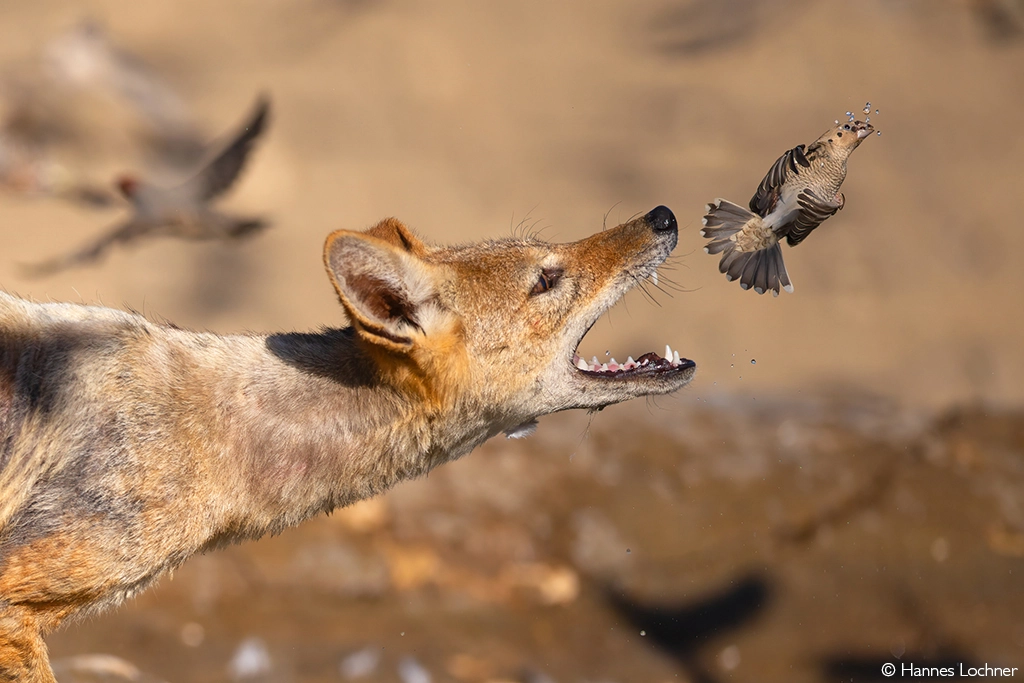
It takes skill to capture a moment like this in the chaos of the waterhole. Timing is everything in action photography, and this image captures the decisive fraction of a second when predator and prey narrowly miss each other. The finch erupts from the water in a spray of droplets while the jackal’s jaws snap shut just behind it. The fleeing birds in the background and the painterly quality of the light add depth and drama to an already extraordinary moment.
Photo and photographer details – read more
Hannes says: “The harsh conditions of the Kalahari dry season draw wildlife of every size to the precious waters of a shrinking waterhole. As a female red-headed finch rose from the water’s edge, droplets scattering into the air around her, a black-backed jackal launched itself forward in a sudden burst of speed.
The photograph captures one of the countless dramas that unfold around scarce water sources in the Kalahari. Every visit carries both opportunity and risk, and even the smallest creatures must remain constantly alert. In this instance, agility and timing prevailed, and the female finch lived to drink another day.”
About photographer Hannes Lochner
Hannes Lochner is a South African wildlife photographer, author and safari guide renowned for his work in the Kalahari. His distinctive style combines dramatic light, atmospheric conditions and behavioural storytelling to create images that reveal the character of Africa’s wild places. Hannes leads photographic safaris across Africa, where he shares his knowledge of wildlife, conservation, and photography with guests from around the world. His work reflects a deep appreciation for nature and a commitment to capturing authentic moments in the field. For the past several years, Hannes and his wife, Noa Koefler, a wildlife videographer, have travelled and worked throughout Africa, continually building a body of work that celebrates the beauty, character, and diversity of the continent’s wildlife. His work has appeared in major international publications and has been recognised in numerous wildlife photography competitions around the world.
Instagram: hannes_lochner
Judges’ comment:
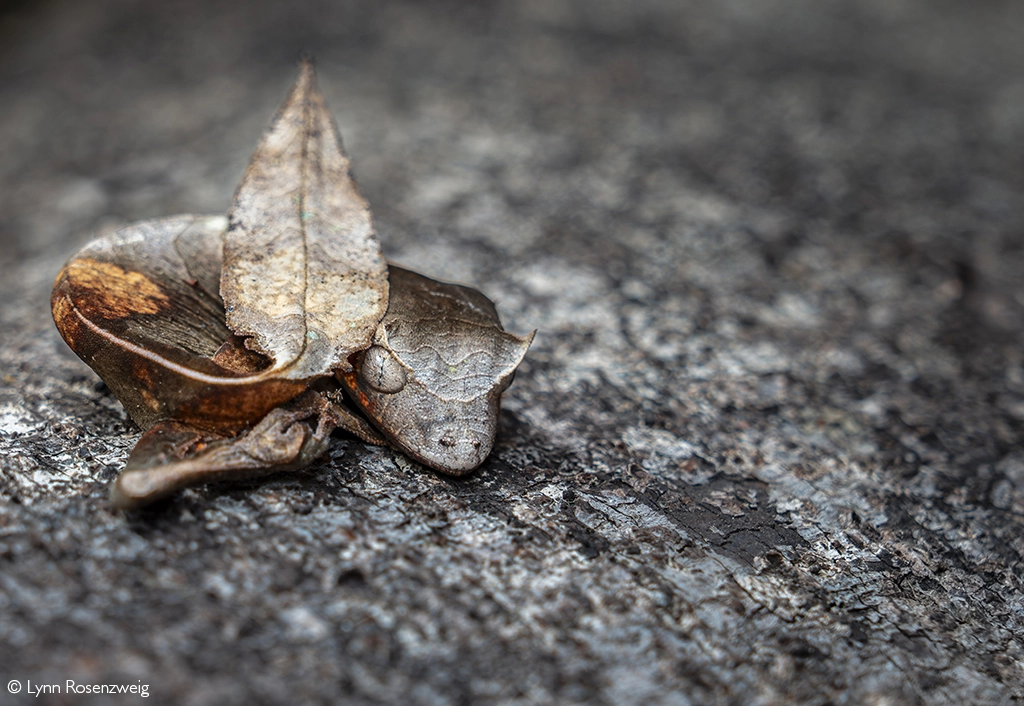
What a delightful encounter with one of Madagascar’s most remarkable reptiles. Curled up, the leaf-tailed gecko appears perfectly at home, its camouflage so effective that it can easily be overlooked. The image captures a charming moment with a species that is both difficult to find and challenging to photograph, making the guide’s sharp eye and the photographer’s careful composition all the more impressive.
Photo and photographer details – read more
Lynn says: “Only at my guide’s insistence did I look more carefully and realise that it was not a plant but a leaf-tailed gecko. I had been completely misled by the astonishing camouflage of this animal. The shape of the gecko’s head echoed that of its tail, which was held above its body like a branch. The texture of its skin resembled weathered foliage, making it difficult to separate the animal from its surroundings.
What fascinated me most was how my brain kept switching between seeing a plant and seeing an animal, trying to determine where one ended and the other began. I was drawn to the simplicity of the scene and the elegance of an animal so perfectly adapted to its habitat. The image invites viewers to slow down, look again and discover something they may not have noticed at first glance.”
About photographer Lynn Rosenzweig
Born in South Africa and now based in the United States, Lynn Rosenzweig has been passionate about photography since receiving her first film camera at the age of 17. Her work is driven by a fascination with animal behaviour, wildlife interactions and the stories that emerge through careful observation. Through decades of travel and exploration, she has documented wildlife, landscapes and cultures around the world, always seeking moments that reveal something deeper about the natural world.
Judges’ comment:
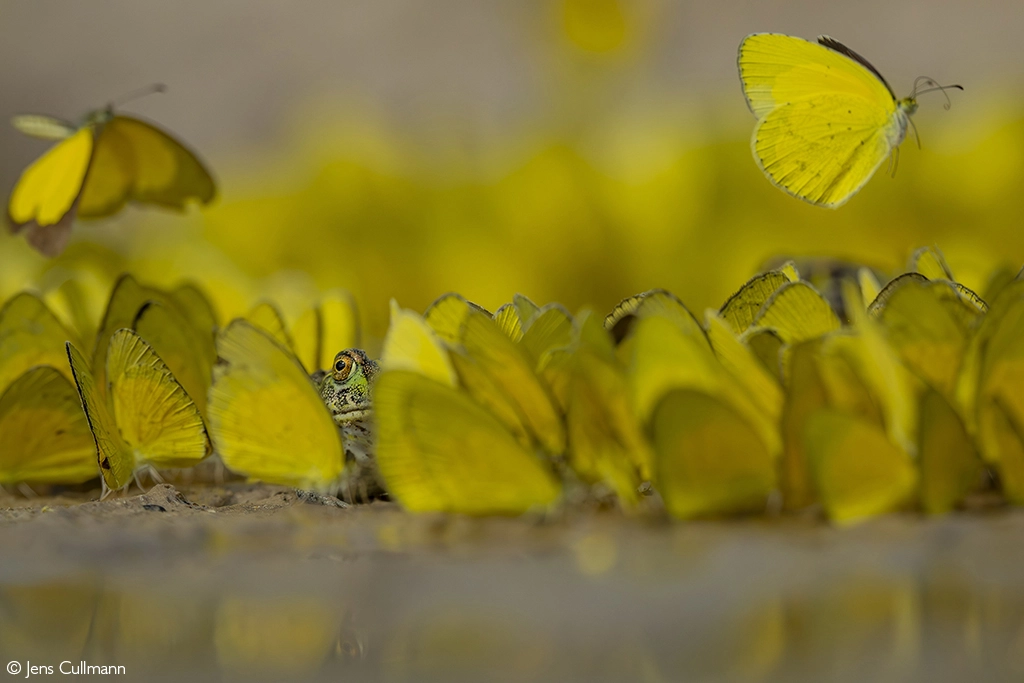
We had a lot of entries of this magic moment from Jens, and it was very difficult to choose our favourite as they were all so magnificent. But this incredibly unique image of the frog hiding in the sea of butterflies just shows how rewarding it can be when patience pays off. The young African bullfrog becomes both hidden and celebrated within the frame. The rich colours, unusual subject combination and low perspective create a photograph that feels distinctly Kalahari: some of the reserve’s most remarkable stories unfold on a miniature scale.
Photo and photographer details – read more
Jens says: “With great excitement, I visited the Central Kalahari Game Reserve in Botswana in mid-March after a period of heavy rain. On my first day, I came across a small muddy pond next to the track where young African bullfrogs were engaged in their quest to survive. At the same time, thousands of butterflies were gathering around the mineral-rich edges of the pond.
To photograph the frogs and butterflies, I positioned my vehicle beside the puddle and spent several days lying beneath it to escape the heat. For five to seven hours each day, I worked from ground level, often in uncomfortable positions, trying to capture the little frogs as they hunted among the countless butterflies. The effort was well worth it when everything came together in this scene.”
About photographer Jens Cullmann
Born and raised in Germany, Jens Cullmann discovered wildlife photography in the early 2000s through a combination of his love for photography and travel. Today, much of his work focuses on Southern Africa, where he is drawn to authentic wildlife moments and the beauty, strength and fragility of nature. Patience and persistence remain at the heart of his photographic approach.
Instagram: jens_cullmann
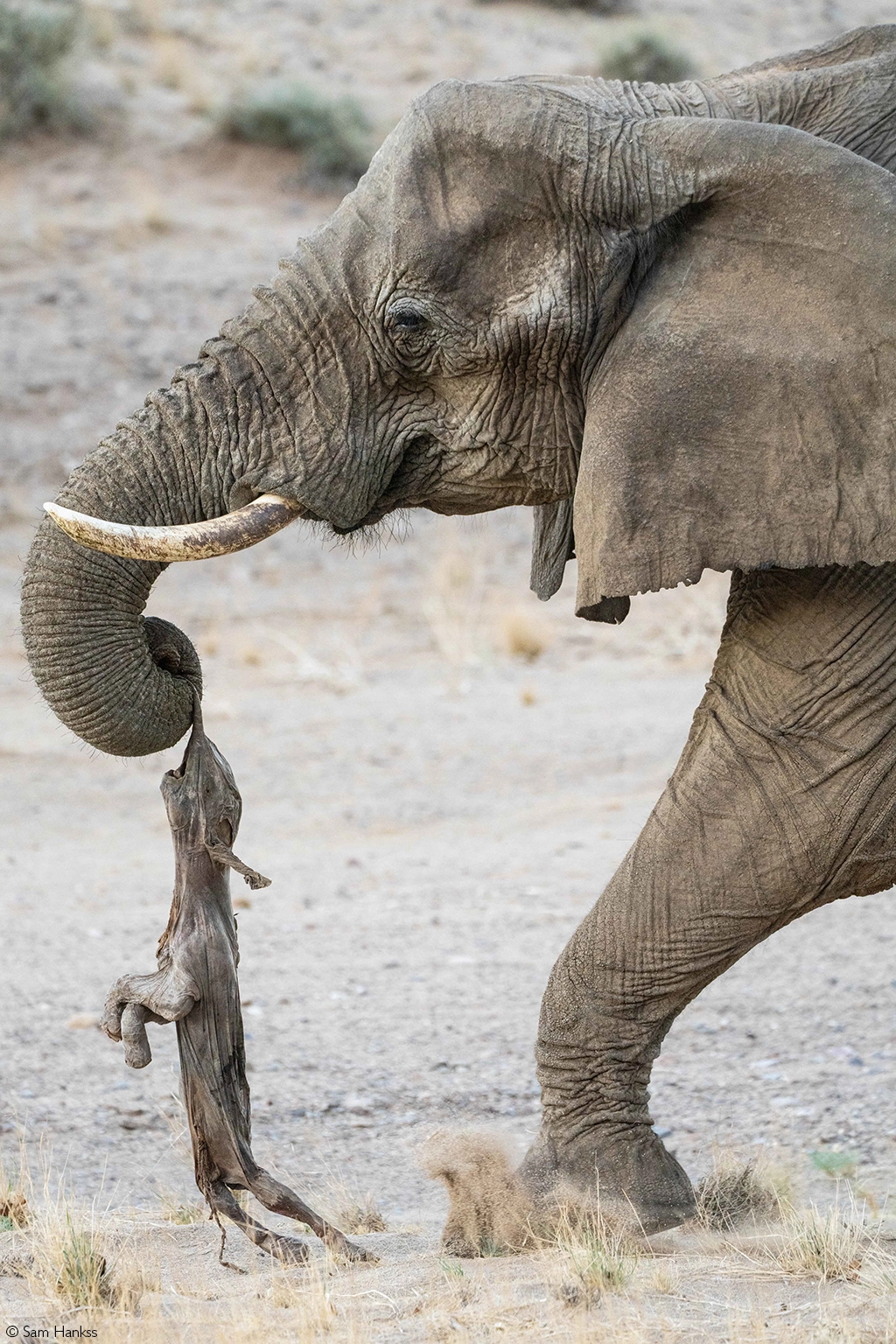
Judges’ comment:
Few images resonated with audiences this year as powerfully as this one. The photograph captures a behaviour that has fascinated and moved observers for decades: an elephant mother’s prolonged attachment to her dead calf. The composition is simple, but it is the emotional weight of the moment that gives the image its power. It is a difficult scene to witness and a poignant reminder of the complexity of elephant behaviour.
Photo and photographer details – read more
Sam says: “A lot of wildlife photography centres on action, but it is often the quieter moments that leave the strongest impression. We had been tracking a herd of desert-adapted elephants through the harsh landscape of Damaraland when one particular cow drew our attention. At her feet lay a stillborn calf.
As the herd browsed, she never seemed to lose contact with the calf. At times she would touch it gently with her trunk, at others she would pick it up and carry it to the next feeding area. Sometimes she carried it in her mouth.
After speaking to several local guides, we learned that she had been carrying the calf for almost a week. When we found the herd the following day, she had finally left it behind.
It is difficult not to anthropomorphise situations like this, but it appeared that the elephant was gradually coming to terms with the loss of a calf she had carried for nearly two years.”
About photographer Sam Hankss
Sam Hankss has been passionate about wildlife and Africa for as long as he can remember. After visiting South Africa as a child, he developed a dream of becoming a safari guide and later worked as a guide in the Greater Kruger, where his love for photography flourished. Today, he travels widely across Africa, leading photographic trips and sharing his passion for wildlife and conservation through guiding and photography.
Instagram: _samhankss
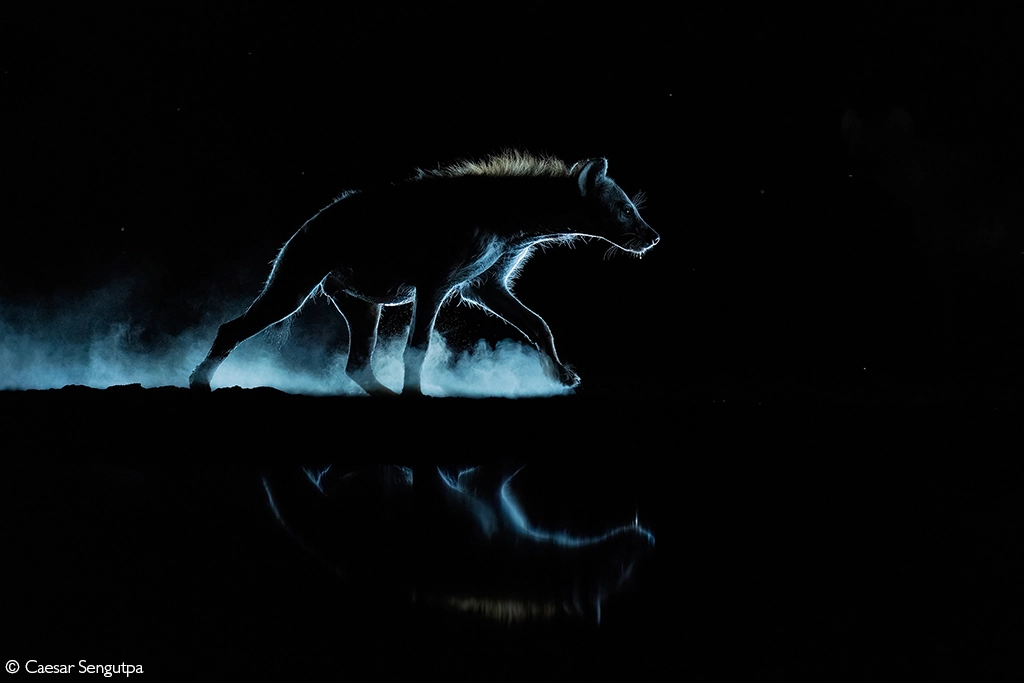
Judges’ comment:
This image demonstrates just how powerful light can be as a storytelling tool. Emerging from darkness and dust, the hyena appears almost ghostlike, its reflection adding another subtle layer to the composition. The photograph challenges common perceptions of a species often portrayed harshly, presenting the animal instead as elegant, mysterious and perfectly adapted to the night.
Photo and photographer details – read more
Caesar says: “Emerging from the darkness, a spotted hyena crosses the edge of a waterhole beneath the African night. Backlit by a carefully controlled light source, its outline glows against a cloud of dust, transforming a familiar scavenger into something altogether different. The reflection below mirrors its presence, creating a scene where reality and illusion briefly meet.
Often misunderstood, the spotted hyena is one of Africa’s most intelligent and successful predators, playing an important role in maintaining ecosystem balance. Here, in the stillness of the night, it becomes a symbol of the hidden life that unfolds after sunset.
This image was photographed in Shompole Conservancy, Kenya, from a dedicated wildlife photography hide that allowed close observation while ensuring the animal remained completely unaware of human presence.”
About photographer Caesar Sengupta
Caesar Sengupta is a wildlife conservation photographer, freelance writer and photography educator. He is a Canon India EOS Maestro and founder-director of DCP Expeditions LLP, a photography learning and community platform established in 2010.
A qualified medical microbiologist by training, Caesar leads photography workshops and expeditions while using photography and writing to highlight biodiversity, conservation and the lesser-known stories of the natural world.
Instagram: drcaesarphotography
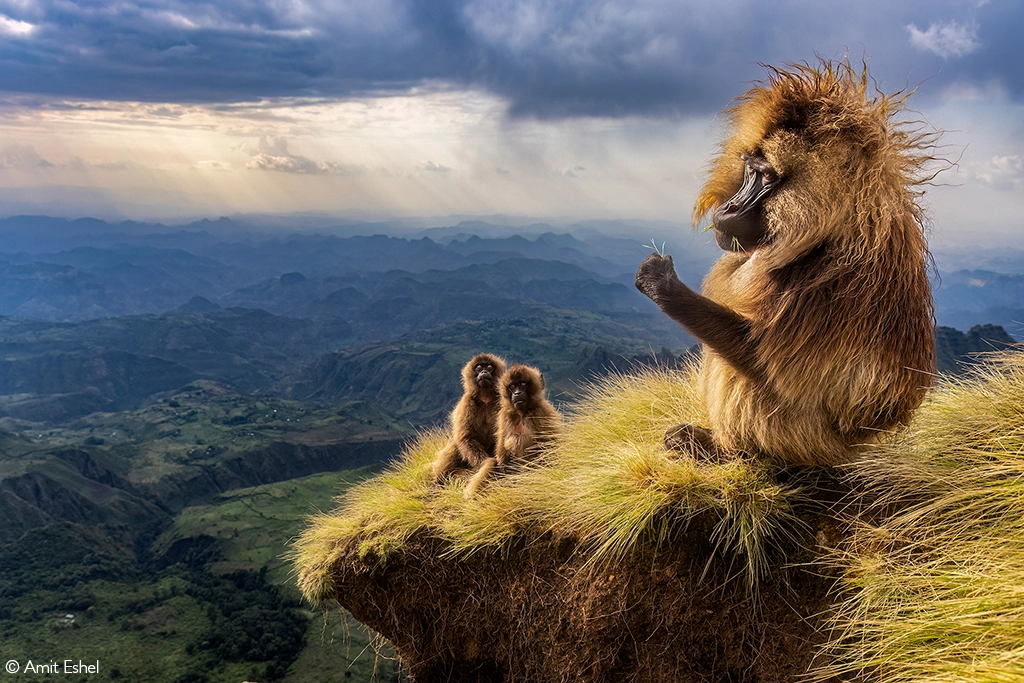
Judges’ comment:
This image captures the essence of the Simien Mountains: vast, dramatic and wild. The imposing male gelada anchors the composition while the playful youngsters and rolling mountain backdrop provide scale and context. The soft post-rain light and layered landscape elevate the image beyond a wildlife portrait, creating a powerful sense of place. Amit was in the exact right place at the right time to capture such a picturesque and voluminous image. What makes the photograph particularly successful is its balance. The geladas are neither overwhelmed by the scenery nor isolated from it. Instead, Amit presents them as part of a vast and fragile Afroalpine ecosystem, creating a portrait that feels both intimate and grand.
Photo and photographer details – read more
Amit says: “I photographed this male shortly after rain while he grazed calmly and kept watch over two playful youngsters near the edge of a cliff in the Simien Mountains. Low clouds hung over the landscape and the cool air added to the atmosphere of the scene. Geladas are unique primates that thrive exclusively in the rugged Ethiopian Highlands, living at elevations ranging from 1,800 to 4,400 metres above sea level. They are the only living primates that primarily graze on grass, with blades and seeds making up most of their diet. Across these highlands, increasing pressure from agriculture continues to fragment the grasslands on which geladas depend. Watching this male feeding while remaining aware of the youngsters around him offered a glimpse into the daily life of one of Africa’s most remarkable primates.”
About photographer Amit Eshel
Growing up in a small community, Amit Eshel developed a fascination with wildlife long before he picked up a camera. Nature was his playground, and his childhood was spent searching for animals, sketching wildlife and dreaming about encounters in the wild.
After graduating with honours in Illustration, Animation and Graphic Design, Amit combined his artistic background with his passion for animals, initially creating wildlife-inspired jewellery using his photographs as reference material. Over time, photography itself became his primary focus.
Today, Amit leads wildlife photography expeditions and works on personal projects in remote locations around the world. His photography combines an artist’s eye for composition with a deep interest in animal behaviour and natural history. In 2018, he made the decision to pursue photography professionally and has since built a career dedicated to documenting remarkable wildlife moments.
Instagram: siberianart
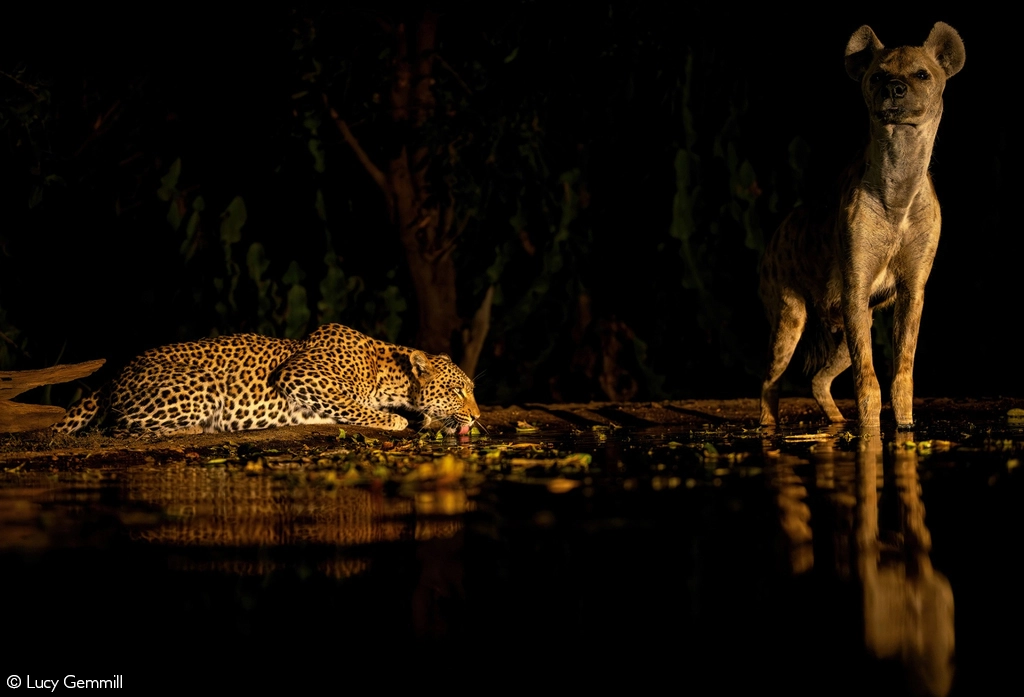
Judges’ comment:
The strength of this image lies in its subject matter. Leopard and hyena encounters are usually defined by conflict, tension or avoidance, making this moment of uneasy coexistence particularly compelling. Drawn together by the demands of the dry season, predator and scavenger briefly set aside their rivalry to drink from the same water source. It is a fascinating behavioural moment and a reminder that survival often requires compromise in Africa.
Photo and photographer details – read more
Lucy says: “I was staying at Kavinga on the Ruckomechi River with my mother and father before we headed down to the floodplain to spend a week walking in the area. I took this image on 18 September 2025. The rains had not yet arrived, so animals visited the camp waterhole regularly throughout the night. I was sitting at the bird hide after supper, long after most people had gone to bed, hoping to see a civet I had photographed the previous evening. Instead, a female leopard arrived to drink. Moments later, a young hyena wandered up, seemingly unconcerned that the leopard was already at the waterhole. The leopard was clearly unhappy about the situation but equally determined to drink. She even attempted to swat the hyena at one point, although I missed the shot because it startled me so much.
After taking a drink, she slipped quietly back into the darkness. The entire encounter took place only a few metres from where I was sitting, and my heart was in my mouth the whole time.”
About photographer Lucy Gemmill
Born in Cambridge, UK, and raised on a small farm in Essex, Lucy Gemmill spent 15 years working as a commercial pilot across southern Africa, Central Africa and Central Asia before settling in Johannesburg with her family.
She began her photography journey in 2017 and quickly developed a passion for wildlife and landscape photography. Whenever possible, Lucy returns to Mana Pools, where she enjoys exploring the wilderness on foot and photographing the landscapes and wildlife that make the area so special.
Instagram: shutterbug_girl
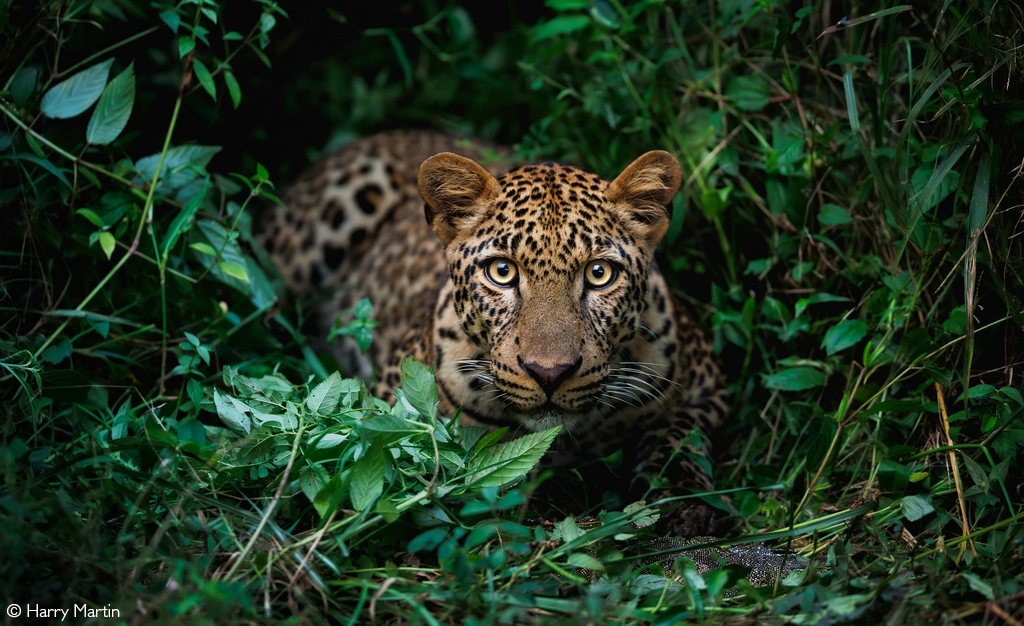
Judges’ comment:
South Luangwa is famous for its leopards, yet this image feels refreshingly different. Surrounded by dense green vegetation after an exceptionally wet season, the young male is photographed in an environment that contrasts with the more familiar dry-season imagery often associated with the park. The monitor lizard kill adds further interest, offering a glimpse into a less commonly photographed aspect of leopard behaviour. Combined with the leopard’s direct gaze and the photographer’s low perspective, the result is an arresting portrait of one of Africa’s most charismatic predators.
Photo and photographer details – read more
Harry says: “During April and May this year, I was fortunate to be based at Msandile River Lodge on the edge of South Luangwa National Park. Known by many as the Valley of the Leopard, I had high expectations for leopard encounters. A biblical wet season, however, meant many roads were inaccessible early in the season and the abundant greenery provided plenty of cover for these elusive cats.
Within my first few days, we came across a monitor lizard that had been killed right beside the road. Suspecting a leopard was nearby, we decided to wait. After more than an hour, our patience was rewarded when a young male emerged from the thicket and approached his kill.
I had taken the passenger seat of the vehicle, which meant there was nothing between me and the leopard sitting just three metres away. As he settled down to feed, I slowly lowered my camera to get as close to eye level as possible. For a brief moment, he looked directly down the lens. After finishing his meal, he disappeared back into the bush. I was left with a racing heart and the feeling that I had witnessed something very special.”
About photographer Harry Martin
Harry Martin is a professional wildlife photographer who has spent the last 12 years leading photographic tours from Scotland to Namibia. With a background in zoology and a lifelong fascination with wildlife, his work combines natural history, storytelling and a strong ethical approach to photography. Having started his photographic journey with 35mm film in 2005, Harry now helps photographers create memorable wildlife encounters and meaningful images in some of the world’s most spectacular wilderness.
Instagram: @harrymartinphotography
To comment on this story: Login (or sign up) to our app here - it's a troll-free safe place 🙂.