




African forest elephants and African ebony trees share a close and ancient ecological relationship. A new study provides the first direct evidence that as elephant numbers decline across Central Africa, so too does the regeneration of ebony trees. The research reveals that elephants are crucial not only for dispersing ebony seeds but also for protecting them from predators – a dual role that determines the tree’s survival in the Congo Basin.
Deep in the humid heart of the Congo Basin, in dense forests, two of the continent’s most iconic treasures – ebony and ivory – are in decline, their fates intrinsically linked. A new study published in Science Advances reveals that the African forest elephant (Loxodonta cyclotis) and the African ebony tree (Diospyros crassiflora) are bound by a mutualism that now teeters on the edge of collapse.
For decades, the story of ivory has been one of poaching and elephant population decline. Forest elephants once roamed throughout the Congo Basin, acting as ecosystem engineers. But poaching for ivory has reduced their population by 86% in the past three decades, pushing the species to the brink of extinction. The repercussions of this loss reach beyond the elephant itself. As the study by Vincent Deblauwe and colleagues shows, when elephants disappear, so does the next generation of ebony.
A tree dependent on elephants
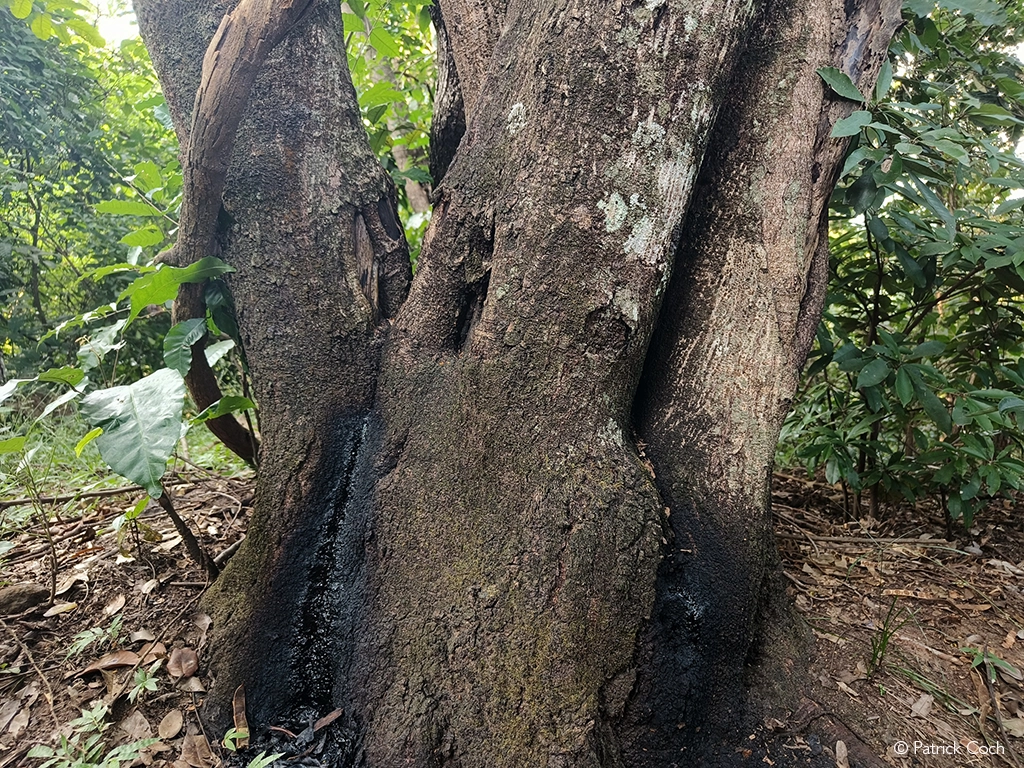
The African ebony tree is one of the most valuable timber species in the world, renowned for its dark, dense heartwood, which is used in the manufacture of fine instruments and furniture. It is a slow-growing, dioecious species – meaning individual trees are either male or female, and only the females bear fruit. Ebony produces large, fleshy fruits that fall beneath the parent tree. These fruits belong to what ecologists call the megafaunal dispersal syndrome – an evolutionary trait where plants rely on large-bodied animals to transport their heavy seeds over long distances.
Elephants are suited to this task. They consume the ripe ebony fruits, digest the pulp, and excrete the intact seeds far from the parent tree. This process performs two critical functions: it transports the seeds to new areas and deposits them within nutrient-rich dung, creating ideal conditions for germination.
Experiments in the forest
The study, conducted at four forest sites in and around Cameroon’s Dja Faunal Reserve, compared areas with healthy elephant populations to those where elephants have been extirpated due to poaching. Researchers collected data on tree size, seed distribution, genetic diversity, and germination rates. They also ran controlled experiments to test how well ebony seeds survived and sprouted under different conditions – in elephant dung, on the forest floor, and when left exposed.
The results were precise. In forests without elephants, young ebony saplings were dramatically fewer – a 68% decline compared to elephant-rich areas. Moreover, almost half of all ebony trees in elephant-inhabited forests were young saplings, compared with only 15% in elephant-free forests. These findings indicate that without elephants, the natural regeneration of ebony is collapsing.
One of the most striking findings of the study is that elephant dung provides critical protection for ebony seeds. Seeds deposited within dung were 8.5 times less likely to be eaten by rodents and herbivores than those lying exposed on the forest floor. The dung acts as both a shield and a fertiliser – reducing predation while improving soil conditions for germination.
In contrast, in areas without elephants, the fallen fruits rot beneath the mother tree or are quickly consumed by rodents such as Emin’s pouched rats (Cricetomys emini) and by herbivores like yellow-backed duikers (Cephalophus silvicultor). Few seeds survive long enough to sprout, and those that do often germinate in dense clusters near the parent tree, where they compete for light and nutrients.

Genetic consequences
To understand the longer-term impact of elephant loss, the researchers analysed the genetic relatedness of ebony saplings.
By examining saplings of different ages, the team reconstructed a timeline of ecological decline. Fifty to a hundred years ago, young ebony trees in the study sites were, on average, born hundreds of metres – sometimes kilometres – from their parent trees. Today, in the same forests, that average distance has shrunk to just over 200 metres.
In elephant-free forests, saplings were found to be much more closely related – effectively siblings growing side by side. This indicates that seeds are now falling close to their parent trees rather than being carried long distances. These ebony trees are essentially now reproducing in patterns more typical of plants that rely on gravity, not animals, to disperse their seeds.
The loss of genetic mixing reduces the trees’ ability to adapt to disease, pests, and climate change. Over generations, such inbreeding could significantly weaken the resilience of ebony populations.

Elephants as forest engineers
Forest elephants influence their environment in numerous ways, extending beyond the dispersal of seeds. By trampling vegetation and feeding selectively on specific species, they shape the structure of tropical forests. They tend to favour slow-growing, dense-wooded trees – such as ebony – while suppressing the dominance of fast-growing, light-wooded species. This process increases the overall carbon storage capacity of forests.
Historically, forest elephants occupied the entire Congo Basin. Today, their range has shrunk to fragmented pockets, with populations surviving in a fraction of their former distribution due to years of intense poaching and habitat loss.
The disappearance of elephants is expected to change forest composition over time, shifting ecosystems to become less carbon-dense and less biodiverse. The study highlights that these are not abstract ecological changes, but measurable transformations already underway in the Congo Basin.
Because ebony trees grow extremely slowly – barely 1.7 millimetres in diameter per year – the effects of elephant decline take decades to become visible. Many of today’s mature ebony trees germinated when elephants were still widespread. The current lack of saplings represents a delayed ecological crisis: the signs of collapse may not be fully apparent for another century.

This slow pace of change creates a false sense of stability. Forests may appear intact today, but the absence of regeneration means that their long-term future is in jeopardy. The study’s authors warn that by the time these effects become apparent, the loss of both elephants and ebony could be irreversible.
While the research focuses on ebony, it reflects a broader pattern across tropical ecosystems. An estimated 70–90% of tropical tree species depend on animals for seed dispersal. As large vertebrates disappear, entire plant communities lose their primary regeneration mechanisms.
The study therefore serves as a warning: defaunation – the loss of large animal species – can trigger cascading effects on biodiversity, forest structure, and carbon storage. Protecting elephants, then, is not only a matter of conserving a charismatic species but also of maintaining the ecological processes that sustain tropical forests.

Want to see forest elephants in their natural habitats on an African safari? You can see forest elephants in Congo Brazzaville’s Odzala-Kokoua National Park while on safari with Africa Geographic. Or, browse our other African safari ideas here.
Protecting two resources at once
Ebony is among the first African timbers to have been exploited commercially, and it remains economically valuable. Combined with poaching and deforestation, this makes the species even more vulnerable. The research shows that elephant conservation indirectly supports the long-term sustainability of ebony and other valuable hardwoods.
According to the study, this mutual dependence holds a conservation message: protecting elephants safeguards trees that are crucial for both ecosystems and human populations. The continued loss of elephants will lead to the gradual decline of valuable timber resources and the forests’ ability to regenerate themselves.
A call for urgent action
The study concludes that the relationship between elephants and ebony represents the interconnectedness of tropical ecosystems. Once elephants disappear from a forest, the ecological functions they perform – seed dispersal, soil enrichment, vegetation control – vanish with them.
Given the current pace of poaching and habitat loss, the authors warn that the Congo Basin may soon lose one of its most crucial forest engineers. The long-term outcome would be a quieter, simpler forest – one less capable of supporting the diversity and richness that define it today.
*Cover photo: Forest elephants in Cameroon, Photo © Jacob Fahr via iNaturalist CC-BY-NC.
Reference
Deblauwe, V., Luskin, M.S., Assola, S.D., Hardy, O.J….Jansen, S., (2025). Declines of ebony and ivory are inextricably linked in an African rainforest. Science Advances, 11(35), doi:10.1126/sciadv
Further reading
- Good news: there are more forest elephants in Gabon than previously believed – first countrywide elephant population estimate in 30 years. Read more about Gabon’s forest elephants here
- Forest elephant numbers are believed to have plummeted 86% in just 31 years, yet their role in maintaining forest ecosystems is critical. Read more about these endangered gardeners here.
- Research has uncovered population density declines of 90% for forest elephants and 70% for savannah elephants across Africa in 53 years. Read more about this alarming study here.
- Stunning high-definition camera trap images reveal Nouabalé-Ndoki’s hidden creatures, including golden cat, leopard, forest elephant and palm civet. Check out these portraits of Congo’s ghosts here
To comment on this story: Login (or sign up) to our app here - it's a troll-free safe place 🙂.